
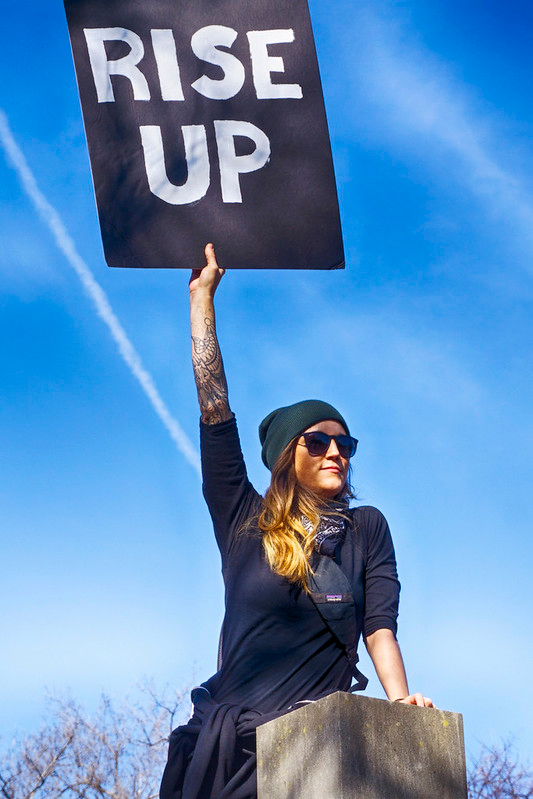
Welcome to Writers Resist Fall 2026

This issue was hard to build. Hard, because the works herein are such powerful representations of the brutal conflicts through which we are slogging, seemingly ever increasing. Still, such vivid reminders are sometimes gifts.

These works reflect 27 saviors distributing words as lifesavers.

From our own Debbie Hall’s conflicted photograph, “Found Art,” to the many pieces demanding trans justice to the exultation of calls to action, they lend hope. Hope, rage, love, humor. We need them all to sustain the resistance. And, perhaps, we might receive some resolution when U.S. voters cast their values on 03 November.

In the meantime, as the image above demands, borrowed from Chelsie Zuccollo’s excellent call to action in “Smash, Build, Rise,” we must—and we will continue to—RISE UP.

On Saturday 14 November at 5:00 pm PACIFIC, we will host this issue’s virtual reading, Writers Resist Reads, at which we envision a bit of celebrating. Please email us at writersresist@gmail.com for the Zoom link.

And so, we welcome you to our hard and powerful Writers Resist Fall 2026. Please read and share your thoughts with these brilliant resisters.

Found Art by Debbie Hall

Two Poems by Marcy Rae Henry

Cost of Living by Nana T. Baffour-Awuah

Testifying with My Daughter Against Missouri SB597 by David Tager

After Roe Was Repealed by Jennifer Karp

Cherry Blossoms by Beck O’Leary

EXPO Marker by Jennifer Elise Wang

Girl (an erasure) by Elizabeth Mercurio

My Rape Wasn’t a Choice by Alberto Lau-Chang

Lemonading by Victoria Melekian

Letter to Self by Joycelyn Zhang

Monarch by Deanna Altomara

transcription by olive bly

On Viewing the Porn Trading Cards Catalogue (1925–2025) by Rachel Lincoln Sarnoff

If Only There Were No Trans Kids by Mitch Roshannon

Silence by Isla Laust

Three Poems by Tushar Sen

Coincidence by Minnie Bartlett

Two Poems by Mia Leonin

The Shirt by Elizabeth B. Morse

Smash, Build, Rise by Chelsie Zuccollo

Aunt Annie’s Recipe for the Resistance by Jane Frances Gilles

“There Will Be Casualties” by Ashley Mace Havird

Static Between the Folding Tables by Fendy S. Tulodo

To my father, whose mother tongue is a village dialect by Anonymous

The Most Radical Protest Right Now Is Handmade by Amanda Jackson

Two Poems by Susanna Lang

A Note from Writers Resist
Thank you for reading! If you appreciate creative resistance and would like to support it, you can make a small, medium or large donation to Writers Resist on our Give a Sawbuck page.

The Shirt

By Elizabeth B. Morse

When the others wore white shirts, Diana wore a black one.

The black button-down shirt meant rebellion. One that was tiny, to be sure, but a rebellion just the same. She’d bought it at Brooks Brothers on sale.

Nobody said anything at the office, even though she and her co-workers sat right next to each other around a table. She sat between two people who often made remarks about other people’s clothing. Your coat wasn’t suited for the weather because it was either too heavy or too light. Your high heels sounded like a horse clopping. Your dress was too flashy; you should have worn something more subdued. To Diana’s relief, the black shirt garnered no comments.

With it, she wore a bra that had the explicit purpose of holding her in so the buttons didn’t gap. She was tired of being perfectly modest, but that level of I don’t care hadn’t happened, at least not yet.

She’d worn the shirt when doing a presentation in one of the conference rooms. The only comments were about the charts and graphs she had drawn on a set of PowerPoint slides. Astute, people said. Accurate for the foreseeable future. Nobody complained about the bright colors in the donut charts.

She was good at her job and earned a good salary. These were accomplishments to be proud of. However, in college, she’d taken studio art and longed for a gallery show of her paintings and sculptures. But making a living took precedence. She had to be practical. She had to pay the rent and utilities, not to mention her phone. But she still kept a sketchbook and drew faces she passed each day. A small rebellion.

At work, she rebelled by taking a lunch hour. After all, the workday was twelve hours long. Once, when she got back, the boss was standing by her desk. He had on a white shirt with the buttons gapping over his stomach. “We’ve got deadlines!” he barked. “No time to go out. Why don’t you just grab a sandwich like the rest of us?”

Her most fierce rebellion was the protests she went to, and she was terrified both times. She did want to fight for economic justice and against racism, but at first, she’d stood on the sidewalk petrified. It took her some time to actually join each march. She’d worn sunglasses so that no one would recognize her, even though one protest was at night.

This time, however, Diana was really going out. Out out. Not just to lunch. It was time to be bold. It was okay to be scared, but it didn’t matter. She had to do what she had to do.

Slowly, she stood up from her swivel chair and put on the puffer coat the boss had laughed at. “How come you’re wearing that?” he’d scoffed. “How can you be cold? It’s spring!”

Finally, his opinion made no difference anymore.

Diana looked around at her co-workers. All of them had eyes on their laptop screens. One was eating what looked like stew and rice out of a glass container.

“I have to leave,” she said. “I have to leave right now.”

They all  looked up, some with raised eyebrows. Nobody said a word.

She opened a glass door and made her way to the elevators. Hungry, she imagined the lunch she would have, complete with soup and dessert. After that, she’d decide what movie she was going to see.


Elizabeth B. Morse’s work has appeared in literary magazines, such as Kestrel and Ginosko, and anthologies, such as Help Yourself. Her work has been nominated for a Pushcart Prize, and she he won first prize for flash fiction in Cardinal Sins. Her full-length poetry collection, Unreasonable Weather, (Kelsey Books, 2025) was an international Book Award 2026 finalist. She has an MFA from Brooklyn College, and is the poetry editor of BigCityLit and a co-editor of Brownstone Poets Anthology. Visit her website at www.elizabethmorsestories.com.

Photo credit:


A Note from Writers Resist
Thank you for reading! If you appreciate creative resistance and would like to support it, you can make a small, medium or large donation to Writers Resist on our Give a Sawbuck page.