
To David Lehman

By Waverly Vernon

David,
you say poetry is not political,
as if Gaza is a metaphor
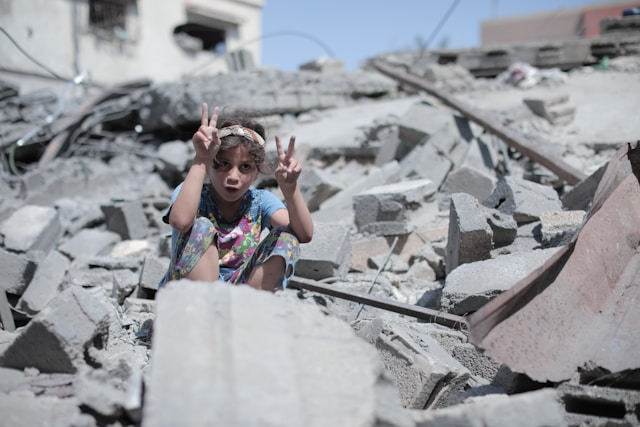
and not a place where children
fold themselves into rubble.

On my television,
the anchors call it a war.
I count the seconds between bombs.
Your voice is nowhere in the smoke.
You are busy arranging flowers.

I want to be like those poets
who care about the moon.
But every time I look up,

                                                      I hear sirens
                          through someone else’s ceiling.

David,
you call it complicated.
The screen shows
a father
carrying half his son.
Complicated    is your word for silence.
Complicated    is how you hide your hands.

I know I am American because
I can mute the channel
and make the massacre vanish.
When I turn off the TV
someone still dies.

Metaphors about peace
are for poets who mistake
neutrality
for virtue.
                          —I do not write peace.

I write children
throwing stones at tanks,
seconds before
they become numbers
you will never name.

       David

                                          the flowers you love
                                          are growing in Gaza.
                                          They grow in craters.
                                          They will not forgive you.


Waverly Vernon (they/them) is a writer and interdisciplinary artist studying at the School of the Art Institute of Chicago, focusing on writing and ceramics. Their work explores femininity, sexuality, resilience, religious deprogramming, and trauma, transforming personal experience into connection and dialogue. Their poetry appears in Moonstone Arts Center, WIA Magazine, Wildscape Literary Journal, Assignment Literary Magazine, Creation Magazine, and Arcana Poetry Press.

Photo by Mohammed Ibrahim on Unsplash.


A Note from Writers Resist
Thank you for reading! If you appreciate creative resistance and would like to support it, you can make a small, medium or large donation to Writers Resist on our Give a Sawbuck page.
Endless War

By Linda Bamber

Cassandra swore there was no Gulf of Tonkin
but of course
no one believed her.
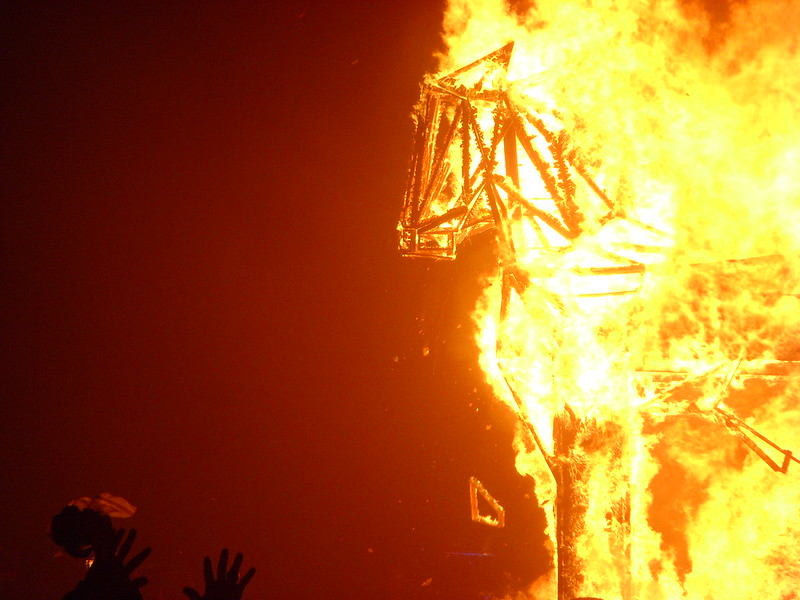
She knew the Trojan Horse was loaded with death
and that there were no WMD’s in Iraq

and if Paris, her brother, stole Helen
Troy would fall
and all its people be enslaved.
Then the Pentagon Papers came out.
Didn’t I . . . ? said Cassandra when people were shocked.

Now infanticide
hostage-taking
retaliation beyond imagination.
Genocide. Starvation. 

Cassandra tears her hair.
Since Balfour’s birth
(frantic, disbelieved)

she’s tried to tell us this
is what would be
from the river to the sea.


Poet’s Note
In classical texts, Cassandra was admired by the god Apollo, who gave her the gift of prophecy. In a different mood, he added the curse that no one would believe her.
The Balfour Declaration of 1917 is generally referenced as the moment when Britain decided it would suit its geo-political interests to establish a Jewish Protectorate in the Middle East.


Linda Bamber is a poet and a Professor of English at Tufts University. Both her poetry collection, Metropolitan Tang, and her fiction collection, Taking What I Like, were published by David R. Godine, Publisher. Widely excerpted and anthologized, her critical book on Shakespeare, Comic Women, Tragic Men: Gender and Genre in Shakespeare, was published by Stanford University Press. Bamber has published in periodicals such as The Harvard Review, The Nation, Ploughshares, The New York Times Book Review, The Kenyon Review, The Florida Review, and The Missouri Review. She is currently writing a novella based on the cross-country expedition of Lewis and Clark. 

Photo credit: “Trojan Horse” by Terra Incognita! via a Creative Commons license.


A note from Writers Resist

Thank you for reading! If you appreciate creative resistance and would like to support it, you can make a small, medium or large donation to Writers Resist from our Give a Sawbuck page.