Graffiti Artists

By Andrea L. Fry

The authorities will start with shame—the lecture on personal property
as if it would reform. But not even close—the claim of ownership is as alien
to ghost writers, as the acceptance of defacement is to those who own.  

But how persistent, how alive the calling card! Yesterday, the overpass
was grey and mournful in the sleet. Today it’s neon orange, bedazzled
in fun fonts, spiky electric blue shapes like speech bubbles in comics.


It’s hard not to smile at exuberance. That treacherous cliff behind
Friendly’s? They washed it in purple, then sent a red zigzag down
the rockface, chubby letters cartwheeling into a vermillion pool of LOVE.

But who are these stealthy anarchists? How do they shimmy up with cans,
spray billows of perfect clouds while dangling like spiders from a thread?
I can only dream of such courage. I’ve spent my life trying to get a mortgage.

If I ever do, I wonder if I’ll join the owners, put up a fence of cypress trees,
install a rumbling garage door capable of decapitating trespassers?
When “Stoney Creek Road” was changed to “Stoned Creek Road,”

my father used it as a teaching moment on vandalism—he must have heard
us chuckling in the back. I can’t help but root for these mischief artists.
And how injurious is their havoc, when governments dispense with lives

as casually as these sprayers paint a rock? They say King Charles III
owns 1/6 the surface area of the planet. Imagine waking up in a London
fog to a golden dispatch stretched across Westminster Bridge: 

Text reading Who sez? Who sez? Who sez?


Andrea Fry has published two collections of poetry, The Bottle Diggers, in 2017 (Turning Point Press) and Poisons & Antidotes (Deerbrook Editions) in 2021. Her poems have appeared or will appear in journals such as Alaska Quarterly ReviewAnnals of Internal Medicine,Barrow StreetCimarron Review, Spoon River Poetry Review, Stanford Literary ReviewThe Sun, and Women’s Review of Books among others. She has been nominated three times for the Pushcart Prize. Andrea is freshly retired from her career as an oncology nurse practitioner and lives in Brookline, MA with her husband and two comical felines. Visit her website at andrealfry.com.

Photo quisnovus via a Creative Commons license.


A note from Writers Resist
Thank you for reading! If you appreciate creative resistance and would like to support it, you can make a small, medium or large donation to Writers Resist on our Give a Sawbuck page.

What Did You Wish For?

By Myna Chang

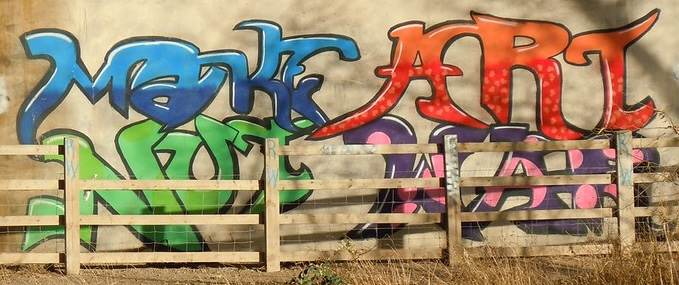
Maria peered at the items locked inside Trillion Mart’s display case. The packet of birthday candles cost only $25, but the environmental tax was 300 carbits. That would put her way over her monthly carbon footprint allotment.

She sighed and leaned against the cool surface of the display. She’d hoped to give little Gabi a special birthday, like the ones she remembered from her own childhood. Her mom had always made her a pretty cake with fluffy frosting. Friends from school sang the birthday song, then her mom lit the candles, saying “make a wish, sweetheart!”

Maria recalled puffing out her cheeks and blowing as hard as she could, but it often took two tries to extinguish all the candles.

“What did you wish for?” her friends always asked in giggly little-girl voices. Maria knew not to tell, otherwise her wish wouldn’t come true. Sometimes, though, she couldn’t help letting slip her wish for a pink pony or neon markers.

An alarm shrilled, yanking her out of her daydream. The display case launched an anti-theft video—she’d maintained physical contact with it for more than 2.5 seconds without buying anything. She jerked away, but screens flanking the aisle had already erupted with the trillionaire’s face, amplified in all his high-def smarm.

“Now, now,” his recorded message scolded. He wagged a finger. “We wouldn’t take more than our fair share, would we?”

Maria noticed the footprint-shaped logo emblazoned on his crisp white shirt. Her own hand-me-down blouse had been patched and re-patched to avoid the exorbitant carbit tax of new clothing. She smoothed a loose thread as the store attendant approached. He wore the pressed green uniform of all the trillionaire’s minions.

After confirming she hadn’t stolen anything, he pointed at the door. “If you’re not buying, you have to go. Can’t have freeloaders in here, breathing Trillion’s reconditioned air.”

“Sorry,” Maria murmured.

She secured her filtration mask and stepped outside, into the brown haze that had hung in the air ever since the trillionaire took power. Maria secretly thought the pollution had only grown worse with the introduction of his complicated carbon footprint scheme.

His doughy face leered down from electronic billboards lining the street, with his current catch phrase rotating above his head in blocky letters: Engineering A Cleaner Future!

The camera angle zoomed out, showing ten shiny sports cars parked in front of a mansion—all environmentally neutral, as defined by his personalized carbon-offset calculations. The image shifted to a close-up of ten seedling pine trees, and then the camera tilted up to focus on a crystal blue sky.

Maria hadn’t seen a blue sky in ages. The atmosphere had been brown and thick with soot since long before her daughter was born.

The thought of Gabi filled her with warmth. Such a smart little girl. She didn’t ask for silly pink ponies for her birthday. No, Gabi wanted a science kit. She was still innocent enough to think she could save the world when she grew up, that she could be an even better engineer than the rich man in charge.

Maria coughed, particulate matter irritating her throat with each breath. Her Trillion Air Mask was on the fritz again.

She glanced at the time. Gabi’s school didn’t get out for several hours. Maybe Maria couldn’t give her child a perfect blue-sky birthday, but at least she could scrape together the ingredients for a proper cake.

• • •

Maria paused behind a dumpster, trying to calm her nerves. She’d never been to the underground market and was unsure which grimy doorway was the entrance. She scanned the alley ahead, and then she spotted it. Her heart thumped in anticipation—and fear. What if she got caught?

She shook the thought away. Lots of people visited the underground market, especially since the carbon allowance had been cut again. Most folks couldn’t make ends meet if they didn’t cheat a little.

The neighborhood had been crowned with lush cherry trees, once upon a time. Now, electronic billboards sprouted in their place. A new video burst to life with a buzz that set Maria’s teeth on edge. This time, the trillionaire juggled weird-shaped balls. No, not balls. They were . . . feet? The image shifted and Maria realized they were his logo—little plastic footprints, each emblazoned with a source of pollution: fossil fuels, beef, luxury goods.

He explained how each person’s carbon footprint was calculated, including the rate of carbit taxation, and how this was tied to shareholder value and population malleability and the amount of greenhouse gas people emitted when they exhaled.

Maria didn’t understand any of it.

A group of teenagers across the street started throwing rocks at the nearest billboard. They chanted, “No more carbits,” while continuing to hurl stones and pieces of trash from the gutter. Maria had never dared anything so brazen, but she couldn’t help smiling when a crack split the screen.

The damage didn’t stop the video, though; the trillionaire kept juggling and laughing.

Maria’s apprehension washed away, replaced by a wave of disgust at his oily voice and his legion of carbon-neutral billboards. No amount of fancy math could justify those monstrosities.

She squared her shoulders and marched into the underground market.

• • •

The market filled an abandoned neighborhood library. Maria remembered visiting as a child to watch puppet hour and look at picture books. The space was now packed with vendors selling everything from homemade baskets to decades-old music chips.

Maria gaped at a table stacked with vintage exercise shoes; all that plastic and rubber in one place. The shoes looked comfortable, but she remembered how much pollution spewed into the atmosphere when petroleum was refined into plastic and rubber. The lesson had been drilled into her head when she was in school. She trailed a finger along a pair of neon pink and purple sneakers, then walked on.

She finally found a table with cooking supplies. Selection was slim. An older woman with widely spaced teeth smiled warmly at Maria and helped her find most of the ingredients for the cake. Altogether, it cost less than even one item would cost at a Trillion Mart, so she splurged and bought a whole cup of sugar.

“What about the tax?” Maria asked. “You don’t charge carbits?”

The gap-toothed woman shook her head. “No, dear. We don’t play that man’s scam here.”

Maria smiled. She still had a little money left. “Do you have any candles?”

The woman scratched her chin. “I don’t get many requests for combustibles.” She rummaged through a tattered box. “Ah, here we go.” She held up a single birthday candle; pink and white wax braided into a tiny pillar of childhood whimsy.

“Oh,” Maria whispered. The sweet swirl of colors conjured images of her mother, of birthday parties past. She still remembered the sugar-ache of that first bite of cake, and the way her mom beamed when the girls said how they loved her frosting.

Grinning, she reached for the contraband candle. “How much?”

The woman winked. “It’s on the house. I hope your kid’s wish comes true.”

“Thank you,” Maria breathed. The unexpected kindness caught her off-guard. She blinked as she tucked the candle into her bag with the other items. “Thank you,” she repeated softly.

A loud boom shook the walls and screams erupted near the front of the building. Maria staggered, gripping the edge of the table. “What’s happening?”

Tables of goods overturned as panicked people stampeded toward the exits.

“Hurry,” the woman yelled, motioning Maria out a hidden door. “It’s a raid!”

Pulse racing, Maria followed her down a short flight of concrete stairs, through a dilapidated fire door, into an unfamiliar side street.

The sudden miasma of acrid air and billboard buzz hit her like a truck. She paused, disoriented. Which way to go? The old woman had already disappeared. Sirens wailed somewhere on her left, so Maria turned right and sprinted as fast as she could, securing her mask mid-stride.

Two blocks later, she had to stop. Each breath burned her throat, searing into her lungs. The filtration mask was useless. She pulled it off to check the connections and found the filter mechanism loose. Etched into its plastic housing was the green footprint logo, with another product slogan: Trillion Air! From your favorite trillionaire!

Maria slammed the mask on the ground and kicked it away from her.

Ahead, tires squealed on pavement. Hardly anyone drove cars anymore, so Maria knew it must be the trillionaire’s raiders.

She bolted toward a different alley, but a pair of soldiers emerged. They wore body armor with the green footprint logo emblazoned on their chest plates. Each one had a long-barreled gun slung around his shoulder.

“Stop!” one of them yelled.

Frantic, Maria spun, seeking somewhere to hide. A huge green SUV careened down the street and jumped the curb, heading directly at her. She lurched behind the dumpster, tripping over the stupid mask she’d just discarded. She hit the pavement hard, knocking the wind out of her and skinning the heels of her hands.

Stunned and gasping, all she could see was her bag, its contents spilling across the cracked asphalt. Hundreds of tiny sugar crystals bounced, the pure beauty of each grain sparkling for an instant, before melting into the gray sludge ringing the dumpster.

“No,” Maria rasped. She wanted to rise, take her things and run back home. She wanted to hold little Gabi and rock her to sleep, to sink backward, into a better time, where her own mother called her sweetheart and she still believed the world’s problems could be cured with a secret birthday wish.

A green boot slammed down, inches from her face. She flinched away from the thick rubber sole, curling into a ball. “Please,” she whimpered, “I didn’t do anything wrong.”

“Oh, yeah?” the soldier’s voice boomed. “Trading contraband goods at an illegal market isn’t wrong?”

He grabbed her by the arm and hauled her up. Something inside her shoulder joint crackled and she cried out. Vomit rose in her throat. She retched, emptying her stomach onto the ground.

It splashed his boots and he cursed. He shoved her toward a second soldier, who caught her and held her upright, pulling her hands behind her back. She gasped at the jagged bolts of agony that radiated from her shoulder down the length of her arm.

The first man opened her bag. Only a few items remained: her ID and carbit card—and the candle. He sneered at her.

“A black-market combustible, purchased without the required carbit tax,” he said. “This is a Class One offense.”

“But it’s just a little birthday candle,” Maria stammered.

The man stood tall, jutting out his chin. He locked eyes with her and grinned, mashing the candle into his chest plate. It left a pink smear. He flicked what was left of it at Maria. She winced when the ruined wax struck her cheek.

“Wax is a petro product, you dumb bitch. And it makes nasty shit when it burns.”

The soldier holding her arms pulled a zip tie around her wrists, launching fresh waves of pain from her shoulder. White spots filled her vision and her knees buckled.

“Guess what the sentence is for cheating the carbit tax?” He yanked her upright with a tight grip on the back of her neck. “You’re going to carbon re-education camp, sweetheart.”

“No!” she cried. She’d heard rumors of people disappearing into these work camps, but she’d never believed it was true. “I have a daughter! I have to get home to my little girl!”

“Should have thought of your kid before you went on this crime spree.” He laughed and turned to his partner. “Think they’ll let her make wax at the refinery?”

The man with the vomit-stained boots grunted. “I hope they send her to the rubber factory.”

He stomped his feet, dislodging some of the vomit. In her dazed state, she noticed that the soldier’s boots left prints in the same shape as the trillionaire’s logo. All this time she’d believed his carbon footprint referred to the environment. Now, too late, she understood its true meaning.

The soldiers dragged her to a large open-backed cargo truck and shoved her to a seat between two other prisoners. They loosened her zip tie, freeing one hand and securing the other to an overhead rail. She moaned, twisting to relieve the pressure on her tortured shoulder.

Several additional trucks and SUVs were parked near the underground market. She recognized one of the teenagers who had been throwing rocks earlier, as well as vendors she’d encountered inside the market. The kindly old cooking vendor slumped next to her, barely conscious. Grime in the shape of a boot tread was imprinted on the side of her face.

A small vid screen in the cargo area played a message on loop: “Get ready for carbon re-education camp, where you’ll work off your debt to society! All while helping me engineer a cleaner future!” The video glitched and froze, stuck on a close-up of the trillionaire’s face.

Maria realized she was crying. Through blurred vision, she made out the footprint logo on the truck’s metal floorboard. She spat a glob of bloody phlegm at it and wiped her face with her free hand. Mingled with tears and crusted vomit, she found a fleck of pink wax. It must have stuck when the soldier threw it at her.

She squeezed the happy-birthday wax in her fist and closed her eyes, wishing she’d never gone to the market, that she was on her way to Gabi’s school right now. What would happen to her little girl, alone and waiting for a mother who wouldn’t be there? A raw sob tore from Maria’s throat. The candle shard dug into her palm, and she wished she could erase this day, stomp out the brutal raiders, sweep away the trillionaire’s bloated footprints.

More than anything, she wished she could do more than wish.

Outside the truck, a raider banged his hand against the cab. “Take ’em to the smokestacks!” The engine backfired as the truck rocked into motion. Maria’s gaze filled with thick smoke; the whole sky blackened with it.


Myna Chang (she/her) is the author of The Potential of Radio and Rain (CutBank Books). Her writing has been selected for the Locus Recommended Reading List, Best Microfiction, Best Small Fictions, and WW Norton’s Flash Fiction America. Find her at MynaChang.com or on Bluesky at @MynaChang.

Photo by K-B Gressitt 2025


A note from Writers Resist
Thank you for reading! If you appreciate creative resistance and would like to support it, you can make a small, medium or large donation to Writers Resist on our Give a Sawbuck page.

Secret Light

By Marianne Xenos

Sylvia stood at her worktable polishing a crystal diadem with a soft flannel cloth. The handcrafted headpiece was adorned with prisms and thrift-store rhinestones. Afternoon sun slanted through the large bay windows of her makeshift studio, the dining room of her late mother’s Victorian house. Sylvia smiled, remembering her mother with a twist of love and loss. “Who needs a dining room, anyway,” her mother had said a few months before her death, letting Sylvia create a refuge for her art.

The sun warmed the well-organized space, glimmering on Sylvia’s collection of art materials. Shelves held old television tubes, colored glass, and Kodachrome slides, and scattered boxes contained vintage jewelry, miniature mirrors, and antique teacups. Sylvia often made small sculptures, usually fantastical assemblages from found materials, but during the past year she’d begun experimenting with larger works involving prisms and projected light.

Sylvia’s brother Ash worked in the room directly over her head. She heard his guitar as he worked on a composition. They were both in their mid-forties and both currently single. They’d considered themselves too old to live with their mother, but after the political convulsion of the last few years, they needed affordable space, and their mother had needed in-home support before her death from the unnamed flu. Sylvia now had the only “day job,” not as a sculptor, but teaching art in the local high school. Ash found under-the-table gig work, because new restrictions from the Bureau for Biological Truth barred trans people from most jobs.

Sylvia held the diadem in a ray of sun, the crystals breaking the light into a rainbow. Natural light was called white, but a prism revealed light’s secret colors, which danced on the walls as Sylvia turned the object in her hands.

“Be careful. You could be arrested for that.” Ash stood in the doorway and smiled. There was no mistaking them as siblings. They had the same dark curly hair. Ash’s was cropped short and Sylvia tied hers back while she worked. They had their father’s brown eyes and olive complexion, and their mother’s strong nose and chin.

“I know. It’s crazy to spend so much time on work nobody will see.”

Ash nodded. They’d had this conversation many times. When President Andrew “Andy” Leblanc had created the Bureau for Biological Truth, he banned everything from rainbow flags to preferred pronouns. Not only that, over seventy percent of galleries had closed nationally, and those still open wanted only classical or representational work, avoiding anything experimental.

Ash held out an envelope. “Have you checked your mail lately? I got a weird letter today.”

“Just getting a letter is weird. I haven’t seen the mail carrier in weeks.”

Sylvia put the diadem on the table. She’d made five of them for the work-in-progress, an art installation she called “Secret Light.” Of course, the piece was just a fantasy at this point. In the current art scene, the work could never be exhibited.

Ash waved the letter in his hand. “Somebody is offering to fund one of my more experimental compositions. And it looks like you have a letter from the same return address.” He handed the unopened envelope to Sylvia. “And get this—they address me as Mr. Diaz-Malone. Mister.”

Sylvia looked up, surprised. “Well, there’s another thing that could get a person arrested.” Acknowledging transgender identity had been illegal for the past six months. She opened her own letter addressed to Ms. Sylvia Diaz-Malone.

“Huh. Somebody wants to fund my installation work, especially anything inspired by light.”

“Something weird is going on,” Ash said, as he walked over to the window, staring at the house across the street. Their neighbors, who recently found a swastika painted on their front door, were covering their multicolored Victorian house—a perfect three-story “painted lady”—with glossy white paint.

One of LeBlanc’s earliest executive orders mandated classical architecture, reminiscent of Greece and Rome, for government buildings. The order was for federal buildings, but as a symbol of patriotism, some began painting their homes stark white. Some even built pillars framing doorways on everything from McMansions to double-wide trailers.

Sylvia taught art history and knew the original Roman Colosseum had been painted with bright colors, as vivid and showy as the painted lady across the street. But Leblanc’s patriots embraced the misunderstanding of whiteness, even if the columns framing their doors were built from Styrofoam blocks.

“I guess the neighbors are finally giving in to pressure,” Sylvia said. “We at least used off-white paint when we painted ours.”

“Yeah, but we didn’t get a swastika on our front door. Or a drive-by bullet, like at Blaze’s place.” Ash turned from the window and glanced again at the letter in his hand. “Have you ever heard of the ‘Propaganda Assets Inventory’?”

“No, is this some new Leblanc thing?”

“No, it’s historical. Supposedly, after World War II, the CIA—believe it or not—helped fund abstract expressionism. They didn’t want France dominating the world art scene, so they secretly supported American artists.”

“That’s ridiculous. Most of those guys were radicals or at least skeptics. They’d never get cozy with the CIA.”

“Exactly, so the backing was top secret. Maybe this is the same thing. Somebody in the government wants to push against Leblanc’s policies.”

Sylvia scanned her own letter. “Or this could be a joke. And even worse, it could be a trick to bring us out into the open.”

“But what if somebody with influence wants to turn things around? Half the world is laughing at Leblanc. Maybe there’s an agency within an agency, somebody who wants a different kind of American exceptionalism.”

“I’m skeptical.” Sylvia took both letters and brought them out to the mail desk by the front door, with Ash following behind. “Let’s think about it. But today we need to rescue Blaze.”

Ash pulled out his phone. “Have you thought about what we offered? Any change of heart?”

“No, he should be here with us. Things are getting too dangerous.”

Despite the swastika across the street, their neighborhood was still safer than the one where their friend Blaze was camping on somebody’s couch. It was an area where whiteness was becoming a cult, and any whiff of color, such as their friend—a gay Black dancer with dyed purple locks—was a target.

Sylvia stood by while Ash facetimed their friend, and asked if he was ready to move in. Blaze hesitated for a moment, and Ash said, “Blaze, you know my mother loved you. She would want you here.” Blaze, looking relieved, agreed.

Ash asked, “Hey, have you received any letters about your artwork?”

“We don’t all live in a big house on Main Street, honey. I haven’t even seen junk mail in two years.”

“Good point,” Ash said, and told Blaze about the offers.

“You think somebody wants artists to stand up against President Andy Android? I’m convinced that guy is nothing but an AI projection.”

Sylvia leaned towards the phone. “What are you even talking about?”

“Well, has anyone ever seen him in public? Ever seen anything other than his torso above a desk?”

“Maybe he doesn’t want to catch an unnamed flu.”

“Or maybe they’ve created a president who can’t die of an unnamed flu.”

The last two presidents had died within a year of each other, each from “natural causes,” rumored to be a rogue virus, unstudied and unnamed. It was possibly the same unnamed flu that killed their mother. She was a former hippie and outspoken recovering alcoholic and loved slogans. Her favorite was, “You’re only as sick as your secrets,” and then she’d died of a secret illness.

Sylvia leaned towards the phone again. “Ash thinks the letters are from a clandestine government agency, trying to regain American exceptionalism in the arts.”

“Ha! And we’re the best they can work with?”

Ash laughed but said, “Maybe they’re looking for a new flavor of exceptionalism.”

“Too many conspiracy theories!” Sylvia said. “I just want to work—to make something beautiful! Or at least make something. Is that too much to ask?”

Blaze sighed and said, “Let’s look at your piece tonight, sweetie. We’ll just do it. Draw the blinds, set up your gear, and run it.”

“Do you have something white to wear? Maybe something sexy.”

“Sexy? You called the right number, girlfriend.”

“Okay,” she said. “We’re on our way.”

At the door, Sylvia paused to reread her letter, wrinkling her nose as though something smelled bad. Ash had put on his public disguise, a pair of tear-drop earrings, faux gold clip-ons from the bottom of their mother’s jewelry box. The earrings had been too boring for their hippie mother to wear, and maybe they’d been a gift from her kids when they were young enough to want an ordinary mom.

“The teardrops of invisibility,” Ash said, as he clipped them on. Sylvia kissed her brother on the cheek, and they went to pick up Blaze.

•   •   •

As they drove towards Blaze’s neighborhood, Sylvia said, “Wait! What’s going on over there?” On the street, a group of kids pushed a girl to the ground. Ash pulled the car over.

“They’re teenagers,” Sylvia said. “Let me take the lead on this.”

“It’s all yours,” Ash said, and they both rushed out of the car.

Sylvia had learned to fight in middle school, defending both herself and her queer sibling from bullies, and as an adult she’d learned to fight smarter rather than harder. She’d dated both women and men, so she wasn’t exactly straight, but she could pass unless she said what was on her mind. Sometimes, in a pinch, she used that privilege, and she put on her schoolteacher persona.

She took out her phone as she ran up to the group. A teenaged girl lay on the ground, and another girl with heavy boots was pulling back for a kick.

“Hey you! Stop it! I’m calling the cops now.”

“Call the Bio Cops, bitch. She’s a queer.”

“No, I’m calling the real cops. This is assault, and it’s illegal.”

The girl with the heavy boots paused and scowled at Sylvia. She didn’t even glance at Ash who stood behind her, and Sylvia hoped the earrings were doing their magic.

“Who the fuck are you? Another pervert?”

Sylvia used her phone to take a picture. “I’m Miss Diaz-Malone, and I work at the high school. Listen to me—after I call the cops I’m sending this picture to your principal. Do you want your parents to see it?”

“But she’s one of them! Look!” The girl with the boots held up a lavender scarf. “She belongs in Bio Camp.”

Sylvia snapped another picture. “You’re okay with the cops questioning you? Nothing illegal in your pockets? Nothing to hide? I’m ready to dial, but leave now, and I’ll let it go.”

The kids swore and grumbled, tossed the scarf back at the girl, but they left. Ash stepped forward to give the girl a hand. She looked rumpled, but no injuries. Something about her reminded Sylvia of herself at that age. Vulnerable, stubborn and always having to fight.

“I’m Sylvia,” she said, “And this is Ash. Are you okay? Do you need a ride someplace?”

“No, I’m almost home. But….” Sylvia raised an eyebrow in question. “My parents are going to be pissed.”

Ash said, “We live in the center of town. The off-white house on Main Street—number 237. If you ever have trouble, come and find us.”

Sylvia gestured to the lavender scarf. “Pretty scarf, but you better stash it until the craziness passes. Just to be safe.”

The girl stuffed it in her backpack. “Thanks,” she said. “My name is Ruthie.”

They got back in the car and watched the girl as she walked away.

Ash said, “Do you really think the craziness will pass?”

“We have to hope. What would Mom say?”

“Something wise and pithy about the thing with feathers or this too shall pass.”

“She quoted somebody once: ‘Hope doesn’t glimmer; it burns.'”

“That reminds me. Let’s go get Blaze.”

•   •   •

They found Blaze waiting on the front stoop of a five-story apartment building with peeling blue paint. His purple locks were gone, but he walked towards the car looking undiminished, tall and handsome in a black leather jacket. While Ash drove home, they chatted about the letters. Blaze had called his old roommate, who confirmed the post office had stopped delivery to that neighborhood a year ago. No mysterious letters had been slipped under the door.

•   •   •

Ash used the front parlor as a rehearsal space, and currently it was the home of Sylvia’s installation-in-progress. They’d pushed the sofa against one wall and collections of instruments stood in the corners. With a wink towards classical architecture, four white pedestals formed a large square in the center of the room, set about six feet apart. Each pedestal was four feet high, and each held a crystal diadem. Sylvia had mounted eight laser spotlights on the ceiling, and they beamed down like pillars of light.

Blaze had packed something sexy. He wore a white, vintage tuxedo, and was bare-chested underneath, except for a string of white pearls. He stood in the center of the room, arms outstretched, tipping his hand in and out of the bright beams.

“I know you’re a sculptor, honey, but this is just screaming for movement—for a dancer.”

“Well, it might just be screaming for you.”

Ash said, “If we ever do this for real, I could play some glass instruments. Like an armonica. Or there’s something called a chromatic aquarion.”

“Yes, that would be perfect. And I know I need to improve the lights—make the beams tighter and stronger—but for now let’s just try it.”

Sylvia turned off all the lamps, leaving only the eight beams of light, and Ash took his guitar to the sofa. Blaze stood in the center of the pedestals and put the most ornate diadem on his head. While Ash began to play, he and Blaze improvised, following one another’s cues. Blaze experimented with the headpiece, sweeping his head through a beam of light, tossing colors like confetti against the bare walls. He paused to adjust the diadem on his head, and took two more from the pedestals, one for each hand. He glanced at Sylvia for affirmation, and she nodded, making a mental note to create a more secure headpiece for a performer and to consider prismatic wands.

Blaze arched and swept the diadems through the pillars of light, matching his movement to the rhythm of the guitar. Twirling his head and hands, he dipped in and out of the beams, from darkness to light and back, color splashing like water against the drawn shades. Yes! Sylvia felt like shouting, but didn’t want to break the focus. The three of them were in sync, the piece coming together like a landscape. The structure of the installation like stones, music like water, and Blaze’s movement like sunlight flashing on the surface. The room held a fizz of energy, reminding Sylvia of the tang of ozone at the edge of a waterfall.

Sylvia thought, Yes, this is working….

A knock came from the front door, startling them all.

Her heart thumped, but she said, “Don’t move. I’ll see who’s there.”

Looking through the peephole, Sylvia saw Ruthie, the girl from the street. Slouched on the front stoop, hands stuffed in the pockets of her hoodie, the girl had a bulky backpack slung over one shoulder.

Sylvia opened the door and saw Ruthie’s swollen face with a new bruise just forming under her left eye.

“You said if I need anything.”

Sylvia looked up and down the street. “Did those kids do this?”

“No, my dad. He said I was drawing attention, putting everybody in danger. So, I left.”

Sylvia let her in and closed the door, turning all the locks.

“The light glimmering on the window shades was beautiful,” Ruthie said. Then her eyes widened as Blaze came out in his tuxedo and pearls.

Ash stood at the door to the parlor holding his guitar. “Ruthie, you’re welcome here no matter what, but I have to ask—what kind of trouble are we looking at? How old are you?”

“I’m seventeen. Hand to god, dude. I’m now legally old enough to converse with queer folks.”

Ash nodded, and Blaze said. “Okay, but here’s a more important question: Are you now or have you ever been a member of the CIA? Or the Propaganda Assets Inventory?”

Ruthie laughed and shook her head. “No, never.”

“Okay, girlfriend, you pass the test. Now help me put blankets over these windows and I’ll show you how the tiaras work.”

“They’re diadems,” Sylvia said as she picked up the two letters on the mail table, once again wrinkling her nose. Was it an opportunity or a trap? She’d been calm while they were working, a rare feeling of certainty, but now her anxiety had returned—anxiety about the world, the future, and the battered girl in her parlor.

Ash put his arm around her and whispered. “Sometimes hope glimmers before it burns, right? You’re the boss for the moment. Do you want to run it again? You might have just gained an intern.”

Sylvia held the letters over the wicker trash basket their mother always kept next to the mail table. “May I?” she asked. “Hand to god, dude, something stinks about this.”

Ash laughed and nodded. “I trust your instincts.”

Sylvia dropped the letters into the trash. Work would calm her panic. It always did.

“Yes, let’s run it again.”


Marianne Xenos is a writer and artist living in western Massachusetts in the United States. She creates stories about magic, history, and family secrets. Most of her characters occupy positions of “otherness”—some as immigrants, some as LBGTQ+, and some because of magical inclinations. Her stories have been published in magazines and anthologies including The Fantastic OtherThe Underdogs Rise, Writers of the Future #39, Orion’s Belt, and the game anthology, Winding Paths. She was a first-place winner of the Writers of the Future contest in 2022 and a finalist for the Speculative Literature Foundation’s Working Class Writers contest in 2024.

Photograph by sila via a Creative Commons license.

A note from Writers Resist
Thank you for reading! If you appreciate creative resistance and would like to support it, you can make a small, medium or large donation to Writers Resist on our Give a Sawbuck page.

They Tell Us

By Dawn Tasaka Steffler

I

Wait until buyer’s remorse sets in
Wait until it hurts the farmers
Until it hurts the veterans
Until the social security checks stop coming
Until they take away birthright citizenship
Until they take away freedom of speech
Until they take away the vote from women
Until another pandemic rears its head and hundreds of thousands die again

Whispers circulate
But what if we don’t want to wait?
Where are the protests?
What are we so afraid of?

Actually we are very afraid
We only act brave

II

They tell us we are the sleeping bear
And you know what they say
You don’t want to poke a sleeping bear

And one of us asks in a clear young voice
Why don’t we want to poke the bear?
If we wake the sleeping bear won’t the nightmare end?
Everyone nods their heads in agreement

They tell us
No, we’re going to roll over and play dead

Wait, are we a sleeping bear or a dead bear?

III

They tell us wait until the midterms
If they want to hang themselves give them plenty of rope
Don’t stand in the way of the process

Perplexed we look to our left and our right
to the person standing next to us

One of us whispers
I don’t think they know what they’re doing
This has never happened before

Ah- but it has
another one of us whispers
Just not here


Dawn Tasaka Steffler (she/her) is an Asian-American writer from Hawaii who lives in the San Francisco Bay Area. She was a Smokelong Quarterly Emerging Writer Fellow, winner of the Bath Flash Fiction Award, and was selected for both the 2024 Wigleaf Top 50 long list and 2025 Best Small Fictions. Her stories appear in Pithead Chapel, Fractured Lit, Moon City Review, The Forge, JMWW, and more. She is working on a novella-in-flash that explores the challenges and joys of parenting queer kids. Find her online at dawntasakasteffler.com and on X, BlueSky and Instagram @dawnsteffler.

Photo credit: Ged Carroll via a Creative Commons license.


A note from Writers Resist
Thank you for reading! If you appreciate creative resistance and would like to support it, you can make a small, medium or large donation to Writers Resist on our Give a Sawbuck page.
Ode to America, November 6, 2024

By Joanne Durham

Oh America, I desperately want
to praise you, but even this poem
has begun wrong, like you began
wrong. How easily you claimed
the name of two continents,
the lands of other peoples. Here
you are, states untied, no belt
of decency holding them together,
all the rot of unentitled claims
shredding your fraying fabric.

Lying in bed before dawn, I fight
that rot creeping through my lungs.
I do not want to suffocate,
least of all from my own faltering
breath. So I walk out onto the deck
of this ocean-facing place
I call home. The stars are still the same,
Orion’s belt shines on, so close
to the Equator everyone on earth
can see it. Some woman like me
will stand beneath it as the sun shadows
away from her, in China, Ghana,
Greece, and marvel
at the three giant stars that hold
this belt secure. In ancient myths
those heavenly bodies make a bridge
to the world of souls. Few of us know
their names, but we know connection,
perhaps that is all we need to know—

The fog thickens as the sun rises,
even the sky doesn’t want to witness
the mayhem below. We are left
to navigate by our own constellations,
what shines true in our fragile lives.
I walk down to the beach, search
for a shark tooth, a reminder
of how old this earth is, how much
it has weathered.


Joanne Durham is the author of To Drink from a Wider Bowl, winner of the Sinclair Poetry Prize (Evening Street Press 2022) and the chapbook, On Shifting Shoals (Kelsay Books 2023). Her poetry appears in Poetry South, Vox Populi, CALYX, NC Literary Review and numerous other journals and anthologies. She lives on the North Carolina coast, with the ocean as her backyard and muse. Visist her website at www.joannedurham.com.

Photo credit: Yuriy Totopin via a Creative Commons license.


A note from Writers Resist
Thank you for reading! If you appreciate creative resistance and would like to support it, you can make a small, medium or large donation to Writers Resist from our Give a Sawbuck page.
The Coming

By Craig Kirchner

His wife rushed in looking like she couldn’t breathe.
They’re coming, the man at the gate told me.
They call ahead so he is not an issue. We have an hour.

He printed out all the poems and put them in a box,
buried them in the woods behind the condo,
gave his wife the key and a scribbled map.

When they come, they’ll take the laptop,
so I deleted and scrubbed the best I could.
Don’t lock the door, they’ll just beat it down.

Tell the grandchildren I was just trying to be me.
It wasn’t meant to be disrespectful or unpatriotic,
and that I love them.

If I return and things ever get back to normal,
we’ll dig them up and be careful who we share them with.
I’ll burn the ones about the camps and the purge.

If I don’t come back, and no one has yet,
you know I have loved you, as much as it is possible to love,
and never meant to ruin your life with my words.


Craig loves storytelling and the aesthetics of the paper and pen. He has had two poems nominated for the Pushcart Prize, and has a published book of poetry, Roomful of Navels. After a hiatus, he was recently published in Decadent Review, Yellow Mama, Chiron Review, The Main Street Rag, and several dozen other journals.

Photo credit: Ralf Steinberger via a Creative Commons license.


A note from Writers Resist
Thank you for reading! If you appreciate creative resistance and would like to support it, you can make a small, medium or large donation to Writers Resist from our Give a Sawbuck page.
Breathe

By Ryan Owen

When her husband lowers the newspaper and stops hiding his cancer, Stacy learns that their voting rights have eroded as quickly as his health.  

The front fold rests on his lap. “How?” she asks.

“With new laws.” He taps the headline with an ink-stained fingertip.

From the kitchen countertop, a screen’s colorless aura startles awake, its glow spilling onto the tan tiles of the floor.

“Let me explain voting rights to you,” a robotic voice replies from the countertop.

Their eyes go wide.

“They can hear us now.” Arthur mouths the words. A hoarse whisper.

A powdery crescent scars the wall where Stacy pitches the device. Black plastic thorns litter the tiles. She steps around them as she picks her way to the bathroom.

She stares at its dead screen as she closes the door. Arthur yells that it can’t hear their words anymore, communicate them to false protectors, misguided champions. Nevertheless, she’s cautious to act, resist . . . persist.

She can’t let them win, or they will silence her words and know her thoughts. Steal her voice. For a forever that feels like death.

She has already locked her smartphone into its metal box in the attic. When she exits the bathroom, she descends the cellar stairway to cut the power to the house.

“Flip the main breaker,” Arthur shouts his deathbed advice. 

He’ll be dead by the election. They both know this. Neither says it aloud.  

She comes up the stairs, following the smooth grain of the wood handrail. She sits at Arthur’s desk, harvesting the loose threads in her thoughts. An early-morning rain soaks the sounds drifting through the window.

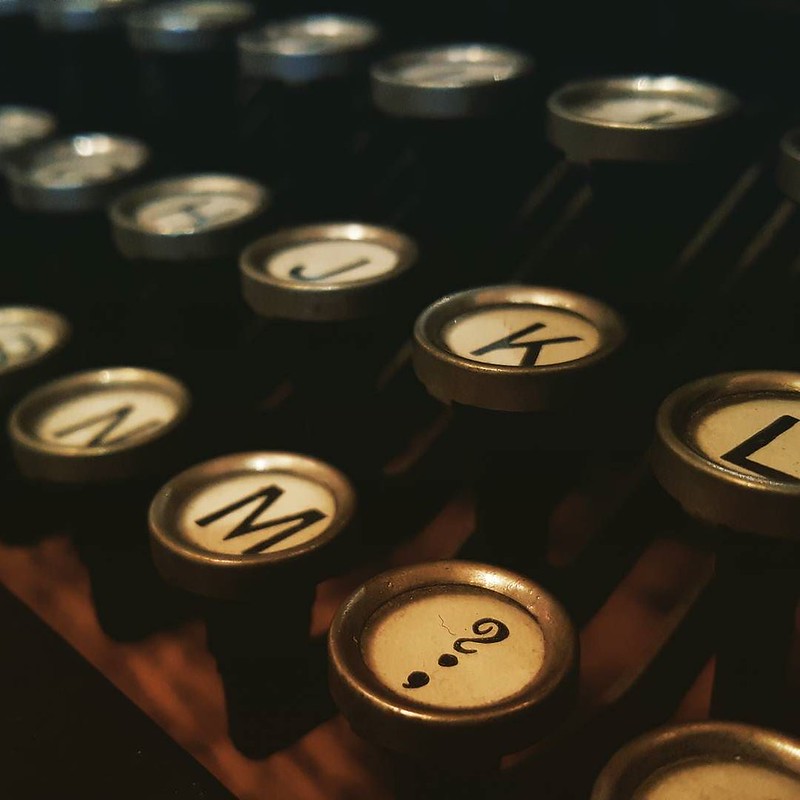
Her fingers rest on the cool glass keys of the typewriter. Their smooth steel rings brush her fingertips.

She is safe here. No one sees her words, reads her thoughts, as she launches them at the page.  

Her inspiration comes alive.

She presses the keys. Like soldiers, the hammers rise, striking the paper, creating the letters, forming the message.  

Will it work? She steels herself against self-doubt.

Her finger slips. The word ‘vote’ has two o’s.

She sighs.

Arthur was a gardener once, and she finds a thick thorn like a dinosaur claw, in the desk drawer. She scratches away the ink of the extra letter. She finishes the word, vote, the t grainy on the rough parchment.

Her fingers shake.

The years have swelled her knuckles, her fingers unbendable rods, rigid stems.  

Her gray hair sways in the reflections of each of the forty-nine glass panes forming the keys.

Vote. Or you never vote again, she types. She breathes.

Arthur breathes beside her. He watches. It’s all he can handle.  

She adds the period. They exhale.

Arthur hands her a new sheet of paper. An eyelet on her sleeve catches on the carriage return lever. 

She inhales.

She begins the next letter.


Ryan Owen is a writer living among the glacial erratics and waist-high stone walls of central New England. Ryan resurrects antique typewriters and writes all first drafts from their glass-and-chrome keys. Ryan’s fiction has been recognized with an honorable mention in the Writers of the Future contest and has been published in Idle Ink, Litbreak Magazine, and Penumbric Speculative Fiction Mag, and is forthcoming in Literally Stories and Writers Resist. Find Ryan on Twitter/X, @4gttnNewEngland or on Bluesky, @iviesofinkribbons.

Photo credit: Ben Rogers via a Creative Commons license.


A note from Writers Resist
Thank you for reading! If you appreciate creative resistance and would like to support it, you can make a small, medium or large donation to Writers Resist from our Give a Sawbuck page.

Two Poems by Lonav Ojha

To Refaat Alareer,
who became a kite


Brother, you looked so loving,

holding very gently

that box of

strawberries, and behind

your home, not yet,

not again,

but incessantly

in ruins.


You were not a number,

you were,

an educator,

a cheerful poet,

settler’s boogeyman,


and now that you’re dead, English is also

a language for mourning.


A strike occurs in a medium

it does not

simply

………

….

fall.


And your words

hang in air

heavier than any

gravity bombs.¹


1. American

•          •          •          •          •          •          •          •          •          •       


A letter to a friend explaining the student movement


I have been listening

to more Bollywood these

days. I have been writing Press Statements

for the Press that does not state what

must be stated. I live in despair. And I

sometimes wish I didn’t have to, but hearing

love songs, Bollywood love songs, without

having anybody to love in a Bollywood sort of way,

means I’m hoping to learn a few things

about romancing myself.


A newly made friend

told me

during the protests that he’s serious about

killing himself, & he was writing

a letter, and another

said she’s cutting herself after many years.

The first person, we don’t talk anymore, because I have

nothing to say.


They’re still alive. I am also still alive.

I am listening to Bollywood songs. I am writing

Press Statements.

I am talking to L, and he says,

the Vice-Chancellor is planning something

HUGE!!

He’s been flying back and forth to Delhi. He,

is a bastard, and I’m listening

to Bollywood songs, and I’m doing alright.

And I’m trying to love my friends, the ones I can,

the ones who can love me.


Long live that look

on your face, and mine. I am

listening to Bollywood

songs, and I’m imagining someone

who would have me fully.

I suffer egregiously from the main character

syndrome. I suffer from having faith

in people. Long live the crane

behind the Magis block that spent a year

building what it will never occupy.

Long live the cats in the New Academic Block

that don’t give a shit. So I am

writing Press Statements. I’ve always

danced in my room,

when nobody’s watching,

when the world is burning,

and I haven’t stopped.


Lonav Ojha is a 22-year-old writer from India. His work has previously appeared on ASAP Art, Agents of Ishq, LiveWire, and The Open Dosa. He was also longlisted for the 2024 TOTO Awards for Creative Writing in English. He writes regularly on his personal blog, Stories Under My Bed, where he attempts to reimagine resistance from the praxis of joy and education. Since the 2014 national elections, his country has plunged into the depths of Hindutva fascism, crushing dissent in all its varied expressions and stifling whatever remained of academic freedom in public universities.

Photo credit: Magne Hagesæter via a Creative Commons license.


A note from Writers Resist

Thank you for reading! If you appreciate creative resistance and would like to support it, you can make a small, medium or large donation to Writers Resist from our Give a Sawbuck page.


The Notorious

By Alex Penland     


Do you remember Yad Vashem? How
the path that leads you through the
exhibit is chronological and single
lined, each point presented on a hair
pin turn of events: here is where a new
legislation was passed, here is where
some diplomat died, here is where the
people thought oh, one more degree
in this pot won’t make the water
boil yet. But then you cross the river
gap to the next section of the exhibit
and are suddenly granted a perception
of time as a whole, not a part, and when
you reach the section where it gets so
bad that you think you must be near the
end you look down the line at all the
bridges and no. You’re half through.
Half through the voices saying we
thought they wouldn’t dare, thought
people were better than they were or
human goodness was more ubiquitous
than it is or some protection was more
sturdy than the flimsy social contract
it turned out to be and things get so
much worse, and the hope of it becomes
less a light in the tunnel and more a
light in the eyes blinding us from the
things that live in the darkness. She
was one of those protections, I think
now, a stone wall painted on paper,
and through the fire it’s amazing she
held the line as long as she did, but
that greasy burning and a squealing
that is not pigs is coming closer now,
and for the moment I am on the safe
side of the shower door, but I can’t
help but look down the crack in the
exhibit hall and think we aren’t even
close yet, we’re not even close to the light.


Alex Penland was a museum kid: a childhood of running rampant through the Smithsonian kicked off a lifelong inspiration for science fiction, poetry, and science-inspired fantasy. Their work has been internationally published in The Midwest ReviewStory Cities, and the upcoming Strange Lands anthology by Flame Tree Press. Their poetry has been awarded by Writers’ Digest and previously appeared in the December 2018 issue of Writers Resist.  They currently live in Scotland studying for a PhD in Creative Writing. You can follow Alex on Twitter @AlexPenname or visit their website at www.AlexandraPenn.com.

Yad Vashem photo by Anders Jacobsen on Unsplash.

The Fire Still Burns

By Gary Priest


Fire makes us all believers.

There’s a unity in fear that allowed science and religion to merge into a rational hysteria that swept us all along on a wave of koala memes and apocalypse FOMO.

The eco-inspired crimewave started in the mid 2020s. This was not just shutting down airport runways or protest hashtags. This was something darker, primal and all persuasive.

My first assignment as a rookie eco-cop was crowd control at the murder of an oil company CEO. He was castrated and hung from a lamppost outside a petrol station on New Year’s Eve, 2028. Six months later, I found myself first on the scene of a luckless idiot who discarded a burger wrapper on a Soho street and was kicked to death by a passing group of vegan death metal kids.

Ten years after those first deaths, “ecoslaughter” was written into the rule of law. By the early 2040s, it was impossible to get a conviction on any death that could show a motive related to saving the planet.

The skies got a little bluer and the oceans were more saltwater than cellophane again.

We saved the world.

Twenty years came and went. I remained on the force.

On a dull evening patrol, I drove past a group of teens waited in an orderly line to get into the hippest of the town’s vice-free nightclubs. I could probably find some reason to take them in. The smallest violations were now offences. Sneaking an outlawed carbohydrate, wearing leather shoes without a permit, and, of course, loitering with intent to pollute, which could be twisted to cover anything anyone did and was great for keeping arrest numbers up.

Hoping there might be some meatier infractions inside the club, I parked my bright green smart car and with one flash of my badge at the door, strode inside the large hall. The whale song and bird tweets were a long way from the old days of EDM and rock ’n roll, but after the Bank Holiday Modular Music riots of ’44, the influencers decided that all human-made music was ecologically unsound.

I still remember the day they executed Keith Richards. The lethal injection didn’t work, so they beheaded him live on the nine o’clock news. The tattered illusion of humane deaths for musicians was put aside. They crucified Miley Cyrus, fed Alfie Boe to a pack of feral hogs and kept going until every last one of them was dead.

Groups of pious youth swayed back and forth to the somnolent sounds of nature. These were the inheritors of the planet.

I hated them and I hated what the world we saved had become.

That was my secret.

Back in the early 21st century, there was a gestalt shift that left no room for doubt in anyone’s mind. They called it Twitter-logic. You never expressed doubts, you never backed down, and if there was a mob, you had better be part of it or you would find yourself its next target.

That shift pulled us back from the brink of global catastrophe. Who’d have thought all those armchair environmentalists would one day bring about the Plastic Purges of 2042, the Meatless Monday Massacres of ’55.

I played along, said all the right things and became the perfect symbol of the new age of woke warrior.

Don’t get me wrong, I was glad the planet had been saved, and I admit that the draconian means were probably the only option we had left by the end of the 2020s. But now that the planet was yet again an Eden, it seemed we had forgotten how to enjoy its bounty and grace.

I clocked up a few arrests in the club. Minor violations of recycling laws and dental hygiene directives. The Prius prison vans came and took the offenders away, and I went back to my patrol.

It was a quiet night and I was nearing the end of my shift when the call came in to investigate a code 411, “possible youthquake in progress.”

She sat alone on a wall by the burnt-out shell of a public library. Hardly a youthquake, but certainly a curfew violation to start with.

She wasn’t much older than fourteen. Her hair was a messy nest of blonde and pink. I could have taken her in for the hour and the highlights, but those abuses were the least of her transgressions.

Smoking a cigarette. In public! A goddamn roll-up! That was a twenty-year minimum sentence right there. At her feet, a small pile of cigarette butts, an empty bottle of bootleg vodka and what looked like the remains of a highly illegal kebab.

I got out of my car. She didn’t look up, just puffed out a plume of smoke and started singing.

Instinctively, I drew my gun. Still, she didn’t react.

The song came from way back in the 1980s. “Are you singing a Russ Ballard song” I asked.

She stubbed out her cigarette on the wall and tossed it to the ground.”‘The Fire Still Burns,” she said. She did not smile but assaulted  me with eyes granite grey and defiant.

“How do you even know music? It was outlawed before you were born.”

Her laugh was flat and without warmth. “It’s all still out there in the dark cloud if you know where to look.”

Another violation.

“And is that how you want to die? Singing some forgotten power ballad from the eighties?”

She shrugged. “You remember it.”

“That’s not the point, you dumb fucking kid. I have to kill you now. You get that, right?”

After the first few years I no longer enjoy the killing, nor did I feel anything other than a grim certainty that to disobey an eco-statute would mean my death as well as the offender’s.

“I have to kill you”’ I repeated.

‘Of course, you do. Been waiting  half an hour for one of you green-booted arseholes to come  and end me.’

My grip tightened on the gun. There was no arrest protocol for this many violations.

“Why are you doing this”’ I asked.

The kid smiled for the first time. “Because extinction is the only rebellion I have left, green-boot.”

I shot her twice in the head and once in the chest. Her smile reddened as she toppled over the wall to the ground. I called the cleanup squad and went home.

For the first time in years, my heart soared. I was too old and too scared to rebel, but that kid hadn’t given it a second thought, and if there was one of her, there were probably more. One kid smoking cigarettes and singing outlawed songs might do little else but give hope to her embittered executioner, but a thousand of them could become a trending topic, a hashtag, a movement, and that was how the world changed these days. In her grey eyes I saw the rebirth of the natural revolt of youth. Our generation saved the world, and now maybe, just maybe, the next one could save us.

Later, in the surveillance dead-spot of three a.m. I started singing “The Fire Still Burns,” softly, in the cold solitude of the night.


Gary Priest writes short fiction and poetry. He has over thirty publications online and in print including Daily Science Fiction, The Eunoia Review, and Literary Orphans. He lives in the UK at the end of a dead-end road, which may explain everything.

Photo by Markus Spiske on Unsplash.

Long Time Listener

By H. A. Eugene


Greetings HTW gang!

First off I want to say thanks to Gabe, Mack, and your producer, the lovely Vicky! I am a fan of the podcast and have been a member of the How’s That Work? gang for almost longer than I can remember! As proof, I submit to you this photo—yes, that’s me in a HTW t-shirt, standing between the inimitable Gabe Gibbons and the illustrious Michael “Mack” McCready, after a live recording at the Bell House in Brooklyn! It’s been years so you probably don’t remember, but my stepdad Kevin took me (he also took the picture). I think I was fifteen. Fact is, I started listening to your podcast when I was just a freshman in high school, and I’m sorry if this makes you feel old! Please consider it a compliment. (Happy-face!)

Anyway, I’m writing today to serve you what I’m going to call a long time listener compliment sandwich: a few tiny corrections, sandwiched between a whole lot of tasty gratitude!

First, the tasty stuff: The podcast How’s That Work? has taught me so much! You guys do such an outstanding job explaining complicated things in simple terms. Maybe it’s your down to earth personalities, I don’t know. But your on-air banter makes you guys seem like friends in real life, and in a lot of ways, it makes me feel like you are both my friends, as well. (Smiley-face!)

If I were to choose a favorite HTW episode, it would be the one where you explain how lightbulbs work. You really brought the story of this humble, first-of-its-kind electric appliance to life in a lively, illuminating way! (Sorry, I couldn’t resist!)

My second favorite episode has to be the saxophone. Where it came from, how it’s viewed in popular music—oh, and I loved your list of most famous saxophone solos. I looked them up and they were oh, so tacky and oh, so terrible!

And if those are my first and second, then my third favorite HTW episode of all time has to be doughnuts. And this is where I must point out my correction. (Gasp!)

In this episode, you mention that the doughnut was invented by Dutch immigrants, with Russian, as well as French influences. This was followed by the statement “we are a nation of immigrants” and “diversity is what makes us great”—two dogmas, which—I hate to say, but absolutely must point out—haven’t been the case for a while, and as such, should not be broadcast as if they were. It’s a fact that aside from a few outliers, the vast majority of the USA’s greatness comes from native-born Americans of European descent; more specifically, native-born Americans of European descent who extoll the Western traditions this country was founded on, and that to this day, are a major part of our American Brand in the World. (Moreover, it bears stating that, when it comes to doughnuts, those largely antebellum foreign influences were assimilated very quickly into our lexicon, and therefore, became American in nature.)

To be perfectly clear, I am well aware that everybody old enough to recall a time before the internet can also recall having been raised with cheesy cliches like these. So I understand why this might seem correct, so don’t feel bad! It was an honest mistake. After all, this is how facts change over time, right? I think it was Gabe who explained, in the saxophone episode, how the instrument started out as a hokey novelty, and how its role in blues, jazz, and rock music eventually brought it the recognition it deserved. Like I said: how facts change.

That said, here are a few other corrections. In your recent episode on the origins of our glorious border wall, the legal framework for fast-track mass deportations actually came about way back in the second Trump term, not the third. Sweeping reforms like these would have been impossible without the cooperation of Congress, which had been all but assured by Justice Ellis, whose interpretation of the first amendment allowed for the type of large-scale fundraising required to defeat our enemies at the ballot box. Then there’s Justice Damiano’s traditionalist views on race, which played a major role in arguing for the repeal of the Voting Rights Act, and its replacement by the much stricter Voter Identification Act. All of this led us down the bumpy road to abolition of the antiquated concept of term limits. (And if you think about it, none of this positive change would have been possible without the faithful support of patriotic media networks that resisted the pressure to give in to liberal fact checking, but I guess that’s another episode, right?)

That said, despite your obvious biases, your border wall episode also helped me to better understand the incorrect liberal reading of our then-current immigration crisis, which falsely claimed that immigration drivers were spurious concepts like “climate change” and “economic destabilization,” as opposed to simpler, more truthful motives, like enrichment on the part of greedy non-Westerners. (And yes, I am aware of the accusations of heavy-handed wielding of the law on the part of certain agencies, incorrectly administered blood tests, unlawful deporting of distant relations, and even cases of basic mistaken identity. But really, without real evidence, stories like these are just a bunch of fake news, am I right?)

In any case, I really can’t thank you guys enough for what you do. Your podcast literally explains the world, and I think for children especially, this is priceless. And for adults? Well, it’s just nice to hear a familiar voice explain complicated things in a simple way.

As for me, I’m sure you’ve figured out I’m no longer a kid! Though, as a private contractor in a counter terror task force, I do work with kids. My team’s focus is Central and South American immigration vectors, and my job is to learn all I can about the problem of ethnic minority dissident groups. I interview the young children we get in the camps, and as you probably guessed I can’t say a whole lot about that! (Eyebrow-raised, intrigue-face!) But all told, we are very proud of our work, and I speak for my whole team when I say, like you, we definitely take learning very seriously!

Your podcast taught me that the world is a wonderful place, full of things to learn and do. It also taught me learning can be fun. Though, if I’m being completely honest, sometimes, the things I learn and do make me sad. Oh well. I suppose it’s like my stepdad Kevin says, the weak need the strong to show them how to walk the straight and narrow, which is his way of telling me I should always be proud of what I do, and never be ashamed. After all, it’s not my fault people get themselves deported any more than it’s a policeman’s fault that people still—even now, with curfews, media blackouts, and extrajudicial paramilitary SWAT teams—break the law. (Sad/puzzled face!)

This was all my way of saying you and your podcast helped make me who I am today. And so thank you for that!

(CYA alert! I really don’t think anything I wrote here is problematic, but feel free to take stuff out as necessary if you want to read it on an upcoming episode. Also, if you have any questions, just reply to this message, and I’ll pass it along to my superiors.)

Anyway, thanks for everything!

Sincerely,
A long time listener and lifetime fan


A. Eugene writes weird stories about food and death and pretty music about homicide and fascism. He currently resides in beautiful Brooklyn, New York, where he is a staff member of the Bushwick Writer’s Group. Find him at www.haeugene.tv and on Twitter @haeugene.

Photo by Brett Jordan on Unsplash.

Mamichu

By Robert Walton


“Mamichu, it’s cold!”

I looked at Ivar. I looked at his knobby lump of a head, at his lips lying beneath his broken nose like twin dead slugs, at his eyes glistening beneath his granite ledge of a brow, eyes so small I never knew their color. There was no pleasure in looking at him. I looked away. “Why do you say this?”

“Because the wind cuts like a gypsy blade.”

“No, why do you say ‘mamichu’? What is mamichu?”

“Just a curse—a Zagreb curse for when you have to look up to see hell.”

“What does it mean?”

Ivar’s brow lowered, extinguishing his eyes. “It’s the worst curse of all.”

“The worst of all?”

“The worst!”  He chuckled like a diesel engine starting on a frozen morning. “It blasphemes sisters, mothers, grandmothers even.”

“Oh,” I recoiled in mock horror, “even grandmothers! Saints preserve us!”

Ivar shrugged. “It should be reserved for the worst of the worst. I say it about the wind, but I don’t mean it, not really.”

“You don’t mean it? Why say it?”

“Habit. Curses become a habit. The morning wind, this camp, they’re not so bad. My grandfather told me of the true gulag, Stalin’s gulag. One in twenty lived. My grandfather was the one.”

“Bah! Old men’s stories. Stalin’s gulag couldn’t be worse than here.”

“Peter, do we have soup?”

“The soup is snot.”

“But we have the snot.”

I did not reply.

“Do we have bread?”

“The bread crawls with weevils.”

“But we have the weevils. Munch them. Savor the snot. You live, man. You live! This Putin camp is paradise. We could be in America, in a ‘tender care center’!”

“Ha! Mar-a-Lago, maybe.”

A troop of guards carrying Kalashnikovs approached the gate. Two dragged a man between them. The camp commandant followed behind. Six guards peeled off, three to either side, and leveled their weapons. Two more slung their rifles and opened the gate. The prisoner’s feet made twin furrows in the mud as he was pulled into the compound and dropped on his belly.

Three hundred men in the compound stood motionless.

“Who is it?” I whispered.

“Yuri—our mate.”

“How can you tell? His face is gone.”

“It will heal. Believe me.”

The guards turned and paced back through the gate. Ivar stepped forward then. He went to Yuri, knelt, rolled him gently onto his back and cradled his head.

The camp commandant stared at Ivar. He was a short, slender man, like a banker or a pimp—a man whose work is to make others work.

“Drop him.”

Ivar didn’t move.

“Drop him.”

Ivar stroked Yuri’s blood-matted hair. “Outside the wire, we are yours. Inside the wire— we may care for each other as we can. It is the law of the camps. The unwritten law.”

“I am the law.”

Ivar didn’t reply, but continued to cradle Yuri’s head in his battered hands.

“You’re the one called Ivar?”

“I am.”

The commandant nodded to the guards. “Bring him.”

Two guards handed their weapons to men standing beside them. Four more aimed vaguely at the motionless prisoners. All six entered the compound. The two gripped Ivar.

Ivar glanced at me. “Peter?”

I nodded.

Then he carefully laid Yuri’s head on the mud and rose on his own. When the gate shut behind them, we were forgotten. A dozen others followed me to help Yuri.

They took Ivar, but they did not bring him back. Only his screams returned—until they ceased.

A line of thirty guards formed in front of the wire the next morning. The camp commandant—chin lifted, eyes bright— stepped in front of them and stared at us. It was a challenge.

Mamichu.

It may have drifted on a forest breeze from pine needles nearby, or sparked from sunlight glinting off barbs on the wire.

Perhaps I whispered, “Mamichu.”

“Mamichu, mamichu.” We prayed, “Mamichu.”

“Mamichu, mamichu.” We chanted, “Mamichu.”

Raw throats opened wide and we roared, “Mamichu. Mamichu!”

Mamichu.


Robert Walton is a retired teacher and a lifelong mountaineer and rock climber, with many ascents in the Sierras and Pinnacles National Monument, his home crags. His writing about climbing has appeared in the Sierra Club’s Ascent. His novel Dawn Drums won the 2014 New Mexico Book Awards Tony Hillerman Prize for best fiction, first place in the 2014 Arizona Authors competition, and first place in the historical fiction category of the 2017 Readers Choice Awards. Most recently, his short story “Uriah” was published in Assisi, a literary journal associated with St. Francis College in Brooklyn. Learn more about Robert at his website and follow him on Facebook.

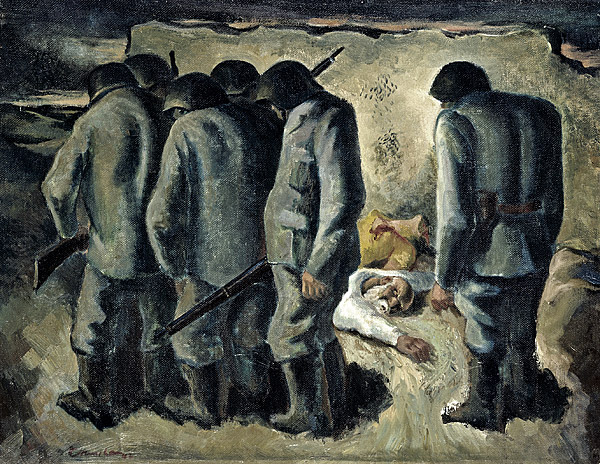
“The New Order” painting is by Noel Counihan, 1942, National Gallery of Australia.

Beware a Kinder, Gentler American Fascism

By David L. Ulin

Originally published by LitHub, November 16, 2016; used with permission of the author.

Let me begin with an admission: I don’t know how to write about this. I’ve been trying since Wednesday morning, day after the election, when I awakened with what felt like the worst hangover in the universe—and without the benefit of having gotten drunk. I’ve tried writing about Harvey Milk and the effect of the White Night Riots on the movement for gay rights. I’ve tried writing about vote tallies and the Electoral College. Tuesday night, I spent half an hour on the phone talking my son off the ledge—or no, not off the ledge, since it was the same one I was standing on. Later, I walked my daughter home from our polling place, where she had spent the day working and had voted in her first election; as we neared our house, she turned into my shoulder and burst into tears. I don’t want to make this personal, but of course I do. All politics is personal, or grows out of personal concerns. I am the father of a gay man and a straight woman, and both are at risk today. If you don’t think this is personal, then you better get out of my way.

I am not an activist, I am a writer. But we are all—we must be—activists now. As to what this means, I don’t yet know. Yes, to protests; yes, to registering voters and contesting elections; yes, to believing—to continuing to believe and fight for—this fractured democracy. But even more, I want to say, a yes to kindness, a yes to the human values for which we stand. This week, I began to dismiss my classes with a wish or admonition: Be good to each other and be good to yourselves. They’re scared. So am I. It seems the least that we can do.

What astonishes me is that the world continues. What astonishes me is that life goes on. What astonishes me is that I can step outside at break of evening, dusk deepening like a quilt of gauze across the city and everything looking as it always has. Down the street, a neighbor walks her dog while chatting on her cell phone; the smell of wood smoke lingers in the air. Just like last week, just like normal, although what does normal mean anymore? We have an anti-Semite as advisor to the new president, who is promising a first wave of deportations immediately after Inauguration Day. And yet, what frightens me is that in a year, or four months, this election, this administration, will become normalized, as will whatever happens next. We will get on with it, we always get on with it, but I don’t want to get on with anything. The dislocation is maddening: the inability to imagine a return.

I’m writing from a place of privilege; I understand that. I am a straight white male living in a (relatively) progressive state. Still, let’s not be fooled about what this means. Hate speech in a high school classroom in Sacramento, a gay man struck in the face in Santa Monica. Objects in the mirror are always closer than they appear. I have relatives who chose not to vote for president in Pennsylvania. In Pennsylvania, where the final margin was 68,000 votes. If this is a Civil War, it is one in which the battle lines are not the Mason-Dixon line but the driveways that separate us from our neighbors, our place in line at the supermarket, the traffic light at the nearest intersection, the kid at the next desk in our schools.

What do we do about it? We stand up, vocally and without equivocation, for the most targeted and the most vulnerable, we give our money and our comfort and our time. We are still a nation of laws, with a Constitution, and an opposition leadership. This, however, cuts both ways. If fascism or autocracy takes root here—and the seeds have already been planted, let’s not delude ourselves—it will be a kinder, gentler fascism, couched in the rhetoric of the American experiment. Normalized. That’s the America Philip Roth describes in The Plot Against America, in which Charles Lindbergh wins the 1940 presidential election and brings fascism to the United States. Roth’s country is one in which the World Series is still played in October, and kids sit in the kitchen with their mothers, talking about what they did at school. “Do not be taken in by small signs of normality,” Masha Gessen wrote last week on the blog of the New York Review of Books. “…[H]istory has seen many catastrophes, and most of them unfolded over time. That time included periods of relative calm.” All the same, Gessen reminds us we must “[r]emember the future. Nothing lasts forever.” To forget the future is to give up hope, and hope is our most prevailing necessity.

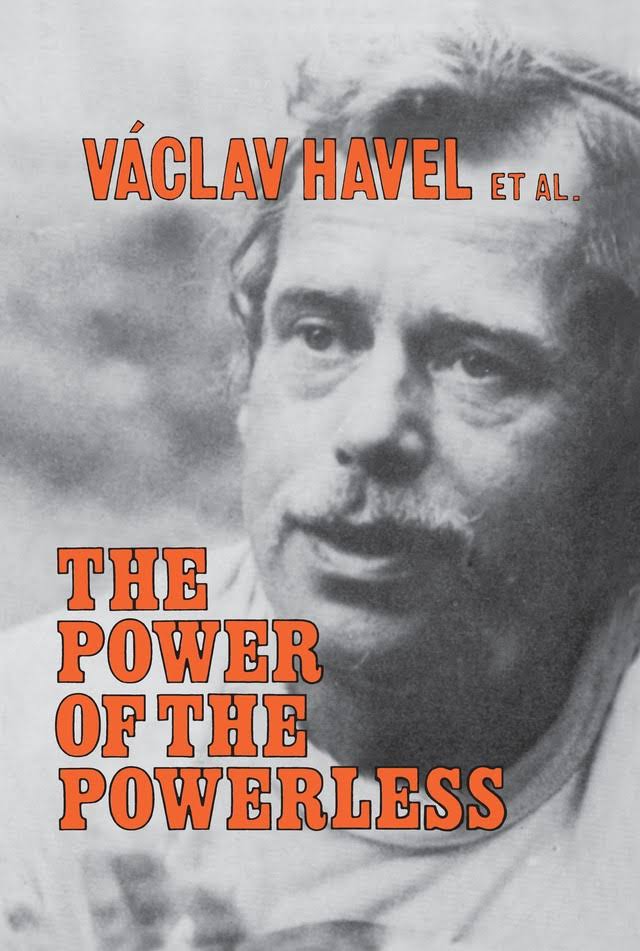
And hope, I want to say, begins with each of us. And hope, I want to say, begins at home. I keep thinking of Vaclav Havel, that dissident turned president, who in his 1978 essay “The Power of the Powerless” stakes out the position of a “second culture,” in which freedom begins as a function of our willingness to behave as if we are free. What makes this essential is its insistence that we are accountable, that the reanimation of “values like trust, openness, responsibility, solidarity, love” falls—personally, individually—to us. Keep the record straight, in other words, bear witness and participate, but also hold onto yourselves. “Individuals,” Havel writes, “can be alienated from themselves only because there is something in them to alienate.” I make a choice, then, not to be alienated; I make a choice to engage. I make a choice to preserve the values of tolerance, of love, of looking out for the other. I make a choice to act as a human being. “If the suppression of the aims of life,” Havel continues, “is a complex process, and if it is based on the multifaceted manipulation of all expressions of life, then, by the same token, every free expression of life indirectly threatens the post-totalitarian system politically, including forms of expression to which, in other social systems, no one would attribute any potential political significance, not to mention explosive power.” This is the resistance I am seeking, this is the revolution we require.

At heart here is a different sort of normalization—the normalization of who we are. We live in a country where we’ve been told (are being told every day) that we don’t belong. What do you think hate speech is? An attack on our right to consider ourselves American. I am an American, however, and so are you … and you and you and you and you. I do not walk away from that. We—and by that, I mean we in the opposition—are a nation in our own right and we have to stick together, to find the necessary common ground. My mother, who turns 80 in a couple of months, told me the day after the election that she had been talking to a younger friend, a woman with a teenage daughter; “I won’t live to see it,” my mother said, “but you and your daughter will.” She was referring to a woman president, but also, in a sense, to the restoration of what let’s call American values, for want of a better phrase. The conversation made me sad, and yet we can’t give in to sadness; that is not our luxury. At the same time, it is also necessary that we express it, that we can tell each other what we are feeling, how we are.

So how are you? I am worried, I am angry, and (yes) I am sad. I am also trying to live my life. This is the normalization I will not yield. Call it second culture. Call it whatever you like. I am reeling, we are all reeling, but I am teaching, I am writing, I am trying to take care of those I love. Saturday evening, I went out for dinner with my family. We sat across from one another and tried to be in each other’s company, which remains, as it has ever been, its own small sort of grace. The following morning, my wife and daughter began making plans to go to the Women’s March on Washington. This is where we are now. This is who we are. Resist. Remember. Stick together. Be good to each other and be good to yourselves.

………………………………………………….

David L. Ulin is a contributing editor to Literary Hub. A 2015 Guggenheim Fellow, he is the author, most recently, of Sidewalking: Coming to Terms with Los Angeles, a finalist for the PEN/Diamonstein-Spielvogel Award for the Art of the Essay.

Reading recommendation: The Power of the Powerless by Václav Havel.