Aunt Annie’s Recipe for the Resistance

By Jane Frances Gilles

Dear nieces and nephews,

You call me “The Resistance Maven.” It’s kind of funny, and I know you mean it as a compliment. But I don’t think you get what’s required to resist. So, here’s my recipe. By the way, there are tons of people who are more active than I, and there are other recipes. This is mine.

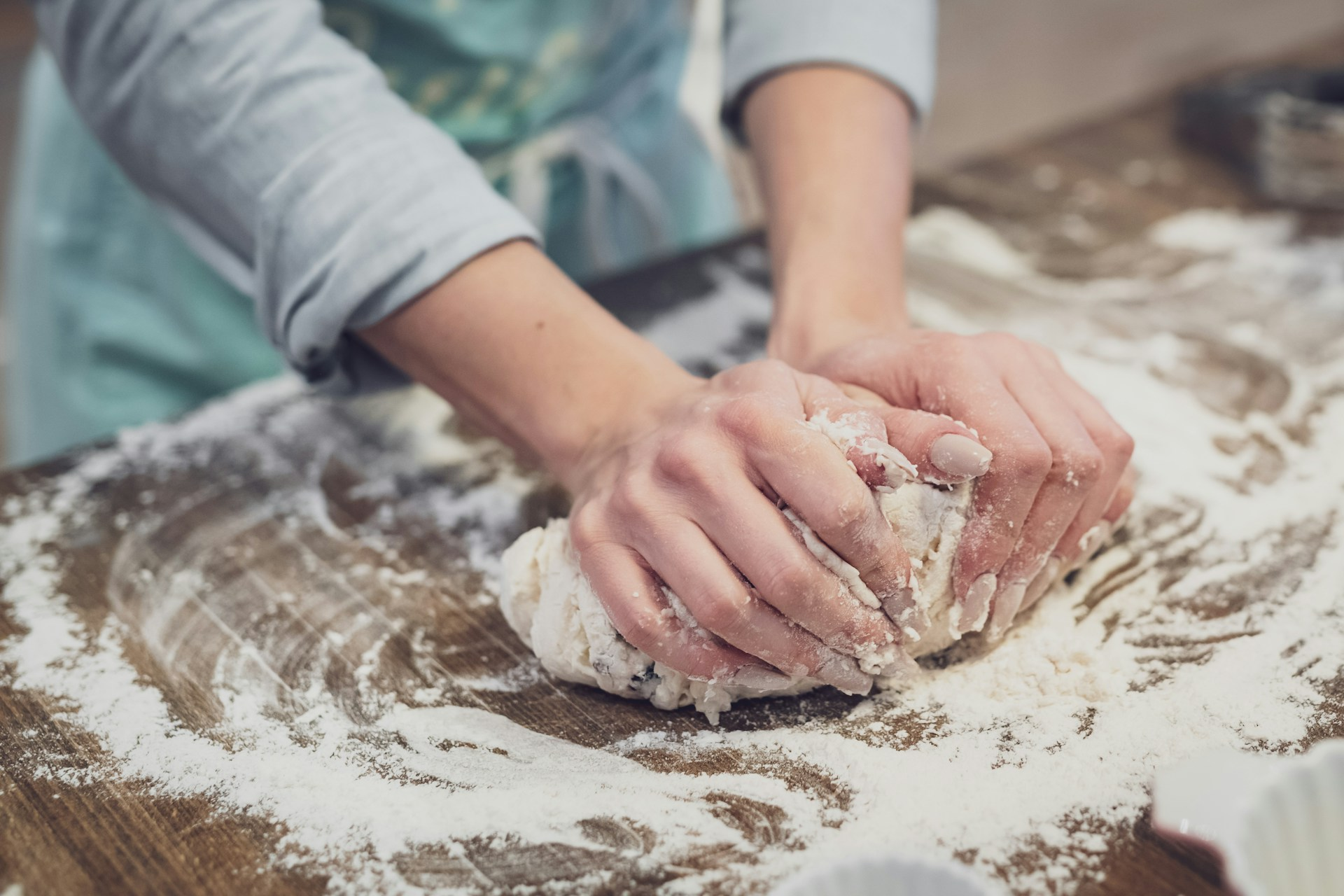
Aunt Annie’s Recipe for the Resistance

Number of servings:
One serving to thousands, maybe millions. (If you keep at it, your efforts will produce a yield far greater than you can imagine, and you will never know how many people you’ve served.)

Preparation time:
Five minutes to a few hours. (The shorter the better. Always be ready.)

Cooking time:
One hour to months. (As long as it takes. Which can be a damn long time.)

Total time:
There’s no end to the work. (It continues. Always.)

Ingredients:

Dry ingredients (These provide the structure and foundation for the recipe)

Fear and Courage: In equal measure

Anger: 1 cup (for intense frustration) to 1 lb. (for screaming outrage)

Humility: 2 lbs.

Curiosity: Start with what you have on hand and keep adding

Love: 1 dozen bushel baskets

Salt: To taste (Like Grandpa always said, “Aim to be the salt of the earth.”)
Wet ingredients (These activate the dry ingredients, making resistance possible)

Time and Inconvenience: Enough to cover dry ingredients

Voice: Equal parts spoken and written

Feet: As needed (for marching and standing up for your neighbors)

Hands: As needed (roll up your sleeves; there’s real work to do)

Your people: ½ dozen to hundreds

Supplies: Variable

Directions:

Gather the dry ingredients. Make sure you take time to consider each of them. Most are self-explanatory. I’ll elaborate on a few.

  1. Fear: You need to understand right up front that resistance requires risk, and risk produces fear. Fear is good; it helps keep you safe. The risks are real, so don’t deny your fear. (When a rubber bullet was used against your great-uncle Fred during a Vietnam protest, he lost an eye. But he’s still out there protesting injustice every chance he gets. Yeah, I know Grandma Gladdie liked to say it was a work injury. That was a lie, God bless her.)
  2. Humility: Humility takes many forms. At this stage in your lives, the key aspect is awareness of your privilege. All of you, dear ones, are privileged. You’re white. You were born in the U.S. Most of you are cisgender and heterosexual. (If you need a lesson on how that contributes to your privilege, ask your Aunt Kate. She has stories. And wounds you can’t see.) You’re able-bodied. Never have you had to worry about getting enough to eat. I could go on and on. Bottom line: Most people don’t have the same advantages as you.
  3. Curiosity: Be curious about your neighbors. Get to know them. Listen to them. (In this family, we’re blessed with the gift of gab—but talking non-stop is no way to learn about others.) Be curious about the world beyond the cocoon you’re living in. I’m not talking about following the news. Yeah, you should pay attention to current events. That’s basic. But to develop empathy for others, get your nose out of your phone and explore the arts, volunteer, travel, read about lives and cultures different from your own. This is a lifelong endeavor. Get on it.

Mix dry ingredients.
Make sure you have enough of each dry ingredient throughout every resistance effort. If you’re running low on any of them, stop and gather more. And watch the portions of each. (I’ve had weeks where I didn’t add enough love and put in way too much anger. Let’s just say it wasn’t good.)

Gather wet ingredients.
These are your tools. Depending on the effort, some are more critical than others, but you need all of them every time. A couple of explanations:

  1. Your People: Some you know today. Some you’ll meet tomorrow. Connect with organizations you believe in and respond to their asks. (Trust me, you’ll be inspired by the people you meet when you resist.)
  2. Supplies: Good shoes for marching, or groceries for your neighbors, or your keyboard for contacting legislators. You might need posterboard or a whistle (who knew whistles would be a thing?) or a new app on your phone or protective gear or a candle (because Grandpa also said, “Never be afraid to let your light shine.”) Sometimes it’s money. Give what you can and be ready to sacrifice.

Fold together dry and wet ingredients. Mix well.

Bake or freeze. (On hot pavement in summer or on icy streets in winter or wherever whenever.)

  1. Seek opportunities to resist. Don’t wait for a crisis staring you in the face.
  2. Stay in conversation with your people. You need each other.
  3. Do at least one thing every day to resist. That said, know that when you need a break, others are doing the work.
  4. Be aware of the feeling—the taste—of resisting. (Sometimes sweet, sometimes spicy, always satisfying.) It feels lousy to doom scroll. It feels lousy to complain without lifting a finger to help. It feels lousy to watch the same horrifying video over and over. So, get in the fight. Stay humble, yet know you are taking actions that place you on the right side of history.

Someday, when I’m gone and you have your own children or nieces and nephews or godchildren or neighbor kids who see you as family, tell them how delicious it is to resist. And share this recipe with them.

Love,
Aunt Annie


Jane Frances Gilles is a writer, former educator, and proud Minnesotan. She holds bachelor’s and master’s degrees in English education and a Ph.D. in education policy. Her fiction has been published in The Writing Disorder and MoonPark Review.

Photo credit: Photo by Theme Photos on Unsplash.


A Note from Writers Resist
Thank you for reading! If you appreciate creative resistance and would like to support it, you can make a small, medium or large donation to Writers Resist on our Give a Sawbuck page.
Breathe

By Ryan Owen

When her husband lowers the newspaper and stops hiding his cancer, Stacy learns that their voting rights have eroded as quickly as his health.  

The front fold rests on his lap. “How?” she asks.

“With new laws.” He taps the headline with an ink-stained fingertip.

From the kitchen countertop, a screen’s colorless aura startles awake, its glow spilling onto the tan tiles of the floor.

“Let me explain voting rights to you,” a robotic voice replies from the countertop.

Their eyes go wide.

“They can hear us now.” Arthur mouths the words. A hoarse whisper.

A powdery crescent scars the wall where Stacy pitches the device. Black plastic thorns litter the tiles. She steps around them as she picks her way to the bathroom.

She stares at its dead screen as she closes the door. Arthur yells that it can’t hear their words anymore, communicate them to false protectors, misguided champions. Nevertheless, she’s cautious to act, resist . . . persist.

She can’t let them win, or they will silence her words and know her thoughts. Steal her voice. For a forever that feels like death.

She has already locked her smartphone into its metal box in the attic. When she exits the bathroom, she descends the cellar stairway to cut the power to the house.

“Flip the main breaker,” Arthur shouts his deathbed advice. 

He’ll be dead by the election. They both know this. Neither says it aloud.  

She comes up the stairs, following the smooth grain of the wood handrail. She sits at Arthur’s desk, harvesting the loose threads in her thoughts. An early-morning rain soaks the sounds drifting through the window.

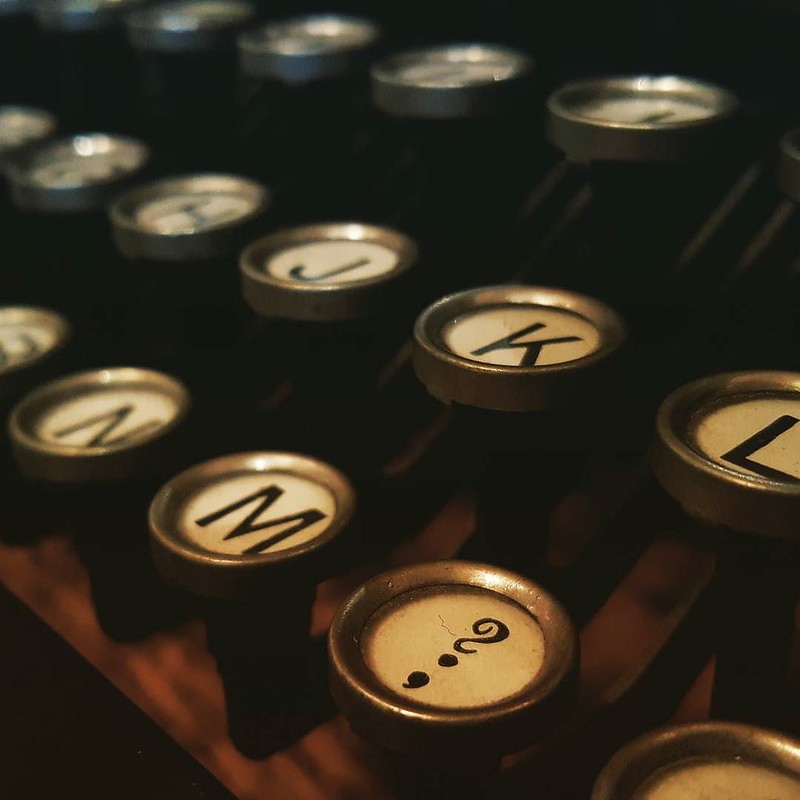
Her fingers rest on the cool glass keys of the typewriter. Their smooth steel rings brush her fingertips.

She is safe here. No one sees her words, reads her thoughts, as she launches them at the page.  

Her inspiration comes alive.

She presses the keys. Like soldiers, the hammers rise, striking the paper, creating the letters, forming the message.  

Will it work? She steels herself against self-doubt.

Her finger slips. The word ‘vote’ has two o’s.

She sighs.

Arthur was a gardener once, and she finds a thick thorn like a dinosaur claw, in the desk drawer. She scratches away the ink of the extra letter. She finishes the word, vote, the t grainy on the rough parchment.

Her fingers shake.

The years have swelled her knuckles, her fingers unbendable rods, rigid stems.  

Her gray hair sways in the reflections of each of the forty-nine glass panes forming the keys.

Vote. Or you never vote again, she types. She breathes.

Arthur breathes beside her. He watches. It’s all he can handle.  

She adds the period. They exhale.

Arthur hands her a new sheet of paper. An eyelet on her sleeve catches on the carriage return lever. 

She inhales.

She begins the next letter.


Ryan Owen is a writer living among the glacial erratics and waist-high stone walls of central New England. Ryan resurrects antique typewriters and writes all first drafts from their glass-and-chrome keys. Ryan’s fiction has been recognized with an honorable mention in the Writers of the Future contest and has been published in Idle Ink, Litbreak Magazine, and Penumbric Speculative Fiction Mag, and is forthcoming in Literally Stories and Writers Resist. Find Ryan on Twitter/X, @4gttnNewEngland or on Bluesky, @iviesofinkribbons.

Photo credit: Ben Rogers via a Creative Commons license.


A note from Writers Resist
Thank you for reading! If you appreciate creative resistance and would like to support it, you can make a small, medium or large donation to Writers Resist from our Give a Sawbuck page.

Twin Pandemics, Twin Cities

By AJ Donley


They warn you about the dangers
that you’ll be feverish
that your throat will hurt
that it’s contagious
that you won’t be able to breathe

they try to scare you away from action
with the risk of symptoms
that have always been there

because COVID is new
but racism is not

I wear a mask to protect my loved ones
from the pandemic that affects them
my white friends and family
worry about what goes into their lungs
when people of color are breathing in
the soot from communities we’ve burned
to the ground then blamed on riots
we doused them in gasoline and got mad
when they lit a match to keep warm
no wonder they can’t breathe

Now I’m feverishly marching
my throat hurts from screaming
anger is contagious—but so is justice—
let it infect you
lest it kills you


AJ graduated from the University of Minnesota, Morris with a BA in psychology and English. She also has her MA in forensic psychology from the University of North Dakota. Currently working in the sexual violence field, she seeks to explore the human psyche and illustrates what she sees with poetry. AJ plays with form, language, and imagery in an attempt to interpret what she experiences. She seeks decadence and authenticity and piercing honesty. Poetry is a practice and is never complete; just as the mind is subjective and dynamic, so too is her writing.

Photo credit: Dominic Dominic Jacques-Bernard via a Creative Commons license.


A note from Writers Resist

Thank you for reading! If you appreciate creative resistance and would like to support it, you can make a small, medium or large donation to Writers Resist from our Give a Sawbuck page.

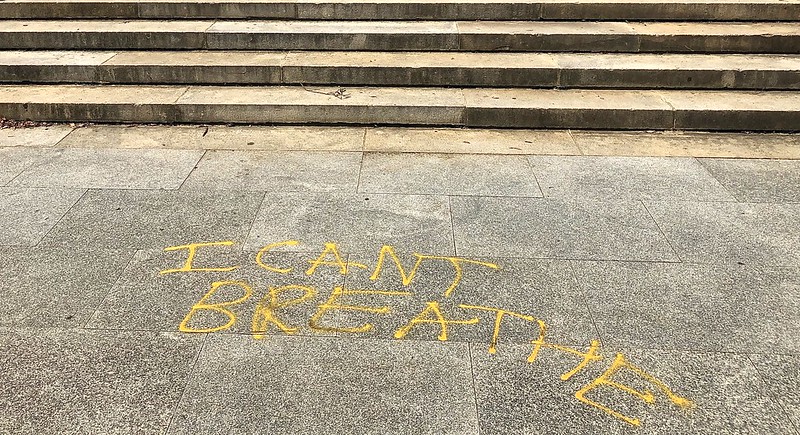
I can’t breathe

By Mary F. Lenox


I can’t breathe
the words said
written on a waste container
near the sidewalk

I wondered what other
unheard voices say
I can’t breathe

Dying fish of the sea
echo
I can’t breathe
as they
navigate through
plastic and oil invaders

Birds
call out
through polluted air
I can’t breathe

Children playing
in urban streets
for lack of space elsewhere
I can’t breathe

Rivers and streams
full of sewage from earthlings
scream
I can’t breathe

Shouting voices of people of color
grieving for relief
from all the ways oppressors
have tried to kill, destroy, eliminate
I can’t breathe

Yet
young and old around the world march and proclaim
No more!

We will not stand silently by
hearing those words
I can’t breathe


Born in Chicago, Illinois, Mary F. Lenox is a poet, writer, speaker, and educator.  She was a professor at the University of Missouri-Columbia in the School of Library and Information Science where she served as dean for 12 years. She is the author of two books of poetry, Threads of Grace: Selected Poems (2015) and Riches of Life: Poems (2019). She resides in San Diego, California.

Photo credit: Tyler Merbler via a Creative Commons license.