
Fun to Be Fabulous

By C. Gregory Thompson

“You look just like my aunt,” the woman said to us, looking at my friend, Sara. “But, of course, she’s dead now.”

We were perched on the aqua blue cushions of an outdoor couch on what we jokingly referred to as the “lanai” at Rancho Las Palmas, a resort in Palm Desert, California. The lanai and this particular couch had become our regular spot for the past three-and-a-half years. From its caddy-corner vantage point, we could see everyone coming and going. We’d returned to our alma mater’s “residency” to visit our professors, fellow alumni and current students of the UCR/Palm Desert Low-Residency MFA Creative Writing program.

This exchange took place the first week of December. The desert winter weather was lovely and mild. I’d noticed the woman roaming around the lanai, stopping to chat with people who walked through the area or were seated at other couches and chairs. Mid-sixties to early-seventies, smartly dressed in a designer-ish pantsuit and gold jewelry, hair highlighted to a bronze color, about five foot six, she carried an oversized red tote bag. She placed the bag on the edge of the stone fire pit we sat by like it was part of her armor. Sara and I looked at her waiting to see what she’d say next.

“You see, I’m Robert Kardashian’s sister.”

Sara, always game for a little crazy, said, “So, you think I look Armenian?”

“There’s no such thing as an Armenian. They’re all Jews who haven’t accepted Jesus,” the woman replied without missing a beat.

After this comment, my own crazy-antennas were at full salute, gyrating back and forth. A bit like slowing down to look at a car accident—you want to, but you don’t want to, fearful of what you might see, but still curious—we watched her to see how far the insanity might go.

“Kris is a horrible person,” she said. “She ruined the family as soon as she married into it. And she poisoned my brother. They called it esophageal cancer, but it was a poisoning.”

Sara and I threw sidelong glances at each other, asking, is she for real? Real or not, she definitely had our attention. In the whacked-out world of the Kardashians, maybe Kris did poison Robert. Isn’t anything possible—especially now?

“Then, when she married that freak, she destroyed the family.”

Her verbs gradually took on more power. First “ruined,” then “destroyed.” The “freak” implied Caitlyn, we assumed. I wondered, did she become a freak to this woman after the Bruce to Caitlyn transition, or is that the moniker she always used for her? I’d venture to guess she disapproved, and “freak” was a more recent descriptor. Listening to her, and, admittedly, not being a fan of Kris, Caitlyn or the whole Kardashian mess, it was fun to hear her trash the family. I didn’t have to look at Sara to know that she was enjoying the teardown, even if false, as much as I was.

“Thank God Kourtney has a brain and Khloe has a heart, because Kim has a hole in her soul.”

Eloquently said, I thought.

And, before we had time to fully absorb these mots justes, she picked up her red bag and left us with these parting words: “It’s all okay as long as we accept God.”

After she was gone, I looked at Sara and said, “I highly doubt she’s his sister or a Kardashian.”

Sara ran inside to ask the concierge and returned with an answer.

“The concierge said, and I quote, ‘She isn’t a Kardashian, but it’s fun to be fabulous.’”

They obviously knew her. She’s probably a regular.

“Did you notice her bag?” Sara asked.

I knew it was bright red and large, big enough to carry a lot of stuff, but beyond that nothing stuck out.

“Trump. Trump International Hotel Las Vegas.”

That was the wording Sara had seen on the side of the bag, in gold lettering. It didn’t necessarily mean that she was a Trump supporter. Maybe she’d picked up the bag before he became our President-elect, but it did sow a little doubt and raised the whole experience up a level.

Sara told me she assumed the woman was a Trump supporter, and that tainted the whole experience for her. She was cool with the woman being crazy and impersonating a Kardashian, but as a Trump supporter, too, that gave her the serious willies. Too much crazy is, simply, too much crazy.

The woman might very well have been team “Make America Great Again!” Somehow it made sense. She could easily be the type not to see through the veneer, to be drawn into the glitz, the flash, the money, and the fake everything—overlooking common decency, human rights, and national security. After all, she had an obsession with the Kardashians. For myself, if I’d ever purchased or had been given anything, especially now, with the Trump name on it, I would have burned it, and I certainly would not be carrying it around in public. She clearly had no issue being seen with it.

While we did giggle and gossip about her and wonder who she really was, the whole experience was actually sad. Later, I spotted her being seated for lunch on the outdoor dining terrace. She’d changed clothes and still looked quite put-together, but she ate by herself. She’d spent the last several hours alone, wandering the resort, trying to impress strangers. Sad, too, that, for whatever reason, she’d decided to co-opt the Kardashian name. To feel more important, out of boredom and loneliness, or was it sheer madness? Trying to understand, it all became too tied up in what is happening right now in our country.

Reality TV, in part, gave us the so-called President. It moved the dial further in the direction of crazy and provided a platform for Trump and his cronies from which to emerge. This woman was part of that; she was affected by what she saw happening with the Kardashians enough to make herself one of them. To top it off, the big red bag with Trump’s name emblazoned across it. A double-whammy of reality world unreality—first a fake family and now a fake presidency, both of which she embraced. The problem for the rest of us? Their fake reality has become our frightening authentic reality.

This was a small moment, a blip in time. But somehow it was huge, too. Because, to me, to us, to Sara and me, it said so much. This woman did not want to be who she was. She wanted to be someone else. Her life was not enough. She wanted bigger and better, a name of the moment—Kardashian. To be that fabulous, or what she perceived to be fabulous.

Pretending that reality is not real ultimately won’t work. Pretending that Trump is not the horrible human being that he is, or believing that his lifestyle has any basis in reality, will doom us all. And, for the lady on the lanai, pretending to be someone she is not will only lead to loneliness and misery, and, even, to that dreaded hole in her soul.

She might just be there already.


Gregory Thompson, a Pushcart Prize nominee, lives in Los Angeles, California, where he writes fiction, nonfiction, plays and memoir. His work has appeared or is forthcoming in Story Magazine, Five to One, Cowboy Jamboree, Full Grown People, The Offbeat, Printers Row Journal, Reunion: The Dallas Review. He was named a finalist in the Tennessee Williams/New Orleans Literary Festival’s 2015 Fiction Contest. His short play Cherry won two playwriting awards. He earned an MFA in Creative Writing and Writing for the Performing Arts at the University of California, Riverside/Palm Desert. Follow him on Twitter @cgregthompson.
84 Lumber Super Bowl ad: The uncensored film

From the family-owned 84 Lumber Company

The original 84 Lumber Super Bowl advertisement created a stir: The content was deemed too controversial by Fox, which banned it from broadcast. An edited version was cut for the game, and The Washington Post published a story about it—because the controversy was reportedly due to the depiction of Donald Trump’s proposed border wall.

Then the company’s CEO declared herself a Trump supporter and said the ad was in keeping with Trump’s immigration stance.

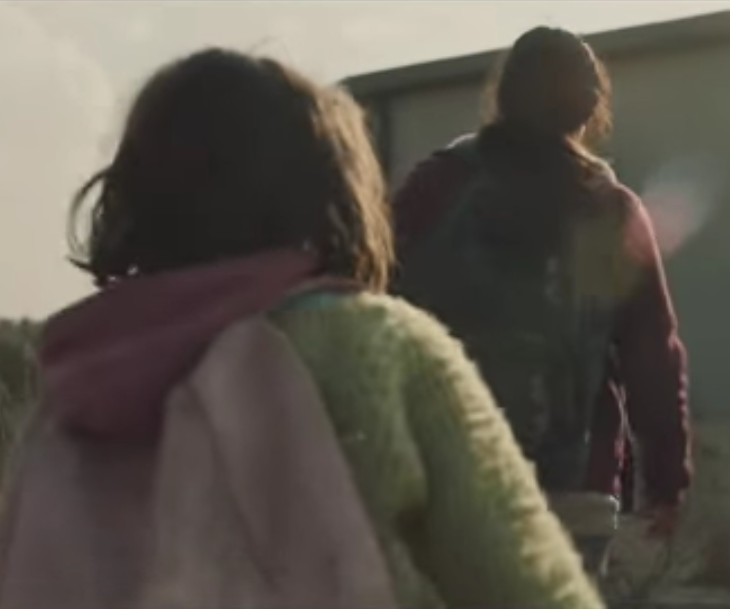
In this full version of the film, not quite six minutes long and with the offending footage, you see a mother and daughter, struggling to reach the United States, not to be stopped by a wall.

So, does the film celebrate determination and legal entry to the United States or does it advocate for illegal immigration?


The Women’s March Issue

Having recovered from the rewarding demands of the Women’s March on Washington—and across the nation and around the world—we are just not ready to give up that fabulous feeling. To sustain it a bit longer, in this week’s issue we feature the works of four writers who marched or would have, had death not defied intent.

The issue includes Julie Friesen’s essay, “March Interrupted,” describing her unexpected detour before the march even began from “the center of the world” to the South; Boston march participant Brenda Davis Harsham, whose poem celebrates “America the Beautiful”; and Julie Harthill Clayton and Rachel Federman’s works, offering a multitude of reasons people marched, in prose and poetry respectively.

Maybe their words will enlighten Donald Trump, who seemed befuddled by what he referred to as “protests.” He claims to have watched them, but he may never grasp them—it’s not at all clear what, if anything, he can understand that hasn’t erupted from his own maw or smart phone keyboard.

Perhaps we can simply be grateful for the inspiration he provides. Which brings us to a video offering in the issue, “Nasty Woman,” the poem that captured the heart and soul of the march, performed by its creator, Nina Mariah.

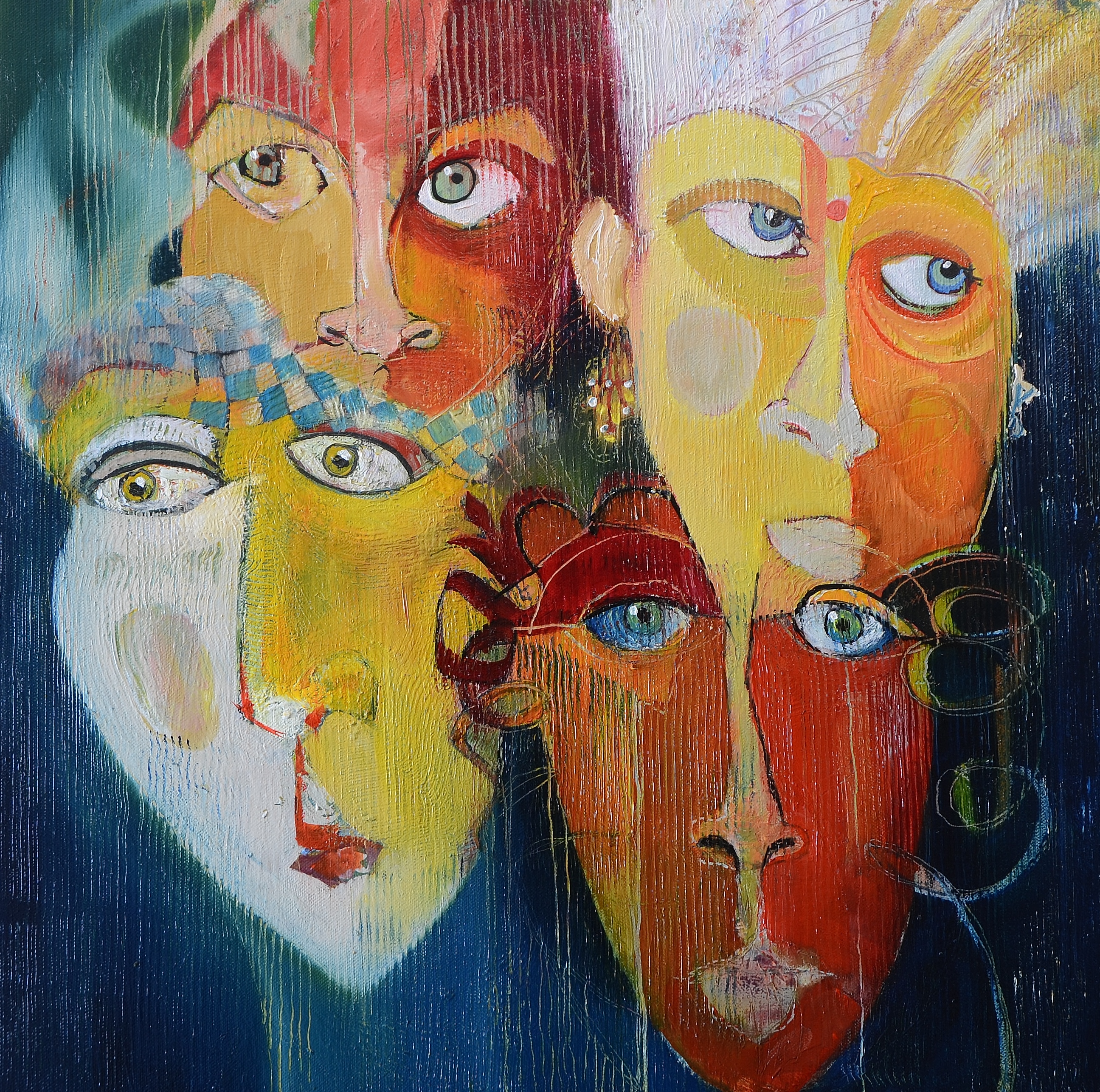
Finally, many thanks to artist Patrick Brown for sharing his most apropos painting, “Sisters,” to launch this week’s issue.

March, interrupted: When plans go South

By Julie M. Friesen


I’m at the center of the world right now, but soon I’ll go far right of center, to Southwest Georgia. My husband has lost a grandmother, and his mother has lost her mother. I need to be there, meaning I can’t be here.

After November 8, a groundswell movement has given me hope. Its extent is not apparent to the public yet, as the media is understandably busy covering the agenda of the new administration and the constant provocations of its leader.

Meanwhile, I’m getting invitations to secret Facebook groups. I’m reading the Indivisible Guide, that teaches those of us inexperienced in civic activism how to hold our members of Congress accountable. I’m watching grassroots-born rallies mushroom all over the country. I’m overhearing an acquaintance at a party casually mention holding resistance meetings in his living room.

As much as I dread January 20, I look forward to the 21st, the day the resistance moves from living rooms and secret groups to the streets of the nation’s capital.

I wanted to be there to make the statement that we will not sit casually by while our rights are infringed—and not just women’s rights, but First Amendment rights, Voting Rights, and Equal Protection rights.

We don’t approve of the discourse, especially that taking place in 140 characters or less. We don’t approve of the advisors or Cabinet nominees. We don’t approve of the proposed legislation. We don’t approve of the bizarre flirtation (and fear the possible collusion) with Vladimir Putin. We don’t approve of the ethics conflicts that are being minimized or outright ignored. We don’t approve of the attacks on the press. Or Muslims. Or immigrants. Or women. Or Black people. Or people with disabilities. Or the LGBTQ community. Or individuals like John Lewis.

We’re here, too.

Instead of marching in D.C., I will be driving past fields dotted with cotton and Trump-Pence signs. After the funeral, I’ll sit with my in-laws who voted for DJT, watching Fox News and biting my tongue raw. But, though I can’t be at the march, it still gives me hope to know that our freedoms of assembly and speech will be vividly on display. This time, I’ll put my voice on the page. Next time, I’ll take it to the street.

We have a voice so long as we exercise our right to use it. And that can be done anywhere, even in Southwest Georgia.


Julie Friesen is a lawyer in Baltimore, Maryland, and a writer in her living room.

Photo credit: Daniel Oines via a Creative Commons license.

America the Beautiful

By Brenda Davis Harsham

Shoulder to shoulder
with people determined
to be heard,
holding up signs
in weary arms,
speaking in tweets
to a man who cannot
turn his back
and ignore millions
around the country
and around the world.
No one can expect
to be heard
if he will not listen.

I hear all of you,
America the Beautiful.
Your voices matter:
We Will Not Be Silent.
Love Trumps Hate.
Insist on the Impossible.
Make America Think Again.
We are ALL Immigrants.
Black Lives Matter.
Don’t Make America Hate Again.
No One is Free If Anyone is Oppressed.
A Woman’s Place is… Wherever She Wants.
Show Up. Dive In. Persevere.
Women’s Rights Are Human Rights.
We’re Lawyers. We’re Ready.
Real Men of Quality Don’t Fear Equality.
Women’s Rights aren’t up for GRABS.
Disability Rights are Civil Rights.
Respect for Existence or Expect Resistance.

Indivisible Under God.
With Liberty and Justice for All.
Healthcare for All.
Words NOT Weapons.
Make Love Not Walls.
Resist Hate.
Roar.
Nasty Women.
Roar.
Never Surrender.


Brenda Davis Harsham marched in Boston. Her poetry and prose have been published in anthologies, online and in journals including Silver Birch Press, NY Literary Magazine’s Awake anthology, the Best of Today’s Little Ditty Anthology, The Writing Garden and The Paperbook Collective. One poem won First Place in NY Literary Magazine’s Poetry Contest. America the Beautiful was previously published on the poet’s website, Friendly Fairy Tales.

Photo credit: Carly Hagins via a Creative Commons license.

Why I marched

By Julie Harthill Clayton

Two Saturdays ago, I stood, marched, cried, chanted and exercised my first amendment right “peaceably to assemble” with a diverse sea of humanity–500,000 or more–for the Women’s March on Washington.

It was one of the most memorable and moving experiences of my life.

Why did I march? Because “women’s rights are human rights.”

And I will vigorously defend the right of every woman—even the ones with whom I disagree—to express their views. This freedom is part of what makes America great.

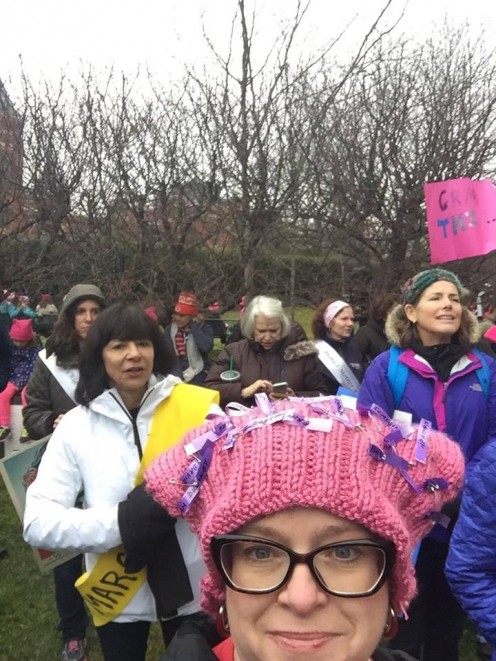
But to dig deeper, why did I get up at 4:15 a.m. to finish adorning the pussy hat that I knit by hand, with purple ribbons representing men and women who couldn’t march with me?

Because I am a bisexual white woman. In a relationship with a man.

The color of my skin, my ability to pass as straight, affords me privileges that many of my LGBTQIA friends and family don’t have.

I own my privilege.

I choose not to hide behind it.

I am a loud, proud bisexual who refuses to pass.

A well-meaning acquaintance suggested that I just lay low for the next four years. Respectfully, I say “No.” That dishonors those who can’t pass, it dishonors my own long personal struggle with my sexuality and identity, it dishonors my fellow bisexuals who are afraid that the “B” in LGBTQIA will be silent.

The “B” must not be silent. We matter, too.

And so I marched. For all the LGBTQIAs. Because we deserve a world in which we don’t have to hide.

I marched for my kick-ass, superhero U.S. Army veteran fiancé. For the women who have shaped him into the feminist he is today.

I marched for those whose causes I agree with.

And for those with whom I disagree. “Whatever each individual woman is facing—only she knows her biggest challenge,” says Gloria Steinem.

I marched for the women who didn’t support the march. There are centuries of women who fought, suffered, and sacrificed so that today all women might feel empowered, respected, and treated as first-class citizens.

I marched for the male children I birthed and raised to be thoughtful, kind and compassionate. And to express their views and make their voices heard. I love them with all my heart, though our worldviews sometimes clash. I know that the women who brought them into being—my mother’s mother and her mother—are woven into their fabric.

I marched for the right for others to call me a “snowflake.” A “feathery ice crystal, displaying sixfold symmetry.” A snowflake is a thing of beauty. Fragile? Yes, at times. But each blizzard starts with a single snowflake.

I marched because I wouldn’t have missed it for the world.

“Why I Marched” was previously published by GayRVA.


Julie Harthill Clayton is an out and proud bisexual with a passion for reading, writing and not arithmetic. Her work has appeared in the Christian Science Monitor, the Internet Review of Books, Curve Magazine, Lambda Literary and more. She is working on her first novel, Two Tickets to Freedom, a semi-autobiographical queer coming-of-age tale. A paralegal by day, Julie spends her free time knitting, writing, and reading anything she can get her hands on. She lives in Richmond with her partner, local artist David Turner, and their mischievous and loving hunting dog, Max.

Photo credit: Julie Harthill Clayton

Why we march

By Rachel Federman


We march because we want to send a message to refugees, to Muslims, to members of the LGBTQ and African American communities, to recent immigrants and to all women, but especially young girls. The message is this: We stand with them and we will fight alongside them.

Because we believe in science.

Because we believe in public education.

Because we want to leave an inhabitable planet for our children.

Because we will not go back on marriage equality.

Because we have not given up on democracy.

Because we will not allow you to sell our national parks to make condos and drill for oil.

Because Black Lives Matter. Period.

Because we believe in freedom of speech and the First Amendment and will not tolerate a president—or anybody—attacking those basic American rights.

Because we will not stand idly by while you take away health care from millions of Americans.

Because we know we as a society have not yet made good on the promise contained in Reverend Martin Luther King Jr.’s dream.

Because we still have that dream.

Because we have a right to peaceful assembly.

Because we know diversity makes us stronger.

Because we know all of us, except our Native American sisters and brothers, are immigrants. Some came here by choice and others were forced against their will, and we will not forget that history.

Because we will fight your pipelines that contaminate water, destroy sacred property, and continue the reliance on fossil fuels that scientists agree is heating up the earth.

Because Russia is not our ally and the clear Russian interference in our electoral process is—at the very least—a threat to all that we hold dear.

Because even the youngest among us knows it is wrong to mock people’s disabilities and even the youngest among us knows that if you see someone doing it, you stand up and tell them it is wrong.

Because we are not afraid of bullies.

Because the “alt-right” is not adequate to describe a global White Supremacist, White Nationalist movement and we will not be complicit with its normalization.

BECAUSE YOU HAVE TO ASK US WHY WE ARE MARCHING.

Because the problem is not voter fraud, but voter suppression.

Because we are on to your gerrymandering ways.

Because we will not go about our daily lives like this fascist kleptocracy is normal.

Because this is #NotNormal.

Because you were endorsed by the KKK and Neo-Nazis cheered when you won.

Because we are patriots who love our country.

Because you are the manifestation of everything we are teaching our children not to be. You are mean. You are petty. You are a bully. You’re greedy. You lie. If we did not stand up and let ourselves be counted, as strongly opposed to everything you are and everything you represent, we would be failing at our most basic task as caretakers.

Because we are stronger than you and we want to give you a little heads up.

Because we will #Resist your fascist agenda as long as we have breath in our bodies.

Because, whether we are Muslims, Christians, Jews, Buddhists, Hindus or members of any other faith, or members of what you might call the faithless, we believe in the commandment to “Love your neighbor as yourself.”

Because we believe the Bible when it tells us, “He that hath two coats, let him impart to him that has none” and “Do not neglect to do good and share what you have” and “It is more blessed to give than it is to receive.”

Because we are not content with despair and don’t have time to waste engaging in any more battles about whether we had the right candidate (we did).

Because we do not agree on all issues, but we know that the right to life extends to a child with cancer to receive the treatment he or she needs to have the best chance at life. The right to life extends to toddlers whose parents leave loaded guns within reach. The right to life extends to the people of Flint, Michigan to have access to clean water. The right to life extends to people across the globe who risk malaria due to rising temperatures, while you threaten to defect from the Paris Climate Agreement.

Because we know it is a moral stain on our collective conscience that 40 million Americans live in food insecure households while the top 1% control more wealth than the bottom 95% and yet you propose to cut taxes again for that top 1%.

Because we know Obama was right in Grant Park on November 4, 2008 when he said, “Change has come to America,” and just because the white, male Aristocracy did not accept that change doesn’t mean it’s not happening.

Because. It. Is. Happening.

Because you just pissed off the wrong 3.52 billion nasty women. And the billions of non-Women who have our backs, and won’t grab us by the anything.


I’m a writer-mom and social justice advocate trying to live a simple, mindful life and mindful of how often I fail. I used to play in a band called Dimestore Scenario and now I write books like Writer’s Boot Camp: 30-day crash course to total writing fitness (HarperCollinsUK, 2017) and I work with nonprofits mainly in the field of minority education. I have a Master of Arts in English from Fordham University and blog about my efforts to live a country life in the city at Last American Childhood.

Alternate Facts by Tim O’Brien

Alternative Facts


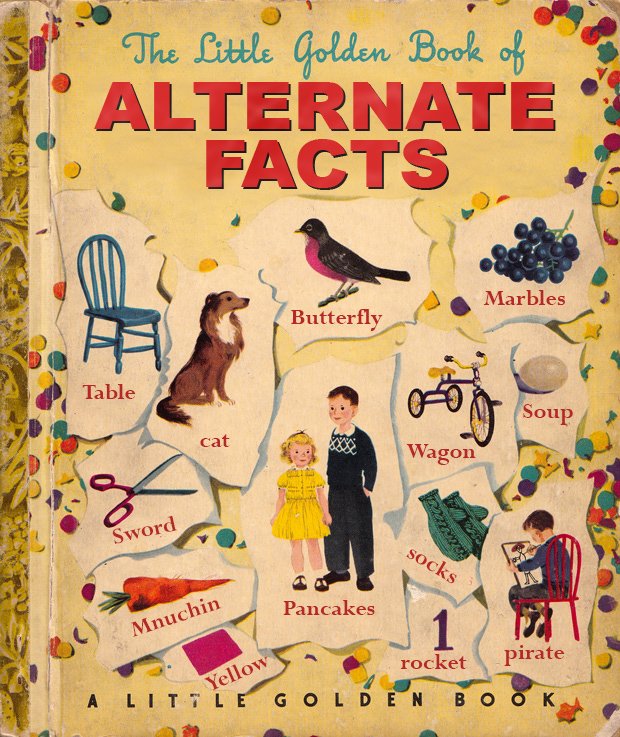
“The Little Golden Book of Alternate Facts” by Tim O’Brien builds upon the classic Little Golden Books to create a satyrical response to Counselor to the President Kellyanne Conway’s euphemism “alternative facts.” She spoke the term on Meet the Press, Sunday 22 January 2017, when referencing false statements made by new White House Press Secretary Sean Spicer about the size of the inauguration audience. Sales of George Orwell’s 1984 have since surged.


Tim O’Brien is an illustrator and portrait painter whose intricately detailed and imaginative illustrations have been published most notably in TIME Magazine as well as Der Spiegel, Smithsonian Magazine, GQ, Rolling Stone, Nautilus Magazine, Newsweek, TV Guide, The Atlantic Monthly, Business Week, Entertainment Weekly, Esquire, PlanSponsor, National Geographic, Playboy, New York Magazine, The New York Times, Reader’s Digest, Avon Books, Dial, Harper Collins, Penguin, Times Books, Scholastic, Simon & Schuster, TOR, Viking, Warner, and many others. Tim has designed several US postage stamps, and he has received multiple awards and recognitions from the Society of Illustrators in New York and Los Angeles, Graphis, Print, Communication Arts Magazine, the Society of Publication Designers, American Illustration, and the Art Directors Club. Tim has over a dozen paintings in the collection of the National Gallery, Washington, DC., and is a winner of the prestigious Hamilton King Award from the Society of Illustrators. To see more of his work, visit his website.

Funhouse

By Dick Eiden

A pity such a sparkling world
fell into our clumsy hands, soiled
with petroleum and blood, slippery
as a swindler leaving town at night
past rows of homes for sale, scrawny
trees tied to stakes on the boulevard.

A pity our shoes were untied, our feet
not planted, we didn’t look up in time.
As the power grid blinks and sputters
we wait in long lines, owe money
to bail bondsman, can’t afford sandbags
for the rising of extreme consequences
murky and corrosive, lapping at our feet.

A pity we now stand before a full-length mirror
curved like the Funhouse, eyeing our big heads,
the flowing lines of our long, twisted bodies,
the crooked path behind us.


Dick Eiden is a retired lawyer and lifelong activist for peace and social justice. He came of age in the sixties, tried to make the world a better place, failed. He has three grown children (one grandchild) with wife Kathleen Cannon. He’s writing a memoir about his life as a lawyer for rebels titled Go Into Banking Instead.

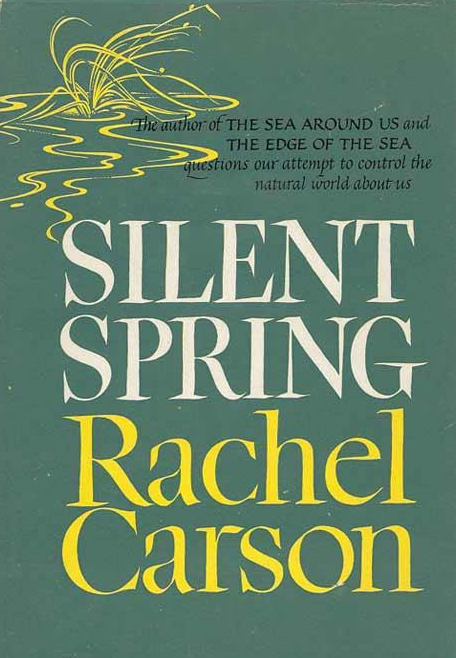
Reading recommendation: Silent Spring by Rachel Carson.


Bedtime Stories from Donald Trump

By Deanne Stillman


“Who has read The Art of the Deal in this room?” Donald Trump last year at a Liberty University rally. “Everybody. I always say, a deep, deep second to The Bible.”

Long before Trump requested a show of hands, there was someone who proclaimed her admiration for the book in an online forum. This was Laurel Harper, the mother of the Oregon school shooter, the man who shot and killed nine people last October at Umpqua Community College. She had read it to her son, she said, before he was born, as the New York Times reported shortly after the incident last year. “Now my son invests in the stock market along with me,” she said. “[He] turns a profit and is working on a degree in finance. His language and reading skills are phenomenal. I tell you this because it’s not too late for you to start helping your daughter.”

A nurse by profession, Laurel Harper was responding to a parent who had asked for advice about her autistic child. Her own son, Christopher Harper-Mercer, had Asperger’s syndrome and was apparently autistic as well, although Ms. Harper couldn’t have known that while he was in utero; she was talking about the importance of what one reads to unborn children and how that can help them later, as she came to realize, even if they have certain conditions. She didn’t mention other books that she had read aloud at the time; obviously it was something she wanted to pass on in a public conversation board.

For a number of days after the shooting, I couldn’t shake what I had read in the Times. I had heard much about The Art of the Deal from people I’ve written about over the years, many down on their luck, or just plain down for the count—just like their mothers and fathers before them, and the ancient ones who preceded their mothers and fathers on their particular circuit. They were looking for a way in, hoping to hit the jackpot, having been locked out of the American dream long ago. They figured that buying and selling real estate could give them a toehold, and they would say so as they sucked long and hard on their Marlboros, and once that was in motion, it wouldn’t be long before they were making deals with the big guys and even drinking the good stuff, instead of the Jack-and-Cokes they scraped up the coin to pay for during happy hour at the Cactus Lounge. “And then you can come and visit me,” they would say, “but you’ll have to be buzzed in at the gates!” You see, they wanted to live where they weren’t wanted, and they would laugh hard at the statement, knowing that behind it, such a fate was not in their cards, and really, the joke was on them.

Recently, I borrowed The Art of the Deal from the library. I wanted to take another look at the book that some now cite as the blueprint for Donald Trump’s campaign—and which, as was just revealed, has caused remorse for the ghost writer, who came up with the title and much of the framing of Trump’s life. What was in the bestseller, I wondered, that an expectant mother might want to pass on to the next generation? In the book’s own language, Laurel Harper was urging her son to dream a banal world of winners and losers, of striving and acquiring things, of air rights, valuable holdings, and letters of intent. Yet behind that language, she was urging him to make something of himself, hoping, as in a fairy tale—for this is indeed a modern one, stripped of gentility and beauty—that some day, he become a king. As I explored the book, I noted certain passages which might be inspirational for a future investor, and I also started to wonder about the conditions in which Ms. Harper might have read aloud. Was she sitting in a comfortable and favorite armchair, under an oft-used reading light? Did she read to him or actually to herself out loud and therefore her son at the same time, in bed as she drifted off to sleep? Did she read to him on breaks at work, or perhaps during a walk in the park? Here is the scenario I imagined. …

“In college,” she begins, quoting the fellow who flips hotels and once owned a beauty pageant, “while my friends were reading the comics and the sports pages of newspapers, I was reading the listings of FHA foreclosures. … I don’t do it for the money. I’ve got enough, much more than I’ll ever need. I do it to do it. Deals are my art form,” she continues as she pages through the book, perhaps giving this a flourish. “Other people paint beautifully on canvas or write wonderful poetry. I like making deals, preferably big deals. That’s how I get my kicks. … No matter whom you’ve met over the years,” she adds, whispering possibly or invoking a soothing voice as the unborn boy floated in the primordial tides, “there is something incredible about sitting down to dinner with the cardinal and a half dozen of his top bishops and priests in a private dining room at St. Patrick’s Cathedral. … [The cardinal] is not only a man of great warmth, he’s also a businessman with great political instincts. … Even in elementary school, I was a very assertive, aggressive kid. In the second grade I actually gave a teacher a black eye—I punched my music teacher because I didn’t think he knew anything about music and I almost got expelled. I’m not proud of that, but it’s clear evidence that even early on I had a tendency to stand up and make my opinions known in a very forceful way. The difference now is that I like to use my brain instead of my fists.” Perhaps she pauses here or stops for the evening, and then picks it up another time, in another place: “I finally found a plane,” she says, maybe with a bit of drama, for indeed, it seems to have been a big moment in Trump’s life. “I happened to be reading an article in Business Week, in the spring of 1987, about a troubled, Texas-based company name Diamond Shamrock. The article described how top Shamrock executives were enjoying incredible perks, actually living like kings. Among the examples cited was a lavishly equipped company-owned 727, which executives flew around in at will.” Flew around in at will, my little one, wouldn’t you like to do that? “There are people—I categorize them as life’s losers—who get their sense of accomplishment and achievement from trying to stop others. As far as I’m concerned, if they had any real ability they wouldn’t be fighting me, they’d be doing something constructive themselves.” Now here comes a really good part, I hope you’re paying attention! “I’m not looking to be a bad guy when it isn’t absolutely necessary. … It just goes to show that it pays to move quickly and decisively when the time is right. …” And here’s the best line of all, if you get anything out of this book, young man, I hope this is it. “I’m keeping my options open,” she reads and then she might have said goodnight and sweet dreams to her unborn son, for that is the way of mothers, and then possibly she blew out a candle.

•     •     •

The primordial stew furnishes us with the building blocks of life. This includes not just vitamins and minerals, but, as research shows, things of a more esoteric nature, such as music and art and literature—sounds and vibrations and words that are imprinted onto a seed and from which that seed goes forth and grows and tries to find his or her way in a world filled with obstacles that are seen or felt in the bones. When I first learned about Laurel Harper reading Donald Trump to her son before he was born, I asked some friends about the books or music that they conveyed to their children while in the womb. Several mentioned nursery rhymes, including those that were cautionary tales; writer Samantha Dunn and musician Jimmy Camp spoke of Bob Marley and the song “Three Little Birds,” which their son, now seven, still loves; John Densmore—the drummer in the Doors—sang “When Irish Eyes Are Smiling” to his unborn child, and others played Beatles songs (“My son is now studying music in Liverpool,” photographer Elissa Kline told me).

I know all about the false hope that The Art of the Deal has conveyed to those who have nothing to lose so why not get into real estate? I’ve seen them take one last gamble on some land-buying scam and I’ve seen what happens when it falls apart and they are back at the Cactus Lounge during so-called happy hour. Mostly, they are destroying themselves, perhaps still harboring fantasies of living behind a gate, in a house that they own, free and clear, but knowing in their heart of hearts that such a thing is beyond their reach and the game is over. So they light up another Marlboro and order another Jack-and-Coke; as the old saying goes, the rich get richer and the poor get drunk.

What happens to someone when he soaks up the idea that the world is comprised of winners and losers before he is even born? That losers are people who stand in his way? What happens when this imprinting is later loaded with guns (trips to the shooting range with his mother) and the prospect of fame (numerous shooters who preceded him) along with Asperger’s syndrome, a parade of personal failures and myriad misread cues? After he was born, Christopher Harper-Mercer did indeed follow the urgings of his mother, for she boasted of her son making hay with investments—behold! a king!—and then, somehow, over time it seems, this path could no longer keep him and nor could the many forks he traveled and one day, he went to school and decided to cash in his chips. “I’m a good boy,” he may have thought. “I am moving quickly and decisively when the time is right. I have kept my options open.”


Originally published by LitHub as “The Art of Dividing the World into Winners and Losers.”


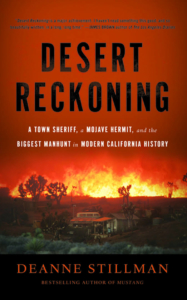
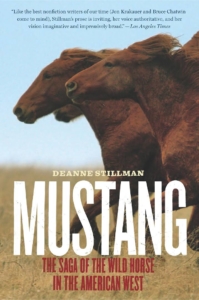
Deanne Stillman is a widely published, critically acclaimed writer, and her plays have won prizes in various festivals.  Her books include Desert Reckoning, based on a Rolling Stone piece, winner of the Spur and LA Press Club Awards, an amazon editors’ pick, recipient of rave reviews in Newsweek, the Denver Post, LA Review of Books and elsewhere; Twentynine Palms, an LA Times “best book of the year” that Hunter Thompson called “A strange and brilliant story by an important American writer”; and Mustang, an LA Times “best book of the year,” praised from The Atlantic to The Economist, and recently released in an audio edition with Anjelica Huston, Frances Fisher, Wendie Malick, John Densmore (the drummer in the Doors), and Richard Portnow. In addition, Deanne’s work has appeared in Angels Flight Literary West, Rumpus, Salon, the New York Times, LA Times, Tin House, Orion, Slate and other publications. She also writes the “Letter from the West” column for the Los Angeles Review of Books. She’s a member of the core faculty at the UC Riverside-Low Residency MFA Creative Writing Program and a winner of an Amtrak Writers Residency. For more information, visit her website.

Reading recommendation: Trump: The Art of the Deal by Donald J. Trump and Tony Schwartz.

Or the horror and read Deanne’s books, instead.

Desert Reckoning

Mustang


Digital Dust

By Pattie Palmer-Baker

The agent sifts digital dust,
not like stardust sprinkled
on profound black,
instead gray-brown specks
leaking out of ATM machines,
trickling from laptops,
dribbling out of phones.

He shapes the particles
into a digital fingerprint,
blots out truth messy with color,
paints the grooves black and white.

When the wind blows
through a Sitka Spruce,
he hears the whisper As-salam alaykum.
He whips the gun
from the back of his waistband
and shoots the words.
He doesn’t know they mean
peace be upon you.


Pattie Palmer-Baker is a Portland, Oregon artist and poet. Over the years of exhibiting her artwork—a combination of paste paper collages with her poems in calligraphic form—she discovered that most people, despite what they may believe, do like poetry; in fact many liked the poems better than the visual art. She now concentrates on writing, both poetry and personal essays. Visit her website.

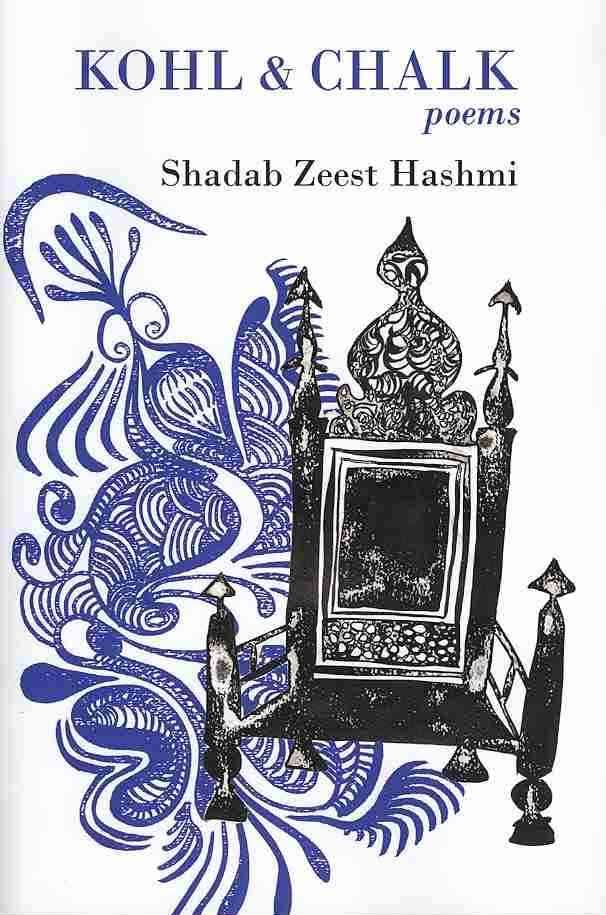
Reading recommendation: Kohl & Chalk: poems by Shadab Zeest Hashmi

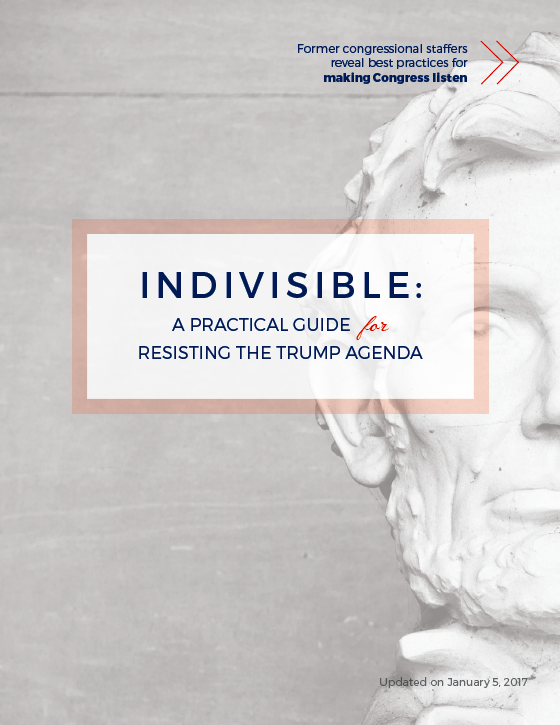
INDIVISIBLE: A Practical Guide for Resisting the Trump Agenda

A note from Writers Resist about The Indivisible Guide:

Donald Trump’s election has motivated a lot of people in a lot of ways, revealing their smarts, their generosity and their passion for making the United States a safe and nurturing home for all people. One of the more pragmatic responses is Indivisible: A Practical Guide for Resisting the Trump Agenda. The guide is cool, not only because it’s free and fabulous, but because the Indivisible team that put it together is a group of seasoned former congressional staffers who know exactly how to get our representatives’ attention. They tell you, in simple terms, the tricks of the advocacy trade.

They’ve also started an online directory of grassroots groups that are using the guide, the Indivisible Local Group Directory. According the the Indivisible team, “[y]ou can now search our directory and find people who are committed to standing with you in this fight. If you don’t find a group in your area, start one yourself! People will join you—there are Indivisible readers in every congressional district in the country.”

We strongly recommend the guide for people ready to conduct advocacy at the local level. If you’re one of them, read on—you’ll be able to download the guide below, thanks to the team’s generosity.

A Note from the Indivisible Team

Since this guide went live as a Google Doc, we’ve received an overwhelming flood of messages from people all over the country working to resist the Trump agenda. We’re thrilled and humbled by the energy and passion of this growing movement. We’ll be updating the guide based on your feedback and making it interactive ASAP. You can sign up for updates at www.IndivisibleGuide.com.

Every single person who worked on this guide and website is a volunteer. We’re doing this in our free time without coordination or support from our employers. Our only goal is to help the real leaders on the ground who are resisting Trump’s agenda on their home turf. We hope you will take this document and use it however you see fit.

We want to hear your stories, questions, comments, edits, etc., so please feel free to ping some of us on Twitter: @IndivisibleTeam@ezralevin, @angelrafpadilla, @texpat, @Leahgreenb. Or email IndivisibleAgainstTrump@gmail.com.

And please, please, please spread the word! Only folks who know this exists will use it.

Good luck—we will win.

Download the Indivisible Guide in PDF here or visit the Indivisible website for other options.


Kindred, a poem by Dave Parsons

Blindness will only make him see better. Broken bones will sharpen his wit.

–Karl Shapiro

On 9-11, we were 1st stunned into numb dazes—I remember the same—in the early sixties and there are the many other days … personal to each of us … that stick like bad cooking to our dead-pan minds, they are the memories that scurry about like ants kicked from the order of their hilly homes. I remember the day that Larry Williams’s photo appeared in the Austin Statesman obituaries with the same confident expression I had seen countless times caged under a baseball Catcher’s mask. There he was—set jaw—Green Beret announcing to his known world that he was finished with games, with this life and his name would become the source of rubbings on a long black wall in Washington. Larry had witnessed the same numbness in the dazed moiré moon faces of a kindred people trapped in their country’s anguish while an Army clerk in Saigon and at his homecoming party, he said to me in a whisper, like a prayer, he had to go back, and this time, he had to be in the thick of it … he must be part of an answer, action, not awe—Whitman’s body electric, to Hell with the angst, the numbness … embrace the pain … fire the spirit—eyes wide open to it all—the same wide and kindred eyes that sent Alison, William, Sandra, Jeffery with a throng of students to the Kent State quad in 1970—demonstrating their outrage over their country, the very home that had seeded them with knowledge and the pride of being raised in a land of gallant freedom fighters, a peopled history of grand idealism that somehow had mutated: it was as if there had been a stock take over—war became a corporate boardroom game; where, moves to erase thousands players was taken in the cool air conditioned minds of executives and politicians thousands of miles from the heat and stench of the jungle factory, changing from a war of rescue to a daily body count. So the students did what they could and the pointing of their single fingers were no match for the rifles; but here’s another legacy for us, the pointed single finger even in its fall, still fired the flame that is the inherent instinct burning like a star in the craw of this nation, where ever we single souls abide, we are steeped in the parables found in our many sacred stories; our monumental buildings may fall to the warped logic of our enemies; and this cornucopia of a planet we so treasure, may turn on us, like some old jaded lover, bringing on us all matter of apocalyptic weathering pain rivaling Old Testament curses —We the People—do not sit long sanguine on the comfort of our couches before the gnashing media poor-sayers or dig head-holes of rationale to bury our worst fears in—We the People—are on the march, on the move from our every beach, plain, forest, hill, or cove, on the phone with our support, in the mail with our personal treasures, we are on the many roads and byways with our pyrotechnic presences, in the hot stink of it with our time and boundless talents—brilliant spirits burning white hot— igniting truth deep in our brethren’s breast—We the People—are truly omnipotent—


Dave Parsons, 2011 Texas State Poet Laureate, is a recipient of an NEH Dante Fellowship to SUNY, the French-American Legation Poetry Prize, the Baskerville Publisher’s Prize (TCU). He was inducted into The Texas Institute of Letters in 2009. Parsons has published seven poetry collections. His latest are Reaching For Longer Water (2015) and Far Out Poems of the ’60s (2016), co-edited with Wendy Barker. He has taught Creative Writing at Lone Star College since 1992. Parsons has four grown children and lives with wife Nancy, an award winning artist and graphic designer in Conroe, Texas. The title and many lines of this poem were taken from a poem that first appeared in his collection, Color of Mourning (Texas Review Press/Texas A&M University Press Consortium, 2007), edited for the Writers Resist movement.

Visit his website at www.daveparsonspoetry.com.

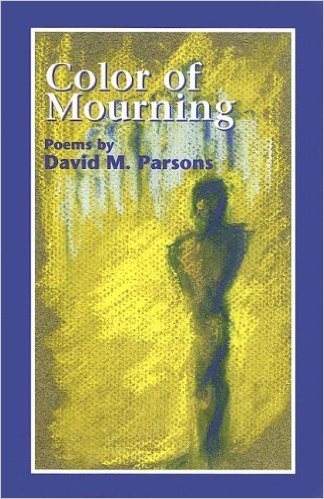
Reading recommendation: Color of Mourning by Dave Parsons

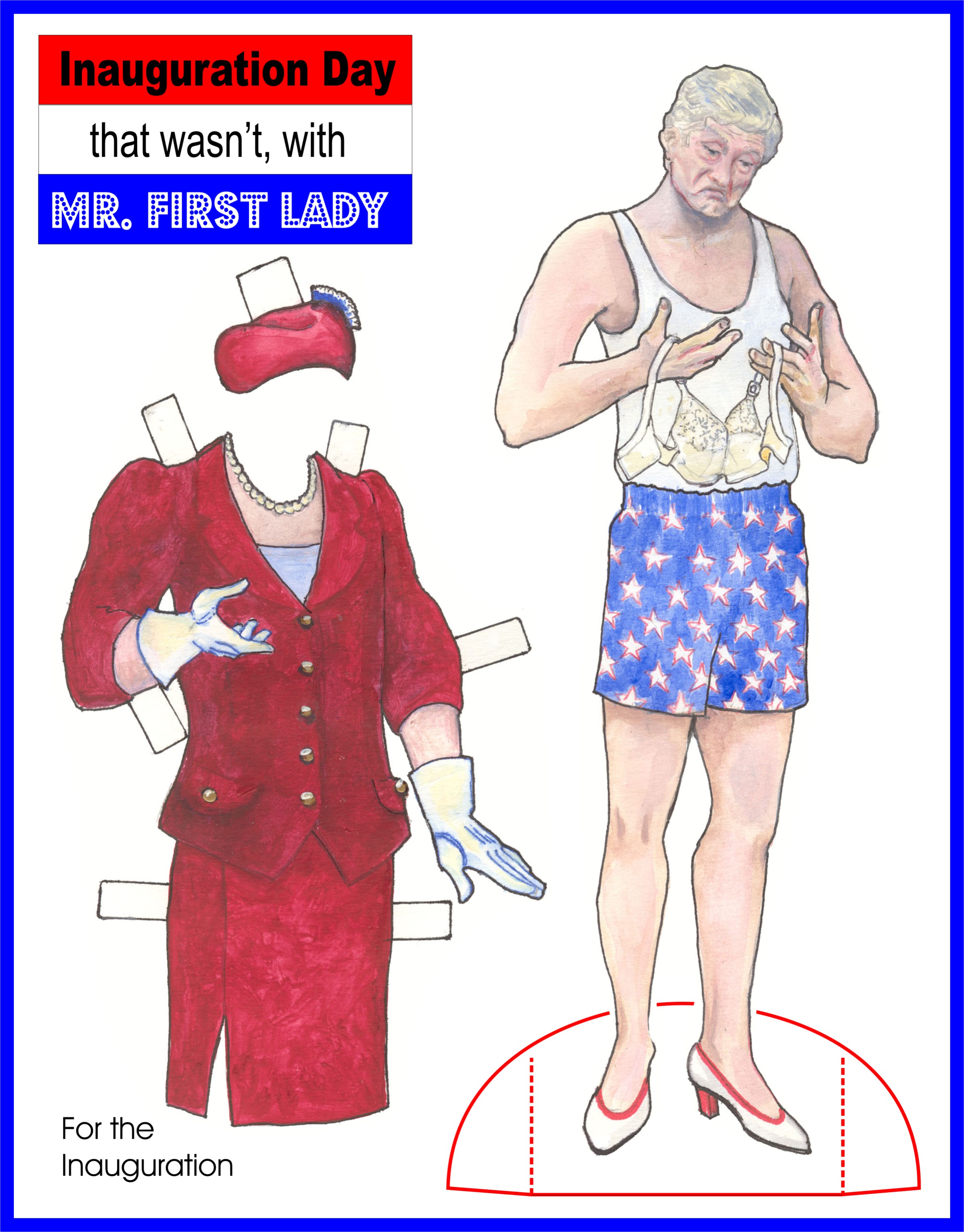
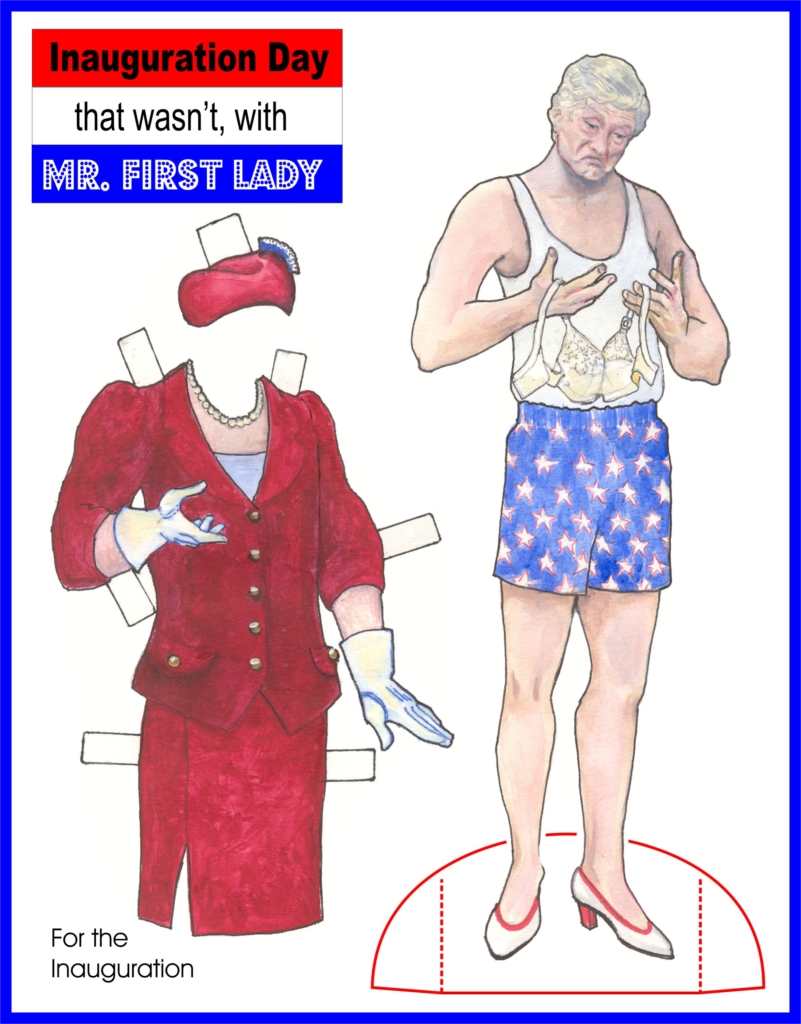
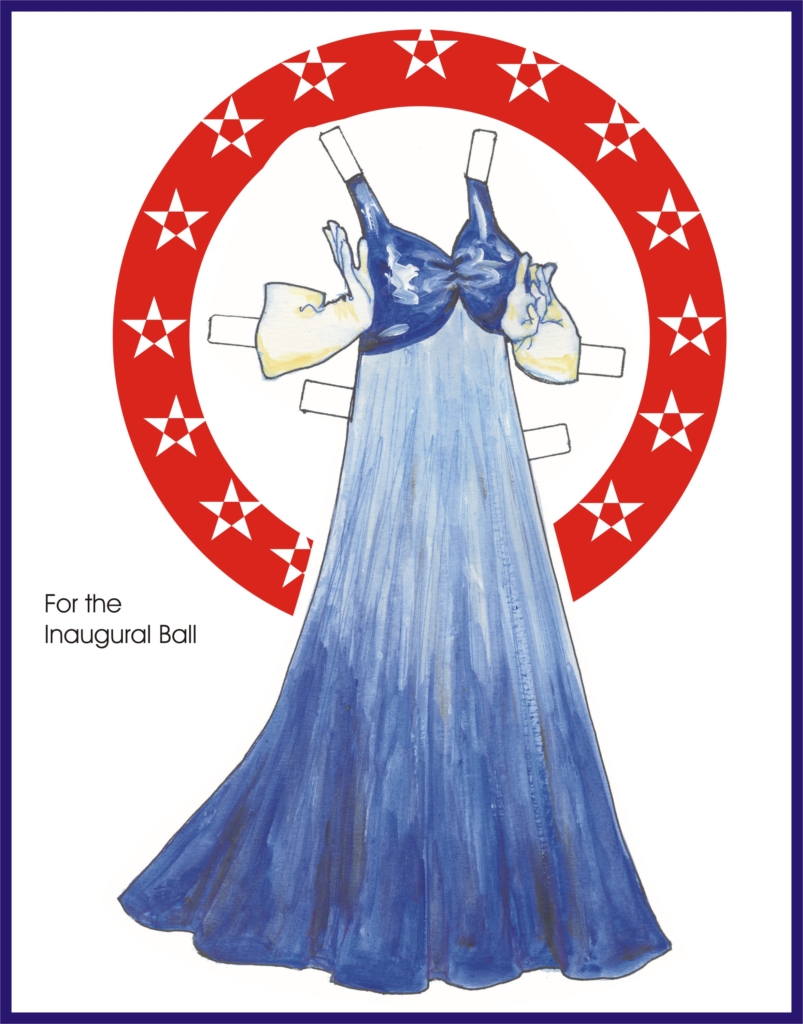
The Inauguration Day that Wasn’t with Mr. First Lady

By Pepper Hume

Inauguration Day fashions

Inauguration Day fashions


Pepper Hume is a refugee from professional theatre design in scenery and costumes. After working all over the country, including years in both Chicago and New York, she retired to her hometown of Bartlesville, Oklahoma. She has a novel and several short stories under her belt—some published—and is working on a reference book on 20th century clothing for writers. In addition to writing, she makes one-of-a-kind art dolls and has designed several published book covers.

Resiste / Resist, a poem and translation by Mariana Llanos

[fusion_builder_container hundred_percent=”no” equal_height_columns=”no” hide_on_mobile=”small-visibility,medium-visibility,large-visibility” background_position=”center center” background_repeat=”no-repeat” fade=”no” background_parallax=”none” enable_mobile=”no” parallax_speed=”0.3″ video_aspect_ratio=”16:9″ video_loop=”yes” video_mute=”yes” overlay_opacity=”0.5″ border_style=”solid” padding_top=”20px” padding_bottom=”20px” admin_toggled=”no”][fusion_builder_row][fusion_builder_column type=”1_2″ layout=”1_2″ spacing=”” center_content=”no” hover_type=”none” link=”” min_height=”” hide_on_mobile=”small-visibility,medium-visibility,large-visibility” class=”” id=”” background_color=”” background_image=”” background_position=”left top” background_repeat=”no-repeat” border_size=”0″ border_color=”” border_style=”solid” border_position=”all” padding=”” dimension_margin=”” animation_type=”” animation_direction=”left” animation_speed=”0.3″ animation_offset=”” last=”no”][fusion_title hide_on_mobile=”small-visibility,medium-visibility,large-visibility” size=”1″ content_align=”left” style_type=”default”]

Resiste

[/fusion_title][fusion_text]

Resiste, hermana, resiste.
Levanta el puño y resiste.
Resiste, hermana, resiste.
Sube la voz y resiste.
Resiste, hermana, resiste.
Eleva la frente y resiste.
Resiste, hermana, resiste.
Hincha el pecho y resiste.
Resiste, hermana, resiste.
Planta los pies y resiste.
Resiste hermana, resiste.
Entrelaza los brazos y resiste.
Resiste, hermana, resiste
Avanza tu cuerpo y resiste.
Resiste, hermana, resiste.
Con puño, con voz, con frente, con pecho,
Con brazos, con pies, con todo tu cuerpo,
resiste.
Resiste hermana, resiste,
Aunque corra tu sangre
Aunque tiemblen tus huesos
Aunque sangre tu alma.
¡Resiste!
Hasta tu último aliento
Hasta tu último paso
Hasta tu último beso.
Hasta que tu sudor se mezcle en el agua.
Hasta que tu puño brille en el cielo.
Hasta que tu grito se oiga en el viento.
Resiste, hermana, ¡resiste!

[/fusion_text][/fusion_builder_column][fusion_builder_column type=”1_2″ layout=”1_2″ spacing=”” center_content=”no” hover_type=”none” link=”” min_height=”” hide_on_mobile=”small-visibility,medium-visibility,large-visibility” class=”” id=”” background_color=”” background_image=”” background_position=”left top” background_repeat=”no-repeat” border_size=”0″ border_color=”” border_style=”solid” border_position=”all” padding=”” dimension_margin=”” animation_type=”” animation_direction=”left” animation_speed=”0.3″ animation_offset=”” last=”no”][fusion_title hide_on_mobile=”small-visibility,medium-visibility,large-visibility” size=”1″ content_align=”left” style_type=”default”]

Resist

[/fusion_title][fusion_text]

Resist, sister, resist.
Thrust your fist in the air and resist.
Resist, sister, resist.
Raise your voice and resist.
Resist, sister, resist.
Lift your forehead and resist.
Resist, sister, resist.
Bloat your chest and resist.
Resist, sister, resist.
Stomp your feet and resist.
Resist, sister, resist.
Intertwine your arms and resist.
Resist, sister, resist.
Push forward your body and resist.
Resist, sister, resist
With fist, with voice, with forehead, with chest,
with feet, with arms, with all your body,
resist.
Resist, sister, resist.
Even if your blood runs,
Even if your bones tremble,
Even if your soul bleeds.
¡Resist!
Till your last breath,
Till your last step,
Till your last kiss.
Until your sweat blends with the water,
Until your fist shines in the sky,
Until your scream is heard in the wind.
Resist, sister, ¡Resist!

[/fusion_text][/fusion_builder_column][/fusion_builder_row][/fusion_builder_container][fusion_builder_container hundred_percent=”no” equal_height_columns=”no” hide_on_mobile=”small-visibility,medium-visibility,large-visibility” background_position=”center center” background_repeat=”no-repeat” fade=”no” background_parallax=”none” enable_mobile=”no” parallax_speed=”0.3″ video_aspect_ratio=”16:9″ video_loop=”yes” video_mute=”yes” overlay_opacity=”0.5″ border_style=”solid” padding_top=”20px” padding_bottom=”20px”][fusion_builder_row][fusion_builder_column type=”1_1″ layout=”1_1″ spacing=”” center_content=”no” hover_type=”none” link=”” min_height=”” hide_on_mobile=”small-visibility,medium-visibility,large-visibility” class=”” id=”” background_color=”” background_image=”” background_position=”left top” background_repeat=”no-repeat” border_size=”0″ border_color=”” border_style=”solid” border_position=”all” padding=”” dimension_margin=”” animation_type=”” animation_direction=”left” animation_speed=”0.3″ animation_offset=”” last=”no”][fusion_text]


Mariana Llanos is a Peruvian writer, author of seven award-winning children’s books in English and in Spanish. Her first book, Tristan Wolf, was published in 2013. Her newest book, Poesía Alada (poetry in Spanish for young people) will be available in April 2017. She studied Drama in her native Lima. After moving to Oklahoma, she worked as a preschool teacher, standing out for her creativity and passion for arts education. Mariana visits schools around the world through virtual technology to encourage students to read and to spark their love for writing, while building bridges of understanding. Visit her website at www.marianallanos.com.

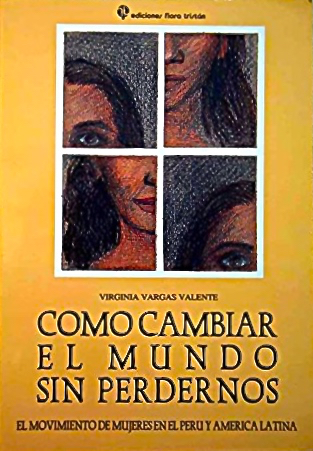
Reading recommendation: Como Cambiar el Mundo Sin Perdernos /How to Change the World Without Losing Ourselves by Virginia Vargas (1992).

[/fusion_text][/fusion_builder_column][/fusion_builder_row][/fusion_builder_container]

Rae Rose Cancels an Appointment

By Rae Rose


Artist’s statement

I am as inconsistent as my sleep.

For people with bipolar disorder, sleep is often an ongoing battle, a ludicrous arrangement, a total crapshoot, and sometimes, ridiculous. More often, I’m crying. More often, I’m ashamed. Some days, I’m a total badass. Some days, I fee like I can’t show up to life.

Simple things become impossible. A lack of sleep affects our ability to work, which affects our ability to obtain health care, which affects our sleep …

Those living with disabilities, as well as friends of disabled people, neighbors/one night stands/Facebook pals/partiers/grocery clerks/loved ones/etc., should be wary of the changing of the guards.

We have to show up for each other.


Rae Rose’s most recent work appears in Jennifer Bartlett’s Hineni Magazine. She is Writers Resist’s poetry editor. You can visit her website at Yours Truly, Rae Rose.

Music is by Eliza Rickman.

On the Front Lines

Fiction by Kit-Bacon Gressitt

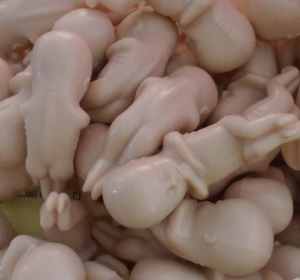
You look in the bedroom mirror, small enough to deny self-adoration, and pull your brownish hair into a ponytail. Tight, like Mother used to do it. You turn to the bed. Your clothes are laid out on sheets held in place by perfect hospital corners. You dress in practical layers, to accommodate the variable temperatures of the daylong vigil you perform every Thursday. First, your underthings, then flesh-tone tights and a plain white t-shirt. Next, the pleated blouse Mother used to wear, when you held the vigils together, and ski pants, a modest one size too large. Finally, a nice worsted wool skirt you found at Goodwill for a dollar. It’s a bit matronly, but you top it off with your 12-week ultrasound hoodie.

You strap on your choose-life fanny pack, loaded with crisis pregnancy tracts and embryo dolls; take the bigger-than-life-size fetus parts poster in one hand and your calico-covered Bible in the other; and you march to the local abortion mill. Battle ready. Here profit motive thrives under Satan’s leering eyes and abortions are marketed to the vulnerable—to provide lucrative embryos for ungodly research. You believe this with all your heart because that’s what the tracts tell you.

You bungee-cord the poster to a tree and take your position between the clinic entrance and the parking lot. You’re armed with the assurance that you’re doing God’s righteous work, as Mother taught you, witnessing for life, sidewalk counseling would-be abortion victims, guiding them away from mortal sin, toward salvation. You adjust the bunched-up layers around your waist while you await the poor misguided mothers, bearing their precious preborns to slaughter. You know they will come, as they do every week, in numbers that torment your heart with the horrid image of God’s beloved innocents torn asunder by evil and torturous tools in the hands of Death’s doctors. But you are stalwart, determined to rescue a life from the great abyss of immoral destruction.
The clinic opens, the women and girls—not so much younger than you—begin to arrive, and you gird your supplies—they are comforting. Mother was so much better at this.

You take a breath. “Excuse me,” you say as you step before the nearest sinner heading for the door. The young woman looks sad. She wears immodest jeans from which she’ll soon burst forth in the full flower of maternal fertility—if you can lead her to Jesus.

“How many weeks are you?” you say.

“Huh?” the girl says, wires dangling from her ears to a front pocket.

“How many weeks pregnant are you?” You give her your kindest, most eager smile.

“Hmm?” The girl frowns, pulls a phone from her pocket and, without looking up, says, “What?”

“Do not renounce God’s miracle growing within you,” you say. “Already it feels. Already it knows life. Already it loves you.”

She stares at you, says nothing. She needs you.

“I know you’re scared and confused, but don’t succumb to the fear of your situation, to the temptation of an easy solution. In truth, it is not easy. There are better ways. God has sent you his love and support—through me. Choose life for your preborn child.”

The girl pulls the wires from her ears. “What did you say?”

“Choose life,” you repeat. You put down your Bible and pull a tiny plastic embryo from your fanny pack. “Look, this one, this one here is probably the size of yours. Choose life for the blameless gift God has given you, and you will receive his endless blessings. Choose life for your baby and heavenly eternity for yourself.”

“You don’t know what you’re talking about,” the girl says and steps around you.

“Please wait!” Mother taught you how to deal with denial. You must use extreme counseling technique. You grab the girl’s hand and drop to your knees. “You needn’t be afraid. Turn your heart away from the evil of abortion. God’s innocent fruit grows in the garden of your womb. Don’t let them suck it out to rot in the bowels of evil!”

“Gross.” The girl pulls away from you.

You hold on tighter. “Don’t do this,” you say. “We’ll help you through your pregnancy and then—”

“Yeah?” the girl says, “and then what?”

“Then the lord will provide.”

“Yeah, right.” The girl snickers and pulls harder. “Let go of me.”

“No, please.” You try not to, but you cry. “Listen to me.” The girl hesitates. Your nose drips. You look up at her and think of Mother. “Before God formed the sinless one in your womb, he knew her. His hands shaped and made her. Would you now turn from the wonder of his love?” You wipe your nose on the sleeve of the ultrasound hoodie and wrap yourself around the girl’s calves.

“You’re nuts.” The girl struggles against your embrace. “Let go—let go!”

“I can’t. Jesus wants me to save you. Please don’t murder your baby! Give your preborn the gift of life!”

The girl yanks one leg free, puts her foot against your chest and pushes you backward. “Cool your shit,” she says. “I’ve got a killer UTI—stay the fuck out of my way.”

You gather yourself and get up from the sidewalk, brushing dirt and leaves from the nice Goodwill skirt, tidying your ponytail, and you wonder if the clinic switched the weekday it murders unborns. Nausea quivers through your belly at the thought of having to change your routine. The routine you and Mother performed together every week. Mother, who didn’t abort you.

“Have a blessed day,” you call after the girl.

She’s already inside.


January 22 is the anniversary of the Roe v Wade Supreme Court decision guaranteeing women the freedom to make their own private reproductive decisions. It’s also Kit-Bacon Gressitt’s birthday, which has long seemed significant to her. Spawned by a Baptist creationist and a liberal social worker, K-B inherited the requisite sense of humor to survive family dinner-table debates and the imagination to avoid them. As a result, she’s a feminist writer, she supports unrestricted access to affordable abortion and other reproductive health services, and she’s an LGBTQ rights advocate. She also birthed a child of color, who’s taught her a lot about white privilege and intersectionality. An erstwhile political columnist with an MFA in Creative Writing, K-B is now an occasional Women’s Studies lecturer. Visit her website, Excuse me, I’m writing.

Because it’s unlikely the nation will see anything from the new administration akin to President Obama’s 2016 commemoration of the Roe v Wade decision, it is reprinted here:

The White House
January 22, 2016

Statement by the President on the 43rd Anniversary of Roe v. Wade

Today, we mark the 43rd anniversary of the Supreme Court ruling in Roe v. Wade, which affirmed a woman’s freedom to make her own choices about her body and her health. The decision supports the broader principle that the government should not intrude on private decisions made between a woman and her doctor. As we commemorate this day, we also redouble our commitment to protecting these constitutional rights, including protecting a woman’s access to safe, affordable health care and her right to reproductive freedom from efforts to undermine or overturn them. In America, every single one of us deserves the rights, freedoms, and opportunities to fulfill our dreams.

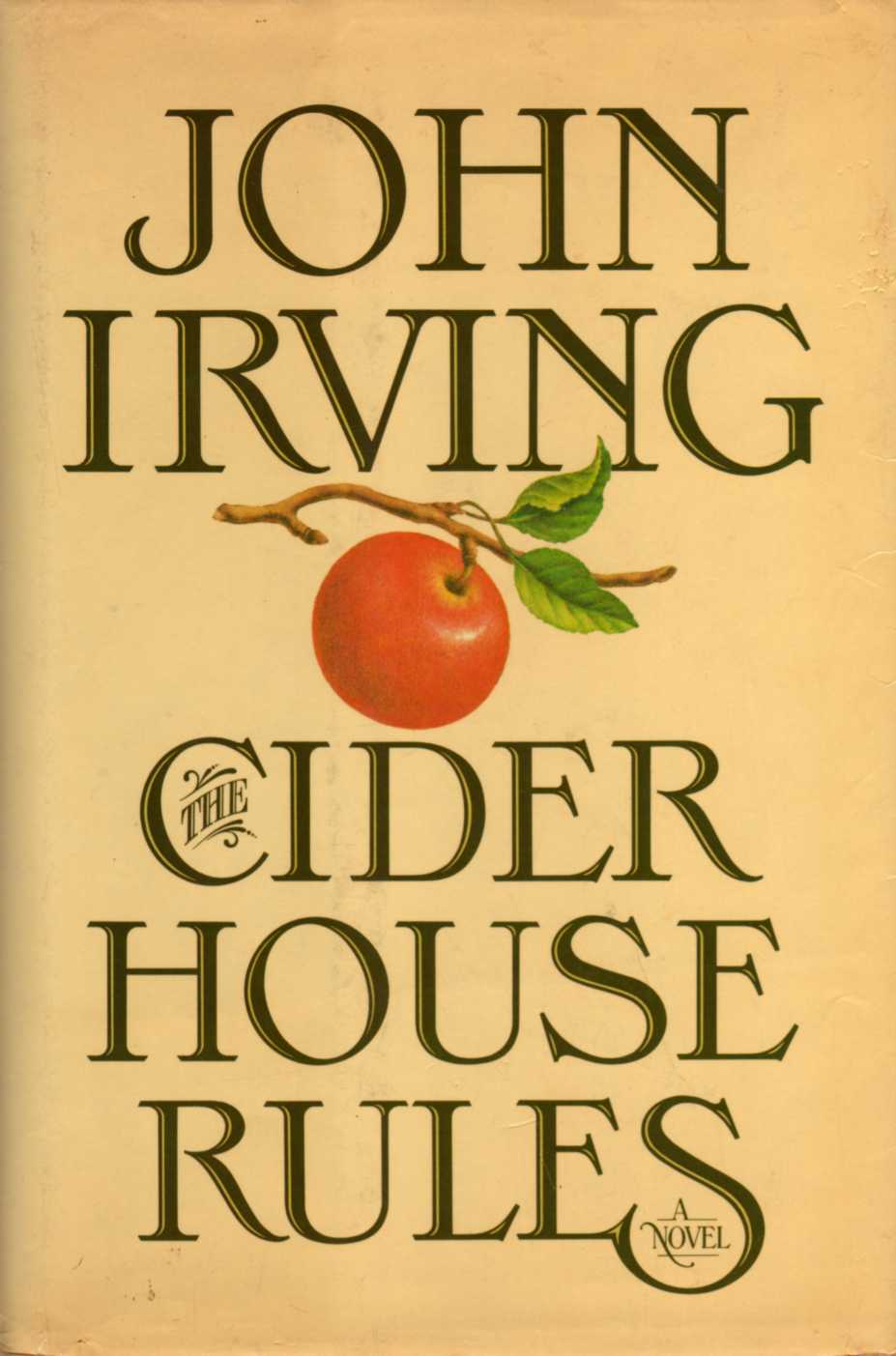
Reading recommendation: The Cider House Rules by John Irving.

Embryo doll photo credit: Anthony Easton via a Creative Commons License.

No Time to Lose

By Sergio A. Ortiz

It’s cold here.
Its color, a ninja turtle orange,
and only 1 day left
for el Presidente Electo
to inaugurate his burned hair,
his head de mal parío,
his enano politician tweets.
People say it’s worth the trip
to his Swearing In,
that this kind of shit makes you grow.
The thing is my body
cannot stand another Jetblue seat,
another Greyhound cafe.
Besides, winter hurts.
Its whiteness rusts the snow.
Its racism confuses me,
makes me feel small,
like a very distant echo.
Fuck it, if I go back to D.C.
It’ll be because I want to visit
the Smithsonian’s
African American Collection.
Where merchant ships loaded
with slaves are still shipwrecked
in my memory.


Sergio A. Ortiz is a gay Puerto Rican poet and the founding editor of Undertow Tanka Review. He is a two-time Pushcart nominee, a four time Best of the Web nominee, and a 2016 Best of the Net nominee. He is currently working on his first full length collection of poems, Elephant Graveyard.

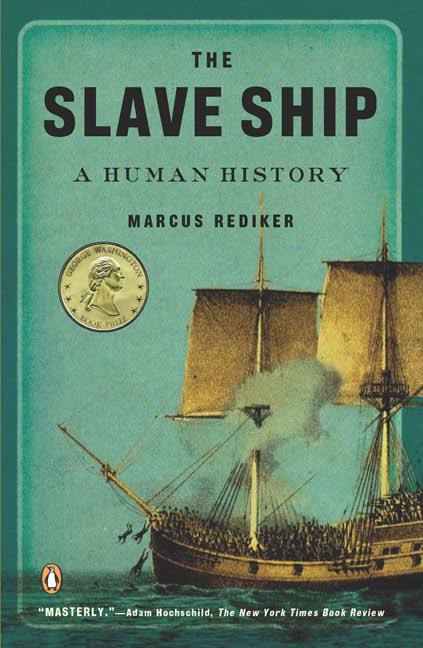
Reading recommendation: The Slave Ship: A Human History by Marcus Rediker.