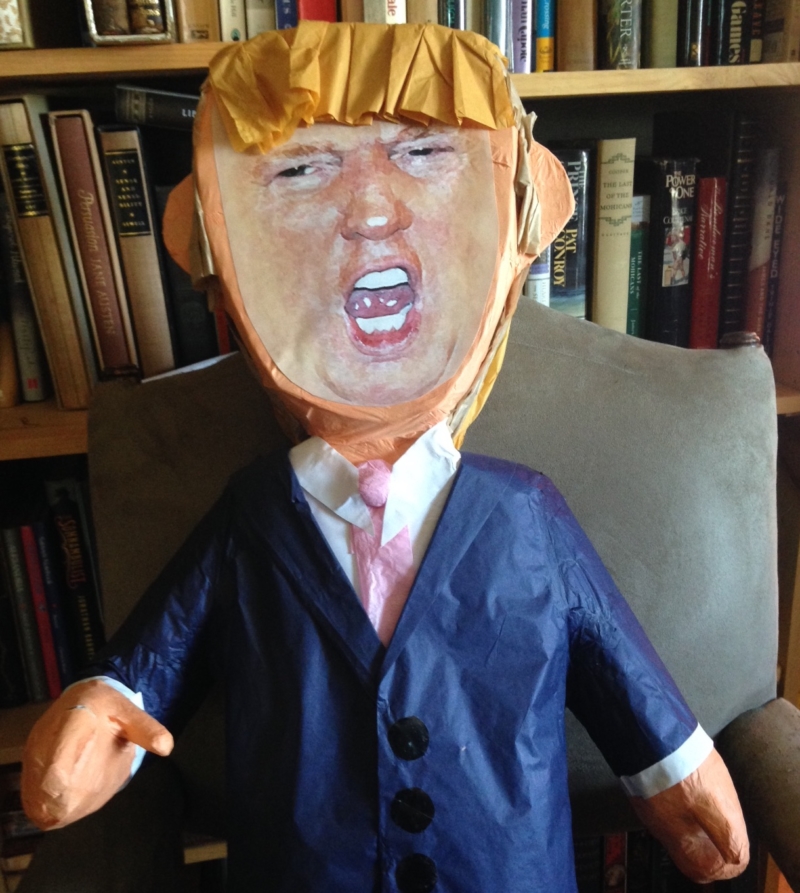
The Completely Imaginary Trump/Russia Theory that May or May Not Prove To Be True or False

By Amy Porterfield Levy


1987 – The Art of the Deal: Nukes Edition

Trump decides that Moscow needs a Trump hotel and, like every good realtor, he thinks about how good he would be at solving nuclear proliferation issues.

Trump: I have a great idea because real estate deals are just like nuclear arms treaties. The Soviet Union and I should work together and bomb France.

Soviet Union: We’ve never heard of you. Also, dial it down, freak.

1996 – Trump hearts Moscow

Trump: I heart Moscow so much that I want to put an exact copy of Trump Tower there. Also, I am broke.

Russians: *sigh* Fine. We heart you too, weirdo. Why don’t we buy a bunch of condos from you so you won’t be so broke?

2007 – Trump Vodka

Trump: I love Russia so much that I made gold Vodka.

Russia: You are gross. Here is some more money though.

2008 – Donald Trump, Jr. visits Moscow a bunch

Junior: Dad has piles of money pouring in from Russia so maybe he will finally remember which son I am.

Also in 2008 – Russia Rolls on into Georgia (the country)

Georgia: Maybe we should, like, join NATO or the EU?

Russia: Nope.

American People: *yawn*

Press: Something, something. … Here are pictures of tanks.

American People: Cool tanks, bro. Hey, wonder if taking out a home equity loan to buy a Mercedes was a bad move?

2013 – Trump’s Miss Universe Pageant Goes to Moscow

Trump: Oligarchs are everywhere! I love oligarchs! Hey, what does oligarch mean?

Prostitute: It’s where a guy is part of a little group that has all the money and all of the political power in a country

Trump: *jumps up and sings* I wanna be an oligarch!

Prostitute: *yawns* Smile for the camera, dipshit.

That’s an overview of Trump’s little case of Russophilia. It could be perfectly innocent; people do get crushes on countries. He could be like one of those women who drink tea instead of coffee because they’ve read too much Jane Austen.

As for Russia, we all know the Soviet Union collapsed and we sort of thought we were friends and everything was fine. Unfortunately, some things went down in Russia while we were busy worrying about sleeper cells and Adam Lambert. It got a little dictatorish and Putin didn’t appreciate having NATO nearby or that whole European Union thing. He was also afraid Hillary Clinton might push democracy down everyone’s throats, which would be super inconvenient.

2014 – Russia invades Ukraine

Russia: *whistles and looks around* Rolling on into Georgia was pretty cool so we’re just gonna go ahead and take Crimea, okay-thanks-bye!

American People: *yawn*

Press: Something, something. …Putin, natural gas, pipelines.

American Government and the EU: *handwringing* How about some sanctions?

Putin: Your dumb sanctions are fucking with my gazillion-dollar deal with Exxon. That is a problem.

Exxon: Yeah, sanctions are harshing our gazillion-dollar buzz about drilling the shit out of the Black Sea.

American People: Ice Bucket Challenge!

Putin’s New To-Do List

  • Break up NATO
  • Break up the EU
  • Fuck with the Americans
  • Make a gazillion dollars
  • Make the ol’ empire big again

July 2015 – Putin meets with top aides (the ones he hasn’t poisoned yet)

Putin: Where are we on breaking up NATO and the EU?

Aides: Just propping up the anti-globalization whiners. The usual.

Putin: Boring. How’s our ‘Fucking with the Americans’ thing going?

Aides: Terrific! Donald Trump just said he’s going to run for president.

Putin: Who?

Aides: That fat American we filmed doing gross stuff with hookers.

Putin: Yeah, that narrows it down. …

Aides: You know, the broke one with the weird hair. Says you’re buddies.

Putin: Oh, him. What a douchebag.

Aides: He’s the douchiest.

Putin: Welp. I’ve got a gazillion dollars on the line and an empire to build so go make life suck for Hillary.

This turned out to be a pretty easy project. Sean Hannity and the rest of White Power radio had become extra-deranged after years of Obama so they happily worked alongside the Macedonian trolls and Internet bots on Facebook and Twitter to amplify the irrational Hillary hate that they’d been fomenting for over two decades.

Pop Quiz: Why do you hate Hillary Clinton

Americans: We don’t. Most of us voted for her.

Trump Voters: Because … pant suits? Emails? WE DON’T KNOW WHY SHUT UP.

Stirring up animosity toward Hillary Clinton and taking advantage of Trump’s natural tendency to be an authoritarian asshole didn’t take much effort and it was also probably a breeze to gain access to the Trump inner circle in order to plant pro-Russian sentiments. After all, who doesn’t have associates who work for Russian mobsters and moonlight as FBI informants? Trump buildings are infested with that kind of sleaze. Just kidding. This is a parody.

July 2016 – Putin meets with top aides (the ones who are still alive)

Aides: Sir, Republicans actually nominated that idiot. Now what?

Putin: *mouth twitches*

Aides: *scared* Did your face muscles move?

Putin: That was me laughing. Go shoot yourself in the back of the head, but call Assange and Kislyak first.

The Russian ambassador, Sergey Kislyak, was evidently skulking around Trump world, probably working some silver-tongued magic on these guys. He’s probably one of those people who gets you to confide in him because he makes you feel like you’re his best friend and possibly the most interesting person he’s ever met. He’s like your sweet, drunk Grandpa except that sweet, drunk Grandpa is a badass motherfucking spy. Trump and his friends probably didn’t even notice they were getting involved in high crimes and whatnot. They’re like those pot smokers who don’t notice they’ve become drug dealers.

Pot Smoker: Hi dude. Just here to buy my weekly dime bag.

Dealer: Hey, man. Buy a little more and I’ll knock down the price.

Pot Smoker: I’ll sell the extra pot to my buddies and that will cover the cost of my weed habit!

Dealer: You are a genius.

Years later…

Pot Smoker: Man, I am very lucky to have lots of buddies and extra cash.

Cops: You are under arrest for possession with intent to sell.

Pot Smoker: *genuine shock* I am not a dealer! I just have hundreds of friends and nice electronics. *cries*

That is Trump’s little gang of genocidal knuckleheads. They probably didn’t mean to collude with a hostile foreign country—it was all so friendly and well-meaning and it made complete sense at the time. Plus, Drunk Grandpa is their bff and he would never dick them over.

Kislyak: You are an American hero. You are also quite handsome. I bet you will beat ISIS and be a world hero one day.

Mike Flynn: *teary eyed* Brown people scare me. Can I have a hug?

Kislyak: *snuggles* I love you. Will you do me a teensy favor as my best friend and suggest chilling out on the sanctions a bit? That would be amazeballs!

(By the way, Drunk Grandpa is darling but he snaps into badass spy mode when he’s dealing with clowns like Carter Page and Roger Stone.)

Kislyak: Hey, Ferret Faces. I will pull out your fingernails if these sanctions aren’t lifted.

Page and Stone: *whining* Why does everyone want to pull out our fingernails?

Kislyak: Shut up and deliver these messages, Ferrets.

While wiretaps, moles, and kompromat would make a great movie, it’s probably more boring than that. Trump may have genuinely thought he was practicing “The Art of the Deal: Sanctions Edition.” A guy with no moral compass, a huge ego, and a complete lack of intellectual curiosity can be easily manipulated by charming, Drunk Grandpas.

Kislyak: You are a tremendously great man who should rule the world. I’m going to stroke your ego like a high-budget porn fluffer.

Trump: I love you. We are best friends.

Kislyak: Totally. Lift those sanctions, you brilliant hunk of smoking hot man meat. I’m going to help you beat mean ol’ Hillary and rule the world.

Trump: I can’t wait to lift sanctions and rule the world. Will you curl up on the couch with me and watch cable news?

Things are unraveling now and these guys are getting stressed and acting stupid so we may see how this ends soon. Putin and Trump could be wallowing around in gold bars and billion dollar bills while Europe is screwed and the United States looks the same but stands for something our kids will be ashamed of one day. This could also end with us sitting on a pile of radioactive dust and eating our dogs, while Paul Ryan crawls through the ruins, bleating about tax cuts.

Or maybe most of us will get our happy ending and live long enough to see handsome FBI agents in windbreakers, gently guiding that fuzzy yellow head into the back of a black Crown Vic where he’ll be whisked out of our lives forever into that far-off place where convicted, humiliated ex-Presidents are stashed. The Ferrets will cut deals and live in constant fear of stairs and tea. As for the bloated, old racists who tried to destroy this country, that’s too fun to think about so we’ll save them for another completely imaginary theory that may or may not prove to be true or false.

Previously published on Huffington Post.


Amy Porterfield Levy is a Florida-based freelance writer and science advocate. She is a contributor to Huffington PostThe Science PostAmerican Council on Science and Health, and The Genetic Literacy Project.

A Poem and Translation

[fusion_builder_container hundred_percent=”no” equal_height_columns=”no” menu_anchor=”” hide_on_mobile=”small-visibility,medium-visibility,large-visibility” class=”” id=”” background_color=”” background_image=”” background_position=”center center” background_repeat=”no-repeat” fade=”no” background_parallax=”none” enable_mobile=”no” parallax_speed=”0.3″ video_mp4=”” video_webm=”” video_ogv=”” video_url=”” video_aspect_ratio=”16:9″ video_loop=”yes” video_mute=”yes” video_preview_image=”” border_size=”” border_color=”” border_style=”solid” margin_top=”” margin_bottom=”” padding_top=”” padding_right=”” padding_bottom=”” padding_left=””][fusion_builder_row][fusion_builder_column type=”1_1″ layout=”1_1″ spacing=”” center_content=”no” hover_type=”none” link=”” min_height=”” hide_on_mobile=”small-visibility,medium-visibility,large-visibility” class=”” id=”” background_color=”” background_image=”” background_position=”left top” background_repeat=”no-repeat” border_size=”0″ border_color=”” border_style=”solid” border_position=”all” padding=”” dimension_margin=”” animation_type=”” animation_direction=”left” animation_speed=”0.3″ animation_offset=”” last=”no”][fusion_text]

By Sima Rabinowitz

[/fusion_text][/fusion_builder_column][/fusion_builder_row][/fusion_builder_container][fusion_builder_container hundred_percent=”no” equal_height_columns=”no” menu_anchor=”” hide_on_mobile=”small-visibility,medium-visibility,large-visibility” class=”” id=”” background_color=”” background_image=”” background_position=”center center” background_repeat=”no-repeat” fade=”no” background_parallax=”none” enable_mobile=”no” parallax_speed=”0.3″ video_mp4=”” video_webm=”” video_ogv=”” video_url=”” video_aspect_ratio=”16:9″ video_loop=”yes” video_mute=”yes” video_preview_image=”” border_size=”” border_color=”” border_style=”solid” margin_top=”” margin_bottom=”” padding_top=”” padding_right=”” padding_bottom=”” padding_left=””][fusion_builder_row][fusion_builder_column type=”1_2″ layout=”1_2″ spacing=”” center_content=”no” hover_type=”none” link=”” min_height=”” hide_on_mobile=”small-visibility,medium-visibility,large-visibility” class=”” id=”” background_color=”” background_image=”” background_position=”left top” background_repeat=”no-repeat” border_size=”0″ border_color=”” border_style=”solid” border_position=”all” padding=”” dimension_margin=”” animation_type=”” animation_direction=”left” animation_speed=”0.3″ animation_offset=”” last=”no”][fusion_text]

Nuestra Música

Hay silencios sagrados
las pausas frágiles entre palabras

Hay silencios desgraciados
quedarnos mudos cuando hay tanto que exige expresión

Hay silencios inesperados
ya no recuerdo el timbre de tu voz

Hay silencios desanimados
tener que repetir una vez más nuestra petición

Hay silencios que insisten
que resisten
que saben salvarse

Hay silencios que son como museos
archivos de almas desvanecidos

Hay silencios que sueñan
con una noche—una sola noche—sin tiros

Hay silencios que inventan su propia historia
para no dejarnos sin narrativa

Hay silencios que inspiran
una íntima benedición tentativa

Hay silencios que hacen una tregua con la noche
ocultando sus motivos

Hay silencios que nos dan la fuerza
de seguir siendo testigos

Hay silencios robados, fallados, falsificados

Hay silencios engañados, lastimados, dañados

Y hay silencios que ruegan ser llenados
de un canto humilde de amor

[/fusion_text][/fusion_builder_column][fusion_builder_column type=”1_2″ layout=”1_2″ spacing=”” center_content=”no” hover_type=”none” link=”” min_height=”” hide_on_mobile=”small-visibility,medium-visibility,large-visibility” class=”” id=”” background_color=”” background_image=”” background_position=”left top” background_repeat=”no-repeat” border_size=”0″ border_color=”” border_style=”solid” border_position=”all” padding=”” dimension_margin=”” animation_type=”” animation_direction=”left” animation_speed=”0.3″ animation_offset=”” last=”no”][fusion_text]

Our Music

Some silences are sacred
the fragile pauses between words

Some silences are disgraceful
we are mute when there is so much to say

Some silences are unexpected
I no longer remember the sound of your voice

Some silences are weary
having to repeat our request, once again

Some silences insist
some resist
some know how to save themselves

Some silences are like museums
archives of vanished souls

Some silences dream
of one night—just one single night—empty of the sound of gunfire

Some silences invent their own history
so we won’t be left without a story

Some silences inspire
a tentative, intimate prayer

Some silences call a truce with the night
hiding their motives

Some silences give us the strength
to carry on serving as witnesses

Some silences are stolen, mistaken, false

Some silences are deceptive, damaged, injured

And some silences beg to be filled
with a humble song of love

[/fusion_text][/fusion_builder_column][/fusion_builder_row][/fusion_builder_container][fusion_builder_container hundred_percent=”no” equal_height_columns=”no” menu_anchor=”” hide_on_mobile=”small-visibility,medium-visibility,large-visibility” class=”” id=”” background_color=”” background_image=”” background_position=”center center” background_repeat=”no-repeat” fade=”no” background_parallax=”none” enable_mobile=”no” parallax_speed=”0.3″ video_mp4=”” video_webm=”” video_ogv=”” video_url=”” video_aspect_ratio=”16:9″ video_loop=”yes” video_mute=”yes” video_preview_image=”” border_size=”” border_color=”” border_style=”solid” margin_top=”” margin_bottom=”” padding_top=”” padding_right=”” padding_bottom=”” padding_left=””][fusion_builder_row][fusion_builder_column type=”1_1″ layout=”1_1″ spacing=”” center_content=”no” hover_type=”none” link=”” min_height=”” hide_on_mobile=”small-visibility,medium-visibility,large-visibility” class=”” id=”” background_color=”” background_image=”” background_position=”left top” background_repeat=”no-repeat” border_size=”0″ border_color=”” border_style=”solid” border_position=”all” padding=”” dimension_margin=”” animation_type=”” animation_direction=”left” animation_speed=”0.3″ animation_offset=”” last=”no”][fusion_text]


Sima Rabinowitz is the author of The Jewish Fake Book (Elixir Press) and Murmuration (New Michigan Press). Her prose and poetry have appeared recently in The Saint Ann’s Review, Amp, Hamilton Arts & Letters, and Trivia: Voices of Feminism. She wrote “Nuestra Música” for her dearest friends and her community in the Bronx.

Photo credit: K. Kendall via a Creative Commons license.

[/fusion_text][/fusion_builder_column][/fusion_builder_row][/fusion_builder_container]

A List by Noria Jablonski

25 things, post-election:

  1. Normally I shy away from posting anything too personal, but this time isn’t normal.
  1. A year and a half ago I was diagnosed with MS.
  1. My professional life came to an abrupt end.
  1. Thanks to the Affordable Care Act, I currently have access to health insurance.
  1. The medication I take to slow the progression of my disease costs $65,000/year.
  1. A drug that has been used for years to treat cancer and rheumatoid arthritis recently showed promise for treating MS. That drug was not brought to market because the patent was about to expire.
  1. I have profound hearing loss.
  1. Hearing aids are not covered by most insurance companies (hearing aids are considered elective).
  1. Healthcare should not be driven by profit motive.
  1. Neither should education.
  1. I became a teacher to help young people find their voices.
  1. I became a writer to find mine.
  1. “… it becomes strange indeed that illness has not taken its place with love and battle and jealousy among the prime themes of literature … literature does its best to maintain that its concern is with the mind; that the body is a plain glass through which the soul looks straight and clear.” – Virginia Woolf, “On Being Ill”
  1. On a Saturday night the spring before last, I suddenly lost vision in my left eye. Everything went dim, grainy, colorless, as if the brightness, contrast, and color knobs had been turned all the way down.
  1. A few days later my right leg went numb.
  1. Before MRI machines, a hot bath test was used to diagnose MS (heat worsens neurological symptoms).
  1. On a trip to Paris several years ago, I visited the library of Dr. Jean-Martin Charcot, who is most famous for his study of hysteria.
  1. Charcot was the first to give a name to multiple sclerosis: “la sclérose en plaques.”
  1. Sclerosis means hardening. It refers to scar tissue formed by lesions of the brain and spinal cord.
  1. Nothing is in my control.
  1. My body feels unsafe. I have been hurt physically and sexually.
  1. “Everywhere in the world they hurt little girls.” – Cersei Lannister
  1. My parents were Sufi. Sufism is a branch of Islam.
  1. My given name is Arabic. It means light of womanhood.
  1. I am not a terrorist.


Noria Jablonski is the author of the story collection Human Oddities (Counterpoint, 2005).

Photo credit: Connie via a Creative Commons license.

Cagey

By Koushik Banerjea


“What are you doing?”

He was surprised by the question, believing himself to have been alone. He had been admiring himself in a shard of mirror he had found earlier, discarded on the dirt road snaking around the park. Gauging his reflection, he tried to look haughty, then severe, by turns flaring his nostrils then dulling his eyes. Was it obvious he was a thief? He didn’t think so, not any more.

“You! I asked you a question. Are you deaf?”

He turned around hoping the disdain didn’t show. His questioner stood, feet apart, in the familiar khaki uniform of the police. The man was carrying a bhuri, a little Ganesh potbelly, sagging over his belt, and in that one detail could be spied so much of what would always divide them. As much as the uniform or the steel tipped lathi, it was the softness of that belly, its partiality to sweetmeats and greed, which marked out this man’s tribe.

“No, sir. I was just leaving, sir,” he said to the policeman, observing the expected protocol but knowing from the deep-set rituals of the cage that it meant nothing.

He watched as the policeman prodded a bundle of rags a little further along the path. The rags began to stir and a dishevelled face appeared, already terrorized long before the steel tip brushed its chin. He realized then his good fortune in even being afforded the courtesy of a question. Standing there with a shard of glass in one hand, he could just as easily have been deemed a threat by the policeman. The city was on edge, the bodies still fresh, and he was taking a risk each time he drifted away from the huddle. He knew he had to hurry back to his brothers, still prone on the same benches where they’d eventually found one another, to warn them of the danger. But when he did, he saw to his relief that they were already awake, sitting up for the policeman’s benefit like a couple of early morning bhadralok, discussing current affairs. The lathi briefly paused, satisfying itself that these were indeed gentlemen and not miscreants, before moving on to the next set of unfortunates.

And watching this, with the shard now safely wrapped in a fold of his vest, it made him think how no one ever asked the right questions. It had been just the same when he was in the cage.

Picking away at the scab, he felt a certain amount of regret. Space was limited here and he had taken to marking his tiny locale with whatever was at hand. More often than not this involved hair (his own), or a chipped fingernail, and on one occasion a tooth unhooked by day after day of the cage gruel. But today he had noticed a scab building up on his forearm, and the urge to scratch the itch had proven too great to resist. The skin had not yet flaked, so his action drew blood and pus. He didn’t mind too much, though, as it made for a richer signature on the floor. He knew the other inmates would be looking at him as he pinched the skin, then released the gunk; knew as well that there would be no complaints, the memory still fresh of those other days when it was their teeth or blood that had lined the floor.

He sensed that his blood had been in some way corrupted by the surroundings. Now even the mosquitoes tended to avoid him on their night-time sorties. The moan and slap of the other wretches meant they were still being plagued by malarial torments, yet his nights were oddly peaceful. He would hold the gruel down and continue to build himself up with press-ups on his knuckles. And he would watch, and wait. The wretches would occasionally come to blows with one another, but even when this happened they were careful not to allow their dispute to spill over into the micro-fiefdom he had marked out for himself. His vest started to fill out with this taut system rigour, vein and fibre and barely concealed violence in those arms; the knuckles long since cured of the taste of floor, safeguarded as they were by an extra layering of skin. And though he was young, one of the youngest in fact in the cage, there was now a strong beard shielding that face.

And then one day the news he had been so desperate to hear. News he had waited so long for that there were times when his resolve had nearly crumbled, when he had imagined that this was what his life would always be. Yet when it finally came it was delivered without ceremony. A perfunctory ‘You!’ and the unlocking of bolts. Space, which he now knew to be the most precious of companions, was apparently needed for another kind of inmate, and with a final reminder that he was a lucky badmaash ringing in his ears, the system spat the thief back out into the dust and the tumult.

No one was there to meet him, and after the initial disappointment, which was barely even that, he felt nothing. Shielding his eyes from the harsh glare of late morning, he squinted at the first building that lay beyond the dirt track and at the thick plume of smoke that was rising from it.

“Bhaiyya,” implored a man, skeletal arms thrust outwards, that simple action evidently so draining that no more words would come.

He paused to look at the man, noting the distant saucers of eyes set back in hollow sockets. Instinctively he reached up to soothe the bridge of his own nose with thumb and forefinger; felt surprised when the fingers traced thick hair in the space just below his cheekbones; strode on purposefully towards the plume without looking back.

As he crossed the waste ground, his eyes picked out more stricken figures, little more than shapes really, only the occasional spasm indicating any life at all. Mostly, they were just covered in rags, though one or two were still sitting, as though meditating, in the clothes they must have been wearing when their lives were touched by fire or tragedy or whatever it was that had left them like this.

He could hardly bring himself to look at these figures, so implacable did they appear in their sadness. It was even worse with the ones who called out to him, begging for food, or, perhaps, just comfort.

“Dada. Bhaiyya. Amar ke kichu ekta ditte parben?”

“Dada. Amar khidda.”

Or sometimes, just “Dada.” Dada, though he was barely old enough to be considered anyone’s Dada. He looked at their arms, little more than flesh starved twigs really, and felt something surging up within him. At this stage, there was still no sign of his own brothers, whose Dada he actually was by virtue of being the eldest. Even so, he found himself studying the blank faces on display for any traces of recognition. Perhaps his brothers no longer looked the same? He had heard how beards were grown or heads sometimes shaved. He knew people had done what they could, had often had no choice but to hide in plain sight. There had been whispers in the cage, the most recent arrivals breathing terrible tales of riot and flame, cleaver and bone. And he had absorbed it all, shapeshifting imperceptibly from a thief to a warrior.

People change, he thought, even in a short space of time. He had seen that for himself in the cage. Right in front of him, big, strong men reduced to urchins, the fight drawn out of their faces with one savage beating. The unexpectedness of it, perhaps the shame, but either way all that swagger absorbed by the blows, repainted as something smaller, delivered in silence. Yet these figures around him now were of complete strangers, and in that sense should have exerted no more pull on his imagination than the boundary markers of detritus in the cage. So when he looked again, this time more closely, and saw that they were in fact not meditating but sitting on recently bandaged stumps, he was as surprised as anyone that the thing surging through him, up through his gut and into his throat, then out of his head, felt more primal than anything he had experienced behind bars.


Author’s Note

“Cagey” is a dark little tale of trial and tribe, set in the turbulent period leading up to the Partition of India, in 1947. The timing feels apt this year, which marks the 70th anniversary of those traumatic events, but also the inauguration of deep disquiet at political upheavals on both sides of the Atlantic. Given that we appear to be stuck in the early stages of “post-truth,” the most honest thing I can say about myself and my writing is lifted from the great Chinua Achebe: “I wouldn’t have wanted anyone to teach me how to write. I prefer to stumble on it … not to be told.” I hope some tiny element of that is present in my words. And yes, every fightback begins in the tales we tell ourselves and one another.


Koushik Banerjea is a London-based writer. His work is featured in Verbal magazine and darkmatter: in the ruins of imperial culture.

Photo credit: Caged Rats, Rajasthan by K-B Gressitt ©2016.

When Our Culture Is Los Angeles Instead of Joshua Tree, This Is How We Elect a President

By Peter Brown Hoffmeister 


Part I

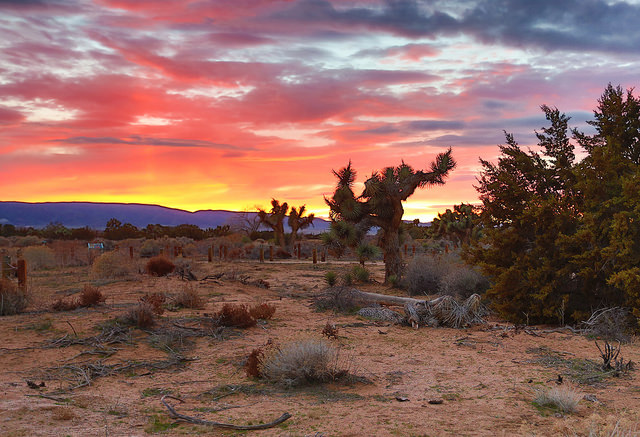
Sunrise, the first day in Joshua Tree, a Purple-Bibbed Hummingbird
flits and dips into the late March blooms off my back patio, and a male House Finch,
head red as a carpet in Hollywood, chatters with his mate about
mosquito meals and black-fly-bacon for breakfast.
I turn and watch a jackrabbit facing west, somnolent on his haunches,
the dark tips of his ears catching the first warm rays angling across
the desert, when a raven plunges to him, dives to within a foot of his head,
catches the rabbit staring off, and the rabbit jumps, or—more accurately—
jigs, startles, his four jackrabbit feet spraddling in the air, straight
out to the sides, before he reconnects with the earth and bounds
into the Cliffrose and Saltbush.

At Macy’s, this week, in Los Angeles, fur coats are 30 % off.


Part II

First night in Joshua Tree, the stars shift counter-clockwise around Polaris—
Capella, Cassiopeia, and Ursa Major—but also
stars and clusters I haven’t yet learned, 3/4 hydrogen, 1/4 helium
thrown from God’s bag, 6000 visible above the Lost Horse Cabin on
any given night. But only 119 miles away
in Los Angeles, the burning wattage of the city pollutes a ground-up whitewash,
as if the people who worship concrete
have painted the sky as nothing.

I’ve heard aspiring actors, aspiring directors, and aspiring producers talk about what
they’ve gained by moving to Los Angeles.


Part III

Cap Rock, walking barefoot back to my car, Cholla spines in the sand and I shuffle
my feet to scuff the spines so they won’t stick.
A coyote yips in front of me, and I try to translate
his yawping whoops,
March Madness, the basketball experts say, would you take Kentucky or the field?
And I say this is the field, right?
Joshua Tree?
Open desert at 4000 feet through the Lost Horse Valley? The coyote
in front of me still, luring me further into the desert, to a pile
of stones I don’t recognize. I follow his yowls for a mile, but
he stays in front of me until
this moment,
now
when coming around a corner to a jamble of orange monzogranite, he’s
in front of me, sitting like a domesticated dog, and I say,
“What was your trick, Trickster?”
But he says, “With them, I didn’t have to. Not at all. People,
they just tricked themselves.”


Part IV

Finally, An Ode to the Red Carpet Itself:

How did you get this job, not a green or blue carpet. Purple
is a royal color and could be the carpet of choice for
stars to stumble across, bubbly and buzzing from limo shots, or
almost stars—the nearly famous—hoping for interviews, cameras, microphones,
anything to reflect their own silicon-enhanced images.
Our president is orange but he was once on that reality show where he always said, “You’re fired!” so emphatically that he must be able to
be a boss
win a game
lead a nation
which is synonymous with
starring in a movie?

If you want to catch a raccoon near a desert spring, drive three-inch nails, angled down,
into a two-pound coffee can, then place something shiny in the bottom:
a silver dollar
a bracelet
a small mirror.
The raccoon, masked and striped as if he’s dressed for a special occasion
will grasp the sparkling object in his small dark hand and he won’t let go, not even after
he discovers that he can’t remove his fist from the trap. Never will this raccoon relinquish the shiny piece of something that he is holding even if he realizes that he
has been caught out in the open, looking like a fool.


Peter Brown Hoffmeister is a poet and fiction writer, and a former Writer-In-Residence of Joshua Tree National Park. His most recent novels include This Is the Part Where You Laugh (Knopf, Random House) and Graphic the Valley (Tyrus Books, Simon & Schuster). His next novel, Too Shattered for Mending, will be released by Knopf in September 2017.

Photo credit: Steve Collis via a Creative Commons license.

Curry’s Common Ground

By Mary Petiet


The man behind the counter glances between the potent spice mixes and my ten-year-old son.

“You like this?” the man asks in a heavy Pakistani accent. He starts ringing up the sale, and cultures connect as my blond towhead grins widely and tells him he loves curry.

When I was ten years old, I had never tasted it. Curry had not yet arrived in our small Massachusetts town, although I had heard rumors of it from my English cousins. Until a few years ago, I had to go into Boston to shop for Indian food.

Now, masala, korma, Punjabi chana, and fish biryani; vibrant spice mixes neatly packed in small boxes stamped “Made in Pakistan”: I wonder at their journey to the new storefront on our town’s main street and marvel at how easily they create amazing Indian dinners. The man behind the counter asks if I know how to cook with them. I recall tasting my first curry as a college student in Scotland in a restaurant promising the cuisine of the Mughal emperors. It made my eyes water and my nose run and I loved every bite of it. Awash in the new spices and always a cook, I asked the waiters, “How do you make this?” “Madhur Jaffrey’s cookbook,” they replied unanimously.

In the store, I regard the man over a box of frozen samosas. The store smells of curry in the way of all Indian markets. As my son runs back for a jar of chutney, I tell the man it took me years to learn how to cook this stuff, starting with a recipe called Malaidar unday in a dog eared copy of Madhur Jaffrey’s Indian Cooking.

Malaidar unday is a simple curried egg recipe and as I cooked it I realized that at its base, Indian cooking has a balanced trinity of flavors: ginger, chili and onion. Over the years, I learned to grind spices and puree pastes, and to add yogurt slowly so it doesn’t curdle. I spent hours filling the kitchen with potent smells from far off places and piling our plates with the spicy stews my son has grown up eating.

The man takes the chutney from my son and tells us his favorite is butter chicken and that the butter chicken spice mix feeds a lot of people. My son says he loves that one, too. We share stories of big butter chicken meals, agreeing there can never be too much of it. The man shakes my son’s hand, we walk out the door, and the fresh air hits us as we leave the smells of Pakistan behind.

Out on the sunny sidewalk, I seize the moment to connect cultures. I ask my son if he has been hearing a lot of scary things about Muslims recently. He says he has: terrorism, the refugee crisis, a possible registry. Just as I have feared, the vitriol has not escaped my child, hate does not happen in a void.

“That man in the store is a Muslim,” I tell him. “He’s from Pakistan, and he likes a good curry just as much as we do. Think of how the different spices in the curry work together to form the coherent whole of the dish. People are like that. We can work together to form a successful whole. The Koran says: Do unto all men as you would wish to have done unto you. Jesus also says: Do to others what you want them to do to you. We have common ground, and we can’t vilify an entire people based on extremists—just as we can’t dismiss all curries as bad when we add too much of one spice to overwhelm one dish.”

When we get home, we break out the butter chicken. I imagine the chicken floating in the marinade as the continents floating in the ocean, and the spices as the people and the animals inhabiting the land and the sea. Later, while the mixture simmers, I watch as it all comes together in a vibrant, balanced, colorful mass, connecting us to each other as surely as it connects us to the greater global mosaic.


Mary Petiet is a reporter, writer and storyteller. Her book Minerva’s Owls is forthcoming from Homebound Publications in April 2017. Visit her website, www.marypetiet.com, and follow her on Facebook.

Editor’s note: Learn more about Madhur Jaffrey, “The Queen of Curries,” and try a few recipes found here.

Photo credit: Sara Marlowe via a Creative Commons license.

i’m sawing off my roots

By Cyrus Parker


watching the place

i had called home

for twenty-five years

turn red

for the first time

in twenty-four—

on a night that would determine

the future

of not only myself,

but so many other people,

many whose entire livelihoods

were on the line—

was the first time

i had ever been

ashamed

of where i’d come from.


Cyrus Parker is a New Jersey-based poet, originally from Michigan, where he spent four years actively wrestling on the local independent wrestling circuit. On a hiatus from the squared circle, Cyrus is taking the time to pursue his other passion—writing. A creative writing major at Brookdale Community College, Cyrus’ work has been published in the college’s annual literary magazine, Collage, and he is currently revising his first poetry collection, DROPKICKpoetry, which he hopes to release sometime in 2017. Follow Cyrus on Facebook and Twitter.

Miscarriage

By Heather Herrman


A month ago, I lost my daughter to a miscarriage. Science did not tell me she was a girl, but I knew it through every bone in my body. My great-grandmother, Wilhelmina Volk, came from Germany when she was sixteen to an arranged marriage with a drunk. The man gave her two children and then left her. Wilhelmina survived by telling fortunes in the streets of St. Louis. She told them with uncanny accuracy. She saw ghosts of people who’d died across the ocean before ever hearing the news. I claim her intuition as I claim the knowledge of my daughter. She existed. She is gone. This is a truth.

At the hospital, the nurse gave me a pill to expel my daughter’s body at home. We knew she was gone because we saw her body in black and blue tones on the sonogram—a little fish who did not move in the ocean of my womb. The tech was cold, ill-equipped to deliver the news.

“There’s no heartbeat,” she said, after minutes of silent prodding, her hand moving the wand inside of me to send the oh so still image onto the screen while my husband and I watched, breathless. “Let me go get someone,” she said.

And that was all. They walked us through the back hallways, so that no one could see us crying. I wasn’t crying. I was a farmer’s granddaughter. I understood life and death. Cycles. Giving and taking. I was strong.

Stupid.

The tears came later as I paced the house, the pills inserted inside of me to get rid of the dead flesh.

“Like a light period,” the nurse told me. “Maybe a little more cramping.”

It was a birth. It was labor. I know, I have done it before. I have a son who is alive and well.

I paced the house like a wild animal for four hours, unable to sit, the contractions coming and going, coming and going, the emotions swelling. When she passed, I could not catch her in time and she was gone. Swimming through the toilet and away. Better, maybe, but I would have liked to see her face, the small gumdrop of the unformed woman she might have become.

We do not talk of such things, women. We smile and grit our teeth to the bodily bits of birth. We make pink quilts and sing songs.

And—because we do not speak—it is defined for us by men who make decisions about protecting what is not theirs.

It is mine to give or take. To lose. To grieve or not. It is not yours.

I have deflated slowly, losing the hormones and pounds, letting them push a needle into my arm each and every week to see if my body has stopped its confusion, if it has figured out, finally, that it is not pregnant. It has not. Still, my breasts are tender, my heart is sore. I weep at things that don’t need tears. And even more for the things that do.

Around me, the world is falling apart.

And my body aches the ache of a mother.

We are broken, and I don’t know how to fix it.

I post the correct posts on Facebook, I speak to relatives in hushed anger about why they must see what it means to let these refugees—these children—into our home, because we are all children. We all ache for a mother.

But I don’t know how to translate this white grief into action. I don’t know what to do or say that hasn’t been said before. I am a pessimist. I am always censoring the personal.

But I like to think my daughter would not. Does not. I like to think she opens her heart and mouth and flies, as Cixous commanded all her daughters to fly, above all this poison through a different language—the language of the body.

The grief of swollen nipples left unnursed, the spread of skin to make a room, left vacant. The body who wants to be made a house.

I do what I have been too scared to do.

I grieve.

My daughter taught me that.

Today, I do not post the protest links on any of the pages where, daily, I make my mask for the world.

Today, I speak from the body.

Today, I speak from the wound.

And with my daughter’s voice, which supersedes me, engulfs me, allows me this audacity to claim the universal womb—I beg my children to come home.


Heather Herrman‘s stories have appeared in journals including The Alaska Quarterly Review, Snake Nation Review, and The South Carolina Review. Her debut horror novel, Consumption, is out now from Random House imprint Hydra. Heather has taught writing classes at places such as New Mexico State University, Clemson University, and The Loft Literary Center. She also worked as a literacy advocate at two Minnesota nonprofits before moving to Omaha to birth her were-child and learn the trade of hunting, capturing, and skinning words alive to feed her pages. Visit her website at www.heatherherrman.com.

Photo credit: Trocaire via a Creative Commons license.

The Candidate

By Bebe Kern


Out of television into living daylight, like
the nightmare demon of my Southern girlhood,
the specter is everywhere: dirty ballcap man
in the pickup with a truck-size Rebel flag flying
over Mardi Gras; salesman with a leer;
frat boy drunk on Dewar’s and privilege
mocking a sissy, marking territory on the lawn
before he grows up to poison a town’s water;
accidental mom, defiantly obese, raptured
on the couch by a blue screen while children
drink sugar by the can and sing battle sounds;
tank gunner banker broker laying waste to marsh land;
old man in camo dreaming in Walmart
of creamy girls and automatic weapons;
grade school bully laughing at my simple shoes.


Bebe Kern lives in the North Carolina Piedmont region, drives a Ford truck, works a day job, and listens to poets and musicians including Donald Justice, Miroslav Holub, Jane Hirschfield, Charlie Smith, Tom Waits, Mary Gauthier, Drunken Prayer, The Handsome Family and Loretta Lynn. She had a poetry class at the University of Alabama under Hudson Strode, and studied at the University of South Alabama with Walter Darring and Stephen Mooney. Her poem, “Pray Mississippi,” was named a finalist by The Thomas Jefferson Center for the Protection of Free Expression. Novelist Julie Edelson reviewed Bebe’s original CD, No Twirling, saying, “Bebe Kern is a lunch pail sort of poet … her work is fresh, with a good strong bite.” 


The Invisible

By Jason Metz


You do not see us, so let me show you. I’ll start here, with a needle. First, there’s an antiseptic pad to sterilize the injection area, to the left of the belly button, just below a birthmark. The needle is more like a fat pen, a pre-filled syringe encased in plastic with a trigger button at the top. Stand in front of the mirror, shirtless, the needle pressed up against the stomach, hold your breath. Click. It hurts. Not a lot, but enough to know that it’s there. It will pass. Ten seconds goes by, a slight gurgling sound as the plunger reaches the end of the barrel, then wait a few seconds more and remember to breathe. Wipe away the droplets of blood. This happens twice a month, on Tuesdays.

The commercial for my medicine has all of the typical scenes you’ve come to expect from the pharmaceutical industry: people trying to get on with their daily lives. They’re packing suitcases and boarding planes. They’re sitting in an Adirondack chair by a lake. They’re enjoying romantic dinners. These things happen while a hushed voiceover lists the potential side effects: serious and sometimes fatal infections and cancers, such as lymphoma have happened, as have blood, liver, and nervous system problems, serious allergic reactions, and new or worsening heart failure. All the good stuff.

None of it phases me. I know what life is like without the medicine. I enjoy packing suitcases and boarding planes and sitting by a lake. The romantic dinners are a little harder to come by, but not for lack of trying. The medicine allows me to try.

What does phase me, is when the commercial airs during football games. Friends, beers, wings. Trying to pretend that the advertisement for my medicine is just another commercial, couched between fast food ads and movie previews. The actors in the commercial represent my reality. This worries me. That the commercial might expose me, that my friends might catch on, that they’ll know something is wrong with me. If a deflection is necessary, I’ll make a joke and mock the commercial, get a laugh out of the room. Besides, these commercials are unnecessarily cruel reminders. They air at times when I’m trying to forget. When I’m living, trying to enjoy myself, keeping hidden. Sundays are for football. Every other Tuesday is for the needle.

I was born with an auto-immune disorder. There is no cure. For the rest of my life, some form of treatment is necessary. Without it, my quality of life plummets. And aside from all those physical symptoms and side effects, here’s what almost nobody tells you: The mental effects can cripple you. They will follow you at every step for the rest of your life. You will not be able to outrun them.

What might happen when you’re sick and always will be, is a depression that weaves its way in and out of your life. Sometimes it’s just a touch, barely there, you might not even notice it. Other times, it will consume you. It will corrode your needs and values and desires. There will be days that you cannot leave the house. You’ll find excuses to not be with friends. You will have great difficulty with intimacy. Those things that seem to come so easily for others. And you might find yourself staring out of a third story window, looking down at the ground, and thinking how easy it could be. Gone.

These might be passing thoughts, not even a suggestion, just more of an option to look at plainly. The fact that these thoughts exist within you is frightening enough, but there they are, so maybe it’s best to acknowledge them. Hang on the best you can and let them pass through. Remind yourself, these thoughts are foolish. It’s not all that bad.

There are other thoughts, too. For example, someone might come into your life. You might let your guard down, let someone get close. The problem with that is, eventually, you might have to talk about what you want for the future. This is where, if you don’t want to lie, if you’re strong enough to give the other person the honesty they deserve, you tell them that you do not want children. This will be a deal breaker for many. You can tell them the reasons why, that children just aren’t for you or that you don’t need to create a life to fulfill your own. There is some truth to this, maybe. But here you are, lying to someone you promised you would not lie to. Here you are, lying to yourself. Here is what you will never tell others. Here is the truth: that you’re afraid of what you’re going to pass down, what’s embedded in your DNA. How could you lovingly create a child and knowingly pass on your pain? How could you bear to watch that? How could you ask someone else to do the same?

It’s in these passing moments that you realize that every single day, even in the smallest of ways, you deal in terms of life and death, always. You are afraid to create one. You are afraid of your own. It’s in these passing moments that you are grateful for the medicine that alleviates your symptoms. It may not make these thoughts go away. But it gives you some distance. You can’t outrun these thoughts, but you can stay ahead.

*   *   *

You do not see us. But we are very much at risk. The Affordable Healthcare Act provides protection for those of us with pre-existing conditions, whether we were born with them or not. And here we are, once again, about to find ourselves at the mercy of the insurance industry. An industry that does not care for us. Without protections in place, they have the power to simply deny us coverage, or charge us exorbitant premiums that we cannot afford. Many of us will be forced to go without coverage, without treatment.

This is how they see us: We are ID numbers in a database. We are a math formula. We are X amount of dollars in premiums. We cost Y amount of dollars in treatments. We never come out in the black. The variable in this formula? Being born. Our complicity? To continually exist. In existence? More than 50 million of us.

We don’t want you to see us, but if you must, see us for what we are: human.

Don’t see us as simple mathematics, as a financial burden, or a losing proposition. We are not disposable.

We are the invisible. We swallow pills and stick ourselves with needles. We are among you. We watch football games and laugh at ourselves on TV. You invite us to your weddings and baby showers and hug us at funerals. We try to be role models to your children. We’re your best friends and, like you, we are trying to get through another day. We might not ask you for help because we too often see help as an admission of weakness. We are stubborn. We work so hard for our invisibility.

But know this: We are in grave danger. Know that we are here, alongside you. Know that we need you, now more than ever.


Jason Metz earned an MFA in Creative Writing from the University of California, Riverside. He lives in Somerville, Massachusetts, on the third floor of a triple-decker, on a hill that overlooks the Boston skyline, where he writes at a small wooden desk, resisting.

Photo credit: Takeshi Hiro via a Creative Commons license.

Better Than Truth

[fusion_builder_container hundred_percent=”no” equal_height_columns=”no” hide_on_mobile=”small-visibility,medium-visibility,large-visibility” background_position=”center center” background_repeat=”no-repeat” fade=”no” background_parallax=”none” enable_mobile=”no” parallax_speed=”0.3″ video_aspect_ratio=”16:9″ video_loop=”yes” video_mute=”yes” overlay_opacity=”0.5″ border_style=”solid” padding_top=”20px” padding_bottom=”20px”][fusion_builder_row][fusion_builder_column type=”1_2″ layout=”1_2″ spacing=”” center_content=”no” hover_type=”none” link=”” min_height=”” hide_on_mobile=”small-visibility,medium-visibility,large-visibility” class=”” id=”” background_color=”” background_image=”” background_position=”left top” background_repeat=”no-repeat” border_size=”0″ border_color=”” border_style=”solid” border_position=”all” padding=”” dimension_margin=”” animation_type=”” animation_direction=”left” animation_speed=”0.3″ animation_offset=”” last=”no”][fusion_text]

By Jens Köhler


We had hoped
that truth
would set us free

We believed
“If you See Something, Say Something”
applied
to things deadlier
than misplaced luggage.
Things like:
the destruction of habitats,
human and other;
systems that punish
blackness and brownness and femaleness;
“alternative facts”.
We Saw, We Said.

We had hoped
that truth
would set us free

But in reality
that freedom
is hard to see

Wiser souls than ours
knew the truth
as they prophesied
the end of bees
the end of flowers
the pitiless hungers
of unchecked powers

Better men than me
knew the truth
of their humanity
while a noose
weighed a curse upon a tree

Our years and labors extracted
attentions redacted
we saw faintly
then with clarity
the denial
of our humanity

No
the truth
plain to see
did not
cannot
will not
set us free.

But,

better planning
better alliances
better training
better complaining
better whistleblowing
better faith
better BS-calling
better elections
better never, never, never, never, never, never, never stopping
better ball not-dropping
better logistics
better heuristics
better self care
better standards of care
better sex
better checks and balances
it’s a long list
and should be longer
with the stuff
that makes you you
and makes us stronger
better diction
better encryption
better privacy
better transparency
better leadership
better followership
better rituals
better victuals

[/fusion_text][/fusion_builder_column][fusion_builder_column type=”1_2″ layout=”1_2″ spacing=”” center_content=”no” hover_type=”none” link=”” min_height=”” hide_on_mobile=”small-visibility,medium-visibility,large-visibility” class=”” id=”” background_color=”” background_image=”” background_position=”left top” background_repeat=”no-repeat” border_size=”0″ border_color=”” border_style=”solid” border_position=”all” padding=”” dimension_margin=”” animation_type=”” animation_direction=”left” animation_speed=”0.3″ animation_offset=”” last=”no”][fusion_text]


better jokes
better pancakes
Come on,
what am I missing?
Fill in the blanks
better kissing
better music
better hospitality
better advocacy
better lobbying
better structural redundancy
better data
better stories
better questions
better showing up
better voting
better tricks
better mortgage lending
better garden tending
better humus
better HUMINT
better humor
better breath mints
better knitting
better maps
better lawyers
better coffee dates
you go out for coffee
come back
I’ll still be going
better investing
better endowment growing
better divesting
better boycotts
which are truly terrible weapons
against feudalism
named for a landowner’s agent named Charles Boycott
who couldn’t even get his mail delivered in the end
better genius
better plod
better art
better succession plans
better representations
better representation
better participation
better capital formation
better information
better fintech
better listening
better policy
better long term memory
better philanthropy
can we please
not use charity
to keep other people’s kids down?
better bets
better interview gets
better farming
better charming
better handshakes
better prepare for earthquakes
better French drains
better benchmarks
better supply chains
better first aid
better patience
better impatience
better exercise
better love letters
better manners
better resolve
better spirit
better aid
better comfort
better gumption
better getting back up

and

and

the truth

will set us free.

[/fusion_text][/fusion_builder_column][/fusion_builder_row][/fusion_builder_container][fusion_builder_container hundred_percent=”no” equal_height_columns=”no” hide_on_mobile=”small-visibility,medium-visibility,large-visibility” background_position=”center center” background_repeat=”no-repeat” fade=”no” background_parallax=”none” enable_mobile=”no” parallax_speed=”0.3″ video_aspect_ratio=”16:9″ video_loop=”yes” video_mute=”yes” overlay_opacity=”0.5″ border_style=”solid” padding_top=”20px” padding_bottom=”20px”][fusion_builder_row][fusion_builder_column type=”1_1″ layout=”1_1″ spacing=”” center_content=”no” hover_type=”none” link=”” min_height=”” hide_on_mobile=”small-visibility,medium-visibility,large-visibility” class=”” id=”” background_color=”” background_image=”” background_position=”left top” background_repeat=”no-repeat” border_size=”0″ border_color=”” border_style=”solid” border_position=”all” padding=”” dimension_margin=”” animation_type=”” animation_direction=”left” animation_speed=”0.3″ animation_offset=”” last=”no”][fusion_text]


I live in L.A., grew up in Toronto, and lived in NYC and Montreal. I am a dad to the most amazing, wonderful lads. I have always been an ideas guy. I get excited about the act of creation and organizing people around interesting ideas. My professional background includes writing, nonprofit management, performing and producing. It all feels like the same thing to me. (Well, no. Staying up late to finish a grant proposal does not feel the same as making an audience laugh. But I am always aware of the connection between the grant that raised the money that helped get the butt in the seat so the performer could try to get that laugh.

“Better Than Truth” was first published on the poet’s website, at jenskohler.com.

Photo credit: Jason Eppink via a Creative Commons license.

[/fusion_text][/fusion_builder_column][/fusion_builder_row][/fusion_builder_container]

No More Cream Puffs

By Darrell Petska


Can’t you feel it?
That chokehold on our throats—
write like this
say it like that
be dignified, calm, aloof—
Hell, today’s hands demand poems
hard as a brick.
Frilly little rhymes?
Maybe Sundays with tea.

Something afraid of us
wants our words meek, not defiant:
“Go ahead, throw your cream puffs.
Now aren’t you a rebel!”—
hoping we won’t throw bricks.
Don’t fall for that.
Now’s not the time for nice.
Something needs to learn
what pissed-off poems can do.


Darrell Petska‘s writing appears in Whirlwind, The Missing Slate, Mobius: The Journal of Social Change, Red Paint Hill, Right Hand Pointing, and numerous other print and online publications. Darrell worked for many years as engineering outreach editor, University of Wisconsin-Madison. He left the university to be the arbiter of his own words. He lives near Madison, Wisconsin.

Photo credit: Way Tru via a Creative Commons license.

Something More

By Cynthia Romanowski


2017: January. Huntington Beach.

I’m on my couch. Tears rolling down. Obama just thanked Michelle in his farewell and I’ve finally lost it. This is not about politics, at least it doesn’t feel like it, it feels like something more.

In the kitchen my boyfriend opens a package from the mail. It’s the Japanese wet stones he’s been waiting for. He stands at the kitchen counter throughout the entire speech, sharpening every blade in we own.

2001: September. Huntington Beach.

Senior year of high school. I am the associated student body president. My job is to show up an hour early for school to lead a group of drowsy overachievers. Besides picking a cabinet of my peers, it’s not very political. We are glorified event planners. Prom. Pep Rallies. Talent show.

On the morning of Sept. 11, 2001, I’m running late for our pre-dawn meeting. I haven’t made copies of the agenda, and a bunch of kids are crowded around a little TV in our offices. Something has happened, but I don’t know what their deal is. So I corral them away from history to discuss Homecoming.

In my first period English class, the fear is palpable. Even here on the West Coast you can feel it, even in a high school classroom. This is Orange County, California and religious kids are talking about the rapture.

I leave class to meet with the vice principal and we decide to do an ad hoc rally in the outdoor amphitheater between classes.

I deal with the moment the only way I know how: I make posters.

I roll out long sheets of white paper and write out political slogans in red and blue. “Let freedom ring.” “God bless the USA.” I have no words of my own, no context, I have nothing but feelings that are too complicated for my developing brain to process and express.

At the rally, I hold the microphone and do what has worked for me at football games and spirit camp and attempt to lead the entire student body in a cheer.

I yell into the mic: “Who here is proud to be an American?!”

The audience is still stunned by the day. Confused. And they don’t react much when I say it again.

I still cringe just thinking about it … how little I had to say.

2004: October. Manhattan.

Sophomore year of college. I’m at “Success and the City,” a conference for the Public Relations Student Society of America. I am vice president of PRSSA at Long Beach State and I hate all the other girls in the group, especially the sorority girl president (I do not yet know what feminism is, let alone Bad Feminism). Donald Trump is the keynote and they are excited to see him speak and it gives me yet another excuse to separate myself. Even at age 20 I know this is fucking ridiculous. That this reality TV star is not a person to admire. I put on headphones and blast the new Yeah, Yeah, Yeahs album, Fever To Tell, and walk all over the city. Alone.

2016: November. Huntington Beach.

I go to my polling place, which is at a church, and vote for one of the most qualified presidential candidates in history, who happens to be female. I don’t love her and I didn’t vote for her in the primary, so I am surprised at the feeling that swells inside me. A clenching of the throat, swift and strong and unexpected. I laugh it off and post on Facebook:

“Just cast my ballot. Had an emotion.”

I have no idea what the evening holds. How minuscule this feeling will seem as the night beats on.

When my boyfriend gets home, I encourage him to rush to the polls. We know she’s going get California, but he goes anyway, and, as in the primary, he fills in the box next to Hillary.

Later, around 1:00 a.m. I will shake him awake to tell him that Trump has won and he won’t believe me.

2003: March. Sunset Beach.

It’s a Wednesday night at my restaurant job and I’m the only server scheduled. The sky is gray, and the bartender and I know that we are poised to make zero dollars. The only customers are Marsha, our office manger, and Kayak Kenny, who is already in his corner with a Miller Light. On the little TV behind the bar there are bombs exploding all over Iraq. Shock and awe. Within seven hours, over 70 sites are destroyed. And the four of us just sit there watching, feeling completely helpless.

On my college campus, it seems like there are walkouts and protests every week. In seminars, we discuss the Patriot Act and WMD’s and Jihad and liberal bias in the media. I am angry and conflicted and disappointed with the status quo, but I don’t do anything. I just work at the restaurant and try to make my way through school. I declare a double major of political science and journalism.

2016: November. Portland.

The morning after the election, I fly to visit my friend Stephanie and her two-year-old. The past 18 hours have been spent bingeing on Facebook, scrolling through the shell shock. Fear and uncertainty abound. Some people are already talking about coming together as a nation, and I want to tell them to go fuck themselves. I turn off my phone instead.

Steph and I meet up with two other writer friends for a sad ramen lunch. We are deflated and dreary, but we have also been stirred awake.

“Goddamnit. Now we have to become activists,” Stephanie says. It’s a statement drenched with privilege, and we acknowledge this fact, how the years of Obama presidency have lulled us into complacency. I think about Bush and all the ways in which this is the same and all the ways in which this is completely different. We talk about Brexit. Make plans to March in January and eventually we do.

By the end of the week, we’ve logged calls to representatives. We’ve donated money. We’ve promised not to forget this feeling. To stay active.

That night on SNL, Dave Chapell and Chris Rock do a sketch about white people being shocked and disturbed by the election and I see myself in the satire.

2003: September. Long Beach State.

To be a good political science major, I join the intercollegiate Model United Nations team. We carry around heavy binders filled with paperwork from the Geneva Convention and Kyoto Treaties. Policy statements and position papers that we’ve written lie next to CIA Fact Book printouts. My father would probably see this moment as my indoctrination into the liberal bias of the university. Perhaps it is.

It is two years before the release of Thomas Friedman’s The World Is Flat, but our advisor, Dr. Larry Martinez, has already honed in on the varieties of upheaval quaking across the globe. Open societies. Open technologies. Open markets. A perfect storm. Economic liberalism and a swelling of wealth at the top.

The California recall is in full effect. A porn star and the lead singer of T.S.O.L. are trying to replace Governor Gray Davis. My dad is excited about Arnold Schwarzenegger, and the Terminator himself is paying CSULB a visit. I’m standing steps away from the actor as a raw egg hits his shoulder. He doesn’t flinch and casually removes his jacket. Thirteen years from now, Donald Trump will announce his candidacy for president, and I will immediately think of this moment: how a Republican action hero won the plurality in California with 48 percent.

2008: November. Long Beach. 

My college apartment is filled with foreign exchange students and we’re all drunk and celebrating the election of Barrack Obama. My roommate leads an International Student’s Group so several nations are in represented: Chile, Japan, Colombia, Italy, Sri Lanka, Germany … then there of a bunch of middle-class Americans like me.

Our filthy living room is full of future journalists and art directors, international NGO organizers and government representatives, engineers and academics. But right now, we are just college kids drunk at a party, trying to sleep with each other. Elated with history. Blissfully unaware that we are about to graduate into the great recession, not yet cognizant of the sheer grit that will be required of us or how long it will take to become all these things that we’ve set out to be. The storm is reaching it’s peak, but we’re still in the bubble.

The next morning, my roommate Daniela tells me the news: They’re talking about Hillary for secretary of state. My mind races into the future and when my eyes meet D’s we smile with a sense of hope. Anything is possible.

2016: November. Huntington Beach.

After Portland and sad ramen. I will go over to my boss’s home office to help him de-clutter and set up a filing system, knowing full well that the paper will pile up and the mess will accumulate in a matter of days. He is a Trump supporter, but a somewhat reluctant one.

We will talk about Trump, and I’ll attempt to look him in the eyes when I say the words: “Grab them by the pussy.” But then my voice will shake and I’ll keep my eyes down on his mountain of useless documents.

I’ll tell him how devastated my friends are, how I’m worried about the environment and my gay friends and my Muslim friends and my friends who are immigrants. I’ll think back to high school ASB and think of Ryan Jaumann. I’ll think back to Long Beach State and think of Julio Salgado. I’ll think of long afternoons spent drinking coffee and chain smoking with Farooq at the Coffee Bean on campus.

“I don’t think he’s really gonna do any of that. … Do you?” my boss will ask.

As we speak, my boss will have three Mexican workers inside his home, washing his windows, and I will wonder what they think of our conversation.

I will want to mention the recent spike in hate crime. I will want to explain our position of privilege, how it offers us the convenience of dismissing threats of registries and walls. I will try to speak. But in the end, my words will be such a sloppy blur, that I won’t even remember most of them.

He’ll talk about Obama’s spending. Deficits and debt. The rising cost of insurance. And I’ll kick myself for not having answers and rebuttals ready.

I will bring up Bush and expensive wars and deregulation. The housing crisis. The situation that Obama walked into. Technological disruption that stretches far beyond the leadership of a single nation. I’ll speak until my voice quivers again. Then I’ll look down at my hands and realize how I’m just shuffling the papers around and not actually organizing anything.

We will sit together among his mess of paper—decades of obsolete invoices sprawled across the floor. The mess will feel small and pointless and I will want to go home. But I won’t.


Cynthia Romanowski holds an MFA in fiction from UCR’s low res program in Palm Desert. Her monthly book round-up, Shelf Awareness, can be found in Coast Magazine and her fiction has appeared in The Weekly Rumpus, The Nervous Breakdown, MARY: A Journal Of New Writing, Lit Central OC and on the podcast No Extra Words. She has also been featured reader for The New Short Fiction Series, Dirty Laundry Lit and Tongue & Groove. Read more of her work at cynthiaromanowski.com.

Photo credit: Joy via a Creative Commons license.

Patriotism Reconsidered

By Lucinda Marshall


My anthem is the serenade of birds,
sung without regard for map lines
delineating human assumption of dominion
over that which cannot be possessed,
and I will not pledge allegiance to,
or defend a flag of illusory freedom.

As the sun greets each day,
I will bravely stand up—against
racism, gendered hate, and xenophobia.

I will join in solidarity
with those who block pipelines
and protest gun violence,
those who feed the hungry
and work to stop the school
to prison pipeline,
and with every person who works
for the common good.

Solemnly I swear not to tolerate
the revision of history to fit
a fraudulent justification for
perpetual war or
wanton destruction of Earth.

This is my oath of citizenship,
because to do anything else is treason.


Lucinda Marshall is a writer, artist and activist. Her recent poetry publications include Sediments, Ground Fresh Thursday, Stepping Stones Magazine, Columbia Journal, Poetica Magazine, and ISLE. Her poem, “The Lilies Were In Bloom,” received an Honorable Mention in Waterline Writers’ Artists as Visionaries Climate Crisis: Solutions. She is the Founder of Feminist Peace Network and the author of numerous published essays and articles, and the blog, Reclaiming Medusa. Lucinda co-facilitates the award-winning Gaithersburg, Maryland Teen Writing Club. She is a member of the Maryland Writers’ Association, and Women, Action, and the Media.

Image credit: “Patriotic League” by Howard Chandler Christy, 1918, from the Library of Congress.


Brother, Can You Spare the Time?

By Kevin Patrick McCarthy


Every day, impoverished buskers lay down a diverse soundtrack on the Pearl Street Mall in Boulder. Even as we studiously avoid their eyes, we’re ensnared in their webs of mood and memory. They count on our collective wondering and remembered joys.

My favorite is a skinny longhair. His white whiskers are choppy, as if he shaves with scissors. He sits upright on a stool in front of Ozo’s Coffee, his guitar ringing as he keeps time with an artificial leg. His thin tenor pushes Dylan’s words a few scant yards.

How many roads must a man walk down,
Before you call him a man?
Yes, ‘n’ how many seas must a white dove sail,
Before she sleeps in the sand?
The answer, my friend, is blowin’ in the wind
The answer is blowin’ in the wind

The old hippy sings it with conviction, reminding us of the essential problems of life. I give what I can. He seldom stops playing, so gratitude comes from the eyes.

About a block away, a newcomer paces a wide arc on the cobblestone. He looks like a surfer who’s seen too much – his downcast face flush beneath blonde bangs. He energetically strums an old Martin, accompanied by bells attached to one foot. He also sings a song from the ‘60s – “Do It Again,” by the Beach Boys.

Well I’ve been thinking ‘bout
All the places we’ve surfed and danced and
All the faces we’ve missed so let’s get
Back together and do it again

It’s a surprising choice for a lone minstrel. The original recording was stuffed with rich harmonies, yet this one scruffy guy takes it on without hesitation. A strong cadence in the lyric drives the tune, and the bummed beach boy carries it off well. By themselves, the words seem vapid, yet when ensconced in a deliberate groove, they conjure strong nostalgia. The simple song taps directly into the universal longing to rekindle old magic.

Eighty years ago, another haunting song symbolized an era:

Once I built a railroad, I made it run, made it race against time.
Once I built a railroad; now it’s done. Brother, can you spare a dime?
Once I built a tower, up to the sun, brick, and rivet, and lime;
Once I built a tower, now it’s done. Brother, can you spare a dime?

Yip Harburg’s lyrics reestablished an essential link between working Americans and the downtrodden. Using code words of intimacy, they reminded us that panhandlers and hobos were the builders and doers of the recent past. There, but for ____, go I.

This time around, even in bleeding-heart Boulder, we’re not yet where old Yip would like us to be. When I expressed disappointment that I hadn’t thought to invite a genial pair of budget travelers in for coffee, our friends were scandalized. When thinly clad characters wander down alleys at dusk, the neighbors assume they’re casing homes for burglary, rather than simply looking for a warm place to sleep.

Make no mistake: However politicians and Wall Street sages want to finesse the narrative, we’re in the midst of an economic depression. Nobel Prize-winning economist Paul Krugman made that clear in his excellent book, End This Depression Now! (W.W. Norton & Company, 2012). Real suffering permeates our culture. Business owners face tough choices, and it shows. Every day I see people driving unsafe cars, riding bailing-wire bicycles, or walking around clearly in need of food, a friend, or a doctor. Last summer, I picked up a hitchhiker deep in the mountains who did not own shoes.

It’s not just those people who are marginalized. It’s friends, relatives, and nearly any one of us who misses a paycheck or two. Yet we’re in denial. We hold street people at arm’s length because we want to believe they just don’t measure up. They’ve failed, somehow, in being Americans. Illogically, the dismissal is child of a larger fear: that this inadequacy, however deserved, is contagious. As a right-wing bumper sticker puts it, we must guard against “trickle-up poverty.”

The programs launched in the 1930s, to mitigate the Great Depression, were predicated on the notion that, in a foundering economy, or when mammoth undertakings are otherwise required, cooperation must supersede competition. Yet the cooperation we need today is unobtainable unless each of us breaks the dehumanizing habit. We’ll simply refuse to put our shoulders to the wheel of cooperative expansion. We’ll quibble over degrees of selfishness.

Now is the time to engage the strength of unity that our parents and grandparents knew. It’s our turn to be the greatest generation. It begins simply—with looking into the eyes of our brothers and sisters on the street. With crossing the bridge, as Martin Buber would say, from “I-it” to “I-thou.” From there it might progress, for example, to remembering better times with the sad surfer. Seeing the achievement and possibility within each ragged squatter. Seeing it within our collective selves.

Yesterday—a fall day drenched in blue and gold— my favorite busker was playing Neil Young’s “Sugar Mountain.”

Oh, to live on Sugar Mountain
With the barkers and the colored balloons
You can’t be twenty on Sugar Mountain
Though you’re thinking that
You’re leaving there too soon

I dropped a bill in his guitar case, but didn’t stop, being Busy And Important. Only later did I realize that I’d actually had time for conversation. We might’ve basked briefly together in sunlight, drinking in the mingled aroma of coffee and rotting leaves. I wanted to tell him that a friend of mine once played the song beautifully, before we were twenty ourselves. I wanted to know how the busker learned it and what it means to him. I wanted to know his name.

The marginalized are casting nets—asking us to remember who we are. Let’s allow ourselves to be caught, if only for a golden moment. It’s not possible or desirable to forfeit our own ambitions and “save” everyone. But we can enrich many lives every day, including our own, by propagating the small kindness of not dismissing one another. This feeds an evolution upon which our long-term survival may depend. As the busker might say, there’s another way to interpret “Blowin’ in the Wind.”


Kevin McCarthy’s essays and poetry have appeared in many literary journals. “Enough Sky” was commended in The Poetry Society’s 2014 National Competition (UK). Kevin is also a fiction writer, teacher, and geologist. Please see locuto.com for funny stories, film recommendations, and Colorado perspectives.

Photo credit: Lincoln SL Photography via a Creative Commons license.

New Madonna

By Celeste Schantz

Visiting a gallery of religious art


I can no longer relate to these dusty
framed virgins and whores. Your Madonnas
are too beautiful; poor, pale, mute dolls
propped against empty cerulean skies.

I want to see some new Madonnas. Of the scars,
of the streets. Our Lady of Goodwill, hunched
at the donated clothes bin. Show me
Madonnas of the long dark night. Our Lady

of Trafficked Saints, protector of school girls
stolen on the cruel road to Damascus.
Render me defenders of girls shot in the head
for being girls. Show me the Malala Madonnas.

Take the apple from Eve’s hand.  She never
asked for that prop in the first place, obvious
as a smoking gun thrust into a pedestrian’s hand
as the robber runs away. Feel free

to put that snake away, too. Eve lives with you
amidst earth’s clatter, sewage, bullets.
Eve is Sarajevo, Sudan, Syria, South Central L.A.
and Appalachia. I could show you

the bleak chiascuro of a sister trudging home
from her second job in night’s dull neon; I’d
shade asymmetry and contrast in her unequal pay.
Color it in napalm, cinder, cement. I’d blend

warm color into her skin…give her some sturdy hips.
Ah, men, you should have shown them as real
women. For this hour, this unjust afternoon,
wags on. Eve and Mary, step down

from that cracked canvas. The distant sun
is lowering behind the trees. Go put on something
bright, happy and yellow. It is time, high time
for these weary sentences to be done.


Celeste Schantz’s work appears in Stone Canoe, One Throne Magazine, Mud Season Review and others. She recently studied in a workshop with the author Kim Addonizio, has studied with the author Marge Piercy, and was a finalist in a worldwide competition co-sponsored by Poetry International, Rotterdam and The Poetry Project, Ireland. She edits The Thornfield Review, which celebrates women authors whose work has often been disenfranchised by the great white male western academic canon. She lives in Upstate New York, with her son Evan, and is currently working on her first book of poetry.

Photo credit: Mother of Syrian Martyr by Lilian Wagdy via a Creative Commons license.


The Daylight Underground

By Héctor Tobar


For the last time, we share a moment of sensual repose. My hand in yours. The sweat on our bare skin, a salty moistness in the desert air. My mestiza, Maritza Melanie. And me, your James, your lover for one hour more.

We weren’t supposed to happen. That chance meeting at the political sociology symposium, at the gloriously plain and functional Ramada Inn of Cabrillo, California. If I had turned to the right instead of the left after making my presentation (“The Voting Patterns of Latino Millennials in Suburbia: A Los Angeles Case Study”) we would have never been. I’ll remember that first lunch and the sudden exchange of intimate stories, the dramedy of our family lives: my absent mother, your oddball father. And that first kiss on your couch, and our lustful fingers and palms, and much later the long walks in search of flora and fauna on the trash-strewn hills above Los Angeles, you showing me the routes the Spanish explorers took, the gathering places of the cholos and the homeless.

Now our final decision as a couple. Do we part ways here, and say our goodbyes at this Tucson hotel? Or do you risk coming with me to the collection point a few blocks away? The risk being that some knucklehead federal officer will see us and smirk at us, and steal that one last thing that belongs only to us. Our farewell caress, the last physical expression of our love. That bond with you that has become as much a part of my being as my citizenship once was. Now the object of his uniformed amusement, his official disdain.

I try not to think the worst of people. A basic politeness is all I ask. But all the kindness is draining from the world. We are too frayed, too harried, too angry, too rushed.

“You need to go,” Maritza says.

“Come with me.”

“I can’t. We discussed this.”

“Just walk alongside me.”

“If they see me with you. … They have cameras.”

“We’ll keep a distance.”

My own theory about the Powers That Be is that they’re less precise and all-seeing than we give them credit for. A million deportations requires blunt bureaucratic instruments, the systematic feeding of names into databases. Persistence, not precision. An army of thick-skulled federal agents and underpaid police officers. Not drones or surveillance. Maritza and her merry band of Pinot-swilling pranksters could start making bombs and those buffoons wouldn’t notice. Not that she and her friends are actually planning such a thing. Assorted acts of defiance is all. Spray-painted slogans scribbled on walls at midnight. Messages of resistance delivered artistically, à la Banksy. Surprise shit-pie attacks on the faces of assorted fascist tastemakers, pundits, and politicos: probably a felony, or soon will be. Fecal assault. I worry for Maritza when I hear her talk about these secret actions. And I worry for her now, as I pick up my suitcase and stand next to her.

Before I open the door I present myself to her. My about-to-be-exiled countenance. My belongings: the one bag allowed per regulations, in compliance with the size requirements. Here I am, Maritza. Reach for me, touch me. She reads my thoughts and holds my paler face with her darker hands and kisses me slowly, and our tongues and lips intermingle, and our entire 18-month love affair, beginning to end, is alive in that moment, until salty tears are dripping into our mouths and we step back and wipe off our faces on our sleeves and I open the door.

“I’ll walk ahead of you. Follow me,” she says. “Just a bit behind. And when you get there we can look at each other, at least.”

“I don’t think I’ll be able to bear that. Seeing you and not touching you.”

“We need to be strong. We need to remember everything we can about this day. The injustice of it. It will make us stronger.”

“OK.” And now I kiss her on the cheek. “Goodbye lover.”

“No, not goodbye.”

She steps ahead of me in her vermillion corduroys, and I follow the movement of her hips and thighs, and I feel a twinge of desire, and then a heaviness in my chest, and finally I remember a spinning slot-machine of Maritza moments. Her coffee-table and lecture-hall brilliance, the intelligent eyes I can’t see. What will she become without me? This is all going to get serious. For her, here, in this crumbling country. Suffering from a chronic case of “convulsiveness,” the word Walt Whitman used to describe the U.S.A. before the Civil War. Arguments over slavery that finally ended with fields and fields of dead. “At some point, you’re going to need some hard people to help you,” I told Maritza just last week. “It may come to that.” When history gets truly fucked up, idealists make common cause with street brawlers. In the French Revolution, Danton and his buddies channeled the anger of the unpredictable and violent mobs of Paris. Nelson Mandela was a heavyweight boxer and he started the Spear of the Nation with a few hard-as-nails dudes offering essential assistance. Not that I have any experience in this myself. I’ve just read about it in books.

One million deportations requires blunt bureaucracy. Persistence, not precision.

There are more people on the street walking alongside us now, and none of them look hard. Like me, they’ve acquiesced. We accept a short bus ride into Mexico today, instead of a year in jail making hopeless appeals followed by this same trip to Mexico. It’s easier, just get it over with. My people are like that. We’re all late to our appointment, too. The bus delayed us, the flight delayed us, who gives a fuck? The government is happy to have our unpunctual but deportable bodies. Walking alone, walking in pairs. Carrying suitcases and backpacks. In mine: the embroidered vest I wore when I proposed to Maritza and books. Curiously enough, mostly Latin American authors in English translation. Bolaño, Cortázar, Lispector. And my New Oxford American Dictionary, Fourth Edition. “You’re taking a dictionary with you? Shouldn’t it be a Spanish dictionary at least?” In our hotel room, between our lovemaking sessions, I opened up my Oxford and looked longingly at my favorite words, like a man studying his children’s faces for the last time before they head out to college. Prolix. Praxis. And my Dictionary of American Idioms, “impossible to find in Mexico,” I tell her, with gems like “whitewash” and “the whole kit and caboodle.”

“You’re such a nerd, James,” Maritza said with a laugh from the bed, pulling a sheet up over her. “A word nerd.”

We reach the address listed on my summons. It’s a fenced-off asphalt lot, with a few Tucson police patrols hovering on the perimeter, and a fleet of Customs and Border Protection vans parked nearby, and CBP agents standing by some tables at the entrance to the lot. Maritza, still walking in front of me, makes a slow turn and gives me a sidelong glance with her eyes cast downward. I almost brush against her back as I walk past.

I stand in line and take in the sorrowful tableau. Families gathering to say farewell, lined up on the sidewalk across the street, a few holding medals of Catholic saints. They mourn as if we were dying, and maybe a part of us is. I think I recognize this one guy ahead of me in line. Smart eyes, wrestler’s biceps, tall. Yeah, he’s the manager at my Jiffy Lube. Suddenly everyone around me looks familiar. The dude with the wispy mustache, can’t be older than 30—I’ve seen him skateboarding on Figueroa. All of us here are from the 90042 ZIP code. The undesirable All-Stars of Northeast Los Angeles, bad hombres and sassy señoritas together one last time as we bid our country adieu. The young woman behind me and the erudite message on her T-shirt: “History is a nightmare from which I am trying to awake.” Smart aleck, Occidental College undergrad probably; she makes the rest of us into a piece of performance art illustrating her message. “Marx?” I ask her. “No, Joyce,” she says. Ah, an English major, that’s why I didn’t recognize her. They’re not deporting housekeepers any more, just the troublesome overeducated “anchor babies” like me and this Oxy chick. Actually, no. That lady further back. I remember seeing her walk up the hillsides to the fancier houses, very mexicana, pobrecita, going home now. Don’t take it so hard, señora, you’re not alone. See?

I decide to take a deep, contemplative breath, and consider this undoubtedly bleak historical moment. My professional observation as a political scientist? The obvious: We’re a wounded community. The soon-to-be deported ripped from the people we’re leaving behind. An old tree with deep and twisted branches, now being sawed through, from top to bottom. The severed bonds of mothers, uncles, sisters, cousins, lovers, and soulmates. I feel our shared nobility, the mixed Mesoamerican-Iberian-Afro-Saxon complexity of us, our twisted bilingual tongues and our triple-tangled DNA, our romantic Latino subconscious and our North American Anglo hang-ups. In our daydreams, we worry. Yes, the Mexican food will we better (by definition); but will we find a decent Starbucks over there, on the other side?

Another professional observation: In the valleys beyond Tucson, the flow still runs northward. Our people are coming here, still somehow smuggling their Spanish-speaking selves over walls, through moats and past motion detectors. Risking their lives for jobs grilling burgers and scrubbing bathrooms. Someone has to do it. They will be living harder lives on this side of the border, undocumented laborers laboring in plain sight, deeper in the daylight underground.

“You’ll be back, Matt,” I hear a lady yell across the street. “You’ll be back.”

“I love you Grandma!” Matt yells back.

I reach the front of the line, and the agent inspects my papers.

“Birthplace,” he asks me.

“Pasadena, California. U.S.A.”

The agent is a big white man who looks embarrassed and/or put out beneath his layers of wool and Kevlar. Maybe he’s nostalgic for the Fourteenth Amendment, too. “Your passport?”

“I gave it to the judge.” He nods and inspects my California Driver’s License, my summons, and gives them both back to me as he punches a few buttons into a mobile device. He waves me forward, through an opening in the fence, into a holding pen. They’ve found an appropriately barren and ugly location in this otherwise pleasant desert city in which to rustle us together. A last vacant, weed-filled lot at the end of our American road.

“This is so fucked up,” the Jiffy Lube manager says to me. He lights a cigarette and offers me one. No thanks. Several other people have started to puff away, and their tobacco smoke forms a series of exclamation points over their nicotine-soothed heads until a soft breeze comes through and the smoke serpentines into question marks. I look through the fence, across the street, and I find Maritza’s face. Wearing shades, of course. My spy, undercover in her Ray-Bans. Or is it so I can’t see her tears?

“This is a nonsmoking area!” one of the agents says. Federal regulations, you know.

“What are you gonna do, deport us?” the Jiffy Lube guy says, and everyone keeps smoking.

I look over at the line and my eye is drawn to a tall woman near the front. Black, straight hair falling over her face. She looks up to wipe her tears. Oh shit! No fucking way! It’s Katarina Consuelo Ramirez. Los Angeles City College adjunct, and my fiery, passionate, and deeply disturbed ex. Known as Kat-Con to her many fans and detractors in the small and incestuous circle of untenured Latino political scientists. Kat-Con, my intimidatingly beautiful partner for two years and Maritza’s nemesis since grad school at Berkeley. Kat-Con with her high cheekbones, the tiny exotic bump in her nose, has many eyes falling upon her. She’s not carrying a single piece of luggage. Not even a purse, as if she were here to model Southwestern eco-fashions. I am Kat-Con, a martyred second-generation Honduran immigrant deportee of Los Angeles: Yes, you may take a picture of me, of the glorious, tragic beauty of my stripped citizenship, with this carefully chosen cashmere scarf against the winter desert chill. She looks up from the agent’s desk and walks into the holding pen and she spots me, and hugs me, and she buries her head in my chest.

“Oh, James. Look at us.”

No, look at Maritza, says the voice in my head. So I do. My fiancée has lifted up her shades in shock. From across the street and through the fence she’s mad-dogging me. I see her mouthing words. I’m not a great lip reader, but I’m pretty sure it’s: “How could you?” followed by “You son of a bitch.” As if I’d arranged my deportation so that I could have a tryst with my ex. With Kat-Con still embracing me, I raise my arms and shrug my shoulders as if to say, How could I know?

I see Maritza turning away, leaving the crowd of onlookers, headed back to her car at the hotel parking lot, no doubt. And now the thought hovers over me. That my Maritza will write me off, forget me, assuming me happily reborn into a Mexicanness I’ve never truly known, content and coital on the other side of the border in the arms of Kat-Con. No. This can’t be. I feel the absurdity and an emptiness all at once. In the name of Thomas Jefferson, Clarence Darrow, and Oscar Zeta Acosta, no! This is one crazy and unfair thing too many. So I break free from Kat-Con’s tearful embrace and push through the crowd to the opening in the fence and the desk, and back out into free Tucson, with the CBP agent behind me yelling, “Hey where the fuck are you going?” And for the three seconds it takes me to cross the street everyone around me—my fellow deportees, Kat-Con, the families on the sidewalk, the Tucson police, and the Customs and Border Protection agents—are all frozen in place, and only I am moving toward the departing Maritza, whose back is still facing me.

“Maritza!” I yell, and she turns, looking at me in confusion, and before she can say anything I’ve got my arms around her, and I’m saying “I love you I love you I love you,” and she whispers “I know you do,” and of course we kiss. An illicit, public meeting of our lovers’ lips, with 100 people and unseen cameras watching. The street and sidewalk around us erupt with appreciative sighs and laughter. I hear ranchera whoops, and catcalls, and a “who-who-whoey!” and an “órale!” It’s as if we were back home in a bar on York Boulevard—before the bars got gentrified. But now the desk agent is walking toward us, and he’s got a baton in his hands. I am about to raise my arms in surrender, when I see Kat-Con running behind him. In that instant I remember that she was once a taekwondo instructor in Oakland, and I watch as she grabs the agent by the shoulders from behind and uses her hands, arms, and legs to expertly separate his feet from gravity. He falls heavily and beefily to the asphalt.

Now that’s a tough woman. But is this “political” Kat-Con, in full militant mujer mode, in a final act of defiance against the machinery of hate? Or is this a Kat-Con who once carried a torch for me? Or is it just the impulsive, crazy Kat-Con who got fired from Cal State Dominguez Hills after she screamed at the dean? Or maybe it’s all those Kat-Cons at the same time. As two CBP agents rush toward Kat-Con and their fallen colleague, a few of the deportees in the pen start climbing the flimsy fence holding them in, and the fence falls, and several of them run across it to kiss and hug their lovers and their mothers. Kat-Con breaks free of the confused and distracted agents. She begins running down the street with long strides, and she turns to flip the bird to the agents and their smashed holding pen. Then she is gone around the corner, free.

“It’s a riot,” Maritza says. A riot of kisses, hugging, wrestling, prayers, sirens, and shouts.

I take Maritza by the hand and we start to run, spontaneously, without thinking about it, as if running were a behavior written deep in the code of our being.

“We’re fucked,” Maritza says a block into our sprint.

“But we’re free,” I answer.

We run one or two blocks more. And then we walk. Normally, as if nothing were amiss, as if one or both of us wasn’t a felon. Back into the daylight underground, where we will remain. Waiting for the data miners and the drones to catch up with us. Maybe this afternoon, maybe tomorrow. Maybe never. We turn a corner, taking a zigzagging route toward Maritza’s car even though no one is following us. We reach a big, open lot of sandy ground with a single huge cactus in the center. “Whoa,” Maritza says. “Look at this.” We admire the plant and the weird, prickly, tangled snakes of its many arms. We stand there, in the crisp sunshine of Arizona winter, and take a moment to hold hands in its holy presence. Maritza says it’s probably 100 years old, and as we continue our journey I think about all the decades it’s survived, all the droughts and the floods, growing gnarly limbs, pushing roots into the desert soil.


Héctor Tobar’s most recent books are Deep Down Dark: The Untold Stories of 33 Men Buried in a Chilean Mine and the Miracle That Set Them Free, which was a finalist for the National Book Critics Circle Award, and The Barbarian Nurseries, which won the California Book Award Gold Medal for Fiction.

This short story was originally published by Slate in The Trump Story Project, which asked authors to imagine the future of the United States under Donald Trump’s presidency.

Photo credit: Daniel Oldfield via a Creative Commons license.

Declaration of Defendence

By Conney D. Williams


I save my tears for weddings and presidential elections
while America the beneficent thrusts anthems up our spleens
the pasty ballot of deprecation without representation
please GOD, bless Ol’ Glory with sufficient stars and stripes
to vandalize my person until even bowels lose their allegiance
I am a casualty of domestic terrorism and
the transparency of America’s image casts no reflection
although lynchings are no longer the rage at picnics
state sanctioned genocide statistics suffice
prison systems compete with the Atlantic
for who holds the most slaves on death row
we live in an error of democracy
afflicted dissidents borrow retribution
then blow up U.S. entitlement and self-appreciation
the three blind mice are completely outraged
there is no spare change for self-imposed tragedies
this nation was bankrupt before its depression
misconceived foreign citizens sweated this economy
through the blood and flesh of capitalisms

let me sign, let me sign
please let me sign on that dotted line
let me sign then make my mark
below the signatures of Jefferson and Hancock

silhouettes and profiling require you know your place
so assume the nigga position please
keep your eyes on the national policy
you are getting sleepy and will not see what you really know
clasp your hands behind your head
lift every voice and sing
join in the organ grinder’s tune
because this is America’s favorite sing-a-long
“o’ say can you see by the dawn’s early plight“
new political pimps occupy opaque condominiums
federally funded on Pennsylvania Avenue
they pray like pious prostitutes but don’t use condoms
they train and arm their adversaries to kill their offspring
we are third world soldiers who don’t cry in public
mis-taken identity is what aborts freedom
the national opinion is infected by syphilis of patriotism
preaching the eminent eulogy for just-us
we are the offspring of Emmett Till, and
still breathe the muddy water of his incarnation
the purple color of our tattered existence
is the congealed breath of intended victims

let me sign, let me sign
please let me sign on that dotted line
let me sign then make my mark
below the signatures of Jefferson and Hancock

we are America’s unsolved national homicide
where is the milk carton campaign to locate lost ancestors
their admonition is forget your holocausts
and continue to smile for the camera
while the republic eats its young to support humanitarian efforts
balance the budget for their domestic foreign policies
in order to sacrifice their homegrown aliens
this is the bastard image of U.S. hypocrisy
but things will be different
when we get back to normal
things will be different
when get back to those ideals
of the baby daddies of the constitution
then I remember
that we didn’t have founding fathers
only mother-fuckers

let me sign, let me sign
please let me sign on that dotted line
let me sign then make my mark
below the signatures of Jefferson and Hancock
let me sign on that dotted line


Conney D. Williams is a Los Angeles-based poet, actor and performance artist, originally from Shreveport, Louisiana, where he worked as a radio personality. Conney’s first collection of poetry, Leaves of Spilled Spirit from an Untamed Poet, was published in 2002. His poetry has also been published in various journals and anthologies including Voices from Leimert Park; America: At the End of the Day; and The Drumming Between Us. His collection Blues Red Soul Falsetto was published in December 2012, and he has released two new poetry CDs, Unsettled Water and River&Moan, available on his website. Conney has performed his poetry on television, radio, galleries, universities, grade schools, coffeehouses, and stages around Southern California and across the country, including the Black Arts Festival. He is a talented public speaker with more than thirty years of experience. Read more about Conney at conneywilliams.com.

Photo credit: Adapted from the original by Robert Couse-Baker via a Creative Commons license.

Consoling My Poem

By Rebecca L’Bahy


Imagine him at night, sleepless in his tacky golden bed.
How he tosses, turns, finally rising
at 3 a.m. to check his phone,
its glow a salve to his tiny soul.

What if it were you lighting up his screen,
what would you say?
Think hard, dear poem, be brave.
It’s true you will never be appointed
to his cabinet or asked to be an aide —

you are a simple, humble poem
but forget all that now — we need a hero,
to hunt down the most powerful image,
believe in words as if they matter, break lines
without mercy, and cast a spell so beautiful
it will do nothing less than save the world.


Rebecca L’Bahy is a writer from central Massachusetts. She is an MFA candidate in creative writing at Emerson College, freelance correspondent, and mother of three. She has had previous work published at Brain, Child magazine and elsewhere.

Photo credit: Jon Seidman via a Creative Commons license.

Winning Campaign, a poem by Karthik Purushothaman

I wear 140 characters
as pinstripes and say
what I think

without thinking.
My superpower is fitting
both feet in my mouth

and projectile vomiting
the stuff between my toes.
I save the reporters

from jumping off buildings,
leaping across canyon
-deep cracks and swimming

upstream to the source
where the current is strongest
and I am the current

world record holder
for the tallest bungee-jump
into a smoldering hot

Geisha, doing three and a half
twirls on the way down
3D-printing

Escher knots
with my throw-up,
bringing samurai swords

to gunfights, and writing
the book of moonlight
so vote for me.


Karthik Purushothaman hails from Chennai, India, is currently an MFA candidate at William Paterson University of New Jersey, and reads submissions to Map Literary. His work has recently appeared or will soon appear in SubtropicsRattleThe Common and elsewhere.