Violent Citizenship

By Sakeena Amwaaj

Existence stamped onto
flattened prison.
Fluid bloodlines dried
into lines invisible
on land. Lines prick us
without our knowing,
weaving fortunes
weaving curses
upon generations.


Sakeena Amwaaj is a pen name, used because of the political climate in both the United State and the poet’s home country.

Photo credit: perceptions (on & off) via a Creative Commons license.

In the Trump Era, Factory Workers Send Secret Messages

By Amy L. Freeman


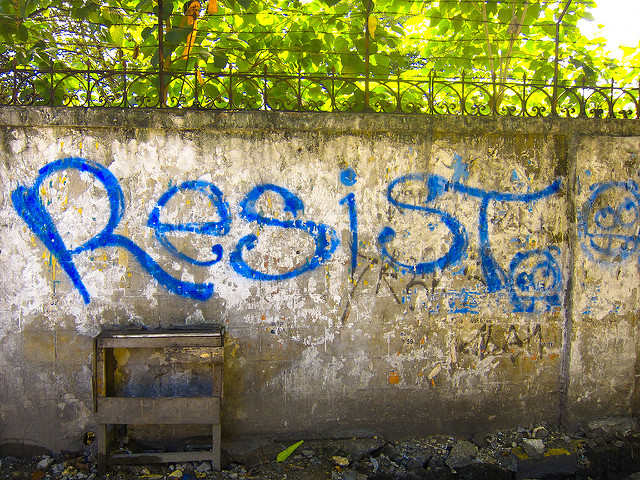
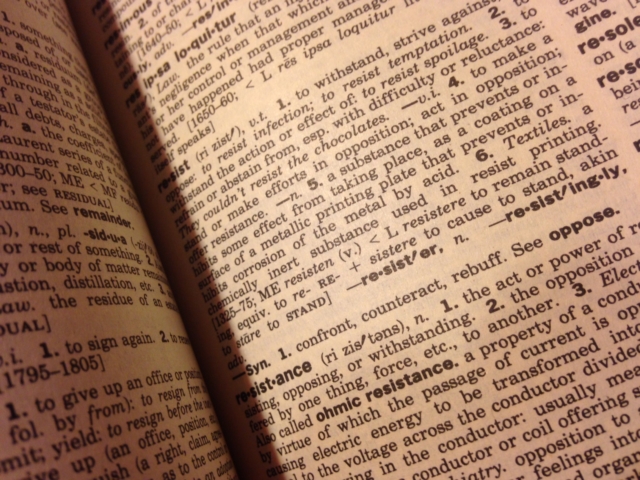
resist

Last Thursday, I found that single word scrawled in black Sharpie on the cardboard inside a package of photos I’d ordered. Odd, I thought, turning over the first of my photos.

The pictures were of me with my children, holding signs at the recent Women’s March, smiling and determined amidst a sea of humanity. I glanced again at the word. Was it intended for me? Vendors don’t send secret messages to customers. And photography places aren’t supposed to look at the content of what I’ve ordered, are they?

I lifted the second pile of photos—me with my children at the March for Science, still smiling, still determined, still amidst a sea of humanity—from a second piece of cardboard. There, in the same hand, another word:

persist

Okay.

Got it.

The words were for me. A photography company’s employee whom I’d never meet had probably broken corporate policy in sending them.

Why, though?

When I was in maybe third grade, a teacher assigned our class to create messages in bottles. We were to take glass bottles, decorate them brightly, write our messages on scraps of paper, stuff in the messages in and seal the bottles as cleverly as we could. I used melted wax, rubber cement glue and a top coat of clear nail polish. On a subsequent field trip, we would toss them off a boat and wait to hear back.

Alone in my bedroom, I had written my message. In the quiet of the night, as I pictured the stranger who would find my bottle, the note was more than a school assignment. I looked out my window at the vast darkness, the far-away stars, the scale of the universe dwarfing me. Torn from my heart, my message was a plea to the unknown:

Hear me. Let me know you’re out there, too. I don’t want to be alone.

That stranger would read my message. Without even knowing me, they would care.

Weeks went by, then months. No one ever replied to my message-in-a-bottle and I eventually forgot about the whole exercise.

That is, until I opened the package last week, when I was suddenly again nine. Except that now, I can see what I could not, then: The power of the exercise wasn’t in the anticipation of an answer but rather in the hopefulness of casting my words out to the universe. The act of writing my message, of fantasizing that someone might find it, of knowing someone could find it, was connection enough.

In that spirit, I’m not going to try to find out who sent me the note from the photography place.

Maybe I’m not even supposed to.

I read that employee’s message, and without even knowing them, I care. Today, alone in my study, I’m typing this message. It’s to you.

Hear me. Let me know you’re out there, too. I don’t want to be alone.

Resist. Persist. Connect.


An attorney by training, Amy L. Freeman’s day job is working with people suffering homelessness. By night she writes. Recent works have appeared in The Washington Post, The Huffington Post (featured content), Dogs Today UK and more. Visit her website at www.AmyLFreeman.com and connect on Twitter: @FreemanAmyL.

Photo credit: Carlo Villarica via a Creative Commons license.

You’re Nightly Run Down

[fusion_builder_container hundred_percent=”no” equal_height_columns=”no” menu_anchor=”” hide_on_mobile=”small-visibility,medium-visibility,large-visibility” class=”” id=”” background_color=”” background_image=”” background_position=”center center” background_repeat=”no-repeat” fade=”no” background_parallax=”none” enable_mobile=”no” parallax_speed=”0.3″ video_mp4=”” video_webm=”” video_ogv=”” video_url=”” video_aspect_ratio=”16:9″ video_loop=”yes” video_mute=”yes” video_preview_image=”” border_size=”” border_color=”” border_style=”solid” margin_top=”” margin_bottom=”” padding_top=”” padding_right=”” padding_bottom=”” padding_left=””][fusion_builder_row][fusion_builder_column type=”1_1″ layout=”1_1″ spacing=”” center_content=”no” hover_type=”none” link=”” min_height=”” hide_on_mobile=”small-visibility,medium-visibility,large-visibility” class=”” id=”” background_color=”” background_image=”” background_position=”left top” background_repeat=”no-repeat” border_size=”0″ border_color=”” border_style=”solid” border_position=”all” padding=”” dimension_margin=”” animation_type=”” animation_direction=”left” animation_speed=”0.3″ animation_offset=”” last=”no”][fusion_text]

By C. S. Guppy


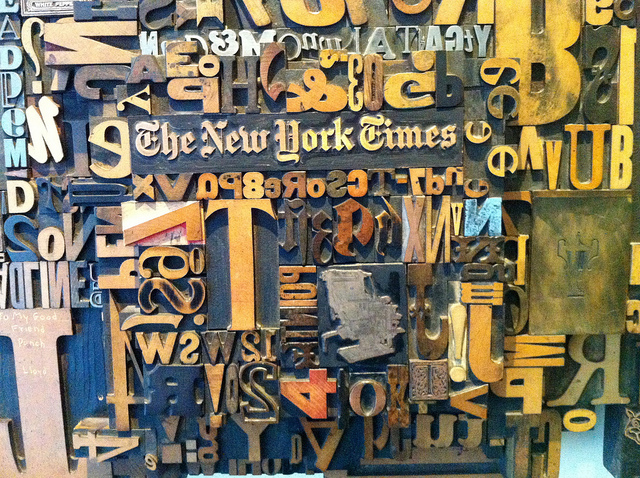
Source: The New York Times evening briefings from February 13 – 15, 2017

[/fusion_text][/fusion_builder_column][/fusion_builder_row][/fusion_builder_container][fusion_builder_container hundred_percent=”no” equal_height_columns=”no” menu_anchor=”” hide_on_mobile=”small-visibility,medium-visibility,large-visibility” class=”” id=”” background_color=”” background_image=”” background_position=”center center” background_repeat=”no-repeat” fade=”no” background_parallax=”none” enable_mobile=”no” parallax_speed=”0.3″ video_mp4=”” video_webm=”” video_ogv=”” video_url=”” video_aspect_ratio=”16:9″ video_loop=”yes” video_mute=”yes” video_preview_image=”” border_size=”” border_color=”” border_style=”solid” margin_top=”” margin_bottom=”” padding_top=”” padding_right=”” padding_bottom=”” padding_left=””][fusion_builder_row][fusion_builder_column type=”1_2″ layout=”1_2″ spacing=”” center_content=”no” hover_type=”none” link=”” min_height=”” hide_on_mobile=”small-visibility,medium-visibility,large-visibility” class=”” id=”” background_color=”” background_image=”” background_position=”left top” background_repeat=”no-repeat” border_size=”0″ border_color=”” border_style=”solid” border_position=”all” padding=”” dimension_margin=”” animation_type=”” animation_direction=”left” animation_speed=”0.3″ animation_offset=”” last=”no”][fusion_text]

Justin Trudeau of
Canada went
smoothly.

Prime Minister Shinzo Abe
returned home from
weekend golf outing
discussed response
to North Korea’s missile
test in full view
of diners

North Korea claims
its launch shows
the White House sent
mixed signals

On the homefront,
hitting a roadblock
in the quest
inside Trump Tower,
pressing on with
global deals

More harrowing details:
Canisters of chlorine
gas, a banned weapon,
were dumped
Russia, contrary to its
repeated claims, bombed
a major hospital

A California dam’s
Modern goddesses
come to life

The best and worst of
the American College of Physicians
Wait it out

Dairy industry
call on Congress to stop
makers of popular
plant-based alternatives

The 36 Questions
That Lead to Love
our latest
“Committed”
help

The resignation as President
Trump’s national
security adviser
was not entirely honest
—a new cruise missile

Mr. Trump
building relationships
with Arab countries
here
here
here

The police
assassination
found guilty of
murder and
kidnapping
the damaged
Oroville Dam

An influential
science advisory group
lent its support to
India as the
deadliest
in the world

[/fusion_text][/fusion_builder_column][fusion_builder_column type=”1_2″ layout=”1_2″ spacing=”” center_content=”no” hover_type=”none” link=”” min_height=”” hide_on_mobile=”small-visibility,medium-visibility,large-visibility” class=”” id=”” background_color=”” background_image=”” background_position=”left top” background_repeat=”no-repeat” border_size=”0″ border_color=”” border_style=”solid” border_position=”all” padding=”” dimension_margin=”” animation_type=”” animation_direction=”left” animation_speed=”0.3″ animation_offset=”” last=”no”][fusion_text]

After trying
some
competing theories:
how to keep them
fresh—
Romantic
walk
at the Westminster
Kennel Club Dog Show

Finally,
set sights on
the White House,
nonpolitical

President Trump
could “live with”
a one-state solution;
anger and
bafflement among
Palestinians

Russia denied
repeated
contact with
Trump campaign

The resignation of
Michael T. Flynn,
the leaks from
American intelligence
agencies to the
news media,
a computer,
iOS device,
Android device

Andrew Puzder withdrew
from consideration

Our reporters make
a harrowing choice:
Here’s a guide to your rights

Throughout the
country, independent
bookstores
have taken on a new life
as centers of
resistance

Police in Malaysia
attack North Korea’s leader,
Kim Jong-un
Mr. Kim
has ordered
more
than
300
executions

For the second straight
year, traffic deaths were up

When all eyes were on her
Beyoncé won
at the Grammys

It’s never been
a next-generation

We are
alone
in the universe

[/fusion_text][/fusion_builder_column][/fusion_builder_row][/fusion_builder_container][fusion_builder_container hundred_percent=”no” equal_height_columns=”no” menu_anchor=”” hide_on_mobile=”small-visibility,medium-visibility,large-visibility” class=”” id=”” background_color=”” background_image=”” background_position=”center center” background_repeat=”no-repeat” fade=”no” background_parallax=”none” enable_mobile=”no” parallax_speed=”0.3″ video_mp4=”” video_webm=”” video_ogv=”” video_url=”” video_aspect_ratio=”16:9″ video_loop=”yes” video_mute=”yes” video_preview_image=”” border_size=”” border_color=”” border_style=”solid” margin_top=”” margin_bottom=”” padding_top=”” padding_right=”” padding_bottom=”” padding_left=””][fusion_builder_row][fusion_builder_column type=”1_1″ layout=”1_1″ spacing=”” center_content=”no” hover_type=”none” link=”” min_height=”” hide_on_mobile=”small-visibility,medium-visibility,large-visibility” class=”” id=”” background_color=”” background_image=”” background_position=”left top” background_repeat=”no-repeat” border_size=”0″ border_color=”” border_style=”solid” border_position=”all” padding=”” dimension_margin=”” animation_type=”” animation_direction=”left” animation_speed=”0.3″ animation_offset=”” last=”no”][fusion_text]


[/fusion_text][fusion_text]

C.S. Guppy started out as a high school English teacher. That was so much fun, she decided to become a Sunday school director, then a desktop publisher, then a technical writer, then a graphic designer, then a copyeditor (for Ecotone literary journal), then a server, then a dog walker, then a mom, and most recently, an activist. She earned her MFA in Creative Writing from the University of North Carolina Wilmington in 2012. Her essays have appeared in The Sun and Alligator Juniper, with one forthcoming in Ruminate magazine. She lives in northern Colorado with her family.

Photo credit: Jeremy Keith via a Creative Commons license.

[/fusion_text][/fusion_builder_column][/fusion_builder_row][/fusion_builder_container]

Inaugural Bird Omens

By Annie Connole

inauguration (n.)

1560s, from French inauguration “installation, consecration,” and directly from Late Latin inaugurationem (nominative inauguratio) “consecration,” presumably originally “installment under good omens;” noun of action from past participle stem of inaugurare “take omens from the flight of birds; consecrate of install when omens are favorable,” from in– “on, in” (see in- (2)) + auguare “to act as an augur, predict” (see augur (n.))


“Keep your #eyes to the #skies tomorrow for the #inauguration for the #birds do no tell
#lies on how the #winds of change shall blow.”

– Maja D’Aoust, January 19, 2017


Signals Lost

The baby bird lay still in the sand beneath my gate. Open beak and neck, disproportionately larger than the rest of the tiny body, are stretched out, waiting to be filled.

Rain had been falling all through the final days of the last administration.

This story begins with the memory of hunger, depletion, lack. Signals lost when the landscape, the heart, and the head become waterlogged, and the scent, the sound that will lead home becomes obstructed by extreme weather.


There Will Be Blood

The rain keeps pouring.
In the center of the road, I find two perfect scarlet circles of blood beside a mourning dove with a wounded heart.

A Sacrifice, whispers the bird.
Of peace. Of love. Of messengers.

My heart bleeds next to the dove’s. My truck stalls before I go down the road to buy more paint so I can make a sign to say something about kindness and being awake and alive and powerful.


Prophesy

Why didn’t the coyotes take you?
I hear the story and prophecy.
Tell the village the dove is dead. Cries will be drowned out by the barking dogs.

I wonder, is it a relief to know what lies ahead?
Who will die this year? Will they be my father, mother, brother, lover, or one whose grace I have not yet seen?

Blood of roses disappears with the rain, an erasure of a life and death.

When does the blood of the bird
Become yours?

I do not pretend that this is anything but what it is.


I Know Why the Caged Bird Paces

Across the street lives a woman who is small with grey hair straight and curled under. Her skin is tan and taut. Her eyes, brown. Clothes hang on her bones.

She asks me to come inside. She needs help with her TV, with her doctor’s appointments. Calling her social worker. Figuring out how to get the physical therapy she needs to keep herself from falling over on her cement floor and cracking her head again.

A clear plastic sheet with a butterfly print separates her kitchen from the main room. In a single bed she sleeps there from late afternoon to pre-dawn. Through the butterfly veil, I see an elevated maze of several birdcages fashioned out of chicken wire, each containing one bird. Are they cages or just homes for birds?

Here in this house, I am asking if she has the card with the number of the social worker and I am looking at paperwork on hospital visits. Recommendation: Must wear oxygen mask when home. At all times.

The woman says, They want me to go to a home. But they can’t take me. I have my birds. I can’t go live in a home. What would happen to my birds?

I watch a pretty quail as she paces along the edge of her cube. Unlike the yellow cockatiel and the grey dove next to her, she appears free. Not fully caged. Three walls, not four. Wanting so much to touch ground. To go somewhere.

All the birds that live with the woman are broken in some way. For some, it may be just one wing that cannot fly. So they pace. She is pacing. Staying in motion. Stopping for too long would mean death.


Ancestors Speak

Down the block lives a man who voted for the new president. From across the fence he talks of jobs, global security, the price of everything.
When the man was very young, his mother took him to a Women’s March.
His mother enters. His mother, who has passed onto the other side, visits him as a hummingbird. She told him she would, and does.
The hummingbird flies over his head and back. Then stalls right there at the fence, fluttering in a cool hum in front of him.
Your mother is talking to you, I say.
I know.

A few days later, a woman tells me, our ancestors are always
Here among us, trying to reach us.

Let her in.


The Hen is a Hunter

I am at the neighbor’s farm, watching a baby alpaca dance, when a red hen runs through the stable, stealing something away.

As I watch her streak by, I look close to see what’s in her beak. It is grey. It writhes. A tail? A … mouse?

Yes, the hen will take the mouse and beat it until it is dead and smashed and she will peck at it …

The hen is a hunter? I had forgotten. For some, brutality and survival are one in the same.


Annie Connole, a Montana native, is a communications professional and multidisciplinary artist now based in California. She graduated from The New School with a B.A. in Arts in Context, and is pursuing an MFA in creative writing at University of California, Riverside.

Visit her website at www.AnnieConnole.com.

Photo credit: © 2017 Annie Connole.

Night Falls Before Morning

By Erica Gerald Mason

On Sunday night I began to read news on my phone,
after an afternoon spent fighting a chest cold
and watching old episodes of
new television shows.
I scanned three headlines with escalating
alarm and concern,
turned the phone off, and returned to the glow
of the larger screen.

Blinking away outrage like a hangover,
I closed my eyes to the world,
as information slipped under my skin.
I turned the phone back on and sought
dear friends at the familiar campsites
of profile pages and news feeds.

Her dog slept in the sun.
He had tacos for lunch.
She said Positive Vibes Only.
He said he never discusses politics.

Am I crazy? I thought.
I typed words of resistance.
But the right ones wouldn’t visit my mind.
Wouldn’t dance across my skin.
I sat in silent frustration for five minutes, ten.

Then:
All of this won’t happen if we don’t let it – I wrote.

I felt Sunday slipping away
as Monday waited outside my door. No more words came.
I turned off the light, placed the phone on the nightstand and
made myself as comfortable as possible in the dark.
Said goodnight and goodbye to
familiar campsites.
I closed my eyes and began to sleep
but I knew I wouldn’t again for a very long time.


Erica Gerald Mason is an author, poet, and speaker living in Acworth, Georgia. Erica writes about creativity, happiness, love, feminism, pop culture and current events. Her work appears in several publications and journals, and she was a featured poet in the 2016 and 2017 Sundance Film Festival Indie Lounge. Her book of poetry, I Am A Telescope: Science Love Poems is available on Kindle and paperback on Amazon. Find her blog and poetry at www.ericageraldmason.com.

Photo credit: Chetan Sarva via a Creative Commons license.

Inaugural Haiku

By Carla Drysdale

Damp Geneva seeps
into our cold feet marching
to protect women.

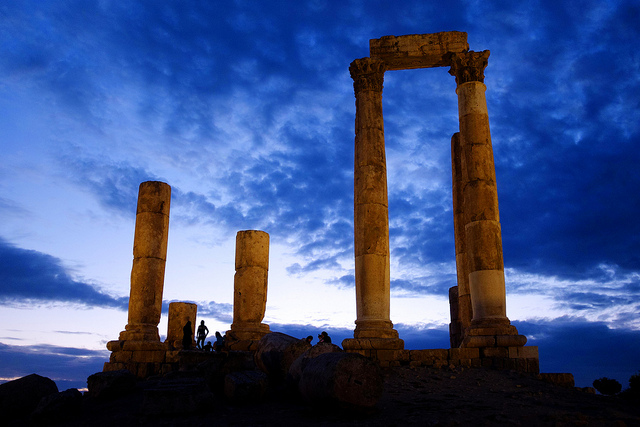
Stone sky tablet for
black calligraphy of trees
writing history.

The new president
says he’ll get rid of columns
when building new rooms.

The new president
says he’ll protect you from them
and then the rain falls.

The president’s mouth
puckers when he peers at us:
“I love you all now.”


Originally published in What Rough Beast, Indolent Books, 2017.


Carla Drysdale is the author of Little Venus (Tightrope Books, 2009) and Inheritance (Finishing Line Press, 2016). Her poems have appeared in LIT, The Tower Journal, Cleaver Magazine, PRISM International, The Same, Literary Review of Canada and The Fiddlehead, among other journals. She has work forthcoming in Nasty Women Poets: An Unapologetic Anthology of Subversive Verse, to be published by Lost Horse Press. In 2014, she won PRISM’s annual Earle Birney poetry prize and was nominated in 2015 for Bettering American Poetry. Born in Ontario, she lives with her husband and two sons in Ornex, France. Visit her website at www.carladrysdale.com.

Photo credit: Mahmood Salam via a Creative Commons license.

Moscow Mule Recipe

By Neleigh Olson


Ingredients

yellow hair

golden showers

systemic misogyny

an angry base

James Bond villains (Russian)

Twitter account

Directions

First, respond bigly, and I mean in a number one way, a terrific way, with the best words, to the number one tricky to our great nation. DO NOT COMPLETE SENTENCES. Keep one foreign friend under wraps, because you have so many friends it’s incredible, and these are the best, I mean smart, powerful people who. EXCLAMATION POINTS!!! Raise the temperature with coal we’re bringing coal back in big way, let me tell you, then beat the angry base with the idea they’ve been beaten long enough while sitting on a golden throne. TWEET ABOUT THIS. Declare the Russians good friends, tremendous friends. Shake well the foundation of democracy, decency, and international security. SAD! Distract!

Serve lukewarm, in a steady stream while your wife eats strings of diamonds. Pairs well with the most beautiful chocolate bomb cake.


Neleigh Olson is a fiction writer in the University of Kentucky’s MFA in creative writing program.

Photo credit: Kim Alaniz via a Creative Commons license.

Mother

By Noah Leventhal


the desert smells like Mother       stones
sundial their way across the dunes        reeking
of dust and blood and evaporation     a lizard

skitters across the scattered sand
each wretched bump in its thorny skin
a testament       drooping brittle grass

reaching up and down with thirst
when the ground shakes     when the wind
dies       when the heat digs deep below

the seas of crust and dust and age
you know Mother cries her paper
eyes out     Mother of blessings says time

is an illusion       this is why we rebuild cities
this is why the night markets churn
an ancient air with sugar       yeast and charcoal

smoke     beneath the rubble a Mother
sings her children out of memory       the markets
an illusion       the Mothers and their songs

of time     the wind       the stillness of the desert
Mother of capability knows        there are no
blessings       only candles that flicker and winds

still enough to let them       sunsets across the beige
expanse       rare things of beauty       curtains
in the window frames     woven in their likeness

houses return to sand       Mother
of capability doesn’t sing at night       she eats
and sleeps to meet the sun       Mother of sadness

rubs shoulders with Mother of peace        Mother
of wickedness trips across Mother of good
will     Mother of gentility interrupts Mother

of gaping wounds       Mother of dearth and poverty
gives to Mother of the rich       Mother of sunrise
lies with Mother of the night       Mother of your wishes

warms Mother of your fears       a million little deaths
descend       a future Mother’s mouth       raining upon
the mother                                   of all bombs


Noah Leventhal is a recent graduate of the classics program at St. John’s College in Santa Fe, New Mexico who currently lives in Los Angeles. As the grandson of a holocaust survivor, he was raised on the poetry of hope and resistance. Even on her deathbed, as other thoughts faded away, his grandmother’s tongue could recite Pushkin with perfect precision. Words stick with us, they become a part of who we are. The way we speak changes the way we think, and the way we think is everything.

Photo credit: Seniju via a Creative Commons license.

Take a Knee

by stephanie roberts

for Colin Kaepernick


Uncle Wade (that stubborn mule), grumbled
“Round them up!”
In what direction? I wondered.
The cane teams of the Caribbean?
or way back
to the cup and knuckle
of Gold Continent and trace origin.
“He’s half white.” I say, spitting cherry seed
against our worn bleached deck
a hard tear dark
hungry for soil’s soft capture.
Tired of the clip of this luxury of bile speech
tainting purple mountain
like the flagrant
spread of fall manure.
I knee down my throat lump of protest
thinking what is more American than that?


stephanie roberts has work featured or forthcoming, this year, in Reunion: The Dallas Review, The Stockholm Review of Literature, Room Magazine (Canada), Shooter Literary Magazine (UK), Burning House Press (UK), Rat’s Ass Review, The Inflectionist Review, After the Pause, The Thing Itself, Nano Text an anthology published by Medusas’s Laugh Press (as a contest finalist) and elsewhere. In 2016, she was a top ten finalist in Causeway Lit‘s fall poetry contest, and her work was featured in The New Quarterly, Blue Lyra Review, Contemporary Verse 2, and Breakwater Review. She grew up in Brooklyn, NY.

Photo credit: Miyukiutada via a Creative Commons license.

The Kindness of Jolene: a #MakeOurPlanetGreatAgain Parable

By Dan McClenaghan


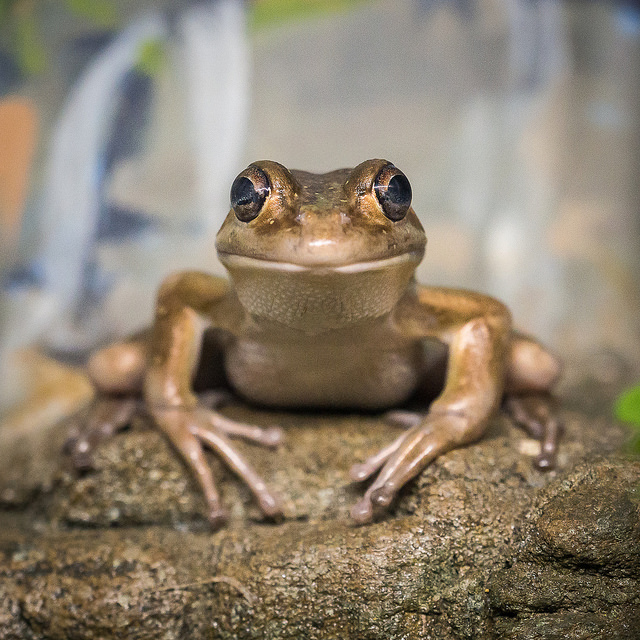
There’s no telling how the frog got into the lettuce. Hopped up out of an irrigation furrow just prior to harvest is the best guess. What is certain is that he ended up in Jolene Rivard’s salad, a rainbow of raw vegetable matter collected by Jolene herself at the salad bar. She didn’t see him hiding there until three bites in, when she stuck him in the butt with her fork.

This minor harpooning sent the small amphibian into a high hop that arced across the table and terminated in a landing, with a splat, on the top patty of Jolene’s husband Frank’s double cheeseburger, momentarily unbunned for the addition of condiments.

Frank tilted the ketchup bottle back and gazed into the eyes of the frog.

The frog returned his gaze and let out a feeble chirp. The melting cheese had entrapped him.

Jolene looked across the table as the frog struggled to free itself from the orange goop. Her sudden awareness of having possibly eaten some frog slime salad dressing made her stomach churn. She took a deep drink of water to rinse her mouth, then spit it back into her glass, as Frank nodded at the salad bar and said, “They got a crock of these guys up there? Wriggling around next to the radish slices?”

This frogs-in-a-crock image ramped up Jolene’s incipient nausea. She jumped out of the booth and strode, with extreme urgency, to the restroom, while Frank lifted the frog from his burger—strings of cheese stretching from each of its four little feet—and dropped him into Jolene’s water glass.

Jolene returned, pale and shaky, and slid back into her booth, as the waitress approached with the iced tea pitcher.

“Oh shit!” the young woman said upon spying the frog, which was swimming the perimeter of his new home.

“Got him at the salad bar,” said Frank. “Then he jumped onto my burger.” Frank pointed at the frog indentation on the cheese.

“Here, I’ll take him,” said the waitress, reaching for the glass.

“No!” Jolene shouted. She’d waitressed in her younger days, and she was pretty sure that a frog going back to the kitchen was destined for a ride inside the garbage disposal. “Bring us a to-go cup.” she demanded. “We’re taking him.”

Frank knew better than to protest. He drove. Jolene navigated. She told him to go to Guajome Park, to the small lake there. Frank carried the frog to the lake and poured him out of the to-go cup. The frog swam off.

It turns out, he was a she and, upon maturation, she laid eggs. Tadpoles emerged. Hundreds survived to adulthood. And on a warm spring evening they formed a choir, to sing a croaking ode to the kindness of Jolene.


Previously published by Excuse Me, I’m Writing.

___________________________________________________________

Dan McClenaghan writes stuff. He began with his Ruth and Ellis/Clete and Juanita stories in the early 1980s. At the beginning of the new millennium, he started writing reviews of jazz CDs, first at American Reporter, and then (and now) at All About Jazz. He’s tried his hand at novels, without success, although he has been published in a bunch of small presses, most notably the now defunct Wormwood Review. This was in the pre-computer age, when we whomped up stories on typewriters, then rolled down to Kinkos to make copies, which we stuck in manila envelopes, along with a return envelope with return postage attached. Times have changed. Aside from the writing, Dan is married to the lovely Denise. They have three wonderful children and five beautiful grandchildren; and Dan is a two-time winner—1970 and 1971—of the Oceanside Bodysurfing Contest. Kowabunga!

Photo credit: Marc Dalmulder via a Creative Commons license.

Mad, Times Four

By Cody Walker

He thought he saw the Sort of Men
He’d always Feared or Hated:
He looked again, and found it was
Eight Years, obliterated.
“It’s Sessions . . . Flynn . . . it’s everyone
Who—.” Silence, then. We waited.

He thought he saw his Dumb Concerns
(Exhausted, Getting Fat):
He looked again, and found it was
Dear God, some KOMPROMAT!
“My prayers are answered! Glory be!
Confirm this story, stat!”

He thought he saw a Thousand Rubles
Shoved inside Trump Tower:
He looked again, and found it was
Ivanka, looking dour.
“A thousand—that’s, what, sixteen bucks?!”
He laughed (for like an hour).

He thought he saw a Frightened Nation
Change its Locks and Keys:
He looked again, and found it was
Some guy on Twitter. “Pleeease!
Just tie him to a chair or something.
Feed him bits of cheese.”


Cody Walker is the author of The Self-Styled No-Child (Waywiser, 2016) and Shuffle and Breakdown (Waywiser, 2008). His poems have appeared in The New York Times, The Yale Review, Slate, Salon, and The Best American Poetry (2015 and 2007). His essays have appeared online in The New Yorker and the Kenyon Review. His new collection, The Trumpiad (Waywiser, 2017), was released in April; all proceeds will be donated to the ACLU. Visit Cody’s website at www.CodyWalker.net.

Photo credit: Daniel Oines via a Creative Commons license.

When You Plant Your Riot-Geared Feet

By Brooke Petersen

when you plant your riot-geared feet and say, we will brook no resistance, we say, listen to your own words. listen to this. listen: the Anglo-Saxon root brūcen means not to endure or tolerate, not to put up with, but to partake in. means, to need or require. to make use of as a right. to delight in. to brook resistance is to fist-up-fight-back because we have a need and a right and a joy—to hand-hold and arms-lock and shout. to brook resistance is to love resistance, to cling to it like rescue-rope, to heave and tug and drag yourself up from the water on its strength. listen to this, listen: when you say we will brook no resistance, you deny yourself joy.

when you say, we will brook no resistance, we say: then we will.


Brooke Petersen is a nonbinary poet who lives, teaches, and resists in San Diego, where they are pursuing an MFA. Their work has appeared or is forthcoming in Versal and on Blog this Rock (a Split This Rock affiliate).

Photo credit: K-B Gressitt.

Meeting Place

By Penny Perry

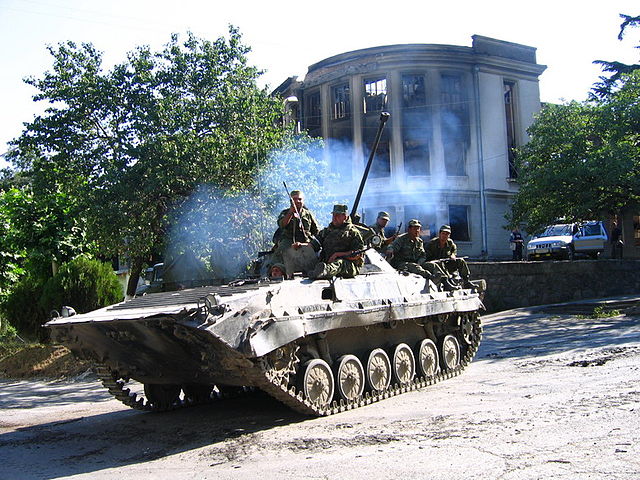
Author’s note: In August, 2008, Russian tanks and soldiers moved into the Republic of Georgia and killed 228 civilians. In March, 2014 under Putin, Russia seized Crimea. President Obama ordered sanctions against the Russians. Now, President Trump wants to remove the sanctions, and Putin wants to recapture the former territories of the Soviet Union. Trump’s admiration of Russia and his possible  collusion with Russian goals gives robust support to Russian aggression.

The Republic of Georgia, 2008 

Chain link fence, a field,
a narrow, wood bench,
shade from an untrimmed tree.
Sparrows still twittering
this August morning.

Maybe they are grandmothers,
wide white arms
in summer house dresses,
open-toed shoes.

The one on the bench in black,
a babushka on her head.

The other, a red print dress
with English letters.
Maybe, only a moment before
she stood, small purse in hand,
gray curls and dress flapping
in the slight breeze.

Maybe the woman in black smiled,
a story on her lips.

Now, wild ivy in her hair.
The red dress hiked above the knees,
white turnip legs stretched out,
purse near curved fingers.
Blood on her nose and forehead.
Eyes open, as if surprised
by the icy crackle of gunfire.

Her friend sits crying.
Two fresh loaves of bread
on the bench beside her.


Penny Perry is a five time Pushcart Prize nominee. Her first poetry collection, Santa Monica Disposal & Salvage, was published in 2012 by Garden Oak Press. Her new collection, Father Seahorse, will be published by Garden Oak Press in 2017.

Russian invasion force photo credit: Yana Amelina (Амелина Я. А.), via a Creative Commons license.

Aprons

By Joyce Teed

Appalling
that we have to
don our aprons
once again
clean this mess up
once and for all
and start beating
like a country
with one heart
beat
feed the lost
address the loss
of
one country
indivisible
and clean the
talking sheets
out of this
country
once and for all
making the bed
of safety
for one and
for all
forever
cleaning away hate
cooking love and
ironing away
our shame
at having let
our house
get so
dirty.


Joyce Teed

I am a light seeker. Teaching American literature for thirty years to high school juniors continues to be my passion. I am appalled that textbook companies in Texas are still trying to revise and ignore Native American genocide and Slavery, the number one and two sins of the United States— and that the current administration of these United States seems to be fostering racism and white nationalism to an extreme I never envisioned. I am not even considering retiring. There is too much work to do, and students need to see and hear from seasoned teachers who remember the Civil Rights era and believe in an America that embraces all people. Since DT’s reign, I have written a poem a week. Who knew that he was the muse I was waiting for?

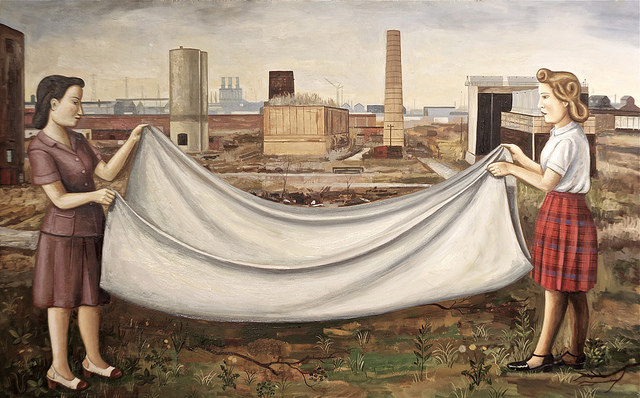
Illustration credit: “Folding the Sheet,” a painting in progress by Rick and Brenda Beerhorst via a Creative Commons license.

An Open Letter to the People Beyond the Fence

From David H. Reinarz,


I am writing to you from the Political Re-Education Farm, which I believe is somewhere in Southern Idaho. They won’t tell us exactly where we are. It’s part of the New Regime’s disorientation/reorientation technique. They’re trying to change our minds. There is a big fence around the farm—President 45 likes walls and fences. The Internal Border Patrol is on guard.

I don’t have a lot of time to write. It’s after bedtime, but it’s midsummer, so there’s still enough light to get this done before the guards do head count. One of them gives us scraps of paper and stubs of pencils he cadges from the supply room. He says his wife is Muslim and is in a camp in Alabama. We write down our resistance words. He says he will get them to the outside. I don’t know if he does. If you see this, know that we have not given up. We are not dead, yet.

We are poets, writers, playwrights, musicians, artists, dancers, actors, some college professors, a few politicians. America’s dangerous intelligentsia!

I was part of a group rounded up in Omaha, a blue spot in a red state. What we’d been writing and publishing was not only making the president crazy, his clones in the governor’s mansion and mayor’s office were angry and embarrassed that we wouldn’t be controlled. Even in the Midwest, there were voices of resistance.

We were held in the public baseball stadium, named after the governor’s family business. We were interrogated. We were given a chance to recant our views and sign a loyalty oath to President 45. It was the same loyalty oath you have to pledge to get a voting card or receive any government benefits since the New Regime initiated Level 2 of Making America Great Again.

Bowing down and giving in wasn’t going to happen. That night, we were handcuffed and hooded and put on a train headed out of town, destination unrevealed.

We do potatoes here. They have de-mechanized the agricultural practices, so there’s more work for more intellectuals to struggle with. Our struggle! On top of that, we are force-marched and receive regular beatings. Not so much that we are injured and can’t work. No, just enough to make us hurt a little more, make our farm work a little harder, know that our thoughts and words have brought us here and are the source of our suffering.

How is your health? How is your physical strength? How is your endurance? Did you ride a bike today? Did you do your yoga? Did you run up the stairs to your office?

You will need this, my friends. You will need this.

After we are done working in the hot summer sun and are physically weak and exhausted, there is interrogation. “What is your name? Where are you from? Who are your friends? Who did the publishing and distribution of your pamphlets? What books and newspapers did you read? What social media did you use? Give us your logins and passwords!”

Then dinner. Potatoes. Always potatoes. Potatoes and road kill.

After dinner there are three hours of re-education. “Who won the election? Who were the losers? How do you demonstrate loyalty to President 45?”

It’s brutal, listening to this guy from the Propaganda Ministry drill us on White Supremacy theory and Creationism and the need for a strong leader in a dangerous world. I think I would prefer another beating. Every day I make the point that whites are not supreme. I remember the Supremes. They were not white, but they were supreme. I also make the point that the only thing created here is a stronger Resistance. And I make the point that the world is only dangerous for those who support the leader, because the people will rise up and take back our country.

I get another beating.

I know you don’t want to hear, “I told you so,” but I don’t mind saying it. “I told you so.” Many people who’ve studied the history of the world and the history of America told you so. It doesn’t take long to take apart a government when you have a self-obsessed president surrounded by a few hard core ideologues, a few bad hombres working for them, a complacent Congress, and a de-fanged judicial system. You can’t just hope that everything is going to be OK. I am telling you this from a political prison farm in Idaho. They should have been stopped early on, before they got rolling.

If this gets to anyone on the outside, all of us here tell you: “Now is the time to resist!”

If this gets as far as the UN Headquarters in Berlin or The World Bank Headquarters in Tokyo, don’t be afraid to help us. We need the whole world to work for justice and to affirm the human rights of our wonderfully diverse population.

Time for dinner. Tonight’s menu: potatoes.

After lights out: Dig the tunnel. Dig, dig the tunnel. Before the hyenas come.

Yours truly,
David H. Reinarz


David H. Reinarz lives in Omaha, Nebraska. He recently retired from a long career as a retail bicycle shop manager. He is an alumnus of the 7 Doctors Writers Workshop and the author of a Story City: Ten Short Stories and One Long Story in the Middle. Published in 2016. It is available on Amazon.com, and he will donate 100 percent of Amazon royalties from all 2017 sales of Story City to the ACLU. His poem, “Album Cover: Songs from the Country Western Café” was published in the Winter 2017 issue of Plainsongs, Hastings College Press.

Photo credit: Ben Dalton via a Creative Commons licesnse.

deity’s daughter

By Nikia Chaney

memories are
like the ringing
of bells sharp
bells she
hangs on
the trees
on the hair of her
little girl the little
girl who
shakes her
braids to feel
cool beads
bang on the ear
the shoulder
blade we walk
to catch sweat
and dew
in the morning sweat
and salt and warm
cold so the woman
the woman places
the dark blanket on
the curled up child
the child kissing
us with wind and need
loneliness echoing
and losing itself down
the hall all
these stars buzzing
their pools on the sidewalk
a black sidewalk
full of chalk black
buildings scored
in the heart the
braid in her
hair falling
loose how we would
do anything
to give her a world
in which she had
worth and i
remember yesterday
she drew a dandelion
up to the sky
and blew and
blew and we clung
onto skirts
and we learned
to breathe


Nikia Chaney is the current Inlandia Literary Laureate (2016-2018). She is the author of two chapbooks, Sis Fuss (Orange Monkey Publishing, 2012) and ladies, please (dancing girl press, 2012). She is founding editor of shufpoetry, an online journal for experimental poetry, and founding editor of Jamii Publishing, a publishing imprint dedicated to fostering community among poets and writers. She has won grants from the Money for Women Barbara Deming Memorial Fund, Poets & Writers and Cave Canem. She teaches at San Bernardino Valley College. Visit Nikia’s website at NikiaChaney.com.

Photo credit: Shardayyy via a Creative Commons license.

familial observation

by Amanda N. Butler

The family
that rallied
against my
first molester
is the same
that voted for
the man
who said
he could grab
me by the
pussy.


Amanda N. Butler is the author of two chapbooks, Tableau Vivant (dancing girl press, 2015) and effercrescent, to be published this fall by the same press. Her poetry has also appeared in poems2go, Haikuniverse, NatureWriting and ALTARWORK, among others. She can be found online at arsamandica.wordpress.com.

Photo credit: torbakhopper via a Creative Commons license

Reflections on Trump, Torture and Camus’ The Rebel

By Karen Malpede


It will get worse.

Much worse with the Trump Administration fully in place. The Cabinet from hell, a collection of incompetents, racists, sexists, fossil fuel and other business moguls, Islamophobes, and ignoramuses, is in a slow, agonizing process of confirmation, one by one, against widespread civil protest and principled opposition from most senators in the minority and toothless Democratic Party. Some Cabinet nominees, like Betsy DeVos, sister of Eric Prince, founder of the notorious private contracting torture outfit, Blackwater, have direct ties to profiting from torture. DeVos is now Secretary of Education with responsibility for overseeing the education of the young.

It will get worse. Until … somehow— No one knows.

A nation can vote its (flawed) democracy away. Or, rather, a non-representational election system, the Electoral College, that favors states with smaller populations, plus half an eligible citizenry—demoralized, ill-educated or disenfranchised and refusing, forgetting or unable to vote—and an influx of billions over many years by the Koch Brothers and others to elect the most right-wing ideologues, can combine—did combine—to put a neo-fascist regime into the White House. One cannot call them public servants; they have been bought.

I was one among many who foolishly, it turns out, thought the nightmare would go away on November 8, Election Day. We were up most of the night, struggling with disbelief and woke to find the country we knew was gone.

What if we had held the Bush torturers accountable for their crimes? Starting with Jessen and Mitchel, the two psychologists who wrote the torture manual, and the private contractors, CACI, Blackwater and the rest, and going all the way up to Cheney, Rumsfeld, Bush, himself. What if we had held Colin Powell accountable for lying at the U.N.? What if we had prosecuted the administration for leading the U.S. into an illegal invasion of Iraq, which posed no present threat? But, despite the efforts of dedicated human rights organizations and lawyers who represented detainees and authors who wrote against the torture program the war, there was not the public will or interest to hold the torturers accountable.

When President Obama announced we must look forward, not back, that, although he would not sanction torture, he also would not investigate the crimes of the past, torture, in journalist Mark Danner’s words, became “a policy choice.” And drone warfare became the murder weapon of choice.

Now we have an announced Islamophobe in the White House who says, against all evidence, “that torture works”; who says the nation and the world are under threat, not from global warming which he calls “a hoax,” or nuclear weapons, but from “radical Islamic terrorism,” which must be stamped out. When he starts a war and uses “national security” to silence all dissent, if and when he turns the police against his own people in order to shut us up, then the resistance will go underground, but its numbers will be eroded as many people concerned mainly with domestic issues will silence themselves.

Two questions occupy me now: how to resist and how to survive.

When I was young, we had assassinations, one after the other, of great leaders, principled if flawed young men: John Kennedy, Medgar Evers, Martin Luther King, Bobby Kennedy, Malcolm X, and many Black Panthers, including Fred Hampton, said to be the new, charismatic leader of a movement and assassinated by “law officers” as he slept in his bed. We had Civil Rights, Anti-War, Native American, Feminist and Gay Rights movements, for which those men and other men and women gave their lives, each movement achieving freedoms that had been too-long denied. Today, we see these movements recognizing and building common cause.

It is in reaction to the freedoms these mass movements won, that the Trump regime vowing to “make America great again” has come to power. The fears of white people struggling with falling incomes and the loss of jobs have been conveniently tied to the interests of the corporate class. The urgency of the fossil fuel industry (predominantly white, male) to extract and sell every last bit of oil and gas under the ground, in reaction to a growing Environmental Movement, has led to “a corporate takeover,” as Naomi Klein said with her usual acumen. We are caught between two fiery methods of mass annihilation, living under a president who is, most likely, mentally unstable, a pawn for corporate interests, and who understands neither the dangers of nuclear war nor climate change.

We are all potential torture victims now. We watch and wait as the instruments of our misery are readied and engaged. We have nothing to confess but that we failed to secure our liberty and protect the earth on which we live, though some of us fought and continue to fight hard and long for just these things.

We make phone calls, sign petitions; we march, by the millions; we rely, again, upon our principled lawyers and judges; we struggle to mount an effective opposition; and we try to keep our souls alive.

I have been reading Camus’ The Rebel, slowly since just after the election. I finished it last night. Camus lived through the worst nightmares of the Twentieth Century in which Nazi Fascism and Soviet Totalitarianism (both begun as revolutionary movements to make things “great”) caused the murders of many millions and gave rise, eventually, to the perhaps now fading but no less dangerous hegemony of the United States.

What does Camus propose? A rebellious heart that governs principled action. “The rebel undoubtedly demands a certain degree of freedom for himself; but in no case, if he is consistent, does he demand the right to destroy the existence and the freedom of others. He humiliates no one. … He is not only the slave against the master, but also man against the world of master and slave.” Is this not a concise, persuasive anti-torture statement?

Moreover, despite his ever-present use of the masculine pronoun, Camus’ book proves itself to be a profound environmentalist, earth-centered, therefore, ecofeminist work. He insists upon limits, recognizing our concern for the present as the key to securing the future, and he acknowledges the finite sanctity of earth, earth’s creatures and earth’s biosystem as determinants of our actions. “The rebel thus rejects divinity in order to share in the struggles and destiny of all men. We shall choose Ithaca, the faithful land, frugal and audacious thought, lucid action, and the generosity of the man who understands. In the light, the earth remains our last love.” He reiterates the thought throughout: To earth we owe allegiance, earth’s needs set limits on our actions.

Camus does not promise success. The Rebel is not a hope-filled, revolutionary statement; Camus abhors the very notion of revolution. He offers, instead, description of an evolution of consciousness that is within the realm of human possibility and sentient being. Camus proposes an “insane generosity … which unhesitatingly gives the strength of its love and without a moment’s delay refuses injustice. … Real generosity toward the future lies in giving all to the present.”


Originally published by Torture magazine.


Karen Malpede is an American social justice, antiwar and ecofeminist playwright. A collection of her plays, Plays in Time: The Beekeeper’s Daughter, Another Life, Prophecy, Extreme Whether, will be published by Intellect Press in 2017. She is a frequent contributor to Torture Magazine.

Illustration by Mario Piperni via a Creative Commons license.

Border Children on the News

By Laura Grace Weldon

Frantic families send their children
past drug runners and thieves,
through deserts, on tops of freight trains,
over 1,700 miles seeking
refuge at our border.

Tonight, we tweeze sushi into our mouths
under a blast of chilled Happy Hour air.
Screens broadcast dark-eyed children
behind chain link fences
while protestors chant
Go back home! and U-S-A!

A congressman vows to expedite
their return to where they belong.
“Yeah, deprived of a hearing,” we mutter
and a guy eating spicy duck wings
next to us says “There are laws for a reason.”

Agile in conflict studies,
the bartender sets out
complimentary edamame.
Offers refills.
Changes the TV station.
Lets the comprehensible violence
of hockey soothe
as our drinks arrive.


“Border Children on the News” was previously published by Blue Collar Review.


Laura Grace Weldon is the author of a poetry collection titled Tending and a handbook of alternative education, Free Range Learning. She has a collection of essays due out soon. Laura has written poetry with nursing home residents, used poetry to teach conflict resolution, and painted poems on beehives, although her work appears in more conventional places such as J Journal, Penman Review, Literary Mama, Christian Science Monitor, Mom Egg Review, Dressing Room Poetry Journal, Shot Glass Journal, and others. Connect with her on Facebook, Twitter or at her site, lauragraceweldon.com

Photo credit: United Soybean Board via a Creative Commons license.
Attitude

By Brigitte Goetze


The alternative ways are in stark opposition, but if she works patiently through her difficulties, trusting herself to life, living each day as fully and as truly as possible, seeking through sincerity of living to solve the problem of their opposition, she may perhaps find a way to a reconciliation.
                                                                           – M. Esther Harding, The Way of All Women

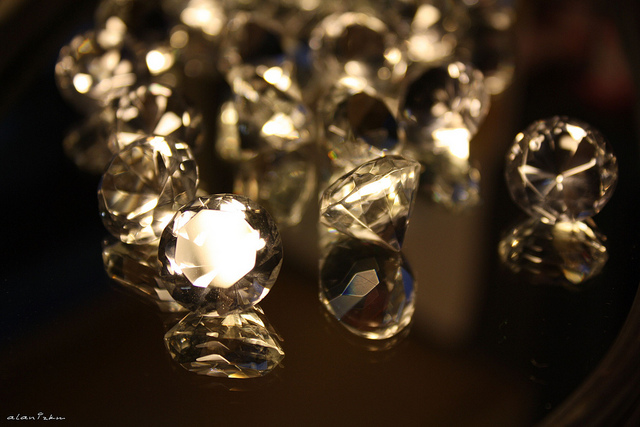
Power will have its way,
no matter how damned
its path. Like flood water
it will widen a small crack,
splitting the land into two,
uprooting what stands innocently
in its commandeered course.

You, who live upstream,
pick up whatever tool you have,
shovel, wheelbarrow, hoe,
rush up the Hill, help
draw a ditch across the slope,
diverting the deluge’s downpour
away from seedlings and old shrubs.

And you, who live downstream,
join your neighbors,
fill sandbags or nourish those
working: many a place can be
cordoned off from the swollen,
murky, ice-cold torrent against which
weapons of war are useless.

Energy cannot be destroyed, but
it can be channeled. Even if some will not
be protected from the inevitable
mud flow, yet, it may not devour all.
We are able, willing, and ready
to defend with our hands and hearts
what we have labored so hard to built.


Brigitte Goetze lives in Western Oregon. A retired biologist and angora goat farmer, she now divides her time between her writing and fiber works. She finds inspiration for both endeavors in nature and in the stories and patterns handed down from generation to generation. Her words have been published by, among others, Calyx, Women Artist’s Datebook 2011, New Verse News, Oregon Humanities, Agave Literary Journal, Pyrokinection, and in such anthologies as Love Letters, On the Dark Path, and Element(ary) My Dear. Visit her website at brigittegoetzewriter.com.

“Attitude” was originally published by NewVerse.News.

Photo credit: U.S. Library of Congress.