Secret Light
By Marianne Xenos
Sylvia stood at her worktable polishing a crystal diadem with a soft flannel cloth. The handcrafted headpiece was adorned with prisms and thrift-store rhinestones. Afternoon sun slanted through the large bay windows of her makeshift studio, the dining room of her late mother’s Victorian house. Sylvia smiled, remembering her mother with a twist of love and loss. “Who needs a dining room, anyway,” her mother had said a few months before her death, letting Sylvia create a refuge for her art.
The sun warmed the well-organized space, glimmering on Sylvia’s collection of art materials. Shelves held old television tubes, colored glass, and Kodachrome slides, and scattered boxes contained vintage jewelry, miniature mirrors, and antique teacups. Sylvia often made small sculptures, usually fantastical assemblages from found materials, but during the past year she’d begun experimenting with larger works involving prisms and projected light.
Sylvia’s brother Ash worked in the room directly over her head. She heard his guitar as he worked on a composition. They were both in their mid-forties and both currently single. They’d considered themselves too old to live with their mother, but after the political convulsion of the last few years, they needed affordable space, and their mother had needed in-home support before her death from the unnamed flu. Sylvia now had the only “day job,” not as a sculptor, but teaching art in the local high school. Ash found under-the-table gig work, because new restrictions from the Bureau for Biological Truth barred trans people from most jobs.
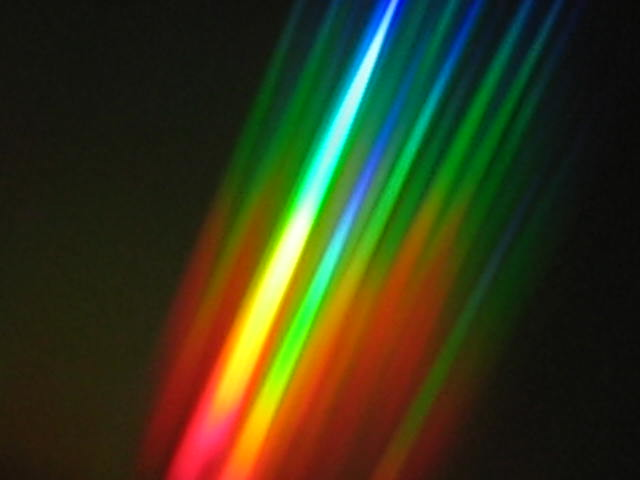
Sylvia held the diadem in a ray of sun, the crystals breaking the light into a rainbow. Natural light was called white, but a prism revealed light’s secret colors, which danced on the walls as Sylvia turned the object in her hands.
“Be careful. You could be arrested for that.” Ash stood in the doorway and smiled. There was no mistaking them as siblings. They had the same dark curly hair. Ash’s was cropped short and Sylvia tied hers back while she worked. They had their father’s brown eyes and olive complexion, and their mother’s strong nose and chin.
“I know. It’s crazy to spend so much time on work nobody will see.”
Ash nodded. They’d had this conversation many times. When President Andrew “Andy” Leblanc had created the Bureau for Biological Truth, he banned everything from rainbow flags to preferred pronouns. Not only that, over seventy percent of galleries had closed nationally, and those still open wanted only classical or representational work, avoiding anything experimental.
Ash held out an envelope. “Have you checked your mail lately? I got a weird letter today.”
“Just getting a letter is weird. I haven’t seen the mail carrier in weeks.”
Sylvia put the diadem on the table. She’d made five of them for the work-in-progress, an art installation she called “Secret Light.” Of course, the piece was just a fantasy at this point. In the current art scene, the work could never be exhibited.
Ash waved the letter in his hand. “Somebody is offering to fund one of my more experimental compositions. And it looks like you have a letter from the same return address.” He handed the unopened envelope to Sylvia. “And get this—they address me as Mr. Diaz-Malone. Mister.”
Sylvia looked up, surprised. “Well, there’s another thing that could get a person arrested.” Acknowledging transgender identity had been illegal for the past six months. She opened her own letter addressed to Ms. Sylvia Diaz-Malone.
“Huh. Somebody wants to fund my installation work, especially anything inspired by light.”
“Something weird is going on,” Ash said, as he walked over to the window, staring at the house across the street. Their neighbors, who recently found a swastika painted on their front door, were covering their multicolored Victorian house—a perfect three-story “painted lady”—with glossy white paint.
One of LeBlanc’s earliest executive orders mandated classical architecture, reminiscent of Greece and Rome, for government buildings. The order was for federal buildings, but as a symbol of patriotism, some began painting their homes stark white. Some even built pillars framing doorways on everything from McMansions to double-wide trailers.
Sylvia taught art history and knew the original Roman Colosseum had been painted with bright colors, as vivid and showy as the painted lady across the street. But Leblanc’s patriots embraced the misunderstanding of whiteness, even if the columns framing their doors were built from Styrofoam blocks.
“I guess the neighbors are finally giving in to pressure,” Sylvia said. “We at least used off-white paint when we painted ours.”
“Yeah, but we didn’t get a swastika on our front door. Or a drive-by bullet, like at Blaze’s place.” Ash turned from the window and glanced again at the letter in his hand. “Have you ever heard of the ‘Propaganda Assets Inventory’?”
“No, is this some new Leblanc thing?”
“No, it’s historical. Supposedly, after World War II, the CIA—believe it or not—helped fund abstract expressionism. They didn’t want France dominating the world art scene, so they secretly supported American artists.”
“That’s ridiculous. Most of those guys were radicals or at least skeptics. They’d never get cozy with the CIA.”
“Exactly, so the backing was top secret. Maybe this is the same thing. Somebody in the government wants to push against Leblanc’s policies.”
Sylvia scanned her own letter. “Or this could be a joke. And even worse, it could be a trick to bring us out into the open.”
“But what if somebody with influence wants to turn things around? Half the world is laughing at Leblanc. Maybe there’s an agency within an agency, somebody who wants a different kind of American exceptionalism.”
“I’m skeptical.” Sylvia took both letters and brought them out to the mail desk by the front door, with Ash following behind. “Let’s think about it. But today we need to rescue Blaze.”
Ash pulled out his phone. “Have you thought about what we offered? Any change of heart?”
“No, he should be here with us. Things are getting too dangerous.”
Despite the swastika across the street, their neighborhood was still safer than the one where their friend Blaze was camping on somebody’s couch. It was an area where whiteness was becoming a cult, and any whiff of color, such as their friend—a gay Black dancer with dyed purple locks—was a target.
Sylvia stood by while Ash facetimed their friend, and asked if he was ready to move in. Blaze hesitated for a moment, and Ash said, “Blaze, you know my mother loved you. She would want you here.” Blaze, looking relieved, agreed.
Ash asked, “Hey, have you received any letters about your artwork?”
“We don’t all live in a big house on Main Street, honey. I haven’t even seen junk mail in two years.”
“Good point,” Ash said, and told Blaze about the offers.
“You think somebody wants artists to stand up against President Andy Android? I’m convinced that guy is nothing but an AI projection.”
Sylvia leaned towards the phone. “What are you even talking about?”
“Well, has anyone ever seen him in public? Ever seen anything other than his torso above a desk?”
“Maybe he doesn’t want to catch an unnamed flu.”
“Or maybe they’ve created a president who can’t die of an unnamed flu.”
The last two presidents had died within a year of each other, each from “natural causes,” rumored to be a rogue virus, unstudied and unnamed. It was possibly the same unnamed flu that killed their mother. She was a former hippie and outspoken recovering alcoholic and loved slogans. Her favorite was, “You’re only as sick as your secrets,” and then she’d died of a secret illness.
Sylvia leaned towards the phone again. “Ash thinks the letters are from a clandestine government agency, trying to regain American exceptionalism in the arts.”
“Ha! And we’re the best they can work with?”
Ash laughed but said, “Maybe they’re looking for a new flavor of exceptionalism.”
“Too many conspiracy theories!” Sylvia said. “I just want to work—to make something beautiful! Or at least make something. Is that too much to ask?”
Blaze sighed and said, “Let’s look at your piece tonight, sweetie. We’ll just do it. Draw the blinds, set up your gear, and run it.”
“Do you have something white to wear? Maybe something sexy.”
“Sexy? You called the right number, girlfriend.”
“Okay,” she said. “We’re on our way.”
At the door, Sylvia paused to reread her letter, wrinkling her nose as though something smelled bad. Ash had put on his public disguise, a pair of tear-drop earrings, faux gold clip-ons from the bottom of their mother’s jewelry box. The earrings had been too boring for their hippie mother to wear, and maybe they’d been a gift from her kids when they were young enough to want an ordinary mom.
“The teardrops of invisibility,” Ash said, as he clipped them on. Sylvia kissed her brother on the cheek, and they went to pick up Blaze.
• • •
As they drove towards Blaze’s neighborhood, Sylvia said, “Wait! What’s going on over there?” On the street, a group of kids pushed a girl to the ground. Ash pulled the car over.
“They’re teenagers,” Sylvia said. “Let me take the lead on this.”
“It’s all yours,” Ash said, and they both rushed out of the car.
Sylvia had learned to fight in middle school, defending both herself and her queer sibling from bullies, and as an adult she’d learned to fight smarter rather than harder. She’d dated both women and men, so she wasn’t exactly straight, but she could pass unless she said what was on her mind. Sometimes, in a pinch, she used that privilege, and she put on her schoolteacher persona.
She took out her phone as she ran up to the group. A teenaged girl lay on the ground, and another girl with heavy boots was pulling back for a kick.
“Hey you! Stop it! I’m calling the cops now.”
“Call the Bio Cops, bitch. She’s a queer.”
“No, I’m calling the real cops. This is assault, and it’s illegal.”
The girl with the heavy boots paused and scowled at Sylvia. She didn’t even glance at Ash who stood behind her, and Sylvia hoped the earrings were doing their magic.
“Who the fuck are you? Another pervert?”
Sylvia used her phone to take a picture. “I’m Miss Diaz-Malone, and I work at the high school. Listen to me—after I call the cops I’m sending this picture to your principal. Do you want your parents to see it?”
“But she’s one of them! Look!” The girl with the boots held up a lavender scarf. “She belongs in Bio Camp.”
Sylvia snapped another picture. “You’re okay with the cops questioning you? Nothing illegal in your pockets? Nothing to hide? I’m ready to dial, but leave now, and I’ll let it go.”
The kids swore and grumbled, tossed the scarf back at the girl, but they left. Ash stepped forward to give the girl a hand. She looked rumpled, but no injuries. Something about her reminded Sylvia of herself at that age. Vulnerable, stubborn and always having to fight.
“I’m Sylvia,” she said, “And this is Ash. Are you okay? Do you need a ride someplace?”
“No, I’m almost home. But….” Sylvia raised an eyebrow in question. “My parents are going to be pissed.”
Ash said, “We live in the center of town. The off-white house on Main Street—number 237. If you ever have trouble, come and find us.”
Sylvia gestured to the lavender scarf. “Pretty scarf, but you better stash it until the craziness passes. Just to be safe.”
The girl stuffed it in her backpack. “Thanks,” she said. “My name is Ruthie.”
They got back in the car and watched the girl as she walked away.
Ash said, “Do you really think the craziness will pass?”
“We have to hope. What would Mom say?”
“Something wise and pithy about the thing with feathers or this too shall pass.”
“She quoted somebody once: ‘Hope doesn’t glimmer; it burns.'”
“That reminds me. Let’s go get Blaze.”
• • •
They found Blaze waiting on the front stoop of a five-story apartment building with peeling blue paint. His purple locks were gone, but he walked towards the car looking undiminished, tall and handsome in a black leather jacket. While Ash drove home, they chatted about the letters. Blaze had called his old roommate, who confirmed the post office had stopped delivery to that neighborhood a year ago. No mysterious letters had been slipped under the door.
• • •
Ash used the front parlor as a rehearsal space, and currently it was the home of Sylvia’s installation-in-progress. They’d pushed the sofa against one wall and collections of instruments stood in the corners. With a wink towards classical architecture, four white pedestals formed a large square in the center of the room, set about six feet apart. Each pedestal was four feet high, and each held a crystal diadem. Sylvia had mounted eight laser spotlights on the ceiling, and they beamed down like pillars of light.
Blaze had packed something sexy. He wore a white, vintage tuxedo, and was bare-chested underneath, except for a string of white pearls. He stood in the center of the room, arms outstretched, tipping his hand in and out of the bright beams.
“I know you’re a sculptor, honey, but this is just screaming for movement—for a dancer.”
“Well, it might just be screaming for you.”
Ash said, “If we ever do this for real, I could play some glass instruments. Like an armonica. Or there’s something called a chromatic aquarion.”
“Yes, that would be perfect. And I know I need to improve the lights—make the beams tighter and stronger—but for now let’s just try it.”
Sylvia turned off all the lamps, leaving only the eight beams of light, and Ash took his guitar to the sofa. Blaze stood in the center of the pedestals and put the most ornate diadem on his head. While Ash began to play, he and Blaze improvised, following one another’s cues. Blaze experimented with the headpiece, sweeping his head through a beam of light, tossing colors like confetti against the bare walls. He paused to adjust the diadem on his head, and took two more from the pedestals, one for each hand. He glanced at Sylvia for affirmation, and she nodded, making a mental note to create a more secure headpiece for a performer and to consider prismatic wands.
Blaze arched and swept the diadems through the pillars of light, matching his movement to the rhythm of the guitar. Twirling his head and hands, he dipped in and out of the beams, from darkness to light and back, color splashing like water against the drawn shades. Yes! Sylvia felt like shouting, but didn’t want to break the focus. The three of them were in sync, the piece coming together like a landscape. The structure of the installation like stones, music like water, and Blaze’s movement like sunlight flashing on the surface. The room held a fizz of energy, reminding Sylvia of the tang of ozone at the edge of a waterfall.
Sylvia thought, Yes, this is working….
A knock came from the front door, startling them all.
Her heart thumped, but she said, “Don’t move. I’ll see who’s there.”
Looking through the peephole, Sylvia saw Ruthie, the girl from the street. Slouched on the front stoop, hands stuffed in the pockets of her hoodie, the girl had a bulky backpack slung over one shoulder.
Sylvia opened the door and saw Ruthie’s swollen face with a new bruise just forming under her left eye.
“You said if I need anything.”
Sylvia looked up and down the street. “Did those kids do this?”
“No, my dad. He said I was drawing attention, putting everybody in danger. So, I left.”
Sylvia let her in and closed the door, turning all the locks.
“The light glimmering on the window shades was beautiful,” Ruthie said. Then her eyes widened as Blaze came out in his tuxedo and pearls.
Ash stood at the door to the parlor holding his guitar. “Ruthie, you’re welcome here no matter what, but I have to ask—what kind of trouble are we looking at? How old are you?”
“I’m seventeen. Hand to god, dude. I’m now legally old enough to converse with queer folks.”
Ash nodded, and Blaze said. “Okay, but here’s a more important question: Are you now or have you ever been a member of the CIA? Or the Propaganda Assets Inventory?”
Ruthie laughed and shook her head. “No, never.”
“Okay, girlfriend, you pass the test. Now help me put blankets over these windows and I’ll show you how the tiaras work.”
“They’re diadems,” Sylvia said as she picked up the two letters on the mail table, once again wrinkling her nose. Was it an opportunity or a trap? She’d been calm while they were working, a rare feeling of certainty, but now her anxiety had returned—anxiety about the world, the future, and the battered girl in her parlor.
Ash put his arm around her and whispered. “Sometimes hope glimmers before it burns, right? You’re the boss for the moment. Do you want to run it again? You might have just gained an intern.”
Sylvia held the letters over the wicker trash basket their mother always kept next to the mail table. “May I?” she asked. “Hand to god, dude, something stinks about this.”
Ash laughed and nodded. “I trust your instincts.”
Sylvia dropped the letters into the trash. Work would calm her panic. It always did.
“Yes, let’s run it again.”
Marianne Xenos is a writer and artist living in western Massachusetts in the United States. She creates stories about magic, history, and family secrets. Most of her characters occupy positions of “otherness”—some as immigrants, some as LBGTQ+, and some because of magical inclinations. Her stories have been published in magazines and anthologies including The Fantastic Other, The Underdogs Rise, Writers of the Future #39, Orion’s Belt, and the game anthology, Winding Paths. She was a first-place winner of the Writers of the Future contest in 2022 and a finalist for the Speculative Literature Foundation’s Working Class Writers contest in 2024.
Photograph by sila via a Creative Commons license.
A note from Writers Resist
Thank you for reading! If you appreciate creative resistance and would like to support it, you can make a small, medium or large donation to Writers Resist on our Give a Sawbuck page.