Meeting Place

By Penny Perry

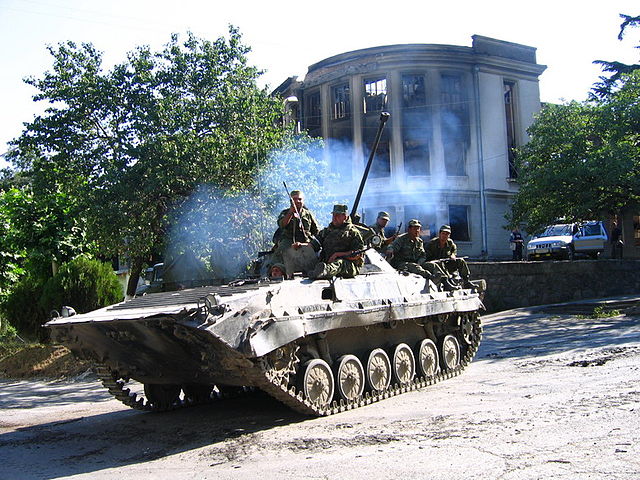
Author’s note: In August, 2008, Russian tanks and soldiers moved into the Republic of Georgia and killed 228 civilians. In March, 2014 under Putin, Russia seized Crimea. President Obama ordered sanctions against the Russians. Now, President Trump wants to remove the sanctions, and Putin wants to recapture the former territories of the Soviet Union. Trump’s admiration of Russia and his possible  collusion with Russian goals gives robust support to Russian aggression.

The Republic of Georgia, 2008 

Chain link fence, a field,
a narrow, wood bench,
shade from an untrimmed tree.
Sparrows still twittering
this August morning.

Maybe they are grandmothers,
wide white arms
in summer house dresses,
open-toed shoes.

The one on the bench in black,
a babushka on her head.

The other, a red print dress
with English letters.
Maybe, only a moment before
she stood, small purse in hand,
gray curls and dress flapping
in the slight breeze.

Maybe the woman in black smiled,
a story on her lips.

Now, wild ivy in her hair.
The red dress hiked above the knees,
white turnip legs stretched out,
purse near curved fingers.
Blood on her nose and forehead.
Eyes open, as if surprised
by the icy crackle of gunfire.

Her friend sits crying.
Two fresh loaves of bread
on the bench beside her.


Penny Perry is a five time Pushcart Prize nominee. Her first poetry collection, Santa Monica Disposal & Salvage, was published in 2012 by Garden Oak Press. Her new collection, Father Seahorse, will be published by Garden Oak Press in 2017.

Russian invasion force photo credit: Yana Amelina (Амелина Я. А.), via a Creative Commons license.

Aprons

By Joyce Teed

Appalling
that we have to
don our aprons
once again
clean this mess up
once and for all
and start beating
like a country
with one heart
beat
feed the lost
address the loss
of
one country
indivisible
and clean the
talking sheets
out of this
country
once and for all
making the bed
of safety
for one and
for all
forever
cleaning away hate
cooking love and
ironing away
our shame
at having let
our house
get so
dirty.


Joyce Teed

I am a light seeker. Teaching American literature for thirty years to high school juniors continues to be my passion. I am appalled that textbook companies in Texas are still trying to revise and ignore Native American genocide and Slavery, the number one and two sins of the United States— and that the current administration of these United States seems to be fostering racism and white nationalism to an extreme I never envisioned. I am not even considering retiring. There is too much work to do, and students need to see and hear from seasoned teachers who remember the Civil Rights era and believe in an America that embraces all people. Since DT’s reign, I have written a poem a week. Who knew that he was the muse I was waiting for?

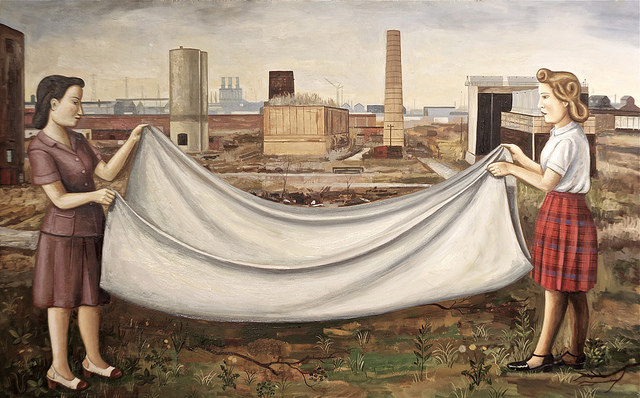
Illustration credit: “Folding the Sheet,” a painting in progress by Rick and Brenda Beerhorst via a Creative Commons license.

deity’s daughter

By Nikia Chaney

memories are
like the ringing
of bells sharp
bells she
hangs on
the trees
on the hair of her
little girl the little
girl who
shakes her
braids to feel
cool beads
bang on the ear
the shoulder
blade we walk
to catch sweat
and dew
in the morning sweat
and salt and warm
cold so the woman
the woman places
the dark blanket on
the curled up child
the child kissing
us with wind and need
loneliness echoing
and losing itself down
the hall all
these stars buzzing
their pools on the sidewalk
a black sidewalk
full of chalk black
buildings scored
in the heart the
braid in her
hair falling
loose how we would
do anything
to give her a world
in which she had
worth and i
remember yesterday
she drew a dandelion
up to the sky
and blew and
blew and we clung
onto skirts
and we learned
to breathe


Nikia Chaney is the current Inlandia Literary Laureate (2016-2018). She is the author of two chapbooks, Sis Fuss (Orange Monkey Publishing, 2012) and ladies, please (dancing girl press, 2012). She is founding editor of shufpoetry, an online journal for experimental poetry, and founding editor of Jamii Publishing, a publishing imprint dedicated to fostering community among poets and writers. She has won grants from the Money for Women Barbara Deming Memorial Fund, Poets & Writers and Cave Canem. She teaches at San Bernardino Valley College. Visit Nikia’s website at NikiaChaney.com.

Photo credit: Shardayyy via a Creative Commons license.

familial observation

by Amanda N. Butler

The family
that rallied
against my
first molester
is the same
that voted for
the man
who said
he could grab
me by the
pussy.


Amanda N. Butler is the author of two chapbooks, Tableau Vivant (dancing girl press, 2015) and effercrescent, to be published this fall by the same press. Her poetry has also appeared in poems2go, Haikuniverse, NatureWriting and ALTARWORK, among others. She can be found online at arsamandica.wordpress.com.

Photo credit: torbakhopper via a Creative Commons license

Border Children on the News

By Laura Grace Weldon

Frantic families send their children
past drug runners and thieves,
through deserts, on tops of freight trains,
over 1,700 miles seeking
refuge at our border.

Tonight, we tweeze sushi into our mouths
under a blast of chilled Happy Hour air.
Screens broadcast dark-eyed children
behind chain link fences
while protestors chant
Go back home! and U-S-A!

A congressman vows to expedite
their return to where they belong.
“Yeah, deprived of a hearing,” we mutter
and a guy eating spicy duck wings
next to us says “There are laws for a reason.”

Agile in conflict studies,
the bartender sets out
complimentary edamame.
Offers refills.
Changes the TV station.
Lets the comprehensible violence
of hockey soothe
as our drinks arrive.


“Border Children on the News” was previously published by Blue Collar Review.


Laura Grace Weldon is the author of a poetry collection titled Tending and a handbook of alternative education, Free Range Learning. She has a collection of essays due out soon. Laura has written poetry with nursing home residents, used poetry to teach conflict resolution, and painted poems on beehives, although her work appears in more conventional places such as J Journal, Penman Review, Literary Mama, Christian Science Monitor, Mom Egg Review, Dressing Room Poetry Journal, Shot Glass Journal, and others. Connect with her on Facebook, Twitter or at her site, lauragraceweldon.com

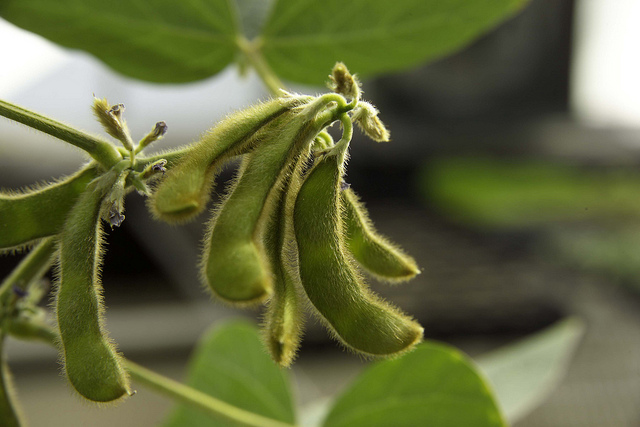
Photo credit: United Soybean Board via a Creative Commons license.

Attitude

By Brigitte Goetze


The alternative ways are in stark opposition, but if she works patiently through her difficulties, trusting herself to life, living each day as fully and as truly as possible, seeking through sincerity of living to solve the problem of their opposition, she may perhaps find a way to a reconciliation.
                                                                           – M. Esther Harding, The Way of All Women

Power will have its way,
no matter how damned
its path. Like flood water
it will widen a small crack,
splitting the land into two,
uprooting what stands innocently
in its commandeered course.

You, who live upstream,
pick up whatever tool you have,
shovel, wheelbarrow, hoe,
rush up the Hill, help
draw a ditch across the slope,
diverting the deluge’s downpour
away from seedlings and old shrubs.

And you, who live downstream,
join your neighbors,
fill sandbags or nourish those
working: many a place can be
cordoned off from the swollen,
murky, ice-cold torrent against which
weapons of war are useless.

Energy cannot be destroyed, but
it can be channeled. Even if some will not
be protected from the inevitable
mud flow, yet, it may not devour all.
We are able, willing, and ready
to defend with our hands and hearts
what we have labored so hard to built.


Brigitte Goetze lives in Western Oregon. A retired biologist and angora goat farmer, she now divides her time between her writing and fiber works. She finds inspiration for both endeavors in nature and in the stories and patterns handed down from generation to generation. Her words have been published by, among others, Calyx, Women Artist’s Datebook 2011, New Verse News, Oregon Humanities, Agave Literary Journal, Pyrokinection, and in such anthologies as Love Letters, On the Dark Path, and Element(ary) My Dear. Visit her website at brigittegoetzewriter.com.

“Attitude” was originally published by NewVerse.News.

Photo credit: U.S. Library of Congress.

Nevertheless, She Persisted

By Carolyn Norr

I followed her to the sea,
she placed ripe pineapples
in the frothing waves that had swallowed
her ancestors and were still swallowing.

The river led to the sea and was laced
with mine tailings
that silenced the frogs and swelled
her son’s bones till he burst.
I followed her to the courthouse to tell.

We knew what was going to happen.
I winced before the bullet hit.
It was her daughter who dragged her
to a quieter place and tended the wound,
chanting under her breath, mami, mami
her brow wet and salty.

I followed her through the broken streets
of the city, walking not fast, not slow
because she held also the hand of her nephew
and the scarves we wrapped around our faces
didn’t quite keep the sting of the gas out
so when tears dripped to the corners of our mouths
we swallowed them.

I followed her through the desert,
hung on her back and tried
not to be too heavy. You are not
too heavy.  She told me. But
I could smell her sweat.

I sat with her in the patch of garden
she tended, along the side of the painted apartments
below the orange pine the bark beetles feasted on
the long hot winter. She brought buckets of water
to the seeds, and the seeds, after all
opened. She sighed.

I held her with a cord finer than a hair,
held her lightly in my womb
almost not touching.
I told her what was going to happen.
I warned her. I gave her a choice.
Nevertheless, she persisted.


Carolyn Norr is a mother and youth worker in Oakland, CA. In chewing over the recent accusation of persistence, she thought of the many women in her neighborhood and around the world who persist in seeking life. She also thought of her own children.

Photo credit: Neville Wootton Photography via Visualhunt / Creative Commons license

Vandals Desecrate Jewish Cemetery

By Laura Budofsky Wisniewski

Not that it’s such a fancy graveyard,
just a hill, a mess,
stones leaning on each other
like the fathers of the bride and groom
after the wedding.
Our names are almost gone,
covered by a weeping moss.
I begged my son before I went, just burn me.
Do they listen?
Under all this dirt, tattooed numbers glow
like fireflies.
My Yacob used to say:
They’re never done with us.
And I would think, so dark an eye
in such a handsome man?
Now his headstone’s cracked like an egg.
Desecration?
Let’s face it.
Small animals and even bears
have squatted on our sacred ruins.
That’s not what drags my bones
here, as if fear were a wolf’s tooth.
No, it’s that I let myself believe
the world was getting better.


Laura Budofsky Wisniewski writes and teaches yoga in a small town in Vermont. Her work has appeared or is forthcoming in Calyx, Minerva Rising, Hunger Mountain, Pilgrimage and other journals. Her grandparents were immigrants fleeing persecution.

Photo credit: Chany Crystal via a Creative Commons license.

Something There Is That Doesn’t Love

By Olga Livshin

…people like me. Does not like our sweatshirts,
pilled, our backpacks, full of bric-a-brac,
us, detained, on the floor, airport animals.
Something has claimed that my adopted
country’s autobiography of openness
is finished. Something opens the mouths
of my Jewish immigrant family to mutter:
good for those terrorists to wait,
hope their turn doesn’t come.
So thank you to all of you,
who sprang to protest when something
forbade people who are like me. Thank you
for translating your memory of Babcia, of
Abuelita, into this mom, traveling home.
Your act of translation climbs over walls,
a prankster with tired eyes. It helps us
know each other. Gently it joins our hands
with Mr. Frost’s, asking, just one more time:
why would anyone help? What
doesn’t love a wall? And the cheeky poet
goes on hinting: “It is not elves, exactly…”


Olga Livshin is a poet, essayist and literary translator. Her work is forthcoming from The Kenyon Review and The International Poetry Review, and it has appeared in Jacket, Blue Lyra Review, Mad Hatters’ Review, and other journals. Livshin is commended by CALYX journal’s Lois Cranston Memorial Poetry Prize, Cambridge Sidewalk Poetry Project, Poets & Patrons Chicagoland Poetry Competition, and the Robert Fitzgerald Translation Prize (twice). She is the founder of White Oak Workshop, a collective that teaches creative Top of FormBottom of Form writing through responses to literature outside the Anglo-American canon. She lives in Bryn Mawr, Pennsylvania with her family. Visit her website at www.olga-livshin.com.

Photo credit: K-B Gressitt © 2017

Some Poems

By Nancy Dunlop

                  Brutal Things Must Be Said  –James Baldwin


Some poems reside
in oven mitts, opening
the stove and reaching
for the pan with the leavened
bread flowing over its edges,
the mitts pull it out, piping
hot. A safe and soothing thing.
We are okay.

Some poems are like an arrow
in a bow, pulled taut, held
with great control, and then
released, the point
searing the air, straight
to the bull’s eye. Such poems
can be hard to watch without
flinching. You
avert your gaze before
the moment of puncture.

But what is the Poem to do? Not
hit its mark? Not speak?

Some poems wait
to be written on
the Reporter’s notepad, upon
arrival at the scene of
an accident. Yes,
it can be that acute
and chaotic and hard
to get the words to dribble
down the page, what with the
flashing lights, the mix
of bloodied coats, limbs
akimbo, sharp spikes of metal
and glinting glass. Just
getting through the barrier
of Yellow Tape surrounding
this type of poem can be
daunting.

But some poems
demand that much of you.

Some poems are loaded
guns, standing
in the corner of a Lady’s
bedroom. You will look
away from these poems,
unless they are tucked
in an anthology, padded by other,
softer Literature. The Professor
turns to this Emily
of a poem, asks
the class, What
does the gun represent? The students
come up with flailing
answers, or they don’t. Every
semester is different. The bell
rings, and it’s on to Psych 101.

Some poems contain
a knife blade, a bottle, a needle, a taser.
some poems rush their sick children
to the ER. Again. Some poems
are raped and constantly
interrupted. With flashback. Flashback. Flashback.

Such poems make it minute
to minute, if
they are lucky. They do not
have the luxury
to protest a Pipeline a trillion
miles away. Or, for others,
a Pipeline is the only thing they have
in front of them, getting
closer, bulldozers trenching
through their land. Tell me,
what is coming through
your front door?

Poems are like people. Each one
has a story, a dark thing they
carry.

You’ll see these poems lying in Hospice beds
when the Chemo stops working.
They use walkers, because their limbs
are dying. They are propped up in institutions,
alone and waiting for some nurse,
to bring a meal, so they can say hello
to someone today. Some poems
have distended bellies and parasites
crawling on them. Some crouch
on sidewalks, covered in cardboard.
Some poems are soldiers
home from combat, never finding
their words, never trusting anything, anybody
ever again. Some poems have survived
concentration camps and are branded
into the skin.

Some poems are typed
on Brown paper, Black paper,
fearing for their safety. Some
poems love other poems,
but are told they shouldn’t.

Such poems expect silence when they appear. Or
brutality. Never sure
of which. They have always
known that they will be
pushed to the margins,
until they fall off the edge
of the page on which they cling.

Some poems are called Nigger,
Cunt, Pocahantas, Fag, Irrelevant,
Wrong, No room
at the Inn.

But some poems can be found
in oven mitts, reaching
into a stove, pulling out
the finished loaf. Your family’s
favorite. You sit around the table,
and break bread, newly
nourished. You bless the world
inside and out your kitchen window,
a hum and patter of words draped
on the counter behind you,
in the oven mitts still warm, still
holding the memory of the shiver
and pop of the yeast, the stretch and
rip of the leavening
that makes way for the release,
the Rising. The final fruition.


Nancy Dunlop is a poet and essayist who resides in Upstate New York, where she has taught at the University at Albany. A finalist in the AWP Intro Journal Awards, she has been published in print journals including The Little Magazine, Writing on the Edge, 13th Moon: A Feminist Literary Magazine, Works and Days and Nadir, as well as in online publications such as Swank Writing, RI\FT, alterra, Miss Stein’s Drawing Room and Truck. She has forthcoming work in Free State Review and the anthology, Emergence, published by Kind of a Hurricane Press. Her work has also been heard on NPR.

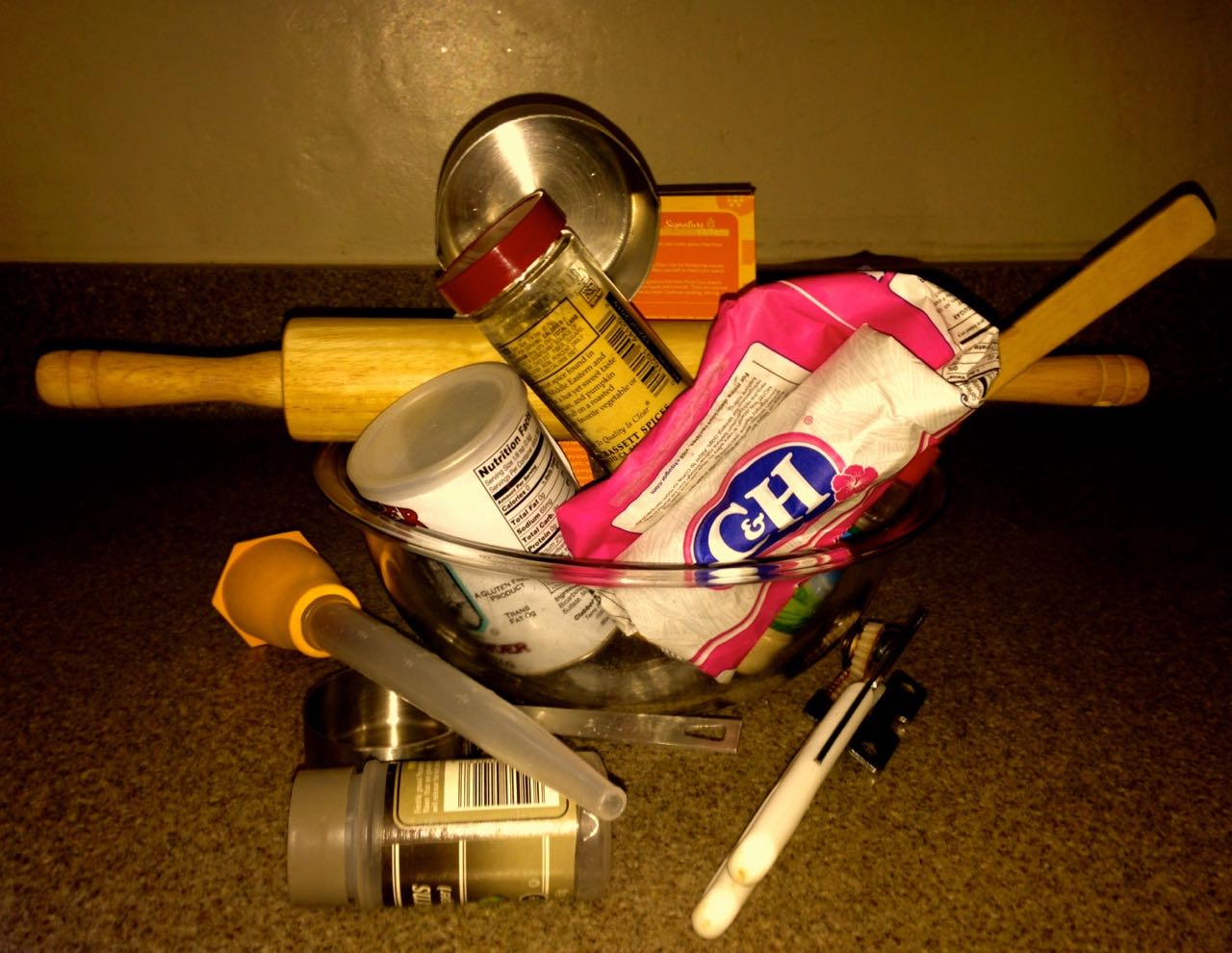
Photo credit: Guru Sno Studios via a Creative Commons license.

First 100 Days: Recipe for Disaster

By Kelsey Maki


In a mixing bowl, combine three cups of intolerance with two cups of ignorance. Add one cup of charged rhetoric and two tablespoons of alternative facts. Stir until smooth. Pour into a bulletproof, non-stick pan.

Topping: In a separate bowl, combine one cup of self-satisfied sugar (GMO) and three cups of concern for corporate America. Add two tablespoons of coal slurry and a pinch of fracking wastewater.

Bake while you watch Hannity.
Let cool for ten minutes before serving.
Eat at your own risk.


Kelsey Maki writes travel articles, literary fiction, and magical realism. She is an English instructor at Brookdale Community College in New Jersey. Her fiction has appeared in Mosaics: A Collection of Independent Women—Volume I. Visit her website at kelseymaki.wix.com/Kelsey and check out her blog Syntax Surfing: A Sentence-Lover’s Blog about Books, at kmakiblog.wordpress.com/.

First 100 Days: We the People Who March

By Yun Wei

We walk because that is all to be done
all our bodies can do
when so much has been done to us.

We walk because it’s not done: the work
of hands pressed against stone
and monuments, the work that hands must do

when there are no more parts
to assemble, just an endless sorting
of hows and whys, punctuation marks

that can’t contain the content,
as if brackets could stand for windows,
as if a parenthesis could pronounce justice,

inclusive, resistance – all the words
we need in stone. (No need to pull down
the monuments: these were already written)

We walk because gravity is sliding past,
because backwards is not a road,
and when the pavement slides too,

and the lampposts and stop lights,
the freeways and ways to freedom,
we will find a rise in morning light

that casts lines as wide as roads
because rising is all our bodies can do
when there is so much to be done,

so much to make bright.


Yun Wei received her MFA in Poetry from Brooklyn College and a Bachelor’s in International Relations from Georgetown University. Her writing awards include the Geneva Literary Prizes for Fiction and Poetry and the Himan Brown Poetry Fellowship. Her fiction and poetry have appeared in decomP Magazine, Roanoke Review, Apt Magazine, Word Riot, The Brooklyn Review and other journals. For the last few years, she was working on global health in Switzerland, where she consistently failed at mountain sports.

First 100 Days: Protest Poem in Two Acts

By Zigi Lowenberg


I.

saturday, january 21, 2017

she’s got the whole world…
holding Mom’s hand, their fists raised in West Palm breeze
while her stepdaughter and grandsons march in Hawai’i
her cousins throng Fifth Avenue
as her Oakland tribe rings Lake Merritt.

only later she learns,
another big lie floats, his number bloats
for Langley his facts are phooey
he signals, he gloats.

II.

street alchemy

making poems with her hopeful feet
gutter balls of fire, the heat—the heat
burning railing throats, running sore
we’re chanting sparks that bite and fuel
crowdsourcing for that asphalt elixir “Justice!”
surely it must come
on our hot sweaty insistent heels
of THIS. 


 Zigi Lowenberg, performance poet and co-leader of the jazzpoetry ensemble UpSurge!, has appeared at music festivals, rallies, clubs, bookstores and universities from NYC to New Orleans to San Francisco. Zigi’s acting credits include The Lysistrata Project, the Stein-Toklas Project, and John Browns Truth, Zigi is a member of the National Writers Union, and Radical Poets Collective. Her poetry has appeared in the poetry journal rabbit and rose. Her essay, “Support the Edge!” will be published in a book Creative Lives (spring 2017). Zigi and her husband, Raymond Nat Turner, are executive producers on UpSurge!’s two independent CD recordings, which have garnered critical acclaim. They live in Harlem and Oakland.

Photo credit: Dennis Hill via a Creative Commons license.

First 100 Days: Sanctuary

By Jennifer Hernandez

Border fence
divides
barbs catch
rip
prevent
free range
prevent
migration
of wildlife
of many lives
gaps
allow glimpses
of el otro lado
amber waves
blue blue skies
gauzy clouds
floating elusive
storms brew
on the horizon


Jennifer Hernandez lives in Minnesota, where she works with immigrant youth and writes poetry, flash, and creative nonfiction. Much of her recent writing has been colored by her distress at the dangerous nonsense that appears in her daily news feed. She is marching with her pen. Recent work appears in Anti-Heroin Chic, Dying Dahlia, New Verse News and Yellow Chair Review, as well as Bird Float, Tree Song (Silverton Books) and Write Like You’re Alive (Zoetic Press).


First 100 Days: Power by Adrienne Rich

By Tarra Stevenson

Living in a white fog of patriarchy/phallocentrism/misogyny

Today a class of teenage girls
radiant
discussed the power
of Marie Curie
her sacrifice to birth knowledge
even in the face of her own death. A radio-
active superwoman.

Today a vice-president eliminated
possibility
potential
denying their rights
denying her fights

and the teenage girls understand this
toxicity.

But they are tired
of sacrificing,
of seeing
(ElizabethWarrenMaxineWatersHillaryClintonHenriettaLacksZeldaFitzgeraldMarinaAbramovicMothersSistersDaughtersJaneDoeUnnamed)
themselves
Sacrificed.

They refuse this half-life.


Tarra Stevenson teaches at an all-girls school, where she is an agitator, educator and feminist. She has fiction in Shirley Magazine and poetry in Vinyl Poetry and Prose. She earned her BA from UC Davis, her MA from Loyola Marymount University, and is currently pursuing her MFA in fiction from UC Riverside’s low-residency program.

Photo credit: Loran via a Creative Commons license.

First 100 Days: Wiretap Tweets—Defined

By Charles W. Brice


Terrible (tĕr′ə-bəl): n. A salutation. Syn.: dear, my dear, hi, hello

Just (jŭst): n. & v. A statement of absolute truth. Ex: Just found out that Obama had my “wires tapped.”

Found Out (found out): tr.v. To receive an incontrovertible revelation of indisputable fact from a minor entertainment personage on Fox News.

Wire (wīr): n. A force aimed at crushing narcissism.

Tap also Tapp (tăp): n. A euphemism for the shattered fantasies of a tyrant.

Lawyer  (loi′yər): n. Someone who will teach everyone a lesson.

Sacred (sā′krĭd): adj. A term used to depict something as being religious when one is wholly ignorant of religion or spirituality. Ex: sacred toothpicks, sacred cornflakes, “sacred election process.”

“Wiretap” (wīr′tăp′): tr.v. To watch, surveil, or look at. Ex: “Wiretap that girl, Billy, and pass me a Tic Tac.”

Bad  (băd): adj. A dyspeptic global emotion experienced upon waking in the early hours and relieved only through tweeting before breakfast or by experiencing a huge, laxative induced, bowel movement.

Sick Guy (sĭk gī): n. Any member of the entire world who disagrees with the tyrant.

Sad (săd): adj. 1. Whatever inhibits grandiosity. 2. n. The present state of affairs in the United States of America.


Charlie Brice a retired psychoanalyst living in Pittsburgh. His full length poetry collection, Flashcuts Out of Chaos, is published by WordTech Editions (2016) and his second collection, Mnemosyne’s Hand (WordTech Editions), will appear in 2018. His poetry has been nominated for a Pushcart Prize and has appeared in The Atlanta ReviewHawaii ReviewChiron ReviewThe Dunes Review, SLAB, Fifth Wednesday Journal, and elsewhere. Read about Charlie’s collection Flashcuts Out of Chaos at The Borfski Press.

Note: Wiretap Tweets-Defined was previously published in Tuck Magazine.

Going Limp

By Ruth Nolan

It was your favorite story, the one you most loved
to tell me, from the days when you were the star
of your high school football team, MVP, you’d say:

It’s important to go limp after throwing a pass
because you know you’re going to get hit
and that way you’re less likely to get hurt

It was the story you loved to share, long before
I’d left the game. We’d drink beer after beer after
a day on the fire crew, over and over you’d tell

the winning story that became the best advice
I’ve ever heard, although I turned it around
to work for me, it became the rules for how to

receive the pass when you threw the ball, hard.
It became more and more important, each time
that you slugged me and cracked open my lip,

when you snuck up behind me and put me in a
chokehold, just to see how I would react, when
you threw me against a wall, our baby in my arms.

I got so good at going limp that for all these years,
I just knew I would deliver that ball all the way to
touchdown, never getting hurt, never going down.


Ruth Nolan, a former wildland firefighter in the Western U.S., is a writer and professor based in Palm Springs, CA. She’s the author of the poetry book Ruby Mountain (Finishing Line Press 2016). Her short story, “Palimpsest,” published in LA Fiction: Southland Writing by Southland Writers (Red Hen Press 2016), received an Honorable Mention in Sequestrum Magazine’s 2016 Editor’s Reprint contest and was also nominated for a 2016 PEN Robert J. Dau Short Story Prize for Emerging Writers. Ruth’s writing has also been published in James Franco Review; Angels Flight LA/Literary West; Rattling WallKCET/Artbound Los Angeles; Lumen; Desert Oracle; Women’s Studies Quarterly; News from Native California; Sierra Club Desert Report, Lumen; The Desert Sun/USA Today and Inlandia Literary Journeys. Ruth holds her M.F.A. in Creative Writing and Writing for the Performing Arts from the University of California, Riverside. She may be reached at ruthnolan13@gmail.com and via Twitter @ruthnolan.

Photo credit: Foxcroft Academy via a Creative Commons license.
Uprising

By Janey Skinner


Pink pointed ears popped up everywhere. Skeins in pocket, women knit as they marched, constructing together the greatest pussy hat of all, its oval opening frilled in coral, cinnamon and crimson yarns, too soft and too strong to tear.

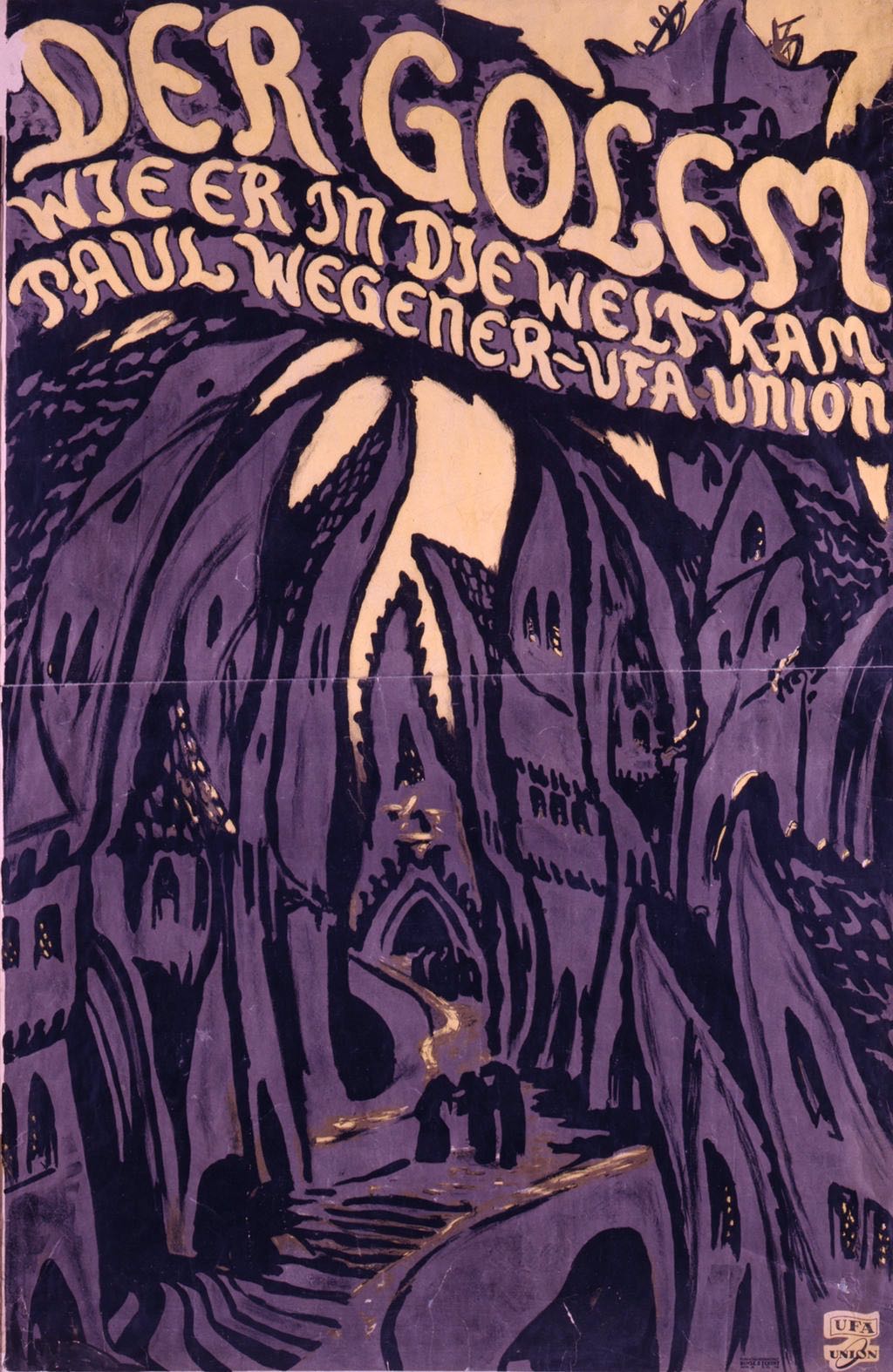
Some say the Golem emerged from that hat, a bud of damp clay and fury that shot to full size in a flash, but I suspect it had long slept among us.

Was it us it pulled in its wake, or we who propelled it? Trouncing toward Washington with the pussy hat on its head, a confection of our relentless resistance.


Janey Skinner is a writer, teacher and activist in the San Francisco Bay Area. Her story “Carnivores” appeared in Best Small Fictions 2016, edited by Stuart Dybek and Tara Masih. She is at work on a novel about resistance to the war in Colombia, when she isn’t fighting for public education or fuming about encroaching fascism. Check her out at writer.janeyskinner.com.

Der Golem movie poster, 1920, in the public domain.

American Signs

By R.M. Engelhardt

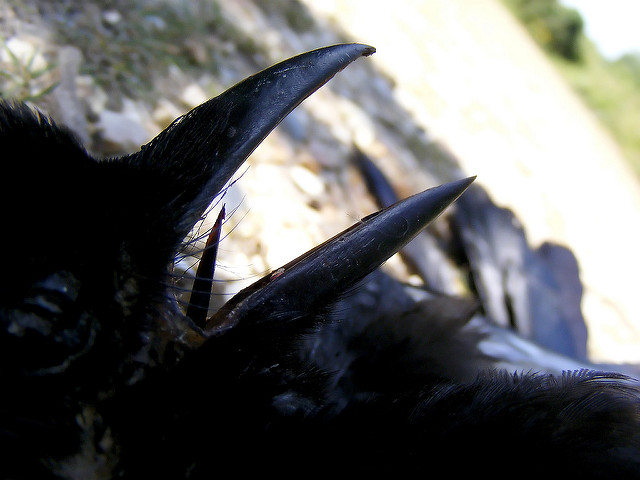
Dead crow in the middle of the road,
Black as death and dark

In the cold November air
When all the trees all sigh

“Remember”

Where there is a change in the scenery
Something different
Like God has suddenly left
The building

A winter without snow
Where a part of your soul

Has departed
From the light


R.M. Engelhardt is a author, poet and writer whose work over the years has appeared in many journals and magazines in print and online, including, Rusty Truck, Thunder Sandwich, The Boston Literary Review, Full of Crow, Fashion For Collapse, Dryland Lit, The Outlaw Poetry Network, and many others. He currently lives in Upstate NY and is the creator of such groups as The Troy Poetry Mission and Poets And Writers Stand Against Trump. Visit the poet’s website.

Photo credit: “Fallen” by Rob Nunn via a Creative Commons license.
Porn Government

By Eliza Mimski

One

He undressed the country and grabbed it in his sweaty palms. As the zipper came down, the country split in two. He inserted his finger into the wrath. He inserted his finger into his following but they didn’t notice. He peeled open the law and banged it into the first half. He abraded the tissue. He promised beautiful garments to the second half. He sweet-talked. The country grew grotesque. It took on an absurd shape. It bulged in strange places. His jack-o-lantern smile assured all that everything was just as it was supposed to be.

Two

A cabinet of little boys who hate women.
They dropped my rights down a well.
Men talking about my body. A frat club making rules about my eggs.
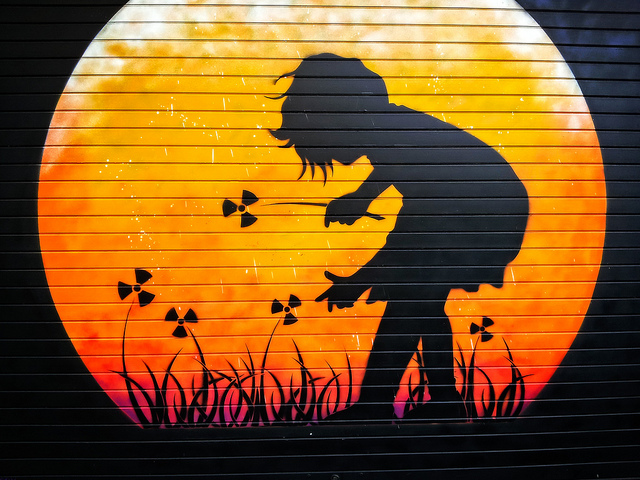
He’s an orange glow – radioactive – and I don’t like him.
A long flight of stairs leads to the past you thought you left behind

Three

The men are nails.
They hold locks in their hands.
They are telling us to go to sleep.
But we are awake.
We rise up.
We are healthier than them.


Eliza Mimski is a retired teacher who lives in San Francisco and writes poetry to help her deal with the election. Right now, it’s her sanity. Her work has appeared in Quiet Lightning’s Sparkle and Blink, Fiction 365, Enclave, Anti-Heroin Chic, Poets Reading the News, New Verse News, and other publications. Visit her website at ElizaMimski.wordpress.com.

Photo credit: “Radioactive Geranium” by Garry Knight via a Creative Commons license.