Secret Light

By Marianne Xenos

Sylvia stood at her worktable polishing a crystal diadem with a soft flannel cloth. The handcrafted headpiece was adorned with prisms and thrift-store rhinestones. Afternoon sun slanted through the large bay windows of her makeshift studio, the dining room of her late mother’s Victorian house. Sylvia smiled, remembering her mother with a twist of love and loss. “Who needs a dining room, anyway,” her mother had said a few months before her death, letting Sylvia create a refuge for her art.

The sun warmed the well-organized space, glimmering on Sylvia’s collection of art materials. Shelves held old television tubes, colored glass, and Kodachrome slides, and scattered boxes contained vintage jewelry, miniature mirrors, and antique teacups. Sylvia often made small sculptures, usually fantastical assemblages from found materials, but during the past year she’d begun experimenting with larger works involving prisms and projected light.

Sylvia’s brother Ash worked in the room directly over her head. She heard his guitar as he worked on a composition. They were both in their mid-forties and both currently single. They’d considered themselves too old to live with their mother, but after the political convulsion of the last few years, they needed affordable space, and their mother had needed in-home support before her death from the unnamed flu. Sylvia now had the only “day job,” not as a sculptor, but teaching art in the local high school. Ash found under-the-table gig work, because new restrictions from the Bureau for Biological Truth barred trans people from most jobs.

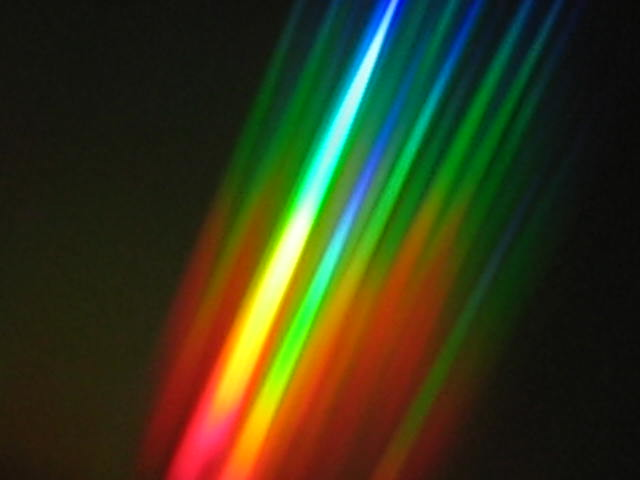
Sylvia held the diadem in a ray of sun, the crystals breaking the light into a rainbow. Natural light was called white, but a prism revealed light’s secret colors, which danced on the walls as Sylvia turned the object in her hands.

“Be careful. You could be arrested for that.” Ash stood in the doorway and smiled. There was no mistaking them as siblings. They had the same dark curly hair. Ash’s was cropped short and Sylvia tied hers back while she worked. They had their father’s brown eyes and olive complexion, and their mother’s strong nose and chin.

“I know. It’s crazy to spend so much time on work nobody will see.”

Ash nodded. They’d had this conversation many times. When President Andrew “Andy” Leblanc had created the Bureau for Biological Truth, he banned everything from rainbow flags to preferred pronouns. Not only that, over seventy percent of galleries had closed nationally, and those still open wanted only classical or representational work, avoiding anything experimental.

Ash held out an envelope. “Have you checked your mail lately? I got a weird letter today.”

“Just getting a letter is weird. I haven’t seen the mail carrier in weeks.”

Sylvia put the diadem on the table. She’d made five of them for the work-in-progress, an art installation she called “Secret Light.” Of course, the piece was just a fantasy at this point. In the current art scene, the work could never be exhibited.

Ash waved the letter in his hand. “Somebody is offering to fund one of my more experimental compositions. And it looks like you have a letter from the same return address.” He handed the unopened envelope to Sylvia. “And get this—they address me as Mr. Diaz-Malone. Mister.”

Sylvia looked up, surprised. “Well, there’s another thing that could get a person arrested.” Acknowledging transgender identity had been illegal for the past six months. She opened her own letter addressed to Ms. Sylvia Diaz-Malone.

“Huh. Somebody wants to fund my installation work, especially anything inspired by light.”

“Something weird is going on,” Ash said, as he walked over to the window, staring at the house across the street. Their neighbors, who recently found a swastika painted on their front door, were covering their multicolored Victorian house—a perfect three-story “painted lady”—with glossy white paint.

One of LeBlanc’s earliest executive orders mandated classical architecture, reminiscent of Greece and Rome, for government buildings. The order was for federal buildings, but as a symbol of patriotism, some began painting their homes stark white. Some even built pillars framing doorways on everything from McMansions to double-wide trailers.

Sylvia taught art history and knew the original Roman Colosseum had been painted with bright colors, as vivid and showy as the painted lady across the street. But Leblanc’s patriots embraced the misunderstanding of whiteness, even if the columns framing their doors were built from Styrofoam blocks.

“I guess the neighbors are finally giving in to pressure,” Sylvia said. “We at least used off-white paint when we painted ours.”

“Yeah, but we didn’t get a swastika on our front door. Or a drive-by bullet, like at Blaze’s place.” Ash turned from the window and glanced again at the letter in his hand. “Have you ever heard of the ‘Propaganda Assets Inventory’?”

“No, is this some new Leblanc thing?”

“No, it’s historical. Supposedly, after World War II, the CIA—believe it or not—helped fund abstract expressionism. They didn’t want France dominating the world art scene, so they secretly supported American artists.”

“That’s ridiculous. Most of those guys were radicals or at least skeptics. They’d never get cozy with the CIA.”

“Exactly, so the backing was top secret. Maybe this is the same thing. Somebody in the government wants to push against Leblanc’s policies.”

Sylvia scanned her own letter. “Or this could be a joke. And even worse, it could be a trick to bring us out into the open.”

“But what if somebody with influence wants to turn things around? Half the world is laughing at Leblanc. Maybe there’s an agency within an agency, somebody who wants a different kind of American exceptionalism.”

“I’m skeptical.” Sylvia took both letters and brought them out to the mail desk by the front door, with Ash following behind. “Let’s think about it. But today we need to rescue Blaze.”

Ash pulled out his phone. “Have you thought about what we offered? Any change of heart?”

“No, he should be here with us. Things are getting too dangerous.”

Despite the swastika across the street, their neighborhood was still safer than the one where their friend Blaze was camping on somebody’s couch. It was an area where whiteness was becoming a cult, and any whiff of color, such as their friend—a gay Black dancer with dyed purple locks—was a target.

Sylvia stood by while Ash facetimed their friend, and asked if he was ready to move in. Blaze hesitated for a moment, and Ash said, “Blaze, you know my mother loved you. She would want you here.” Blaze, looking relieved, agreed.

Ash asked, “Hey, have you received any letters about your artwork?”

“We don’t all live in a big house on Main Street, honey. I haven’t even seen junk mail in two years.”

“Good point,” Ash said, and told Blaze about the offers.

“You think somebody wants artists to stand up against President Andy Android? I’m convinced that guy is nothing but an AI projection.”

Sylvia leaned towards the phone. “What are you even talking about?”

“Well, has anyone ever seen him in public? Ever seen anything other than his torso above a desk?”

“Maybe he doesn’t want to catch an unnamed flu.”

“Or maybe they’ve created a president who can’t die of an unnamed flu.”

The last two presidents had died within a year of each other, each from “natural causes,” rumored to be a rogue virus, unstudied and unnamed. It was possibly the same unnamed flu that killed their mother. She was a former hippie and outspoken recovering alcoholic and loved slogans. Her favorite was, “You’re only as sick as your secrets,” and then she’d died of a secret illness.

Sylvia leaned towards the phone again. “Ash thinks the letters are from a clandestine government agency, trying to regain American exceptionalism in the arts.”

“Ha! And we’re the best they can work with?”

Ash laughed but said, “Maybe they’re looking for a new flavor of exceptionalism.”

“Too many conspiracy theories!” Sylvia said. “I just want to work—to make something beautiful! Or at least make something. Is that too much to ask?”

Blaze sighed and said, “Let’s look at your piece tonight, sweetie. We’ll just do it. Draw the blinds, set up your gear, and run it.”

“Do you have something white to wear? Maybe something sexy.”

“Sexy? You called the right number, girlfriend.”

“Okay,” she said. “We’re on our way.”

At the door, Sylvia paused to reread her letter, wrinkling her nose as though something smelled bad. Ash had put on his public disguise, a pair of tear-drop earrings, faux gold clip-ons from the bottom of their mother’s jewelry box. The earrings had been too boring for their hippie mother to wear, and maybe they’d been a gift from her kids when they were young enough to want an ordinary mom.

“The teardrops of invisibility,” Ash said, as he clipped them on. Sylvia kissed her brother on the cheek, and they went to pick up Blaze.

•   •   •

As they drove towards Blaze’s neighborhood, Sylvia said, “Wait! What’s going on over there?” On the street, a group of kids pushed a girl to the ground. Ash pulled the car over.

“They’re teenagers,” Sylvia said. “Let me take the lead on this.”

“It’s all yours,” Ash said, and they both rushed out of the car.

Sylvia had learned to fight in middle school, defending both herself and her queer sibling from bullies, and as an adult she’d learned to fight smarter rather than harder. She’d dated both women and men, so she wasn’t exactly straight, but she could pass unless she said what was on her mind. Sometimes, in a pinch, she used that privilege, and she put on her schoolteacher persona.

She took out her phone as she ran up to the group. A teenaged girl lay on the ground, and another girl with heavy boots was pulling back for a kick.

“Hey you! Stop it! I’m calling the cops now.”

“Call the Bio Cops, bitch. She’s a queer.”

“No, I’m calling the real cops. This is assault, and it’s illegal.”

The girl with the heavy boots paused and scowled at Sylvia. She didn’t even glance at Ash who stood behind her, and Sylvia hoped the earrings were doing their magic.

“Who the fuck are you? Another pervert?”

Sylvia used her phone to take a picture. “I’m Miss Diaz-Malone, and I work at the high school. Listen to me—after I call the cops I’m sending this picture to your principal. Do you want your parents to see it?”

“But she’s one of them! Look!” The girl with the boots held up a lavender scarf. “She belongs in Bio Camp.”

Sylvia snapped another picture. “You’re okay with the cops questioning you? Nothing illegal in your pockets? Nothing to hide? I’m ready to dial, but leave now, and I’ll let it go.”

The kids swore and grumbled, tossed the scarf back at the girl, but they left. Ash stepped forward to give the girl a hand. She looked rumpled, but no injuries. Something about her reminded Sylvia of herself at that age. Vulnerable, stubborn and always having to fight.

“I’m Sylvia,” she said, “And this is Ash. Are you okay? Do you need a ride someplace?”

“No, I’m almost home. But….” Sylvia raised an eyebrow in question. “My parents are going to be pissed.”

Ash said, “We live in the center of town. The off-white house on Main Street—number 237. If you ever have trouble, come and find us.”

Sylvia gestured to the lavender scarf. “Pretty scarf, but you better stash it until the craziness passes. Just to be safe.”

The girl stuffed it in her backpack. “Thanks,” she said. “My name is Ruthie.”

They got back in the car and watched the girl as she walked away.

Ash said, “Do you really think the craziness will pass?”

“We have to hope. What would Mom say?”

“Something wise and pithy about the thing with feathers or this too shall pass.”

“She quoted somebody once: ‘Hope doesn’t glimmer; it burns.'”

“That reminds me. Let’s go get Blaze.”

•   •   •

They found Blaze waiting on the front stoop of a five-story apartment building with peeling blue paint. His purple locks were gone, but he walked towards the car looking undiminished, tall and handsome in a black leather jacket. While Ash drove home, they chatted about the letters. Blaze had called his old roommate, who confirmed the post office had stopped delivery to that neighborhood a year ago. No mysterious letters had been slipped under the door.

•   •   •

Ash used the front parlor as a rehearsal space, and currently it was the home of Sylvia’s installation-in-progress. They’d pushed the sofa against one wall and collections of instruments stood in the corners. With a wink towards classical architecture, four white pedestals formed a large square in the center of the room, set about six feet apart. Each pedestal was four feet high, and each held a crystal diadem. Sylvia had mounted eight laser spotlights on the ceiling, and they beamed down like pillars of light.

Blaze had packed something sexy. He wore a white, vintage tuxedo, and was bare-chested underneath, except for a string of white pearls. He stood in the center of the room, arms outstretched, tipping his hand in and out of the bright beams.

“I know you’re a sculptor, honey, but this is just screaming for movement—for a dancer.”

“Well, it might just be screaming for you.”

Ash said, “If we ever do this for real, I could play some glass instruments. Like an armonica. Or there’s something called a chromatic aquarion.”

“Yes, that would be perfect. And I know I need to improve the lights—make the beams tighter and stronger—but for now let’s just try it.”

Sylvia turned off all the lamps, leaving only the eight beams of light, and Ash took his guitar to the sofa. Blaze stood in the center of the pedestals and put the most ornate diadem on his head. While Ash began to play, he and Blaze improvised, following one another’s cues. Blaze experimented with the headpiece, sweeping his head through a beam of light, tossing colors like confetti against the bare walls. He paused to adjust the diadem on his head, and took two more from the pedestals, one for each hand. He glanced at Sylvia for affirmation, and she nodded, making a mental note to create a more secure headpiece for a performer and to consider prismatic wands.

Blaze arched and swept the diadems through the pillars of light, matching his movement to the rhythm of the guitar. Twirling his head and hands, he dipped in and out of the beams, from darkness to light and back, color splashing like water against the drawn shades. Yes! Sylvia felt like shouting, but didn’t want to break the focus. The three of them were in sync, the piece coming together like a landscape. The structure of the installation like stones, music like water, and Blaze’s movement like sunlight flashing on the surface. The room held a fizz of energy, reminding Sylvia of the tang of ozone at the edge of a waterfall.

Sylvia thought, Yes, this is working….

A knock came from the front door, startling them all.

Her heart thumped, but she said, “Don’t move. I’ll see who’s there.”

Looking through the peephole, Sylvia saw Ruthie, the girl from the street. Slouched on the front stoop, hands stuffed in the pockets of her hoodie, the girl had a bulky backpack slung over one shoulder.

Sylvia opened the door and saw Ruthie’s swollen face with a new bruise just forming under her left eye.

“You said if I need anything.”

Sylvia looked up and down the street. “Did those kids do this?”

“No, my dad. He said I was drawing attention, putting everybody in danger. So, I left.”

Sylvia let her in and closed the door, turning all the locks.

“The light glimmering on the window shades was beautiful,” Ruthie said. Then her eyes widened as Blaze came out in his tuxedo and pearls.

Ash stood at the door to the parlor holding his guitar. “Ruthie, you’re welcome here no matter what, but I have to ask—what kind of trouble are we looking at? How old are you?”

“I’m seventeen. Hand to god, dude. I’m now legally old enough to converse with queer folks.”

Ash nodded, and Blaze said. “Okay, but here’s a more important question: Are you now or have you ever been a member of the CIA? Or the Propaganda Assets Inventory?”

Ruthie laughed and shook her head. “No, never.”

“Okay, girlfriend, you pass the test. Now help me put blankets over these windows and I’ll show you how the tiaras work.”

“They’re diadems,” Sylvia said as she picked up the two letters on the mail table, once again wrinkling her nose. Was it an opportunity or a trap? She’d been calm while they were working, a rare feeling of certainty, but now her anxiety had returned—anxiety about the world, the future, and the battered girl in her parlor.

Ash put his arm around her and whispered. “Sometimes hope glimmers before it burns, right? You’re the boss for the moment. Do you want to run it again? You might have just gained an intern.”

Sylvia held the letters over the wicker trash basket their mother always kept next to the mail table. “May I?” she asked. “Hand to god, dude, something stinks about this.”

Ash laughed and nodded. “I trust your instincts.”

Sylvia dropped the letters into the trash. Work would calm her panic. It always did.

“Yes, let’s run it again.”


Marianne Xenos is a writer and artist living in western Massachusetts in the United States. She creates stories about magic, history, and family secrets. Most of her characters occupy positions of “otherness”—some as immigrants, some as LBGTQ+, and some because of magical inclinations. Her stories have been published in magazines and anthologies including The Fantastic OtherThe Underdogs Rise, Writers of the Future #39, Orion’s Belt, and the game anthology, Winding Paths. She was a first-place winner of the Writers of the Future contest in 2022 and a finalist for the Speculative Literature Foundation’s Working Class Writers contest in 2024.

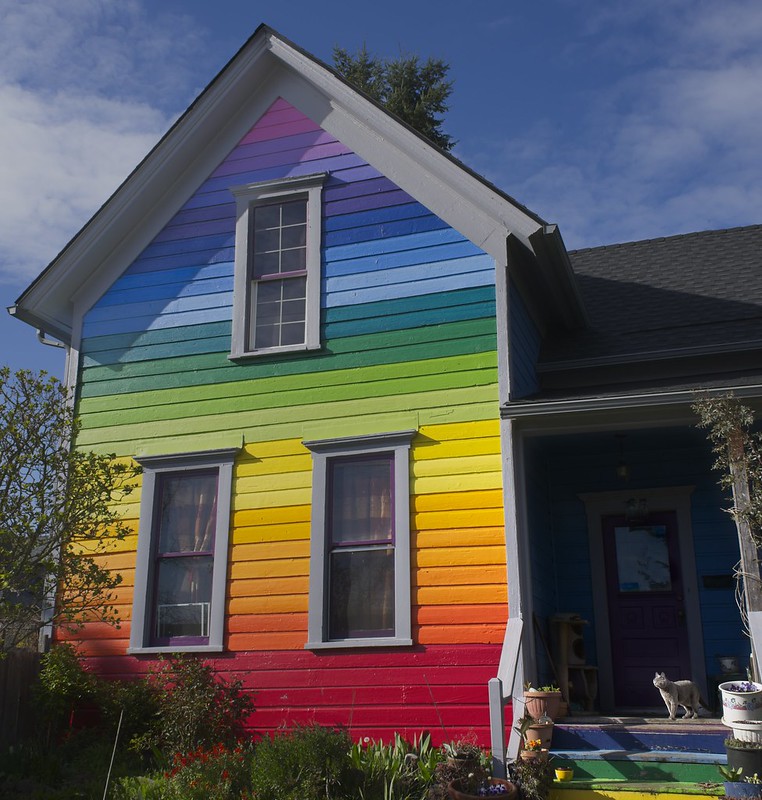
Photograph by sila via a Creative Commons license.

A note from Writers Resist
Thank you for reading! If you appreciate creative resistance and would like to support it, you can make a small, medium or large donation to Writers Resist on our Give a Sawbuck page.

Second Flags

By Annette L. Brown

I was slicing tomatoes from the garden, their rich juice nearly overwhelming the grooves in the cutting board, when I heard the story of Lauri Ann Carleton’s murder. I stopped to make sure I heard correctly, my knife hovering mid cut. Yes, Lauri Ann Carleton, 66 years old, died August 18, 2023 in Lake Arrowhead, California. Story details could not escape my ears when CNN broke for commercial: The Mag.Pi clothing store . . . a confrontation over a Pride flag . . . a man with a gun.

My husband, my dinner-prep partner, reached for me, rested his warm hand on my lower back as we stared at the TV. I remember wondering, What is happening to us? Sometimes, when I watch the news, I do not recognize my own country—the people I’ve imagined us to be.

Though not a member herself, Lauri Ann Carleton raised a Pride flag in honor of the LGBTQ+ community—a community defined by diversity and acceptance. She had been asked by various townsfolk to remove her flag. She refused. I imagined her pulling her Rainbow from its sleepy quarters each morning, placing it in its storefront holder, watching it catch the breeze. It fluttered there, a symbol of peace, defying those unable or unwilling to recognize its meaning.

                                                                        •

In war, people fight for flags, or at least for what they symbolize. I remember visiting the Marine Corp War Memorial in Washington D.C.—the sculptured image of six men pushing into place the second flag to be raised on Mt. Suribachi during the WWII battle at Iwo Jima. The first was not large enough to be seen across the island, not large enough to render the response to the second—gunshots of celebration and cries of joy from soldiers fighting on land and sailors in ships just offshore.

                                                                        •

The cries over Lauri Ann Carleton’s loss lacked celebration. The gunman killed a wife-mother-friend-community advocate, then fled the scene. Police followed. Now he’s dead. I wonder what fear terrorized the shooter’s heart, what war waged within, so horrific he had to kill over that flag. Community members mourned Lauri Ann Carleton by crowding her storefront with flowers, sidewalk-chalk messages, and Pride flags—the display, a greater rainbow than could ever be contained by a single flag. I studied the image of her shop until the explosion of color, ironically initiated by the gunmen, grew into a vice constricting my breath.

                                                                        •

The day I visited the Marine Corp War Memorial was hot and humid. I remember at one point a gust of wind wrapped loosely around the inside of my collar, lifting the hair from my neck. When I closed my eyes to receive that cooling restorative, I could almost hear the snap of the war memorial’s flag whipping in the chilled February wind of 1945; I could imagine how battling soldiers were lifted by the tendrils of hope streaming from the stars and stripes, though the battle waged on for weeks.

                                                                        •

When her family left Lauri Ann Carleton’s body at the hospital, a new flag, secure in its delivery packaging, awaited them on the porch. She died over a flag she had planned to replace, the colors the gunman despised, too faded for her commitment.

                                                                        •

Sometimes watching the news stings my eyes, hitches my breath. Still, I don’t seem to look away. Scientists who study these things report people respond more intensely to negative stories than to positive as measured by changes in heart rate and the electrical conductivity of skin. But some things have no accurate ruler. They cling to memory in immeasurable ways.

I didn’t go to Lake Arrowhead, didn’t see individuals placing rainbow gifts at the Mag.Pi storefront. I couldn’t tell if there were any gusts of wind. Yet I cannot forget. I wonder if Lauri Ann Carleton’s new flag is still nestled in the dark of its packaging. I suppose it doesn’t matter. That second flag doesn’t need to flutter from a pole for its tendrils to stretch hope toward us.


Annette L. Brown is a personal essayist and creative nonfiction writer who has pieces reflecting her love of nature, family, beauty, and humor in several publications including Flash Fiction Magazine, Every Day Fiction, several volumes of the Personal Story Publishing Project (Randell Jones) and in Bad Day Book, Parenting. Annette is grateful for the support and friendship of her writing group, the Taste Life Twice Writers. 

Photo credits: Pride flag by Cecilie Bomstad on Unsplash.


A note from Writers Resist
Thank you for reading! If you appreciate creative resistance and would like to support it, you can make a small, medium or large donation to Writers Resist from our Give a Sawbuck page.

Make a Splash

By Ell Cee

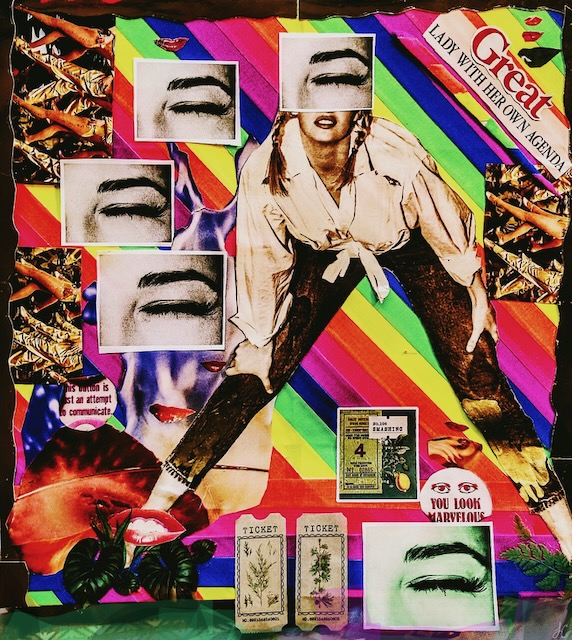
a photo collage with images reflecting body and sex positivity, joy, and self expression


Artist statement

As a queer person and artist, I’ve been struggling with the constant legislative attacks against the queer community echoing across America. So what’s at the heart of my piece, Make A Splash? Honestly? This is me looking into the eyes of homophobic politicians, homophobic people, and those who just sit neutrally on the fence and let it happen, and licking my sapphic lips at them. This is me bending over and spanking my ass in their general direction, while winking mischievously. With Make a Splash I wanted to celebrate and relish queer joy. I wanted vibrant colors, rainbow vibes, womxn intentionally and joyously existing as sexual beings. I wanted to celebrate the bodies of womxn. I wanted to be very open about what this piece was. I loved the image of a blue jeans model from the 80s bending over and looking at the camera. I put the kicking legs of cabaret dancers around the edges. I put a cut open, ripe, luscious strawberry surrounded by lips. I put winking-eye photos that almost look like Polaroids everywhere, echoing through the piece. I included lush greenery at her feet and last but not least, tickets to ride placed between her legs. And of course, the cherry on top of it all: the caption I created in the top right corner that reads, “Great Lady WITH HER OWN AGENDA.”


Ell Cee (They/She) is a lifelong artist as well as a member of the LGBTQIA2S, genderqueer, and disabled communities. They create one-of-a-kind pieces whose vibrancy and glow inspire joy. Ell uses recycled materials in much of their art, such as cardboard boxes, packaging materials, repurposed labels, and even discarded library books. Her art ranges across mediums: from watercolor markers, highlighting elements, paints, pencil, photography, mixed-media, hand lettering, to pen & ink, and high resolution image conversion processes. Find Ell’s art online at https://linktr.ee/EllCeeTheArtist and @EllCeeTheArtist on Instagram.


A note from Writers Resist

Thank you for reading! If you appreciate creative resistance and would like to support it, you can make a small, medium or large donation to Writers Resist from our Give a Sawbuck page.


Wrong Rainbow

By L. Acadia


Describing our droomhuis for Dutch class, my
worksheet filled with my dream house’s garden:
Hollyhocks, hydrangea higher than I,
wrought iron table for morning coffee,
serenading birds, frogs ringing a pond.
My love wrote an interior my mind
couldn’t fit: puppy-claw impervious
tile floors, dormer bedroom, dinner-party
primed kitchen, postprandial dancing space.

Years later, we recall the exercise,
tossing balkon, keuken, venster, fit now
to a dream house: open-plan high-ceilinged
flat—wood beams leading the gaze towards mountains,
snug loft for out-of-town or drunken friends,
green balcony, community garden,
busses to work: a millennial dream.

Rooftop looking out to summer salons
poetry, perhaps acoustic guitar.
Headlights flooding the street below create
a waterfall of light, mist spraying to stars.

We call our droomhuis “Jesus house” for the
forest of crosses, scandalous portraits
of unfashionably long-haired white men with
palm-wounds. The seller greets us cordially,
his wife places hands over their kids’ chests,
as though guarding their hearts from our inter-
racial lesbianism’s tick’ling daggers.

When they ghosted our offer, we enquired
through a new realtor. The Jesus house dad
asked, “are your clients a normal couple?”
Nee.


L. Acadia is a lit professor at National Taiwan University and member of the Taipei Poetry Collective, with poetry in Autostraddle, New Orleans Review, Strange Horizons, trampset, and elsewhere. Twitter and Instagram: @acadialogue

Image credit: Jim Choate via a Creative Commons license.


A note from Writers Resist

Thank you for reading! If you appreciate creative resistance and would like to support it, you can make a small, medium or large donation to Writers Resist from our Give a Sawbuck page.


Two Poems by Nancy Squires

As the Waters Rise


O God, look down
On all our drowned.
Hear us, we beg—
We’re on our knees.
Sorry, so sorry
About the trees,

The polar bears, the birds,
The bees; the icebergs
Gone, the thirsty lawns,
Plastic gyres, redwood
Pyres and all the many,
many cars. The eclipsed stars

We never see. Our Father
In Heaven, we pray
To Thee: Give us
This day.
We promise, oh we swear
On a stack of extinctions

We will repair
Our awful ways
And lead us not into oblivion
Although we can’t pretend
We had no clue. Save us
Now—before
Amen.


It’s No Use, Ron DeSantis


Before Marie Kondo-ing
I had a pile of beads
in a drawer, cheap baubles
from Gay Prides past:
Chicago, where the crowd spilled
into Halsted, slowing the procession
to a crawl; New York,
where drag queens rode the floats
in headdresses three feet tall
just like Carnival; and Boston,
many years—the one
where Kevin was The Little Mermaid
on the Disney float—his costume
(which he stitched himself),
perfection and his makeup,
animated glam. That woman on the Harley
who dyed her mohawk rainbow
every year, and the time
Sally spotted her coworker
coming down the route—
she was surprised to see him
in a wine-colored corset.
No beads
from Lansing, Michigan,
my first Pride—not
a parade but a march
and what got thrown
at us were insults, curses, glares
from people holding signs
that said God hated us.
So let’s say gay
and everything else
there is to say.
I should’ve kept that pile
of shiny plastic beads—
not sure if it was joy
they sparked but something—
Kevin reclining up there
amongst the other Disney folk
his shimmery mermaid tail
sparkling in the morning sun.
Say it: gay.
All the livelong day.
She and he and them
and they: we
aren’t going back
inside the boxes.


Nancy Squires is a writer, lawyer, and freelance copy editor. Her creative nonfiction and poetry have appeared or are forthcoming in Dunes Review, Split Rock Review, and Blueline Magazine. She grew up, and currently resides, in Michigan.

Photo credit: Linda De Volder via a Creative Commons license.


A note from Writers Resist

Thank you for reading! If you appreciate creative resistance and would like to support it, you can make a small, medium or large donation to Writers Resist from our Give a Sawbuck page.

Birthday Wishes

By Phoenix Ning


Sixteen-year-old person of color desires escape from this inferno
where dark-skinned individuals burn, and alabaster spectators
cheer from the sidelines, popping confetti guns and feeding
oil to ancient flames while claiming to be long-awaited saviors.

Eighteen-year-old student desires world history classes with curriculums
that celebrate African kingdoms, Indigenous empires, and South Asian cultures;
textbooks that condemn armor-clad imperialists stripping gowns of freedom;
articles that honor revolutionaries whose empty pockets did not silence their shouting.

Twenty-three-year-old woman desires to shatter the chains created
by men who think all girls are moons trapped by their gravity,
males who believe themselves to be suns instilling life into
fragile females who must offer their bodies as tokens of gratitude.

Twenty-year-old lesbian desires to taste the sweet wine of love
and cavort in inebriated glory with the woman whose gentle touch
sparks wildfires in her heart frozen by acerbic remarks fired by toxic relatives
when she turns her head away from men and smiles at her rough-hewn ladylove.


Phoenix Ning is a twenty-year-old Chinese writer of sapphic antiheroines and queer found families. She is currently a senior studying human-computer interaction. When not writing, she can be found watching C-Dramas and penning raps. A fierce advocate of diversity in media, she hopes that her audience will feel empowered after reading her words or listening to her songs. Learn more at ladyphoenixning.com.

Image credit: Jennifer Rakoczy via a Creative Common license.


A note from Writers Resist

Thank you for reading! If you appreciate creative resistance and would like to support it, you can make a small, medium or large donation to Writers Resist from our Give a Sawbuck page.

Vile Affections

By Soon Jones


I grow up in a Florida church being warned about
god-hating bull dykes and sissy fairy fags
leaving the natural use of the woman,
which is sex, because
all a woman is good for
is sex and tempting men.

Yet when a woman tempts another woman
somehow that is not about sex,
though I’m pretty sure it is:
I want Crystal instead of Stephen,
the hottest boy in youth group,
apparently.

At a sleepover with church girls
I panic when they throw
down a copy of J-14 magazine
with *NSync on the cover,
and interrogate me on who
I want to marry.
This is a trap:
there have been rumors about me
and they’re all true.

I pick Lance Bass for his friendly face.
This is not the wrong answer,
but it is still not the right answer.
I should have said Justin Timberlake or JC Chasez,
apparently, but I’ve made my bed

so now I have to buy Lance Bass stickers
and say how hot Lance Bass is at youth group
and now everything I own is covered
in Lance Bass. I even write about him
in my diary, in case someone reads it.

I doodle in my Lance Bass notebook
while my pastor rants about an “it”
with “hips of a woman, but a face like a man”
who served him coffee in some roadside diner.
He shares his fantasy of renting a room
in a Miami hotel close to the gay bars
on Memorial Day weekend, and how,

God willing,

he would hide in the air ducts
and descend on the bull dykes and sissy fags
with an AK-47 and a Bowie knife, for
they which commit such things
are worthy of death.
He throws his head back in ecstasy,
licks his lips at the thought
of all those queers he would sacrifice
on the altar before the Lord.

I hold Lance Bass to my chest
as the men shout “Amen!”
tossing hymnals at the pulpit
like panties.


Soon Jones is a Korean lesbian poet from the rural countryside of the American South. Their work has been published in Juke Joint, Westerly, beestung, and Moon City Review, among others. They can be found at soonjones.com, on Twitter, and on Instagram.

Poet’s note: Passages in italics are taken from Romans 1:27 and 1:32.

Photo Credit: “Ungodly Hate” by K-B Gressitt.


A note from Writers Resist

Thank you for reading! If you appreciate creative resistance and would like to support it, you can make a small, medium or large donation to Writers Resist from our Give a Sawbuck page.

Sip-In: 1966

By Jesse Mavro Diamond


For LGBT Rights Activist Dick Leitsch


Carpenters, bankers, bricklayers, undertakers.
Why gay bars?
Because we could only be gay
In gay bars.

The N.Y. State Liquor Authority CEO:
no discrimination in bars. Why?
because bars had the right to refuse customers
not acting suitably. Therefore, disorderly.

Bankers, bricklayers, undertakers, carpenters.
And Dick, a former Tiffany salesman
all risking entrapment because
wasn’t flirtation with a cute, undercover cop
worth the risk?

At the West Village bar,
John, Dick, Craig and Randy
dropped the “H” word bomb.
We are homosexuals and we want a drink.
Dick, Craig, John and Randy
I can’t serve you!
You’re not suitable! Therefore disorderly!

It’s true:
when a carpenter has sex with a banker
or a bricklayer has sex with an undertaker
or a John has sex with a Craig
or a Randy has sex with a Rick

being orderly is simply not suitable.


Jesse Mavro Diamonds latest book of poetry, American Queers, will be published in 2022 by Cervena Barva Press. Her poetry has been published in many journals in The U.S. and Ireland. Her awards include first place in Eidos magazine’s international poetry competition for “A Very Sober Story,” the Tennessee Williams Literary Festival’s One of Ten Best Poems in the U.S. for “Swimming The Hellespont,” and “Chetwynd Morning,” chosen by Lascaux Review for its prize anthology. “An Elegy for Devron,” was musically scored by composer Mu Xuan Lu and premiered at Jordan Hall, Boston, in 2008. For many years, Mavro Diamond taught writing courses in Boston area colleges and high schools. She initiated and taught the first creative writing course Boston Latin School ever offered in its 386-year history.

Photo credit: USC Doheny Memorial Library.

Reparative Therapy

By Dein Sofley


It’s not that there’s anything wrong with you. It’s just that, well, you know … it’s normal to have sexual feelings. Our bodies were made to procreate.

Reproduce.

Have babies.

When you’re married.

It’s just that a man and a woman, they fit together, by design.

See?

A woman provides the egg and a man provides the seed. It’s how God intended it to be.

Yes, Jesus, too.

Well, Mary was a virgin birth.

A virgin is somebody who hasn’t had sex yet.

Sex happens when a man and a woman love each other and they want to make a baby.

Yes, Jesus is God’s son.

No, God doesn’t have sex. Didn’t they teach you anything in Sunday school?

God made Adam out of dust and Eve out of Adam’s rib. “Be fruitful and multiply,” that’s what God said to them.

Do you understand?

You can’t make a baby with two women or two men. You need an egg and a seed.

That’s why I’m here to help you. Me, and your parents, just want what’s best for you. We want you to have a great life.

What you have is a condition.

Yes, it’s kind of like being sick.

No, I don’t have to administer a shot.

We might do some body work and EDMR.

No, it’s not going to hurt.

Eye Movement Desensitization Reprocessing.

Don’t worry. I’ll explain it to you later. I assure you, it doesn’t hurt.

What?

Oh. The condition’s called SSA. Same Sex Attractions.

But, don’t worry. I can cure you.

Look, there’s a lot of changes happening in your body. You’re just confused about your feelings.

There. There. It’s okay. You’re not alone. We all struggle with sin. What you’re going through is just a moment.

Here. Take a tissue.

You see, this is how you know God loves you. He listened to your prayers.

We’re all here to help you and there’s other people, kids your age, who struggle with the same condition. They can help you, too, through support groups and prayer.

It’s called “SSA.”

No, you’re not born with it.

No, an SSN is a different thing.

You see, sometimes we’re attracted to people for different reasons. Say you like Ashley’s hair or the way Danny laughs.

Okay, well, whose hair do you like?

Fine. Sadie’s hair.

Danny snorts when he laughs?

Okay, so maybe my examples weren’t the best, but you get the idea, right? You don’t have to be gay. It’s probably just adolescent infatuation or maybe you felt alienated at some point in your life.

No, not like Lilandra in X-Men.

I’ve never read Sandman.

Loki’s a shapeshifter, that’s different.

Look, we all seek approval. We all need love and acceptance.

Yes, even Blake. Pray for his salvation.

It’s just that sometimes we don’t get enough from our parents, or we get too much, and our imaginations run riots trying to invent what we lack. What you’re experiencing is a call to come back home to God. It’s a test of faith.

Here, why don’t we start with this worksheet?

No, it’s not a potato.

It’s an iceberg. See, those are waves. That’s the ocean. Down there’s a whole lot of stuff we can’t see. Feelings.

Yeah, sort of like your mom’s five-layered bean dip, I guess. More like … hmmm … has a friend ever wanted to play a different game than you at recess and it made you angry? Well, maybe you felt sad, too, down here, underneath.

That’s the stuff we’re here to find out about, so we can sort out your feelings.

It’ll be okay. I promise. You’ll feel better. Happy. You won’t be gay anymore. Godliness just takes a little work. You’ll be a better Christian, you’ll see.  You’ll say, “Thank you Jesus for saving me.”


Dein Sofley teaches refugees English in the sanctuary city of Chicago. She earned her BA from Columbia College and her MFA in fiction from UC Riverside’s low-residency program. Her work has appeared in The Coachella Review, Writers Resist and the upcoming Five on the Fifth.

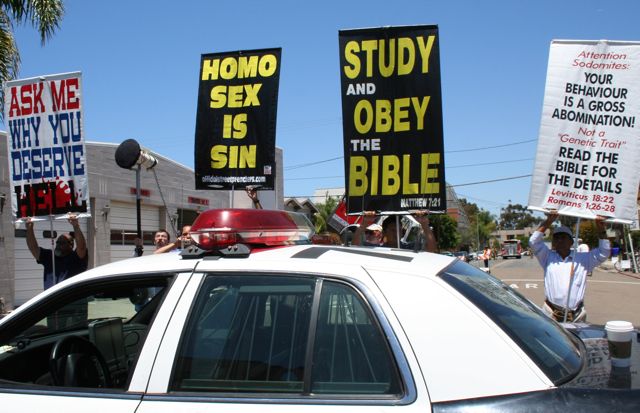
Westboro Baptist Church photo credit: Travis Wise via a Creative Commons license.