
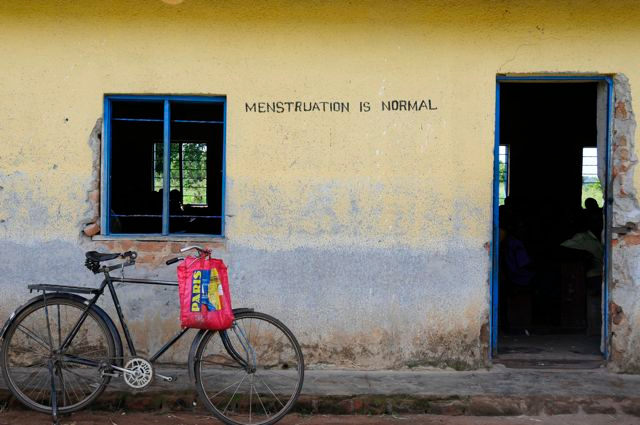
Letter to Self

By Joycelyn Zhang

It was the day of your school’s 5K. Sweltering.

You ran until your lungs wheezed. Your shorts were green, like everyone else’s, and together you were a forest from the waist down. You forced yourself to drink the sludgy fountain water and ignored the way it stung your convulsing throat. You ignored the sharp running cramps that stabbed your stomach, the ones that usually attacked your sides. You ignored it—until you felt something gush into your green shorts. Damn it. Meekly, you excused yourself and tried not to waddle as you entered the cool of the locker room.

With toilet paper at the ready, you pulled down your shorts, exposing tender, indented flesh. You expected the stale stench of urine, but found, instead, that red sap had trickled down your thighs and bloomed in your underwear.

You weren’t injured and you weren’t dying. Nothing had pierced your skin, and yet you were bleeding. But instead of screaming like you wanted to, you limped back into the heat, breathing quick and tight. You remember saying something vague to the (male) gym teacher, something about needing to see the nurse. You remember the nurse’s gentle, rehearsed tone as she pointed you to the bathroom. The rest of the day, you felt all the eyes on you—classmates, teachers, janitors—seeing through your clothes, into your shame. The shame raged hot and cold down your spine when you told your parents you’d gotten your period. You were taught to scrub and scrub and scrub the stiffened blood in the bathroom sink—it couldn’t mix with the wash and contaminate the other clothes. And you scrubbed until there was no trace of the red sap and your fingers started peeling around the edges.

You rarely went shopping with your parents after that, too afraid of walking down the Feminine Hygiene aisle, slipping packages of pads in the cart. You couldn’t bear to look at the cashier’s face as he scanned the boxes. Alone in your room, you wondered why there was a price tag on menstruation.

Now, you get pissed when period ads interrupt YouTube videos, portraying empowered, graceful women prancing on stages or grassy fields as though there isn’t a stick of cotton tearing at their insides. Somehow, you just know a man pitched the design.

Now, your clothing resents you. None of your underwear escapes unstained. You hate sitting down in public, worried about what might show when you stand up again. You hate your dance tights and leotard, and how they barely cover anything.

Guys seem different now. Their eyes widen and they pretend to vomit if the “P” word comes up. When your brother knocks over the grocery bag, sending a package of pads popping out at him, he screams and locks himself in his room. Even your dad whispers “Period” like it’s some taboo thing. They act afraid when it comes to your period, yet they insist it’s the reason you have differing opinions—nothing short of hormonal insanity could explain why you would disagree with them. You hate how they leave their marks on everything that isn’t theirs, be it a form of childbirth or a woman’s reproductive organs or even the words that are supposed to belong to you and the girls around you. You hate how the woman is always blamed for the pregnancy, shamed for sleeping around. Men are aggressive go-getters who deserve the submission from all women they are attracted to, remember?

You hate everything. You’re not even sure if it’s of your own volition or if it’s because you’re on your period. Because you’re ON your period as you write this. And this time, it’s personal. Like (S)Mother Nature had a boxing match with your uterus and the uterus is losing. Unfortunately for you, it never throws in the towel. So you have no choice but to soldier on (like a woman).

And in these moments, you scream and curse all gods from every religion possible for bringing this burden to womankind, and to you, in particular.

Childbirth isn’t something you ever want to go through, so what’s the point of having a period at all? You have to wonder if something’s wrong with you because in the single eye of society, those eggs, those promises of another human being, are (most of) what you’re valued for. They are the reason laws about women’s bodies are written and passed by men, the reason everything about them is sexualized, magnified, condensed into beautified fodder for men’s viewing pleasure. You’re nothing but fertile ground waiting for seeds.

What if you refused? What if you stood up and wiped away all that dirt and ripped the trowels from their greedy hands? You’d be free—but would you really be a woman? What is a woman without her children?

And what of those people whose lives will never cross yours—who, despite all your differences, share this invisible connection with you? Here’s where you know the patriarchy has succeeded: you feel so isolated in your room, watching shadows dance upon the tampon-white ceiling.

Yesterday, you were in the school bathroom with another girl. A girl who giggled as she tugged one of the cheap school tampons from the dispenser. The tampon expanded with sink water—a soggy, unusable joke. Her perfume clouded your brain, and you avoided her gaze in the mirror. She was a girl, too, wasn’t she?

You wanted to say, “You’re not just a girl. You’re not bloodstained underwear or a wrinkled tampon. You’re not a cherry, an oven, a fertile field. You are human.”

Period.

But you didn’t.


Joycelyn Zhang is a San Diego writer whose work strives to examine the deep-seated biases present in modern culture. She is a second-generation immigrant living in a bifurcated world. Her work has been featured in Élan Literary Magazine.

Photo credit:


A Note from Writers Resist
Thank you for reading! If you appreciate creative resistance and would like to support it, you can make a small, medium or large donation to Writers Resist on our Give a Sawbuck page.
The Most Radical Protest Right Now Is Handmade

By Amanda Jackson

There’s a sweet settling fiber artists know, where time softens and fingertips warm with effortless energy. Meditating on patterns, settling into rhythm, mesmerized by repetition.

Top to bottom, bottom to top. Stitch, stitch, stitch. My mom taught me to cross stitch as a little girl, kittens, rainbows, and hearts emerging from hundreds of tiny x’s.

Knit, purl, knit, purl. Almost all my classmates knit when I studied visual art at the Interlochen Arts Academy. We may not have known it then, the magnitude of fiber art or it’s connection to resistance, but we were most content with piles of yarn curled in our laps. Butterfly kisses of soft mohair, luxurious cashmere, we even craved thick, scratchy wool against our fingers.

• • •

Fiber art has been a seasoned storyteller. It has passed messages in plain sight, spied on opposition, and formed social movements, threads tightened into banners, votes for women, my body, my choice, love is love. It has documented injustice, asserted identity, and expressed solidarity where words fell short or posed risk. Quiet and unexpected, fiber art has voiced the silenced, resisted unapologetically, and woven strength greater than any one of us could alone.

Suffragettes embroidered protest banners in the early twentieth century. They were marched through city streets, draped over railings, and held up high. Domestic labor became public defiance, claiming space and igniting collective power.

Fiber art has become a global language of protest.

During the Pinochet dictatorship in Chile, women made arpilleras, small, hand-sewn tapestries that depicted scenes of daily life, violence, and disappearance, transforming fabric into testimony and bearing witness to human rights abuses where speaking out was fatal.

For Palestinians in the diaspora, the continued practice of tatreez, a traditional hand-embroidery technique, sustains cultural memory and asserts enduring identity.

During wartime, where there were knitters, there were often spies.

During WWI and WWII, the Belgian Resistance and Allied spies used knitting to gather intelligence. Undetected women positioned near railway lines encoded information in their knitting as a form of steganography, or hidden writing. La Dame Blanche, with over 1,000 agents, provided 70 percent of Allied military intel in WWI.

Spies such as Elizabeth Bentley used knitting bags to secretly transport documents. Phyllis Labour Doyle, a notable British Special Operations Executive (SOE) agent sent over 135 messages through the language of knits and pearls while operating behind enemy lines in the 1940s.

The U.S. Office of Censorship eventually banned the mailing of knitting patterns abroad during WW II.

• • •

The loom met me like a familiar dance partner, seamlessly moving into step. I’d leaned my full body into the work, digging into memory, borrowing from dreams. I wove Lake Michigan in layered blues, bright, warm sunsets, white pages peeling from birch trees with stories etched in coal. I’d granted them weight line by line in my fiber arts classes at Interlochen.

In another place or time, would I have been layering and stitching fiber into maps or messages, passed openly, unnoticed?

Will I still?

• • •

By transforming yarn and thread into a medium of expression, fiber art continues to take a stand.

In the aftermath of Donald Trump’s 2016 election, Kat Coyle created the “Pussyhat,” deliberately reclaiming the term as solidarity after his misogynist comments surfaced during the campaign. The quote itself does not merit repetition. For many women, its video is easily recalled, its impact still visceral.

The Pussyhat Project remains a collective act of care, visibility, and belonging, with over 160,000 projects recorded: “Women’s rights are human rights. Always have been. Always will be.”

Welcome Blanket was a craft-centered, community-powered response to the first Trump administration’s proposed 2,000-mile wall along the United States–Mexico border. Los Angeles artist Jayne Zweiman invited fiber artists to reimagine the barrier in fabric. Across living rooms and kitchens, hands knitted, sewed, crocheted, and wove blankets, a refusal to let policy have the final word.

The project quickly exceeded its goal and aims to encircle the globe in 36,521 handmade pieces. 8,000 have been collected so far.

Most recently, deep red yarn and pointed red hats with tassels began appearing across social media following a surge of federal immigration enforcement in Minnesota and the deaths of two residents as a result. In response, Minneapolis yarn shop Needle & Skein launched a fundraiser to support the community, offering $5 patterns for “Melt the ICE” hats that quickly gained widespread support.

It was clear to Gilah Mashaal, a Jewish immigrant, how her shop would protest. “What’s happening in Minneapolis has been so egregious and awful and so destructive to our community.”

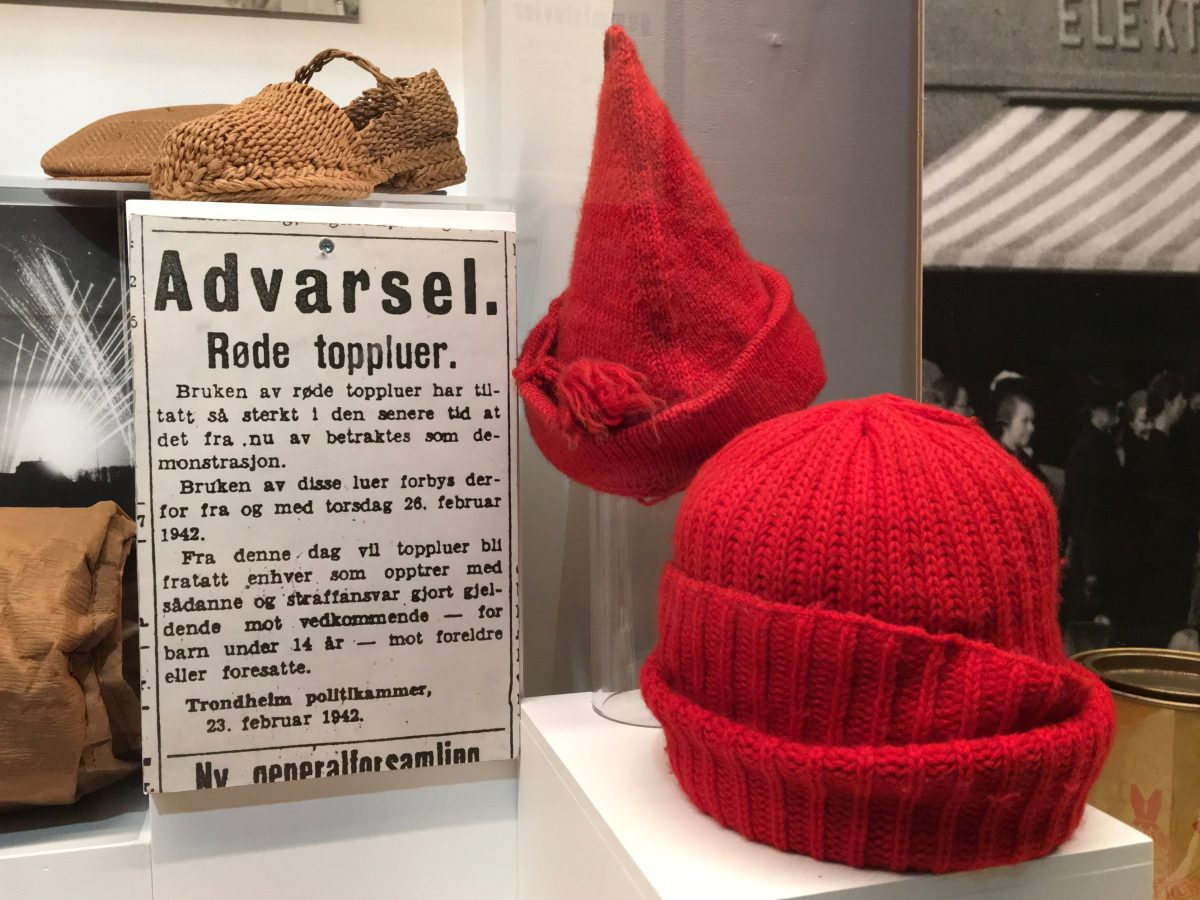
The hats were inspired by Norway’s WWII “nisselue,” or Santa hat, worn in opposition to Nazi occupation as a symbol of hope and morale. For Norwegians, the hat was meant to be “distinctively non-violent.” They eventually became illegal for citizens to wear or distribute.

Having also learned Norwegian traditions from my mom, I came to recognize their subtle strength early on.

Since launching the “Melt the ICE” hat project, Needle & Skein has raised over $650,000 for organizations supporting community members affected by ICE, inspiring knitters and crocheters around the world.

My local yarn shop, Wool & Honey, started a fundraiser for Minneapolis with bold, red yarn spun to order. They’ve hosted community “Melt the ICE” knitting gatherings at their shop in northern Michigan and the Leland Public Library. Grassroots organization, Indivisible Leelanau purchased 200 stamps for the group to send “resist postcards” to Congress and the White House.

It’s uncertain whether “Melt the ICE” hats will become illegal, like the nisselue before them. For now, the pattern is still available through Needle & Skein on Payship and Ravelry.

From stitched banners to the pink and red hats of contemporary protest, fiber art highlights the persistent power of small, deliberate actions. So, we knit, croquet, embroider, weave, and stitch.

We resist.


Amanda Jackson is a creative nonfiction writer exploring fiber art, resistance, and the politics of domestic craft. Her work uncovers the histories stitched into cloth and the enduring power of art. She lives in northern Michigan with her spouse and loyal rescue shepherd, Jax.

Photo credit: Courtesy of the Norwegian Resistance Museum.


A Note from Writers Resist
Thank you for reading! If you appreciate creative resistance and would like to support it, you can make a small, medium or large donation to Writers Resist on our Give a Sawbuck page.