The Great

By Alex Penland

He had a reason for his name: “The Great”
Now buried in the Valley of the Kings—
Statues and treasures, all of which abate
Behind the wheel of fate that spins and sings
And has four thousand years beneath it now!
Yet Ozymandias somehow persists—
Face on our screens, obscuring ancient snow,
We laugh, despair, continue to resist.
We plebeians, outside the formal walls
Marble temples, or gold as they see fit—
Endure as empires rise, stagnate, and fall.
And forget King Ramses when we see it.
Four thousand years have passed and still we stand
On broken stone, our visage in the sand.


Alex Penland was a museum kid. The child of a photographer and a Scuba diver, she spent her teenage years in the field: Penland has worked with Smithsonian archaeologists, NASA software engineers, volcanologists and photographers. She has been bitten by a shark, she watched the final shuttle launch from the fire escape outside Launch Control, and she has been a certified diver since age twelve. She likes dogs, long walks on the beach, and socialized medicine. Also books. She is one of two directors of The Writers’ Rooms in Iowa, an editor for hire, an amateur linguist and a Taurus. Her work has received many accolades, including an Honorable Mention for The Great in the Writer’s Digest Annual Contest 2017. You can follow Penland on Twitter @AlexPenname or visit her website at www.AlexandraPenn.com.

Photo credit: Institute for the Study of the Ancient World, NYU, via a Creative Commons license.

If You Have to Ask, the Answer Is ‘Yes’

By Marvin Lurie

It sensitizes certain nerve endings.
You can see and hear what many can’t.
Your training begins young,
the neighbor who won’t let her daughter play with you,
taunts and shoves in the playground.
You are woven an invisible garment
act by act, word by word.
to wear for life.
It has a star on it
that can be made visible by those who hate you.
If you forget for a while,
you will discover gangs of haters
dedicated to reminding you.
You may find comfort with others like you
in your own holy place,
only to find it too is threatened.

A new Pharaoh arises.
He is attractive to those who hate you,
who believe they are now empowered
to say “America First.
This is a white Christian country.”
He continues to hint approval
while weakly denying it.

Now you understand
why your ancestors
slept with their shoes under their pillows,
sewed coins in the hems of their coats.


Marvin Lurie is retired from a career as a trade press editor, president of an association management and consulting firm, and senior executive in an international trade association. He began writing poetry as an undergraduate at the University of Illinois. He and his wife moved from the Chicago area to Portland, Oregon in 2003 where he has been an active member of the local poetry community including service on the board of directors of the Oregon Poetry Association for two terms, as an almost perpetual poetry student at the Attic Institute of Arts and Letters in Portland and as a participant in several critique groups. Visit his website at marvlurie.com.

Photo credit: Wikimedia Commons, courtesy of Faigl.ladislav.

Liberty Turns Her Back

A ghazal by Shawn Aveningo Sanders


Step on a crack; you’ll break your mother’s back.
Cross the border at midnight; they call you wetback.

Pick the apples, the nuts, the oranges from trees,
up down up down up down—such a strong back!

Share stories by the fire in your native tongue,
how it stirs such hatred, such ire—Go back

to your shithole country! they chant, they scream.
Your children can no longer dream; we take back

our promises. After all, it’s what Americans do best,
like taking from the Natives, and never giving back.

This behavior trickles straight down from the top,
learned from our leaders as they hoard their greenbacks.

Now, show us your papers or we’ll send you back.
No empty seats for Jesus. Not even in the back.


Shawn Aveningo Sanders started out as show-me girl from Missouri and after a bit of globetrotting finally landed in Portland, Oregon. She is a widely published poet whose work has appeared in more than 130 literary journals and anthologies. She’s a Pushcart nominee (2015), Best of the Net nominee (2017), co-founder of The Poetry Box, and managing editor for The Poeming Pigeon. A proud mother of three, Shawn shares the creative life with her husband in the suburbs of Portland.

Photo credit: William Marnoch via a Creative Commons license.

Life on ICE

An essay by Jorge Antonio Millan, illustrated by Christopher Woods


“With liberty and justice for all.”

To some, the morning pledge of allegiance was a formality, routinely required. For me, it was something different altogether. As I remember it, I could sense the somber notion of being part of something bigger. The pledge harnessed in me feelings of safety, affirmation and equality.

Now in my mid-thirties, I lay here on my bunk, on my 1,718th day in Immigration and Customs Enforcement (ICE) detention and wonder where all that palpable justice went.

Although my beginning was in Mexico, my principles of Americanism began early: I arrived in the United States an infant. Growing up, I never gave my citizenship much thought. I knew I was different; I just didn’t feel it.

Do I feel it now? Yes, yes I do.

In our looking-glass world of immigration enforcement, ICE can decide, for any number of reasons, to detain a noncitizen for weeks, months, or in my case, even years. To my family, my detention excites indignation, astonishment. To the legal system, perhaps little alarm.

Courts and commentators have long assumed that ICE detention is a form of civil confinement merely because the proceedings of which it is part are deemed civil. But how can they know what we detainees are going through? We are experiencing it—they are not. Likewise, as immigration activists and lawyers argue the dangers of prolonged detention, they, too, can only speculate.

To set the foundation, I want to make it clear. I may be on American soil, but the American solidarity I grew up in stops at the locked steel doors of my detention facility.

ICE detention—as I see it and live it—is nothing more than outright racial antagonism.

Although the most punitive features of penal confinement resonate through these walls, ICE detention runs on a different frequency. Here—you can feel it in the air—detainees are placed on the lowest human level. Whatever your race, the color of your skin, or the nature of your beliefs, you can’t help but feel the mixture of indignities. It’s not just the fact that most of our basic freedoms are taken away, it’s the whole process itself. Our lives are being dissected at every stage, and we are often criticized for past behaviors that don’t reflect who we are today.

This has made me question my self-worth and personal identity. What is to become of me? Do my life-long history in the United States and my family ties mean nothing? And while this psychological warfare runs its daily course, my living conditions are tightly regulated. I am truly an alien to the free world.

During my detention, I’ve been the recipient of many bond hearings. Let me tell you, as I’m sure my fellow detainees will agree, at these hearings you are on trial. And when the Immigration Judge denies your release, it might as well be a jail sentence.

I know how this all sounds, but I don’t bear any ill feeling toward this country. After all, I am an American—at heart. I suffer here not just for my livelihood, family, and children, but for the way the American flag made me feel when I pledged allegiance to it. Yet I truly believe I will someday experience those feelings again.

So, I definitely would not use the word “civil” to describe ICE detention. Whatever cloak or disguise ICE detention may assume, this place tests the deepest notions of what is fair and right and just.

Thus, it is critically important to consider the question Immigration Judge Anthony S. Murray once asked me, “How long can ICE hold you?”


Jorge Antonio Millan entered immigration custody in 2013, where he remains to this day. To level the playing-field, Millan has undertaken comprehensive paralegal and criminal justice studies while in immigration detention. Millan wrote “Life on ICE” to provide acute insight into our immigration system.

Christopher Woods is a writer, teacher and photographer who lives in Texas. He has published a novel, The Dream Patch; a prose collection, Under a Riverbed Sky; and a book of stage monologues for actors, Heart Speak. His work has appeared in The Southern Review, New England Review, New Orleans Review, Columbia and Glimmer Train, among others. View his photography gallery at Christopher Woods.zenfolio.com.


Sudan

By Carolyn Welch


The last white male rhino is dying. What
among us is meek?  The largest?

The trophy sized slow moving giants
whose downfall is simply a matter of

being trophy sized and slow?
Scientist ready to rush in with swabs and

test tubes to save cells, hair, semen.
The stock market, however, is fine,

our precious blinders intact and well.
Tonight we build a fire, not

because we need fire or heat or light.
We watch flames struggle, nurse them

against the odds, until they devour
our wooden offerings.  A bit of heat.

A little light. The rhinoceros quieting
half a world away.


Sudan, the last male white rhinoceros, died at the Dvur Kralove Zoo in Czech Republic March 19, 2018. Extinction attributed entirely to human activity.


Carolyn Welch worked for many years as a pediatric intensive care nurse and currently works as a family nurse practitioner. Carolyn’s poetry and fiction have appeared in Gulf Coast, Poet Lore, Sundog, Tar River Poetry, Conduit, Connecticut River Review, High Desert Journal, The Southeast Review, Zone 3, The Minnesota Review, American Journal of Nursing and other literary journals.  Her poem “Rain Run” was nominated for a Pushcart Prize. Her poetry collection, The Garden of Fragile Beings, was published October 2018 by Finishing Line Press. She has an MFA from the Bennington Writing Seminars, and lives in Tennessee with her husband, children and three spoiled rescue dogs.

Photo credit: Laura Bernhardt via a Creative Commons license.

Shot Three Times

By Karly Noelle White


I think often of the musician,
I forget his name,
who drove home from a gig one night,

his elderly van coughed up smoke,
was braked to the shoulder,
he called for a ride and he waited.

Just standing by the side of the road,
humming a worship tune he had led
that past Sunday; God is great, God is good.

The flashing red and blue;
police pulling up with grim faces.
“Help is on the way,” he told them.
But they took one look and agreed

this guy fit the profile––they turned over his gear,
disassembled the drum kit,
but found no stash or secrets.

His hands were flat against his legs,
he knew the drill. He complied and complied.
But their body cams went dark.
He died.
Shot three times.

Another man; with the same slender build,
sang the same sort of songs,
drove to the same sort of gigs
in the same sort of van,

And then of course, there’s his skin:
the color, my husband refers to as mocha,
warm and inviting,
a sharp contrast to my cream.

I burrow into my husband’s arms,
he assures me that he is not afraid.
But I can’t stop hearing the bullets fly,
the musician’s widow’s cries.


Karly Noelle White is an author, copywriter, and editor. Her work has been featured in the award-winning anthologies Lines of Velocity, Untangled, Nothing Held Back and Pieces of Me, all by WriteGirl Publications. She is a proud wife and mother and nurses a tea addiction. She earned her degree in English Literature at Biola University and cares a lot about faith, justice, literature, equality, education and Batman. She can be found online at Mrs. White in the Library and on Facebook.

Photo credit: Infrogmation of New Orleans via a Creative Commons license.

Philomela in the Rooms (2017)

By Michelle M. Tokarczyk


Where we listen.
Each day is a hand opening possibilities.
Each story is a nugget of success, or
a remnant of lost days and broken bonds.
Reminding us the straight and narrow
is wide enough to support us.
Hold us firm against the cravings
that still salivate in our mouths.

Where we listen.
Until a woman’s voice cracks
the way that truth cracks secrets and lies
and all the walls that still, we build.
“_____   ____   ____ raped me.”

We listen. Picture
the man holding more
power than we can picture. Look
at the woman I do not know but know
she is trying to recover. Staring
at the space here her words hang. Powerless.

And we, women, listen, crossing our arms
across our chests as if we’re afraid
they’ll crack open and our own hearts
will spill out.

We will listen, but not speak.
We are powerless. We can do nothing.
Not now.
Not yet.
We will never forget.


Michelle M. Tokarczyk has published two books of poetry Bronx Migrations and The House I’m Running From; as well as work in numerous journals and anthologies including the minnesota review, The Literary Review, Slant and For a Living: The Poetry of Work. A professor of English at Goucher College, she divides her time between Baltimore and New York City, and spends as much time as possible in resistance work.

Image: Tereus Severing Philomela’s Tongue, Virgil Solis 1562

Horror Story

By John Sheirer


After a year of making hundreds of calls each day, wearing out another pair of shoes every few weeks, and knocking on more doors than he thought could exist in the whole country, David planned to take his family for a well-earned weekend in the country on the first Saturday of November.

As he watched the famous buildings of the capitol city fade in his rearview mirror, David nicked a tiny patch of early morning ice and spun his car through the railing of the Virginia side of the Francis Scott Key Memorial Bridge. His wife and kids slipped through the windows before the car dipped beneath the water. They had only cuts, bruises, and a terrible scare.

But David had to be pulled from the Potomac River’s chilly water by the strong hands of a local fisherman who happened to be a former college swimmer. His plunge sent him into a coma that lasted for two long months in a sad wing of the city’s largest hospital.

When he unexpectedly awoke, the medical staff sprinted for the room’s television, clicking off a shouting match on a news program that he couldn’t quite hear. Dark expressions hovered above the lab coats crowded around his bed.

“I’m alive?” he asked.

The faces nodded but remained troubled. David grimaced, swallowed hard on his arid throat.

“My wife?” he croaked. “My children?”

“They’re fine,” the nurse told him, expelling a held breath. She encouraged him to drink slowly from a small plastic cup. The icy water burned.

“Why?” he asked between painful sips. “Why do you all look so terrified?”

“We have some—” The head physician halted. His gaze found the floor.

The nurse rescued his sentence: “Some bad news.”

She inhaled a long, slow, deep breath of filtered hospital air and spoke two hushed words: “Trump won.”

David’s screams could be heard all the way to Pennsylvania Avenue.


John Sheirer a teacher and author who lives in Northampton, Massachusetts. He has taught writing, literature, and communication full-time at Asnuntuck Community College in Enfield, Connecticut, for the past quarter century. His books include memoir, fiction, poetry, essays, political satire, and photography. His most recent book is the satire, Donald Trump’s Top Secret Concession Speech, available in print and as an audiobook read by Mike Hardeman (Rocky Mountain Mike of the Stephanie Miller Show.) Find John at JohnSheirer.com.

Photo credit: Mike Maguire via a Creative Commons license.

Some Facts for This Moment

By Shana Ross


1.

Not only is man far from the only animal to use tools, some birds have even been observed making and using prosthetics—mostly artificial legs, after losing them to predators, sometimes in botched attempts to save a nest and fledglings, but one ostrich was observed replacing its wing even though it could obviously not fly.

2.

Pluto is highly unstable and will likely fracture itself in a geologically near future. This, of course, is one of the main reasons its planetary status was revoked, even though scientists deny any such bias based on unpredictability and fragility.

3.

Despite popular mythology having Joan of Arc cropping her hair short like a boy’s, she actually invented the French twist, later popularized by Grace Kelly, whose marriage into the Monaco monarchy gained her ownership of the castle where Joan’s mortal remains were interred. Some of them.

4.

Squirrels only hide nuts in caches of odd numbers. They feel great about their prospects for the winter, but many will die before spring.

5.

One of the great pyramids is sinking, slowly but surely, and it is illegal under Egyptian law to photograph the now obvious difference. Older images hid the discrepancy with perspective and unusual angles.

6.

In upper Scandinavia, where the sun sets for a fortnight over solstice, reindeer faint at first light each year. One myth casts this as relief that the sun has returned, but scientific study finds that the endocrinology is identical to that of the beasts’ reaction to very large bears and repeated sonic booms, so they are certain it is pure fear.

7.

Debussy was colorblind. Ironically, he tends to be a favorite of synesthetes, particularly his nocturnes. I have been known to cry, seeing what he fumbled into.


Shana Ross is a poet and playwright with an MBA. She lives in Connecticut and works globally as a consultant and leadership expert. This decade, her work has been published in Anapest Journal.

Image credit: Carl Glover via a Creative Commons license.

This poem was previously published by SHANTIH Journal.


And now for a brief moment of self-promotion

Need holiday gifts, a distraction from battering news, a sense of camaraderie—or perhaps something with which to annoy a Trump-loving family member?

Buy this book!

Or, as our jacket blurbs say:

“DON’T BUY THIS BOOK! The Whacked Out Writers Resist book is BAD. Its FAKE fiction! Poetry doesn’t rhyme! Essays are TOO LONG! Writers are NOT smart! Should be in jail. It goes down as WORST ANTHOLOGY EVER by far! Don’t read!”

–@realDonaldTrump

“You’re asking me if it’s irresponsible for the president to try to censor a book? Let’s talk about books. Their publishers are what’s irresponsible. They kill trees. You’d think the liberal elite would be all over that.”

–Kellyanne Conway, Senior White House Advisor

Read more about the anthology here and order your copies at your local bookstore or at Powell’s Books, Indiebound, Amazon or Barnes&Noble.

Sales proceeds will keep us publishing the resistance, so thanks for your support!

BTW: If you send us proof of purchase, we’ll mail you free a Writers Resist bumper sticker. Email your receipt and your address, with “bumper sticker” in the subject field, to WritersResist@gmail.com.


America

By Asante Keron Hamid


Picking and choosing what to
keep and what to crop.

Pick of the litter. Pick
of the cotton. No
Afro picks. No
cornrows.

Three-fifths out of the photograph
and one stanza too censored for an
epitaph and one bullet too deceased
for the polygraph to detect our truth.

Blue in black water and white up
brown nostril and white on black
chalkboard and nappy hair knotted
into spiritual song. Strum along:

We will not die, USA.
P.S.A: We can’t die.
Shackles, whips, chains,
tar and feather, names 
We won’t die, USA.


Asante Keron Hamid is a poet / writer born and raised in Brooklyn, NY. His work can be found in The Ibis Head Review, Dissident Voice, and Tuck Magazine among other publications, and he can be found on Instagram @asante.avenida.

Photo credit: USDA NRCS Texas via a Creative Commons license.

Post-Election

By Anna DiMartino


Tonight, we’ll eat salad–
it’s all I can handle.

Under water, I try
to rinse the dirt
from the lettuce.
No matter how careful,
I always manage to miss
a little bit of grit.
Without fail, it turns up
in that last bite.

But not tonight.

One by one,
I tear each leaf
from the core,
inspect every pucker.

When I reach the heart,
I startle. There, lurking
in the fold, a paper wasp,
still, except for the twitch
of its venomous stinger.


Anna DiMartino’s work has appeared in The Atlanta Review, Lake Effect, Whale Road Review, The Cancer Poetry Project 2: A Year in Ink (San Diego Writers, Ink Anthology), Serving House Journal, and in the book Steve Kowit: This Unspeakably Marvelous Life, and Slipstream. Her website is www.annaodimartino.com.

Clowns

By Mark Williams

Anytime Giuliani talks on television the words “available
for birthdays” should flash beneath him on the screen.
                                                                – Paula Poundstone

Dear Paula,

Are you sure you thought this through? I mean,
it’s possible some kid’s mom might just call, thinking,
Once a great man, always a great man. And who’s to say
that kid doesn’t have a friend who’s coulrophobic: afraid
of guys like Rudy. A wiener dog blew up in the friend’s face,
and now he walks into the party and there’s Rudy
with that sneer of his, twisting a balloon like it’s the truth.
Only now we know a balloon isn’t always a balloon.
In the mouths of some, a balloon is an elephant, a butterfly
or swan. And speaking of elephants, you probably know
the idea of sending in clowns started with the circus.
A beautiful flying trapeze artist falls to the sawdust
and the cry, “Send in the clowns!” fills the Big Top.
Then the clowns come in, and they’re so busy squirting
giant flowers and squeezing into tiny cars
that we forget the trapeze artist is no longer flying—
or beautiful. As you’re no doubt aware,
Stephen Sondheim wrote “Send in the Clowns”
for Desiree Armfeldt (played by Glynis Johns) to sing
in Act Two of the 1973 musical, A Little Night Music.
Rejected by her lover, Fredrik, Desiree sings,

Where are the clowns?
There ought to be clowns 

But as for calling Rudy and sending in his friends, Paula,

Don’t bother, they’re here.


Mark Williams’ writing has appeared in The Hudson Review, Indiana Review, Rattle, Nimrod, The American Journal of Poetry, Poets Reading the News, New Ohio Review (online) and the anthologies, New Poetry from the Midwest and American Fiction. His poem, “Carrying On,” will appear in The Southern Review this fall. He carries on in Evansville, Indiana, where he wishes balloons, not animals, were used at the annual Thanksgiving circus.

Image from the original Broadway show.

Street Art by Jennifer Meneray


Jennifer Meneray (Jenn) is best known for her participation in feminist resistance. Witnessing the injustice that took place in her hometown of Hinkley, California, encouraged her to focus on documenting stories less heard in the mainstream. As an artist, she explores how social movement is a way to demand social justice. Now, based in Washington, DC, Jenn has documented forms of resistance, starting with the No Dakota Access Pipeline (No DAPL) water protectors. She continues her work in the city today.

Monster’s Lament 3.o

By M.A. Banash


It’s 11:55 a.m. I’m crouching on the toilet at work. Pants buckled. Jabbing my phone to download an app. I want to get pizza for dinner but I’m too—what’s the word?—nervous, uptight, about ordering on the phone. The acoustics are daunting. Figure I should finally get in step with the world and do it with an app. But the reception sucks and I don’t want to spend all afternoon in the can. Abort. I get up, flush, wash my hands and walk out.

Like yesterday I wanted to get out. Go for a walk on the greenway. But I diddled around all morning and by the time I got in the car a few stray raindrops were falling on the windshield. I drove by the entrance to the trailhead. Turned around a few hundred feet up the road. Drove right past the entrance again and headed back home. I blamed the impending rain. And parking. And that I didn’t have my umbrella. And that I was late already and would have to cut my walk short to get back home to eat lunch in time to read enough of the new book, a novel about a being trapped in ice, real and metaphorical.

Now I want to give my ham sandwich to the guy wearing a cardboard sign full of holy scripture at the intersection of South and Tyvola, but worry he doesn’t like mayo on ham. Who does? Why can’t I get over this? Or anything really?

The dead hawk in the middle of Johnston Rd. The day splitting the horizon into a singed orange through the trees and a roiling purple on top, on my way to the dumpster in the morning. The sound of babies crying the next aisle over in the grocery store, making me want to sweep everything from the shelves, the cans of sweet corn “packed in the field,” Extra-Strength stain removers, the store-brand Oreos, Sriracha Ramen noodles, “Spring Morning” scented dryer sheets, Garlic Tandoori naan, Cheddar Colby Jack cheese in aerosol cans. Nothing goes away. It just kind of changes its shape, its tone, its presence. But it never leaves. It’s always there. Here.

And now the President of the United States knows about me, too. He said that I’m like a “boiler ready to explode.” That I need to be in a hospital. How does he know about me? How can he know that? Nothing could be further from the truth. Nothing.

I may want to wipe everything off the grocery store shelves, may think about what it would be like to feel the wind rush past me as I fall into the Grand Canyon, may tell myself over and over that truth, reality, happiness are only one or two slight adjustments away and that I deserve it, that tonight I will stop and tomorrow I will start. That it’s a marathon and everyone has to be in shape to run a marathon. And I’m not quite in that shape yet. Or anyone to talk to.

I just want to lie down. And rest. Sleep. No dreams. Just sleep.


Matt was born and raised in PA and has lived in the Carolinas for the past twenty years. He writes poetry and short fiction. His work has appeared in Penumbra, Poetry Quarterly,  SurVision, The Blue Nib and Micro Fiction Monday.

Photo credit: Mike Mozart via a Creative Commons license.

Remodeling the kitchen won’t expand your mind

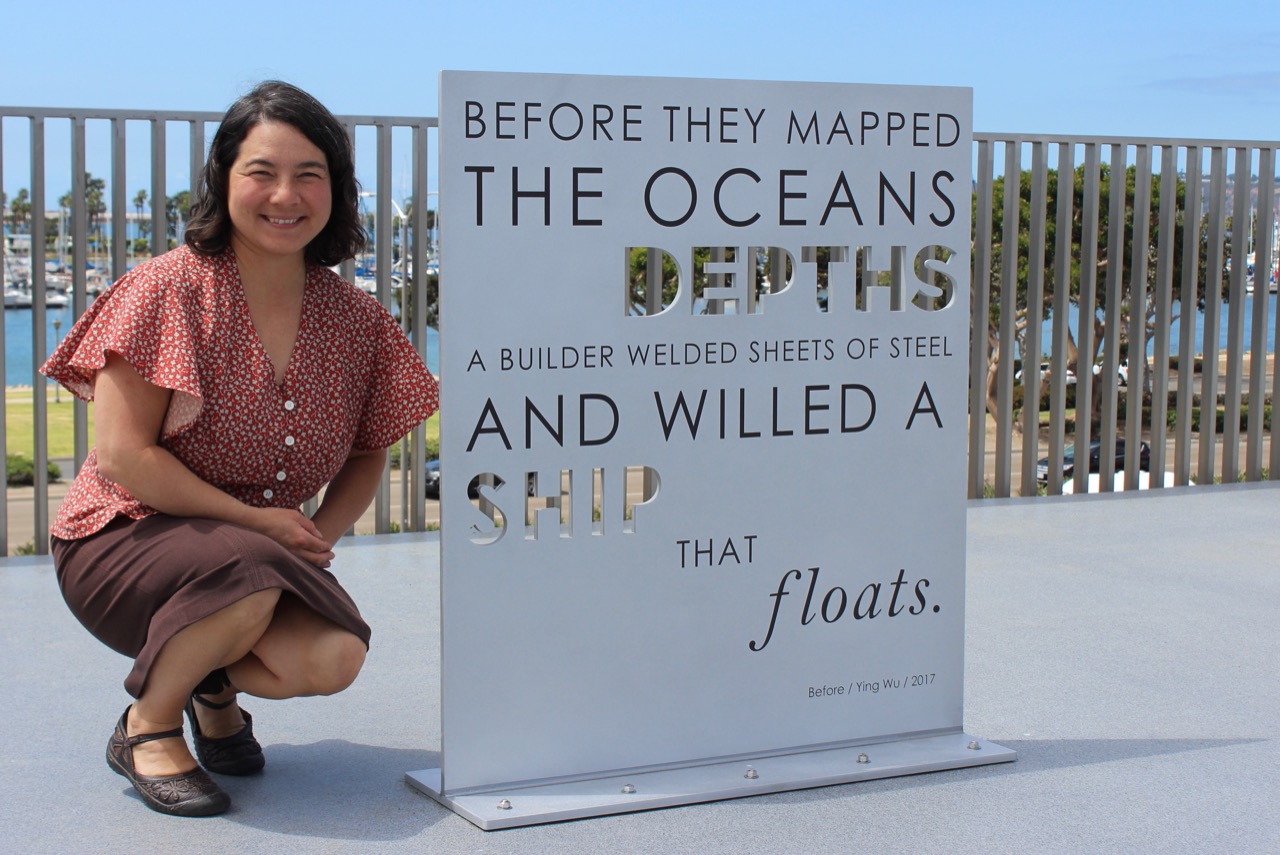
By Ying Choon Wu

My fellow law-abiding citizens –
as we steer our carts
through Costco and Walmart
and Target and Best Buy,
let us remember this:
We are somewhere.
Inside our shoes.
Between the cans of soup
and bags of noodles.
Between crossing off sanitizer
and searching for arugula.
Between the chill of dawn
and the cool of night.
Between apex and nadir.
Between the arc of the sky
and our parking spots.

We are more than 7 billion in the world.
Each one of us is somewhere.
The bones of our forefathers are somewhere.
Our baby bonnet buttons,
the old TVs we forsook for flat screens,
the prizes from our Happy Meals – are somewhere.

My law-abiding brothers and sisters,
as we dream frontiers from our cul-de-sacs,
and pull the crab grass,
and whiten our teeth,
I ask of you this: Touch your navel.
We came into life through connection.
Feel the soles of your feet –
We are somewhere.
We are here.


Ying Wu is a poet and cognitive neuroscientist who studies insight and creativity.  She hosts San Diego’s Gelato Poetry Series (www.meetup.com/BrokenAnchorPoetry/) and is part of the organizational team for the Kids! San Diego Poetry Annual.   She embraces poetry as a medium for creating community and connecting people.  Her work has been featured in Serving House Journal, Synesthesia Anthology, Blue Heron Review, The San Diego Poetry Annual,  The Poetry Superhighway, and The Clackamas Literary Review, and is on display at the San Diego Airport.  She is a recipient of an Oregon Literary Fellowship, and was awarded honorable mention in the 2017 Kowit poetry competition.  She lives in the San Diego Bay on a sailing catamaran with her husband and daughter.

Photo credit: Polycart via a Creative Commons license.

This poem previously appeared in the Clackamas Literary Review.

Elegy

By Bänoo Zan

For Jamal Khashoggi

I am Allah—
Al-Rahman[1]
Al-Rahim[2]

banished from
faith
and love

mourning—

beauty—
my Word—

censored—

I am mourning
my death—

The robe
of my Kaaba
stained with blood
of free speech

I have witnessed
Terror—

my sons beheaded
my daughters
deprived of light

I am Allah—
Beloved of
bards and prophets
Idol of rebels and Sufis

fleeing from
custodians
who desecrate
my house of
refuge

My body dismembered—
scattered over the woods—
I am seeking hearts
to take me in

They have stamped me
on their crown—
used me as cheap gold—

Bleeding
I wonder
if I will survive

Free me—

Free Allah
from despots

Free yourself
from fear

Let me live—

apostate infidel that I am—

At times like this—
with watan[3]
soaked in worshippers’ blood—

with faith soiled
and values sold—

which god do you worship?


Bänoo Zan has numerous published poems and poetry related pieces (over 170) as well as three books. Songs of Exile, her first poetry collection, was shortlisted for Gerald Lampert Award by the League of Canadian Poets.  Letters to My Father, her second poetry book, was released in 2017. She is the founder of Shab-e She’r (Poetry Night), Toronto’s most diverse and brave poetry reading and open mic series (inception: November 2012). Follow the poet on Facebook, Twitter @BanooZan, and Instagram.

Photo credit: TMAB2003 via a Creative Commons license.

This poem was previously published in Dissident Voice.

[1] Gracious, compassionate
[2] Merciful
[3] Homeland


Citizens United to Make Oz Great Again

By Nancy Austin


When the Supreme Rulers lifted limits on campaign contributions,
The wind began to switch, the House, to pitch,
and the Senate, fat on fundraising festivities.
Wizards and witches from east to west, north to south
could now hide behind curtains, throw balls of fire,
send flying monkeys, flaunt crystal balls.

Oz TV buzzed with slogans as candidates paired with PACs.
Almira Gulch with Western Witches for Oil,
I’ll get you my pretty, and your little dog too.
Lion with Independents for Advancing Education,
Elephants, donkeys and me, oh my.
Scarecrow avoided all PAC’s and was branded
If I only had a brain.

Dorothy snagged The International Landscapers,
Look no further than your own backyard,
and the Realtors Network, There’s no place like home,
and almost took it, but the Wizard was backed
by Foreign Flying Monkeys, whose slogan,
Pay no attention to the man behind the curtain,
was lost on the newly courageous heartless and brainless.
Now, there is liberty and justice for all
(very bad wizards).


Text in italics from or adapted from Wizard of OZ. Director Victor Fleming. Metro-Goldwyn-Mayer Studios Inc., 1939.


Nancy Austin was born in Whitefish Bay, WI, but has lived on both coasts and points in between. She holds a master of science in psychology, ran a community support program for individuals with mental illness in Green Bay, and retired early to move to the northwoods.  She relishes time to write in between operating an unofficial bed and breakfast on Bear Lake, for her family and friends. Austin’s work has appeared in journals such as Adanna, Ariel, Midwestern Gothic, Portage Magazine, Sheepshead Review, Verse Wisconsin and the Wisconsin Poets Calendars. She has a poetry collection titled Remnants of Warmth (Aldrich Press/Kelsay Books, 2016).

Image credit: Mark Rain via a Creative Commons license.


Dave

By David H. Reinarz


Dave stepped out of his air-conditioned house and sat down on the front porch. Not on a chair. On the concrete step.

The concrete step on the porch of Dave’s house was very hot. Dave could feel the heat through the seat of his stone-washed denim blue jeans and Fruit of the Loom boxer briefs.

The concrete step of Dave’s house was very hot, because it was 97 friggin’ degrees. Dave’s forehead instantly bloomed with perspiration, followed closely by his armpits. The humidity was probably about 97, too. He took off the turquoise and orange plaid cotton button down shirt. He didn’t want sweat stains on it. He had bought it on an impulse in the fashionable menswear store in Regency.

Dave’s shoulders and arms and back and chest now glistened. The soft soles of his feet were uncomfortable.

This must be what it’s like for those poor devils crossing the Mexican desert, trying to get to the Rio Grande, he thought. Or those poor bastards trying to escape North Africa across the Mediterranean to Europe. Or those poor kids working all day in that factory in Asia who made my plaid shirt. Bloody shame, that is. The world is not an easy place!

Dave took a sip of iced mocha cappuccino. He could go back inside. Inside Dave’s house, the computer-controlled environmental enhancement system kept everything at exactly 72 degrees Fahrenheit and 45 percent humidity.

But, no, he would sit outside on the concrete step of the porch of his house in the heat for a bit longer. You know, in solidarity with all those poor souls trying to claw their way across the face of the planet in search of … what?

Well, he raised his glass in symbolic salute, thoughts and prayers. Thoughts and prayers.


David H. Reinarz was born in Minneapolis and now lives in Omaha, Nebraska, and he has a BA in Philosophy and Religious Studies from the University of Nebraska, Omaha. Retired from a career as manager of retail professional bicycle shops, he is an alumnus of the 7 Doctors Writers Workshop (2015) and has been writing short stories and poetry since 2015. Dave is the author of two collections: Story City: Ten Short Stories and One Long Story in the Middle (2016) and The Sweet Jesus Trilogy and Other Stories (2017). His books are available in paperback and Kindle on Amazon.com.

Photo credit: Mr. TinDC via a Creative Commons license.

Goddammit, you gotta vote because

By Tara Campbell


when hate comes marching into town
it bashes streetlights left and right
incited by a raving clown.

They’ll yank the phone- and power lines down
to shock and choke us in the night
when hate comes marching into town.

We’ll stand together—black, white, brown
queer, Muslim, Jew—against the blight
incited by a raving clown.

When angry men fling fists around
we’ll arm the women (impolite!)
when hate comes marching into town,

and we’ll sing loud enough to drown
them out, when they shout all their shite
incited by a raving clown.

But only votes retake the ground,
rebuild, and reignite the lights
when hate comes marching into town
incited by a raving clown.


Tara Campbell (www.taracampbell.com) is a Kimbilio Fellow, a fiction editor at Barrelhouse, and an MFA candidate at American University. Prior publication credits include SmokeLong Quarterly, Masters Review, Jellyfish Review, Booth, and Strange Horizons. Her novel, TreeVolution, was published in 2016, followed in 2018 by Circe’s Bicycle. Her third book, a short story collection called Midnight at the Organporium, will be released by Aqueduct Press in 2019.