¡Despierta!

By Ada Ardére 


She lies rotting in saltwater that thrashes about white resorts
that in their time and in their place drown out her voice
as it would otherwise be heard begging, pleading, screaming
for the lives of her children as they sit in wards without power,
diabetic comas consuming the elderly and children equally
while Brooks Brothers suit clad Epstein socialite collaborators
avert their eyes from her teary visage in slave-maintained
golf clubs across the sea refusing to acknowledge her
in any way but kicks and spit upon the whore they sell,
upon the bloodied lips and cracked teeth of a mother of millions
without water or food or even the dignity of acknowledgement!

She is remembering for them all the counts and strikes upon their bodies
in the century since forced annexation where experiments
upon illiterate women gave rise to mainland women’s endless fucking and
the cessation of hormonal migraines and acne for little girls in elite schools
who would never see the effects of nuclear testing on her northern coasts,
oh she remembers for them, she refuses to let death or time erase
the millions of hours of modern indentured servitude that her
children were deceived into for the cost of a boat ride to a land
they were already citizens of but still not yet seen as anything
but the dark skinned/too pale inbetweeners of a failed negro kingdom
the lazy, laid-back rapists, thieves of virtue, papists thirsting for jobs!

She is listening to the century long echoed call and response of the tired
cry from Lares whose drone was cannons and drums from
the hearts of those who still remember the Taíno name, to those
as they roar the name of both tormentor and consoler, ¡Maria!,
to the silence of supposed compatriots in congressional halls
whose only gestures are public prayers for miracles they
could manifest themselves in otherwise forgettable acts
of mercy if only they did not reduce her and her people
to lesser than dogs, and she listens to the swelling response:
a beast cannot be made more beastly nor can its cry
be muted as it awakens to the only means that is left to it!


Ada Ardére is a Puerto Rican poet from New Orleans, who now lives in Kansas City. She studied philosophy of art and Plato, and loves beat poetry. Her poems have recently appeared in 34th Parallel Magazine and online in Wussy Mag.

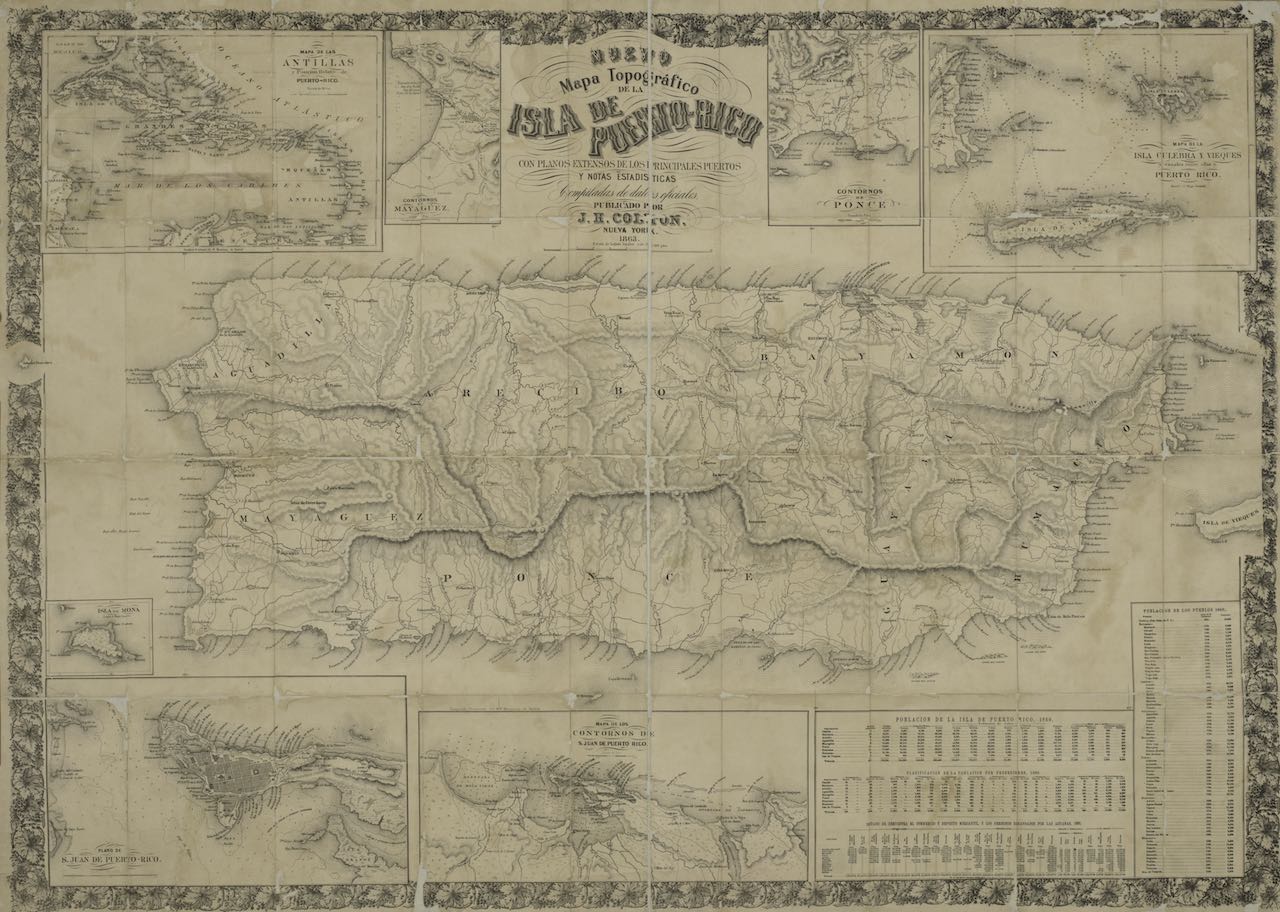
Map of 1863 Puerto Rico from New York Public Library.

Apartheid

By Rebecca Ruth Gould


“We don’t serve Arabs,”
says the man behind the counter.
He fixes his eyes on me &
awaits my consent.

My Arab taxi driver is unfazed.
Racism is an old story
in the land of David.
Politeness took over.

We head for the car.
The road is a silent witness to atrocity.
Barren valleys cascade,
one after another.

God is a strange creature,
I think to myself.
What idiot would choose this sterile land
for launching his career?

We reach Bethlehem: checkpoint 300.
I disembark.
Arabs are not allowed
to cross like white women

with American passports.
I journey by foot to the two-storied
white limestone home where
I’ve taken up abode.

I pass tourists in t-shirts,
Banksy portraits,
& soldiers armed with kalashnikovs.
Like the racist at the counter—

like every well-heeled politician—
like every international law—
armed soldiers avert their gaze,
revealing glare of the sun.


Rebecca Ruth Gould’s poems and translations have appeared in Nimrod, Kenyon Review, Tin House, The Hudson Review, Salt Hill, and The Atlantic Review. She translates from Persian, Russian, and Georgian, and has translated books such as After Tomorrow the Days Disappear: Ghazals and Other Poems of Hasan Sijzi of Delhi (Northwestern University Press, 2016) and The Death of Bagrat Zakharych and Other Stories by Vazha-Pshavela (Paper & Ink, 2019). Her literary translations have earned comparison with the world’s greatest poets, with a reviewer in The Calvert Journal recently noting, “With her new translation, Rebecca Ruth Gould follows in the footsteps of Russian literature luminaries like Osip Mandelshtam and Marina Tsvetaeva.” Her poem “Grocery Shopping” was a finalist for the Luminaire Award for Best Poetry in 2017, and she is a Pushcart Prize nominee.

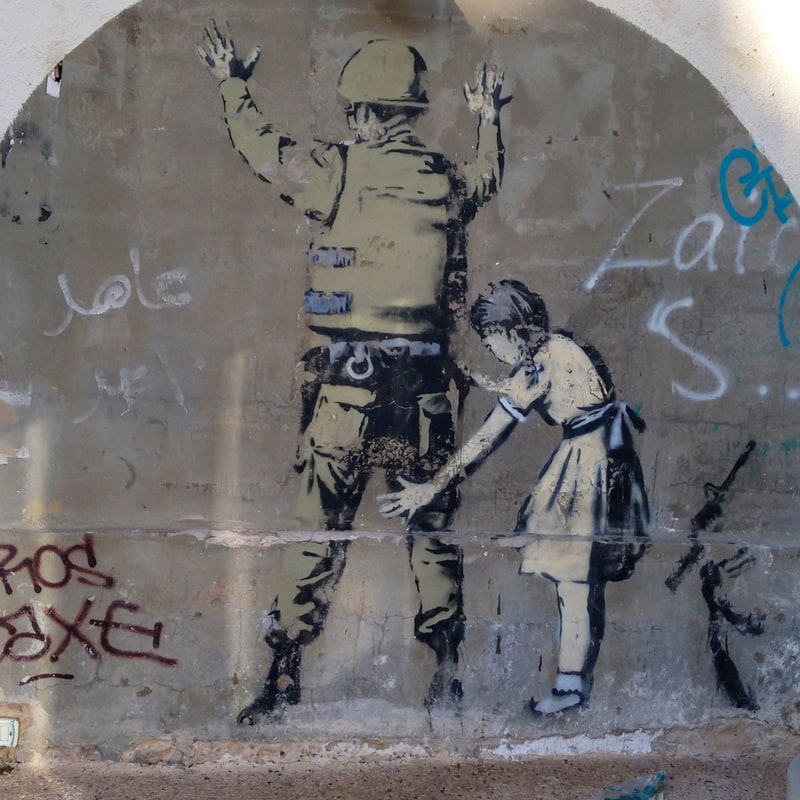
West Bank mural photo by Dan Meyers on Unsplash, 2014.

Dan’s note: This was done by Banksy, which I didn’t learn until a couple years later. I paid a Palestinian cab driver to take me to their side of the wall and took a few photos of the “graffiti”/art with my iPhone. The West Bank is walled off like a prison and heavily guarded by the Israelis. For those reasons, of all the “graffiti” I saw, this one resonated the most with me. I hope this pic introduces others to this amazing piece of art or gives some context to those who have seen it before.

Storm Front


By Judith Skillman


Artist Statement

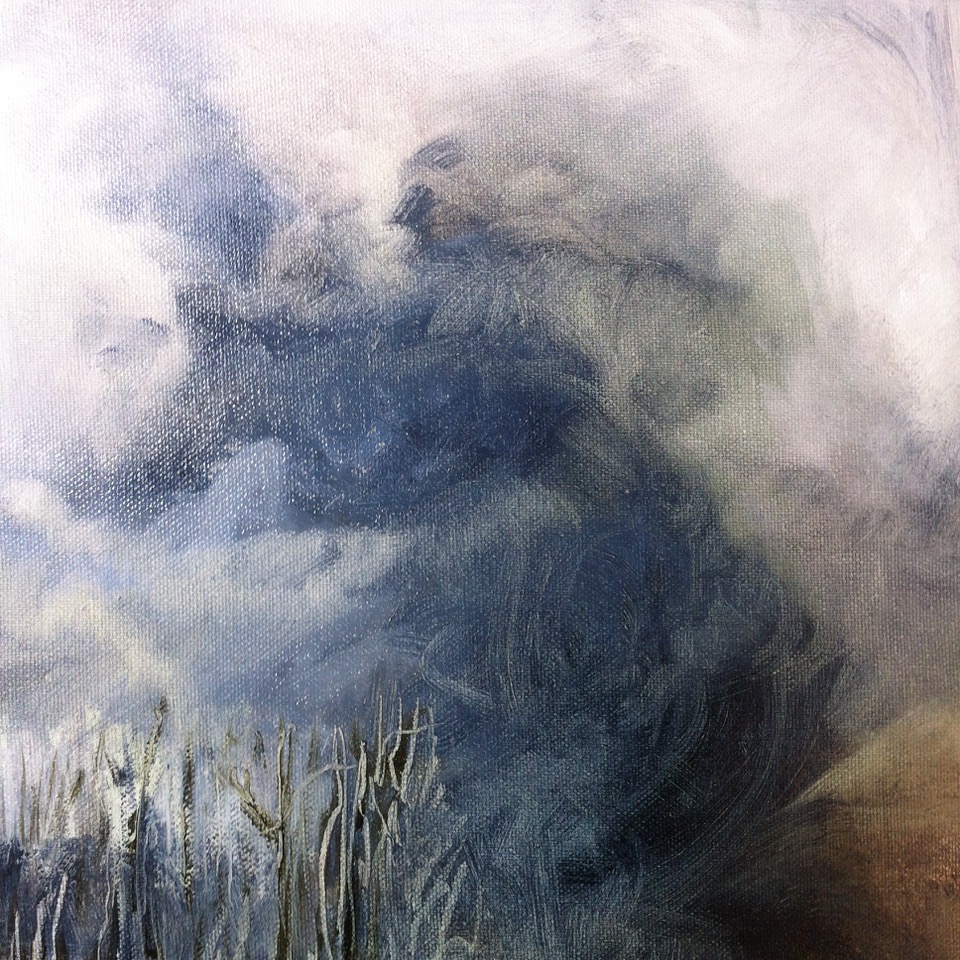
In “Storm Front,” oil and cold wax on canvas,  12” x  12”, the artist used a rag in equal measure to paint and wax. A paint scraper was employed to etch out the trees at the bottom left. Nature provides solace during times of affliction, whether that affliction be physical or political. One can imagine that those who have been targets of fascism and racism—dreamers who deserve their amnesty, “illegal” Mexicans who perform heroic jobs American refuse to do, and the poor from whom government support has been taken and put into the pockets of the very rich—these people still and always remain citizens of the natural world.

Perhaps not surprisingly, given the German term Sturm and drang (transl. as storm and urge, or action and high emotionalism—in the German usage, however, against 18th century norms in literature and music)—a website by the same name, “Stormfront,” which had its domain name “seized for displaying bigotry, discrimination, or hatred,” has become a growing force for white nationalists and neo-Nazi’s. To call this site troubling would be euphemistic. Inherent in the attitudes of those who patronize this site lies a disturbing reality. Not only is the current administration bent on making the rich richer and the poor poorer, it is determined to sacrifice nature in the bargain.

Regulations of vehicle greenhouse gas emissions implemented under the Obama administration have been undone; FEMA has stricken the term “climate change” from its plan book and “climate change” websites have been likewise censored; the Trump admin has decreed that accidental bird deaths, in violation of the Migratory Bird Treaty Act (MBTA), are legal.

To date, the actions of this administration have broken with a tradition of environmental protection—the result of Rachel Carson’s Silent Spring (1962), and other like-minded literature that focuses on understanding the impact humans have had on the earth. The actions taken by Trump and his cronies undo measures to safeguard the only place we have to live. They are shocking; they fly in the face of science, spirituality, and God-given rights for plants, animals and humans.

“Storm Front,” then, can be seen as what has happened since the Trump administration came to power, and what is to come. Viewing the painting requires an admission that this is not the time to sit idly by. Both the natural and the human world require concrete forms of protest—resistance—in order to survive the onslaught of such a dangerous and powerful ignorance.


Judith Skillman is interested in feelings engendered by the natural world. Her medium is oil on canvas and oil on board; her works range from representational to abstract. Her art has appeared in Minerva Rising, Cirque, The Penn Review, The Remembered Arts, and elsewhere. She also writes poetry, and her new collection, Premise of Light, is published by and available from Tebot Bach. Judith has studied at the Pratt Fine Arts Center and the Seattle Artist’s League under the mentorship of Ruthie V. Shows include The Pratt, Galvanize, and The Pocket Theater, in Seattle. Visit jkpaintings.com.

Brown, Orange, and Beige Like Caramel

By Alexander Schuhr


“Maybe you want to play with him,” the woman says, leading the little girl toward a toddler sitting in the sand. The boy doesn’t need anybody to play with. He is completely absorbed with his task of shoveling sand into a bucket. Nevertheless, this woman seems terribly eager to see her girl join him in this endeavor. She proceeds to drag her child away from my daughter.

For my daughter, the fact that everybody has a different color is as self-evident as mundane. Her stuffed dinosaur is green, her plush duck is yellow, and she has a pink teddy bear. Similarly, mommy is brown. (A more accurate description than “black.”) Daddy is orange. (Inaccurate, as far as I’m concerned, but so is “white.”) She describes herself as “beige like caramel,” sometimes clarifying “like Leela,” an Indian-American character in Sesame Street, portrayed by the actress Nitya Vidyasagar. (Comparable complexion, though different ethnicity—but why would she care about that?) In the protected world of our home, I have a comparably innocent approach to skin color. In the outside world, however, a different reality imposes itself.

In the two years of her life, my daughter has undergone a complex transformation of racial identity, unbeknownst to her. For some time after her birth, her complexion remained very similar to mine, and her hair was straight. People considered her Caucasian. On more than one occasion, my wife was asked, with an insolent tone of disbelief, if she was the mother. Then, there was an extended period of ambiguity. The child’s hair became curlier. Her once milky skin tone turned into café au lait, still with lots of milk but just enough coffee to keep people guessing. Few would guess out loud, of course. People feel much too uncomfortable talking about race. I’ve seen them several times, the relieved expressions on faces, like when a bothersome puzzle is solved, when either my wife or I appeared next to the other, thus clarifying my daughter’s race.

Her skin became only slightly darker. At some point, she must have crossed a threshold, though, and the “one-drop rule” went into effect. Then she was no longer “ambiguous” but “black.” Suddenly it was an overwhelming majority of black people, occasionally other “people of color,” who would interact with her, call her cute, and tell me how beautiful she is.

Along with her apparent transformation to “blackness,” came my worry that she may be subjected to the same vicious, sneaky forces that I’ve seen too many times applied to my wife. Social scientists call them “new racism” or “racial microaggressions,” these subtle traces of racial bias in everyday situations. They are faint symptoms of a social disease, well known to virtually any minority group, yet often unacknowledged by the Caucasian majority. They are harder to spot than the hateful slogans of the white supremacist with the swastika tattoo, the degrading slurs of the hooded clansman, or even the thinly disguised attacks of the populistic demagogue that are effortlessly decoded by his intended audience. No, new racism is subtler, less identifiable. It is conveyed by the flight attendant whose cheerful demeanor becomes cold and distant when serving an Asian passenger, by the group of giggling co-eds that turns silent when the Hispanic classmate enters the lecture theater, or the motorist who, while waiting for the green light, feels compelled to lock the car when he spots the Black pedestrian on the sidewalk. The ambiguity of these signals makes it difficult to identify their nature. Each isolated incident may be vague and open to alternative interpretations, but their aggregation makes all doubt vanish.

And now there is that woman, who pushes her daughter away from mine, toward the deeply absorbed toddler with the shovel. She gives me a nervous smile, which reveals uneasiness as well as defiance. I don’t smile back. While I feel offended by her action, I cannot be certain of its meaning. Part of the viciousness of subtle racism lies in its obscurity to the recipient, and sometimes even the perpetrator. Consequently, I find myself wondering whether I am too suspicious. Maybe it’s innocent. Maybe she knows the little boy and fears he is lonely or bored. Maybe she fears older kids (my daughter is not older than hers, but unusually tall for her age). Maybe she fears me, the only dad on the playground. I try to find other explanations, but cannot ignore the one reason that seems to be an obvious possibility, and I dread the day this reason may appear equally possible to my little girl.

Yet, it is a bitter truth that she will become aware of racism in its subtle and not so subtle forms. And it is my duty to prepare her, so that she will be able to identify the deficiency in the senders of such messages and never attribute it to herself. It is a duty I face with the utmost determination, but also with profound sadness. I cherish our protected world, where people are simply brown, orange, or beige like caramel.


Alexander Schuhr is an author, essayist, and scholar. He was born and raised in Munich, Germany. Before coming to the United States, he lived in various countries in Europe and Sub-Saharan Africa. He holds an M.A. in political science and a Ph.D. in economics. He writes fiction and creative nonfiction.

Photo credit: Kevin Pelletier via a Create Commons license.

This essay previously appeared in Brain, Child Magazine and The Good Men Project.

Was it foolish to think so?

By Sara Marchant

My husband’s birthday is November eighth. He takes the day off. We drive to Idyllwild for lunch. It is a windy day so we have the patio to ourselves until an elderly white lady with an elderly dog joins us. She greets the waiter by name and he greets the cranky old dog by name. The dog only growls.

“Did you vote yet?” the elderly lady asks.

“Yes,” the waiter looks toward our table before answering.

“Let’s whisper who we voted for,” the lady suggests. They both look our way this time. They put their heads together and whisper in each other’s ears.

They squeal in tandem as they pull away and slap hands. I am smiling when they glance our way again. The waiter walks to our table and peers into my coffee cup.

“I told you it was too strong,” he says. “I’ll bring you fresh and drink that cup myself.”

“I’ll take the fresh,” I laugh, ‘but you’d better not drink after me. I have a head cold.”

“Okay, okay,” he takes the cup and walks away laughing.

The bell on the restaurant door rings out.

“Who do you think they voted for?” my husband asks.

“Hillary, of course.” I am astounded he even needs to ask. “She’s a college-educated woman who lives in Idyllwild, and he’s a gay Mexican man. They’re with her.”

“How do you know he’s gay?” my husband argues. “You can’t know that.”

“I know,” I say. He stares; he won’t speak until I explain. “When he joked about drinking my coffee, did you feel uncomfortable? Territorial? Jealous?”

“No,” my husband says. “It’s like you were talking to your brother … oh.”

“Yep.”

The waiter brings the fresh coffee, and I drink it. We pay and prepare to leave. The elderly lady waves. I point to her “I voted” sticker and give her a thumbs up. Her dog growls in farewell.

We’ve declared the day social media free. We don’t go online and we watch the 1960s television series Stoney Burke instead of election coverage. We have that last day free, and when I think of it later, that last free day, I remember the elderly lady and our waiter’s gleeful high five.

*     *     *

Wednesday my mother calls me, early. She is crying. She needs me to go online and see if her neighbors are lying. They aren’t lying. Unless the whole world is lying.

“Are you sure? Are you sure?” my mother keeps asking. She can’t accept it.

“I don’t understand,” she says. “How could this happen? Are people really this stupid? I don’t … I can’t …” She ends the call because she is crying again.

When I was a little girl, my mother told me of a nightmare she first had when she was four years old. In the nightmare there is an awful man, an angry red-headed man wearing a trench coat and clenching knives in both hands. Surrounding my mother are the bodies of women, stabbed, hacked and bleeding. The awful red-head, Mr. Agony, is on a bridge above my mother’s head; he holds a woman by the arm. He throws the woman off the bridge and when she hits the ground her head comes off. My mother runs over and grabs the head, holding it with the neck uppermost so the blood doesn’t run out. She thinks that if the blood is preserved the head can be sewn back on. She is four years old. In trying to save the woman’s head, my mother realizes, she has lost track of Mr. Agony. He is no longer up on the bridge, she sees. He will be coming for her next. My mother had this dream for many years.

She thinks maybe her parents shouldn’t have allowed her to see the newsreels of the camps being liberated.

Wednesday I don’t go to work. My English as a Second Language students, mostly Chinese, have asked to cancel class. I remember going to the post office. I remember that four of five women I saw there couldn’t meet each other’s eyes. I remember crying with my mother. I remember crying with my friend Senta. I remember screaming at my husband when he asked why I was crying. I don’t remember much else.

*     *     *

Friday is my birthday, but I have to work. We celebrate on Saturday by going to brunch. The plan is to catch a movie after, but the thought of sitting in the dark with a bunch of strangers, strangers who might possibly have voted for bigotry, misogyny, racism, and environmental destruction, makes my skin crawl. Instead I decide to go food shopping. I want full cupboards and I want to be in the light.

We go to my husband’s favorite Chinese grocery store in Temecula. He once bought a cake mix called “Puto” there; this delights him. And the cake was quite tasty. In the rice aisle we spend 20 minutes talking with an older woman from Okinawa. She tells us about the cleanliness of Japanese rice compared to Californian—“California rice is just filthy”—why brown is better than white, and how CostCo is the best value for bread because the price of bread is just ridiculous.

“You don’t look like a bread eater,” she tells my husband.

“I’m not,” he says, pleased. “I’m Native. American Indian,” he clarifies.

“Your people walked across the Bering Straight,” she says. “I went to citizenship school.”

Later on, my husband says to me, “That lady sure needed to talk about rice.”

“It wasn’t about the rice,” I say. “It was never about the rice.”

*     *     *

That night, eating dinner, my husband asks about impeachment. My mother, who is eating with us, looks up, hopeful.

“Impeach the puppet so the master is in charge?” I ask. “That guy advocates conversion therapy. Using electric shock.”

My mother vomits. She literally vomits in revulsion, anger and fear.

When my mother was ten, her older sister was kidnapped, raped, and tortured before being dumped on the side of the road. My aunt spent the next two years in a mental hospital. In the 1950s no one talked about rape. We don’t even know if the doctors in the hospital were told what had happened. The only therapy my aunt received was shock therapy.

“I’ll never let anyone take you away,” my husband tells my mother. “Anyone coming for you or my wife will have to go through me.”

My mother shakes her head. My husband still doesn’t get it.

“You’re too young to remember,” my mother says once she’s cleaned up and comfortable, sitting on the sofa with a cup of hot tea. “Once the hate is institutionalized, everyone loses.”

When we are alone my husband will question me. “I get that you are Jews, I get that you are Mexican, I get that you are worried for your gay family, but your mom actually threw up.”

“My mom is an elderly, disabled Jew, with Mexican children, black grandchildren, Chinese grandchildren, gay grandchildren, but this was never about an election,” I will tell him. “This was never about Republicans or Democrats or red or blue. This was about thinking we lived in a country where we knew our neighbors. Some of them are assholes, sure, but we thought we lived in a country that would protect us from the assholes. We thought they would keep us safe. And we woke up Wednesday and discovered we weren’t safe at all.”

Were we foolish to ever think so?

…………………………………………………………….
Sara Marchant

Sara Marchant, a prose editor for Writers Resist, received her Masters of Fine Arts in Creative Writing and Writing for the Performing Arts from the University of California, Riverside, Palm Desert, and her Bachelors of Arts in History from the University of California, San Diego. Her work has been published by The Manifest-Station, Every Writer’s Resource, Full Grown People, and Brilliant Flash Fiction. Her work is forthcoming in the anthology Nothing But the Truth So Help Me God: All the Women in My Family Sing. She lives with her husband in the high desert of Southern California, where she enjoys teaching ESL at a Christian university, despite being the only Mexican-American Jew on campus.

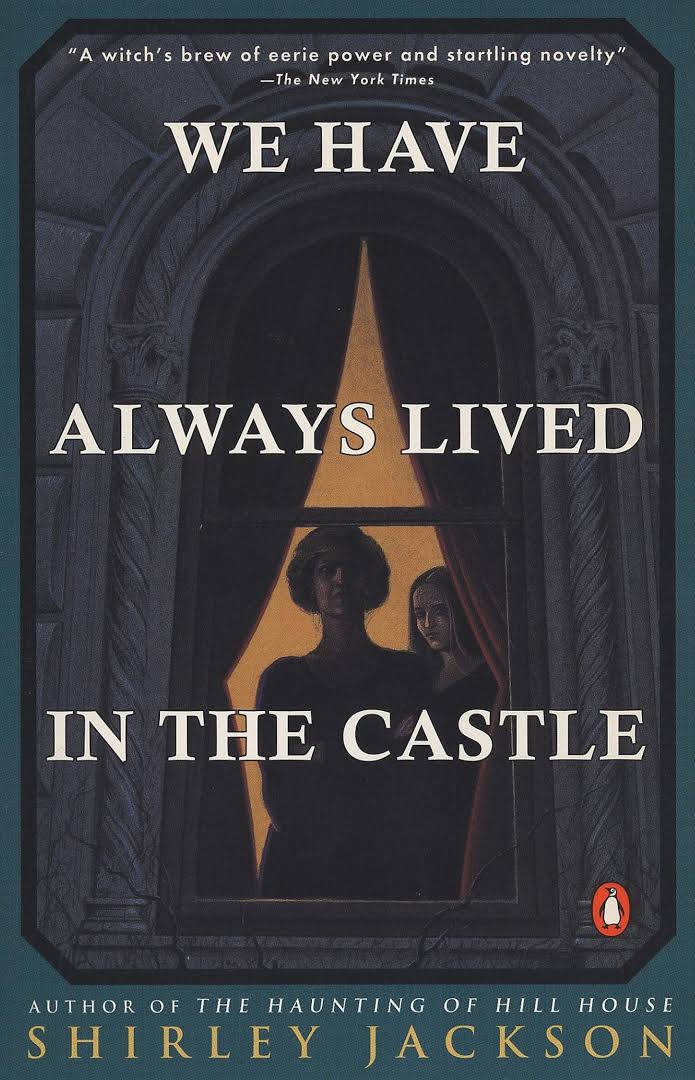
Reading recommendation: We Have Always Lived in the Castle by Shirley Jackson.