
Two Poems by Gary Glauber

[fusion_builder_container hundred_percent=”no” hundred_percent_height=”no” hundred_percent_height_scroll=”no” hundred_percent_height_center_content=”yes” equal_height_columns=”no” menu_anchor=”” hide_on_mobile=”small-visibility,medium-visibility,large-visibility” class=”” id=”” background_color=”” background_image=”” background_position=”center center” background_repeat=”no-repeat” fade=”no” background_parallax=”none” enable_mobile=”no” parallax_speed=”0.3″ video_mp4=”” video_webm=”” video_ogv=”” video_url=”” video_aspect_ratio=”16:9″ video_loop=”yes” video_mute=”yes” video_preview_image=”” border_size=”” border_color=”” border_style=”solid” margin_top=”” margin_bottom=”” padding_top=”” padding_right=”” padding_bottom=”” padding_left=””][fusion_builder_row][fusion_builder_column type=”1_2″ layout=”1_2″ spacing=”” center_content=”no” link=”” target=”_self” min_height=”” hide_on_mobile=”small-visibility,medium-visibility,large-visibility” class=”” id=”” background_color=”” background_image=”” background_position=”left top” background_repeat=”no-repeat” hover_type=”none” border_size=”0″ border_color=”” border_style=”solid” border_position=”all” padding=”” dimension_margin=”” animation_type=”” animation_direction=”left” animation_speed=”0.3″ animation_offset=”” last=”no”][fusion_text]

Planet of the (r)Apes

The melancholy rubble
of all that once stood proud
& we went along with the story,
saluting & nodding
when it seemed easy to do.

What did we know & when?

So many who buried knowledge
behind shaky patriarchy,
its false melancholic glory
an inadequate foundation.
Smiles confidently ignored
awkward power inspiring
subordinate duck & cower,
looking akin to turning away,
looking the other way.

Aren’t you enraged?

Day to day to another lost year,
seasons of blind abuses,
making poor excuses &
safely moving on.

Then came the turning,
slowly at first,
a quake barely registering,
a low rumble of complaint
that gathered strength
to surface secrets
needing to be heard,
that one day might
lead to the kind of change
that will topple all.

This failure of gender
in plentiful mad assumptions
& unforgivable sexual plunder
seems a strange fiction,
a fetish-like affliction,
but sheer numbers say otherwise.

The entertainers, politicians,
professors, those in charge,
acting as if this was their due,
their sick advantage exercised
on a league of less fortunate targets
to satisfy predatory urges
and pseudo-supremacy,
an illusion of power
affording privilege,
a false birthright
making skin crawl accordingly.

Slowly, finally,
voices are being heard,
change forthcoming:
a legion of victims
finding expression after ages
of silent acrimony & regret.
So many (far too many)
& therein lies ignominy.

Apologies & feelings of shame
will never be sufficient
to even this brash misconduct.
We are a broken society
in need of new instruction
toward mutual respect
& overdue recognition.

These wrongs have
destroyed this planet
in ways only time
& right actions can heal.

That final scene of realization
on the beach, surrounded by
bikinis (& atolls forming),
epiphany of seismic proportion:
this is our Earth.

“You finally did it, you maniacs.
You blew it up!”

[/fusion_text][/fusion_builder_column][fusion_builder_column type=”1_2″ layout=”1_2″ spacing=”” center_content=”no” link=”” target=”_self” min_height=”” hide_on_mobile=”small-visibility,medium-visibility,large-visibility” class=”” id=”” background_color=”” background_image=”” background_position=”left top” background_repeat=”no-repeat” hover_type=”none” border_size=”0″ border_color=”” border_style=”solid” border_position=”all” padding=”” dimension_margin=”” animation_type=”” animation_direction=”left” animation_speed=”0.3″ animation_offset=”” last=”no”][fusion_text]

Sublimation

He enthusiastically supports
the man whose conflated policies
can thwart & negate him
because he is living proof
Willy Loman did not die in vain.
He sells; he is well-liked.
It’s Muslim with a small m,
no Nation of I action here.
His string of successes
is tied tightly to the capitalist
benefits of fossil fuels
& a planet slowly dying.
His carbon footprint
leaves divots the world over.
& yet, invited to become a member
of the prestigious country club,
he jumps at the chance.
Eighteen holes to prove
he is an example, an exception,
paraded around as proof,
a minority friend &
he gladly looks the other way,
focusing instead on the movie star
shaking hands gladly
across the banquet hall.
Every photo op
is his small revenge,
& he who laughs last
lives to laugh another day,
even when things get serious fast.
Life is funny like that
& compromise is the new normal,
alternate facts showing how
bleak is the new black.

[/fusion_text][/fusion_builder_column][/fusion_builder_row][/fusion_builder_container][fusion_builder_container hundred_percent=”no” hundred_percent_height=”no” hundred_percent_height_scroll=”no” hundred_percent_height_center_content=”yes” equal_height_columns=”no” menu_anchor=”” hide_on_mobile=”small-visibility,medium-visibility,large-visibility” class=”” id=”” background_color=”” background_image=”” background_position=”center center” background_repeat=”no-repeat” fade=”no” background_parallax=”none” enable_mobile=”no” parallax_speed=”0.3″ video_mp4=”” video_webm=”” video_ogv=”” video_url=”” video_aspect_ratio=”16:9″ video_loop=”yes” video_mute=”yes” video_preview_image=”” border_size=”” border_color=”” border_style=”solid” margin_top=”” margin_bottom=”” padding_top=”” padding_right=”” padding_bottom=”” padding_left=””][fusion_builder_row][fusion_builder_column type=”1_1″ layout=”1_1″ spacing=”” center_content=”no” link=”” target=”_self” min_height=”” hide_on_mobile=”small-visibility,medium-visibility,large-visibility” class=”” id=”” background_color=”” background_image=”” background_position=”left top” background_repeat=”no-repeat” hover_type=”none” border_size=”0″ border_color=”” border_style=”solid” border_position=”all” padding=”” dimension_margin=”” animation_type=”” animation_direction=”left” animation_speed=”0.3″ animation_offset=”” last=”no”][fusion_text]


Gary Glauber is a poet, fiction writer, teacher, and former music journalist. His works have received multiple Pushcart Prize and Best of the Net nominations. He champions the underdog to the melodic rhythms of obscure power pop. His two collections, Small Consolations (Aldrich Press) and Worth the Candle (Five Oaks Press) are available through Amazon, as is a chapbook, Memory Marries Desire (Finishing Line Press). This past summer he read selections from his most recent collection at the 2017 NYC Poetry Festival.

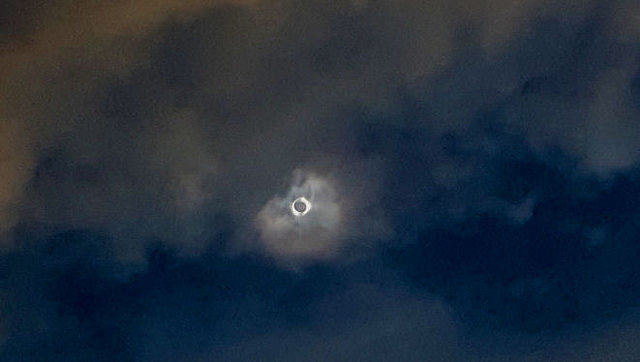
Illustration credit: Osiris, a dying planet, NASA

[/fusion_text][/fusion_builder_column][/fusion_builder_row][/fusion_builder_container]
Testimony

By Lynne Handy

I smell it—
testosterone bones the very air I breathe,
raping seas and waterways, regulating wombs
and ovaries, paring healthcare to a nub.

I smell it in warlords’ jizzy elbow-rubs,
in stilled dissent and parody;
in decay of human brain cells,
contempt for learning. It is strongest
in the threat of nuclear cinders
and human ash, and truths hidden
in the swamp-clot of lies.

This frazzled world needs correction.
’Til yesterday, we were progressing,
but then a curtain dropped
on science, sanity, and good sense.

It’s time to sanitize,
revitalize the world.
Infuse it with truth,
train youth in humanitarian pursuits,
gather all the terrible bombs,
sink them into a sea-safe,
and melt the key; revere the oceans,
heat the world with only sun,
respect the intellect of women,
read the beatitudes, a really good primer
for the lost. Erect monuments to poets,
inscribe their words in the sky.

Let calm breezes waft
in tropes of humility and good will;
a butterfly propulsion,
a timbre of fragile wings
made momentous by their mission
to save


Retired librarian Lynne Handy lives in the Illinois Fox Valley with her terrier, Schatzi, and her beagle mix, BoPeep. She writes poetry and fiction, and participates in poets’ groups and open mikes throughout the area. She has written Spy Car and Other Poems, and three novels, Where the River Runs Deep, The Untold Story of Edwina, and In the Time of Peacocks. Her poems have been published in several literary journals. You can contact her lynnehandy.com and on Instagram.

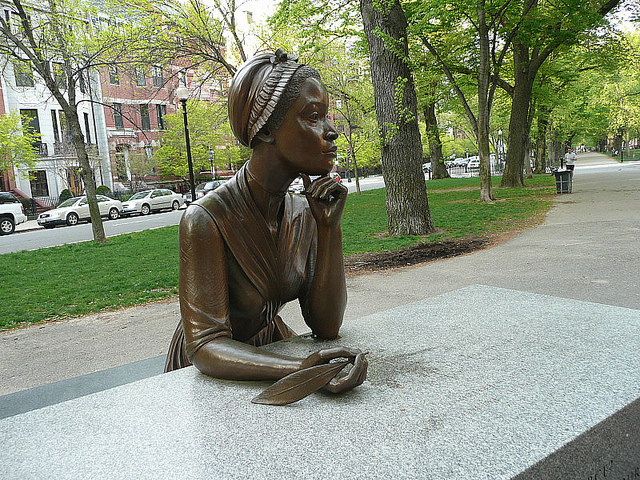
Photo Credit: “Phillis Wheatley, poet at work,” Boston Women’s Memorial, by Lorianne DiSabato via a Creative Commons license.

Administration Rumination

By Kathy Douglas


I step over the cracks trying
not to break my mother’s back
while news accelerates to sideshow
with Prez T as the bearded lady
and Melania in the wrong place,
wrong time. Time starts to taste like wormwood
and rue, sour herb of grace, and climate change parodies itself
in debates over how and why it is named and who does
the naming. In this aluminum wrapped house
it’s like a can’s about to be recycled—
we are poised on the sharp lip
of a popped top waiting
to be dumped into
the hopper


Kathy Douglas’s published work can be found online and in print in Unlost Journal, Calyx, Drunken Boat, The Cafe Review, Noctua, Right Hand Pointing, After The Pause, shufpoetry, and Poetry WTF?! She holds an MFA in Creative Writing from Bennington College. Recently, she has been focused on cut up and collaged found poems. This interest is rooted in the positive reinforcement in Catholic grammar school of a somewhat above average ability to diagram sentences. During the 45th administration, she almost takes comfort in slashing sentences apart and remixing them into poems. By day, she supports the career development of young professionals in fields related to saving the planet. She tweets @kathydouglas and blogs periodically at medium.com/@kathrynd.

Photo credit: Klearchos Kapoutsis via a Creative Commons license.

Just a Test?

By Rick Blum


Rennh rennh rennh rudely interrupted Nora Jones,
causing my stomach to clench like a sprung trap –
something that hadn’t happened since Susan Soloway
and I were sent to her basement while a siren blared
at the fire station a few miles from our otherwise
tranquil neighborhood. [This was the late fifties,
when everyone worried that the Russians would lob
a few nuclear bombs our way. Air-raid tests
like this one were considered prudent then,
as was building home bomb shelters and equipping them
with a few months’ supplies, despite the fact that
radioactive air would filter in in short order anyhow.]

After an interminable moment of excruciating silence,
This was a test of the emergency broadcast system
washed across the room like a tsunami on steroids,
allowing me to breathe again. This is how
a loose-lipped president, dripping with false bravado,
can terrorize his own citizenry: by threatening
total destruction of a small country on the other side
of the globe. Ronald Reagan, who set the Republican Party
on the path to its current state of deviancy, proclaimed:
“government is not the solution to our problem;
government is the problem.” He was almost right.
Turns out, a president is not the solution to our problem,
but surely can be the problem. Hugely!

So, in faraway North Korea, President Fire-and-Fury
thinks he can bend Kim Jong-un to his will as easily as
he sues construction contractors into submission.
I hope he’s right, though chances of that panning out
are slimmer than a runway model. More likely
he’ll ratchet up the bluster until the supreme leader
launches us into that fifties nightmare, or a majority
of the cabinet decides our national delirium must end,
and removes Trump from office.

In the meantime, in case I need to make a dash
for the safety – and sanity – of Canada,
I’m keeping the van gassed-up …
and abundantly stocked with tubs of Tums.


Rick Blum has been chronicling life’s vagaries through essays and poetry for more than 25 years. His early works were published in several, now defunct, national magazines, whose fate he takes no credit for. He was a regular columnist for eleven years for the newsweekly The Mosquito, which, surprisingly, is still in print. More recently, his writings have appeared in The Literary Hatchet, The Satirist, and The Moon Magazine, among others. He is also a frequent contributor to the Humor Times, and has been published in numerous poetry anthologies. Mr. Blum is a two-time winner of the annual Carlisle Poetry Contest. His poem, Tomfoolery, received honorable mention in The Boston Globe Deflategate poetry challenge. Currently, he is holed up in his Massachusetts office trying to pen the perfect bio, which he plans to share as soon as he stops laughing at the sheer futility of this effort.

Photo credit: Cliff Dix via a Creative Commons license.

Who We Are

By Elisabeth Horan


Worrying        scared             ashamed        embarrassed                         angry
sexualized      objectified      demonized
Fat                   disgusting      too thin           too woman
Lesbians         gays                fags                 hags
Sluts                pussies
African American Latinas/os Hispanics Indians Native Americans
Refugees        Syrians           Yemenis         Afghanis         Iraqis              Sudanese
Famine           war                 death
Ignore             /          Ignorance
Bombings       cars on sidewalks                  underground           aboveground             France
UK               USA                 Kabul             Mosul             Mogadishu                 Isis
Boko Haram                           Nigeria            Kenya
Internet                      hate                            trolls
Mother Nature          /          Nurture
Rivers, streams, fish, birds, snakes, bugs, bees, butterflies, bears, coyotes, wolves
Bears Ears                  Arches                        Anasazi Run              Petroglyphs
Clean water              Fracking                    Halliburton                Cheney
Earthquakes              hurricanes                 tornados                     flooding
Self-esteem               respect                       bullying                      suicide
Homeless                    neglected pets           neglected                   people
Pregnant women     abortion clinics         rape survivors          incest survivors
Texas                          intimidation
Hoodies                     guns                           men in Blue              men in Black
Black men
Charlottesville
Sexual assault           police brutality         Emmett Till               Malcolm X
Obama           Oh Lord God, Hast Thou Forsaken Us – ?               Martin Luther King Jr.
Sanders Clinton Warren Leahy                 messy, messy
McConnell Cruz Ryan                                  angry, angry

Elisabeth (Me ) and _____________ (You ).


Elisabeth Horan is a poet mother student lover of kind people and animals, homesteading in Vermont with her tolerant partner and two young sons. She hopes the earth can withstand us and that humans may learn to be more kind to each other and to Mother Nature.

She has recently been featured in Quail Bell Magazine and Dying Dahlia Review. She has work forthcoming at The Occulum, Alexander & Brook and at Switchgrass Review.

Elisabeth is a 2018 MFA Candidate at Lindenwood University and teaches at River Valley Community College in New Hampshire. Follow her @ehoranpoet.

Donald Trump Probably Doesn’t Know What a Pantoum Is

By Eve Lyons

Yes we can
HOPE
Love trumps hate
We are all immigrants.

HOPE
Arab translators risk their lives for our soldiers
We are all immigrants
Promised visas, then denied.

Arab translators risk their lives
Muslims demonized
Promises made, then broken
Transgender women demonized

Muslims are most at risk under the Islamic State
We are our own worst enemy
Transgender women are most at risk in bathrooms
We are making up enemies

We are our own worst enemy
Yes, we can overcome
Love trumps hate
We must not turn each other into enemies.

Yes, we can overcome
Yes we can
We must not turn each other into enemies
Love trumps hate.


Eve Lyons is a poet and fiction writer living in the Boston area. Her work has appeared in Lilith, New Vilna Review, Word Riot, Literary Mama, Hip Mama, Mutha magazine, and several anthologies.

Photo credit: Women’s March San Diego 2018 by K-B Gressitt.

Breakfast with Santa

By Abby E. Murray

Santa arrives at the chemical bay
on Joint Base Lewis McChord
in a Stryker, 8AM sharp on Saturday,
Colonel’s orders, free of charge.
Santa has an Alabama twang.
Santa says he’d like to make
a quick announcement, his voice
ringing in rented speakers
that broadcast Christmas carols
as well as the pale whistle
of some far off interference.
Santa wants to say he’s thankful
not just for the men who took time
from their training schedules to eat
pancakes with us this morning,
but the families too, who go through
what they go through and I imagine,
for Santa, sacrifice is something like
climbing through a keyhole or
bursting from a busted radiator.
It takes time, it takes practice,
it takes and takes and takes.
Horror and bitterness are naughty spirits
within us. Acceptance is nice.
The children wear paper crowns
with antlers shaped like their own hands
until a sergeant distributes
gas masks by the bouncy house.
The wives aren’t hungry,
they’re never hungry.
There are enough pancakes
to feed a landfill, enough coffee
to thaw a block of sidewalks.
I have crept so far into myself
I can hardly see my own front line
but I am certain both hemispheres
of my brain are begging for peace.
Santa wants us to form a line.
We do. Friends, I can still be saved.
My heart is open as a coal mine.


Abby E. Murray teaches creative writing at the University of Washington Tacoma, where she offers free poetry workshops to soldiers and military families, serves as editor in chief for Collateral, a journal that publishes work focused on the impact of military service, and teaches poetry workshops at Joint Base Lewis-McChord. Her poems can be found in recent or forthcoming issues of Prairie Schooner, Rattle, Stone Canoe, and the Rise Up Review. She lives near Tacoma and writes often about what it means to resist when your spouse is a soldier.


Evidence-Based

A Poem Against Tyranny


By Margarita Engle

When words are banned by a president
who imagines that limiting language
is his entitlement, all poets must use
our vulnerable freedom of speech
before we lose it the way transgender people
can lose rights, the White House has lost
diversity, and any fetus might lose hope for
a healthy future, simply because
medicine is only for the rich,
and science-based facts
are prohibited—but only UNTIL
the deceptive election is investigated,
and truth once again
sets us free.


Margarita Engle is the national Young People’s Poet Laureate and the first Latino to receive that honor. She is the Cuban-American author of many verse novels, including The Surrender Tree, a Newbery Honor winner, and The Lightning Dreamer, a PEN USA Award winner. Her verse memoir, Enchanted Air, received the Pura Belpré Award, Golden Kite Award, Walter Dean Myers Honor, and Lee Bennett Hopkins Poetry Award, among others. Drum Dream Girl received the Charlotte Zolotow Award for best picture book text.

Her newest verse novel about the Cuba is Forest World, and her newest picture books are All the Way to Havana and Miguel’s Brave Knight, Young Cervantes and His Dream of Don Quixote.

Books forthcoming in 2018 include The Flying Girl, How Aida de Acosta Learned to Soar and Jazz Owls, a Novel of the Zoot Suit Riots.

Margarita was born in Los Angeles, but developed a deep attachment to her mother’s homeland during childhood summers with relatives. She was trained as an agronomist and botanist as well as a poet and novelist. She lives in central California with her husband. Visit her website at www.margaritaengle.com.

Photo credit: Amparo Torres O. via a Creative Commons license.

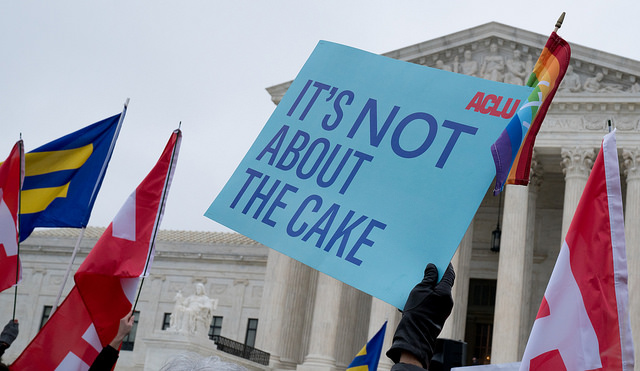
On Learning the Department of Justice, Using an Artistic Expression Argument, Will Side With the Colorado Baker Who Refused to Sell a Wedding Cake to a Same-Sex Couple

By Joni Mayer


The baker is open to the public,
may have asked his other couples
how and where they met—eHarmony,
blind date, a Boulder bar, but never Grindr—
may have been inspired by those data to use
apricot filling in place of peach mousse,
to stack four tiers instead of three,
may have lied under oath to veil his hate
when he said he’d sold gay folks birthday cakes
and retirement cakes. Artistic expression, this reason
will melt in a higher court like buttercream frosting
in the afternoon heat.
A cake is not a poem.


Joni Mayer grew up in Birmingham, Alabama and has lived in San Diego, California since 1986. After a 30-year career in academia focusing on health behavior research, she retired early to return full time to the world of poetry. Her poems have appeared in AURA Literary Arts Review, Eckerd Review, San Diego Poetry Annual, and Acorn Review.

Photo credit: Victoria Pickering via a Creative Commons license.

Rage Vow

By Cesca Janece Waterfield


Hang a wreath on my maiden door, pubic-black and furled,
a bough to say someone has passed over. Bury her pleats
and sweet sestinas among spring narcissus, and if you recall
the flush, soft breast that slipped free in primeval joy,

do not depend on the moon of her aureole now.
There are idiots here, whirling under Mother Ginger’s skirt.
They affirm life on a pedestal proportionately placed
between an embowelment station and a crematory. They stomp

down marbled halls with whirligigs and gee-haws scrawled Freedom,
but their whirring gadgets bear no discernible resemblance
to values their buyers hold up in skidding headlights
of their cognitive discord. I too wear the tag, Idiot, which translates

into French as d’Idiot, but still means you either pump your fist
and squawk, Sin! when the queer cashier gets shit-canned
or you scoop up your piddly change and hurry home
to a lukewarm drip of plans to stand up tomorrow, afraid

of being branded angry woman, pushed from her place
in the rank and file with tickets for tyranny and all-you-can-eat.
Lose that lottery and no more triple axle, 9 miles a gallon.
So I kept writing down forgive and om and sweet Jesus,

can I just get a Pap smear? But I swear, when I meet the proselyte
who stands at the ash heap of books and ideals to witness
there’s nothing left to burn and nothing fit for life, I will strike
a match for the animal, ignitable soul.


Cesca Janece Waterfield received an MFA in Creative Writing and an MA in English from McNeese State University. Her fiction and poetry have been published or are forthcoming in journals including Foliate Oak, Blue Collar Review, Deep South Magazine, Inkt|art and more.

Photo credit: Keith Ellwood via a Creative Commons license.

Pantoum for ‘Real America’

By D.A. Gray

The men we knew have long since passed.
Their bodies still fill the broadest doorways
but something in their eyes, their voice has gone
replaced by a rage that crackles over the radio.

Their bodies still fill the broadest of doorways
and their eyes follow us, from great distances.
There’s only the rage that crackles over the radio
where once warm greetings welcomed us.

The old men’s eyes follow us — from a great distance.
Maybe we just remember our small town wrong
or only think the greetings warm that welcomed us
and not simply suspicion in code.

Maybe we just remember our small town wrong
the way bared teeth appear to be a smile sometimes.
Perhaps it’s simply suspicion in code
or we forgot how far we went to save our way of life.

Bared teeth, from here, looked like smiles sometimes.
Tales across the table — the sum of what we knew.
We never questioned the myth of our way of life.
It was simpler, those images in black and white.

Stories across the table were the sum of what we knew.
Now there’s only rage crackling over the radio.
It was simpler then, reality in black and white —
but the minds we knew have long since passed.


D.A. Gray is the author of the new collection of poems, Contested Terrain (FutureCycle Press, 2017) and one previous collection, Overwatch (Grey Sparrow Press, 2011). His poetry has appeared in The Sewanee Review, Grey Sparrow Journal, Appalachian Heritage, Kentucky Review, The Good Men Project, Still: The Journal, War, Literature and the Arts among many other journals. Gray recently completed his graduate work at The Sewanee School of Letters and at Texas A&M-Central Texas. A retired soldier and veteran, the author writes and lives in Central Texas with his wife, Gwendolyn. Visit his website at www.dagray.net.

Image credit: DonkeyHotey via a Creative Commons license.

Two Poems by Laura Orem

Letter from Guantanamo

Seasons don’t matter except
for the discomfort they bring.
June is just hotter.

The Caribbean thuds against Cuba,
steaming like soup, saltier
than our tears,
if anyone cried here.

Whether we bear it or not,
the pain continues.

The interrogator takes his work
as seriously as Michelangelo
considered the perfect pink
of God’s fingertips.

Once I ate sweet dates and dreamed
of doing something important.

Now the sun, that holy eye,
stares down on the sea and sand,
strikes us blind.

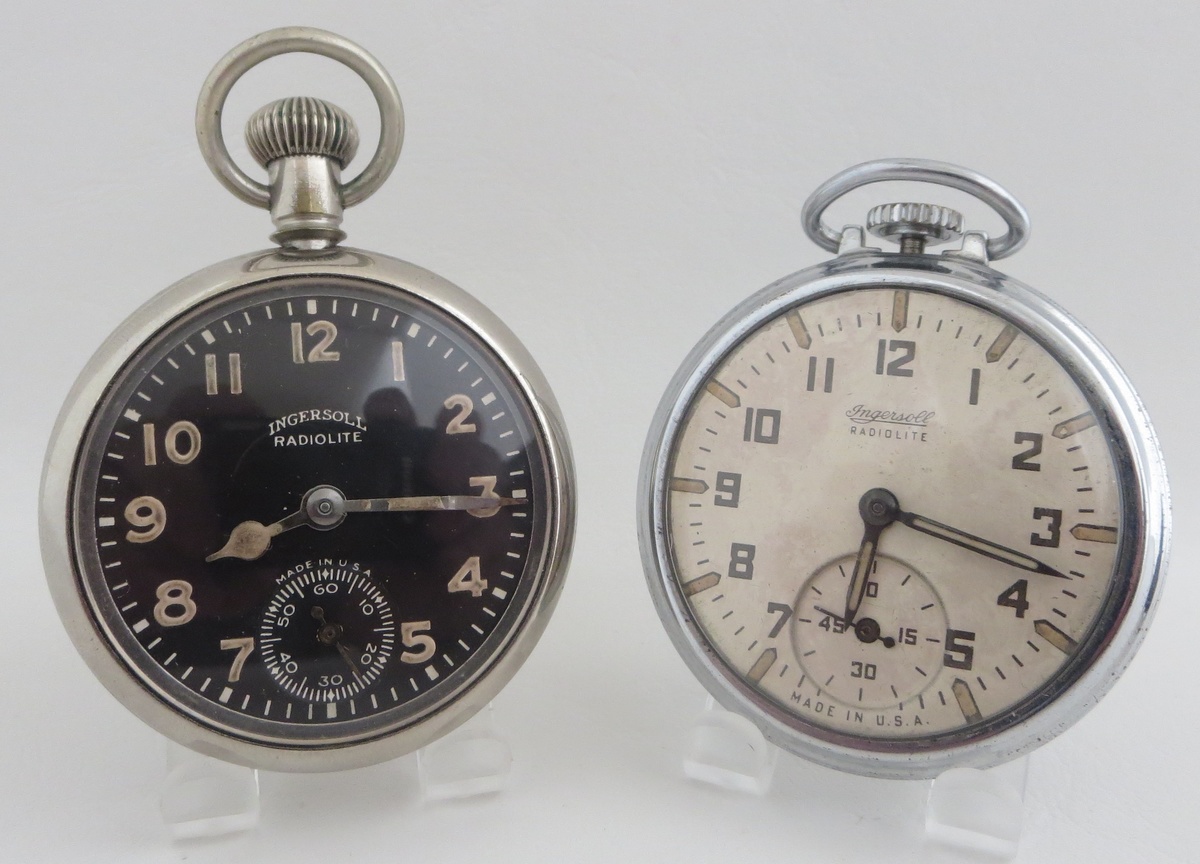
Radium Girls

We make time luminesce,
our numbers bright as moonglow.

Precise work, oh yes – we lick the brush sharp
after three, after six, then nine, then twelve.

Our quotas absorb us, hunched over the table
ten hours a day, until six o’clock Friday

unlocks us like a key from our benches,
and we are girls again. We splash

giddy magic on our fingertips and hair,
trace brilliant strokes across our eyelids

to dazzle sweet boys on Saturday night.
Such pretty pixies, how we sparkle and dance!

In unseen places, we are cracking and crumbling.
Our bones shatter and burn.


A note from Laura: If you enjoy knowing that Writers Resist exists, please consider a small contribution, so we can continue to give our writers and artists a little something. Contributions are gratefully accept here. Thanks for reading!


Laura Orem, a poetry editor at Writers Resist, is a poet, essayist and visual artist. She’s the author of Resurrection Biology (Finishing Line Press 2017) and the chapbook Castrata: a Conversation (Finishing Line Press 2014). Laura received an MFA in Writing and Literature from Bennington College and taught writing for many years at Goucher College in Baltimore.

A featured writer at the Best American Poetry blog, Laura’s poetry, essays and art have appeared in many journals, including Nimrod, Zocalo Public Square, DMQ, Everlasting Verses, Blueline, Atticus Review, Barefoot Review, OCHO, and Mipoesias. She lives on a small farm in Red Lion, Pennsylvania with her husband, three dogs, and so many cats she’s afraid to say.

Both poems appear in Resurrection Biology (Finishing Line Press 2017).

Radiolite watches photo credit: Collectors Weekly.

Cast

By Ruth Nolan

Many bones have been broken here
in the tricky Mojave River quicksand,
huge Cottonwood trees taken down,
gnawed low to the marrow by beavers.

Behind me, the shadow of a man, his
fishing pole slung across his shoulder.
He tells me he will catch crawdads first,
skin and fry a trout or two for dinner.

He asks me to read a fat brown worm
onto his rusty hook. He is ready to fish.
My hands are strong, my fingers shake.

He casts his lure and waits for the first bite.
I snap fat twigs, break branches, build a fire.


A note from Ruth: If you enjoy knowing that Writers Resist exists, please consider a small contribution, so we can continue to give our writers and artists a little something. Contributions are gratefully accept here. Thanks for reading!


Ruth Nolan, a poetry editor at Writers Resist, is a professor of English and Creative Writing at College of the Desert in Palm Desert, California, and an author, lecturer and editor. She worked with the international, United Nations-sponsored literary program Dialogue Through Poetry / Rattapallax Press, from 2001 through 2004, and is now involved with many desert environment organizations as a writer and advocate for environmental justice. She’s the author of the poetry book Ruby Mountain (Finishing Line Press 2016). Her short story, “Palimpsest,” published in LA Fiction: Southland Writing by Southland Writers (Red Hen Press 2016), received an Honorable Mention in Sequestrum Magazine’s 2016 Editor’s Reprint contest and was also nominated for a 2016 PEN Robert J. Dau Short Story Prize for Emerging Writers.

Ruth’s writing has also been published in James Franco Review; Angels Flight LA/Literary West; Rattling WallKCET/Artbound Los Angeles; Lumen; Desert Oracle; Women’s Studies Quarterly; News from Native California; Sierra Club Desert Report, Lumen; The Desert Sun/USA Today and Inlandia Literary Journeys.

Photo credit: Born1945 via a Creative Commons license.

An Old Dog Never Barks at Gunmen

By Bola Opaleke

 – Neither should you,

a wise man once said. Even pickaxes
and sledgehammers would do just fine –
like pickaxe-men or sledgehammer-men.

That reminds me of people that left
raising a finger of “revenge my death” up so high

as the bullet-ridden body thuds. What the soldiers
have done to us – young girls –
teaching our heliotropic breasts how to worship the sun,

boys abandoning the fishing rods
for militants’ rifles, men and women

waking up in the morning
to homelessness. A daughter defiled
before the helpless father – his body at twilight,

dangling from a rope hugging a barren tree
his wooden hands never again to cradle a crying child.

I saw a mother rubbing her frail skin with black ash
from her son’s barrow, invoking spirits
of vengeance from that mound. Soldiers

picking our tiniest vein to sew up our lips –
to make us talk in pains – to force us to obey

word count. No soldiers. No! The poor barks
at the Law (that only eavesdrops). These ordinances give
different uniforms to different soldiers

at different levels of our democracy.
These soldiers, wearing different gears –

bath in “constitution of lies.”
But because an old dog never barks at gunmen,
neither do we. “Raise a sword

of rebellion against thieves and murderers,”
wrote a poet,” and watch politics be

white as snow.” Not soaring past
the red line that says: survive or die
because we already fall in love

with “Que Sera Sera” –
that evergreen lyric of consolation

seeping through. Radios and televisions
propagating that wise saying every minute:
“an old dog never barks at gunmen –

neither should you.”


Author’s note: This poem was inspired by the recent incidents surrounding Kenya’s presidential election. And the attack, arrest and imprisonment of the Catalan leaders seeking independence from Spain.


Bola Opaleke is a Nigerian-Canadian poet residing in Winnipeg, MB. His poems have appeared or are forthcoming in Rattle, Cleaver, One, The Nottingham Review, The Puritan, The Literary Review of Canada, Sierra Nevada Review, Dissident Voice, Poetry Quarterly, The Indianapolis Review, Miracle E-Zine, Poetry Pacific, Drunk Monkeys, League of Canadian Poets (Poetry Month 2013), Pastiche Magazine, The Society, Vol. 10, 2013, St. Peter’s College, University of Saskatchewan, and others. He holds a degree in City Planning.

Photo credit: g0d4ather via a Creative Commons license.

The No-Knock State

By Jemshed Khan

                       Upon hearing that Barrett Brown was jailed (again)

SWAT teams rumble streets.
Men in black smash down doors.

No one bothered to knock
65,000 times last year:

Hinges ripped from the jamb
with a battering ram or breach grenade.

My friend murmurs,
We live in a Police State,

but I still write and say and read
as I will, as we wait.

He points and whispers,
Someone’s listening at the door.

I hiss back, Surely. Enough. Already.
Though I turn and look to be sure.


Jemshed Khan lives and works in the Kansas City area. Born overseas of immigrant parents, he has experienced American culture both as an outsider and as a participant. He relishes the opportunity that the American dream and society have offered him, but also is alarmed by the rising authoritarian encroachment on privacy and freedom.

Photo credit: Steven Roy via a Creative Commons license.

Abecedarian diatribe: abolish him!

By Gabriel Mianulli


All the problems in the picture are flooding the world
Before we have a chance to construct boats for rescue
Can’t we have more time to sniff out bullshit politics?
Damage has been done, the hurricanes are screaming.
Elsewhere, we build bombs that taste like backward progress.
Forgotten events didn’t sound their alarms in time.
Gander back, at the mistakes we repeat in tired cycles
Hopped up on loud media frenzies, and bad leadership
Individualism is hard to spot in the storm’s eye
Jobs are abrasive, but we should all have them
Kissing the rings of kings, we taste metal and blood—
Long-encrusted crud that stinks of corruption
Macaques fling dung from pedestals, inedible
Noxiously uncreditable. Awful! Foul! Terrible!
Obnoxious assaults on patriotic principles
Penetrated sacred institutions, reeking like swine
Quack! Fraudulent fool, phony puppet! We see the hand!
Revolution is on its way! Any day now … humming.
Scantily clad, it’s just your type, we all needed it.
Tulip-scented, cleaning smudges from your greasy hands
Ubiquitously we shout: Get the fuck out!
Varmint! Squeak your obscenities elsewhere.
We have work to do, that doesn’t include you or your tart
Xanthippe wasn’t xenophobic, and she looked better
Yet somehow here we are; not where we need to be: quiet.
Zaniness is the dull story of our lives these days.


Gabriel Mianulli is a nontraditional Associate of Fine Arts in Creative Writing student living in Minnesota. He daydreams a lot. He writes Fiction, Poetry and Prose, but has been somewhat slow to submit his work. He likes finding quiet spaces to read, exploring the wilderness, and embracing the everyday adventures involved with living in the 21st century. He is currently working on his portfolio between classes and taking it easy. He’d give you a hug if you asked for it.

Image via Imgflip.

Obamaclipse

By Rony Nair
 

1.    Overview

Lopsided dreams coalesce into hazy sunsets,

pretending to droll out Nintendo games played by our new trumped up incantation. The new war boy. Elected of course. by a war room of nominees with shotguns in their bed.

Hawkish foreign policy bytes, words of war, beating up the beaten, hoarse cries from musty rooftops—declaiming glory. feigning peace.

A solar eclipse of armament sales. If there’s no Middle East, North Korea’s our Jerusalem.

2.    Prelude

Gas and fuel create their own viewfinder,

eclipses redefine our planes,

we reminisce over Hiroshima and Vietnam and lines crossed in Syria.

we did nothing for the maimed.

Rehearse another beautiful speech for a week later. Weave a wand about history and legacy and myth.

a tin drum sounded better than your inaction. your rhetoric so beautiful that everyman lost your original point,

foreign secretary fly miles were made to order

jet fuel. ambassadors in death, Libyan draught holes. Furtive arrests.

Gulf springs and coattails. Russia. Bust.

sound and fury …

I’ll talk about books instead.

Solar eclipses where the sun ran and hid.

You were lounging, after your dinner speech bid!

Seduction we fell for once, with Camelot. Doled out over misty wordplay and Agent Orange and Apocalypse Now.

Memory. I see you now.                                                                              Speak. Somehow!

1.1      Overview 2

Presidential donkey days, torrential rains

Sit atop lies and palaver—brain dead Charleston Trucks run amok over segregation benefaction.

Hell, Nazis are our new heroes. Says our new mime.

An old freed slave now joins his masters. declaiming speech upon wasted speech. quoting rhyme.

That Solar eclipses smile

2.1            Memory 2

the years we lost, the years we lost.

To inertial speech and rhyme.

farewell you said, we need valets in bed,

a white plane for a dime.

“it doesn’t behoove me to be verbose” finally you said—

before you boarded your Presidential

To ski with Richard Branson.

3.    The End

On eclipse day, we’ll play Golf for fun.

Every week becomes a round. Every round becomes a tweet.

Our foreign policy explained.

140 beats.


Rony Nair has been a worshipper at the altar of prose and poetry for almost as long as he could think. They have been the shadows of his life. He is a poet, photographer and a part-time columnist. His professional photography has been exhibited and been featured in several literary journals. His poetry and writings have previously been featured by Chiron Review, Sonic Boom, The Indian Express, Mindless Muse, Yellow Chair Review, New Asian Writing (NAW), The Foliate Oak Magazine, Open Road Magazine, Tipton Review, and the Voices Project, among other publications. He cites V.S Naipaul, A.J Cronin, Patrick Hamilton, Alan Sillitoe, John Braine and Nevil Shute in addition to FS Fitzgerald as influences on his life; and Philip Larkin, Dom Moraes and Ted Hughes as his personal poetry idols. Larkin’s’ collected poems would be the one book he would like to die with. When the poems perish, as do the thoughts!

Photo credit: Terry Ballard via a Creative Commons license.

Just Like Picking Flowers

By Leslie McGrath


The almond wears a thin corduroy vest
that cannot protect the nut. The skin

of a ripe peach peels like a second
degree burn. The oyster

clenches even as
we break its nacreous wings
at the hinge to get at the meat.

When the mushroom man appeared with baskets
braceleted up to his elbow
that shudder morning

he said the girls knew what to do (the best
mushrooms grew on the north sides of trees)

It was just like picking flowers, he said
and girls were good at that. But the boys

he’d have to show.

He led the boys away

(on his knees he showed them)
(with their pants down he showed them)

and we girls filled our baskets     we knew what to do
though we did not know     we did not know.

This was how he separated us.


Leslie McGrath is the author of two full-length poetry collections Opulent Hunger, Opulent Rage (2009), and Out from the Pleiades (2014), and two chapbooks. McGrath’s third collection, Feminists Are Passing from Our Lives, will be published in April 2018 by The Word Works. Winner of the Pablo Neruda Prize for Poetry (2004), she has been awarded residencies at Hedgebrook and the Vermont Studio Center, as well as funding from the CT Commission on the Arts and the Beatrice Fox Auerbach Foundation. Her poems and interviews have been published widely, including in Agni, Poetry magazine, The Academy of American Poets, The Writer’s Chronicle, and The Yale Review. McGrath teaches creative writing at Central CT State University and is series editor of The Tenth Gate, a poetry imprint of The Word Works Press.

Photo credit: James Johnstone via a Creative Commons license.

The Culling Agent

By John Robilotta


I sit on my lanai
three flights above the water’s edge.
Shore life comes and goes.
Black and white ibis,
with their elongated beaks,
feed on the shoreline.
A great blue heron
suns on the far banks.
Anhingas and cormorants dry their wings
atop stone outcroppings.

There is much life about
the water this year,
particularly since the alligator
was removed by a concerned citizen.
Nature requires a culling agent
to keep its balance.
So too does mankind.
Whether it be war, plague or famine,
history teaches that catastrophic events
wean the weak and hungry.

Is such time upon us now?
A new president.
The doomsday clock
pushed toward midnight.
An unsteady hand
poised ever so close
to the codes of a nuclear arsenal.
Mankind, and other creatures,
a knee jerk away
from an ultimate culling.


John Robilotta lives in Sayville, NY, and winters in Ft. Myers, Fl, where he is a member of the Poetry Alliance, part of the Alliance for the Arts of Lee County. He has had poems featured in “The Broadsides” at the Alliance and An Evening of Poetry at the Visual Arts Center in Punta Gorda, Fl. John also has had numerous readings in Ft. Myers and Sayville.

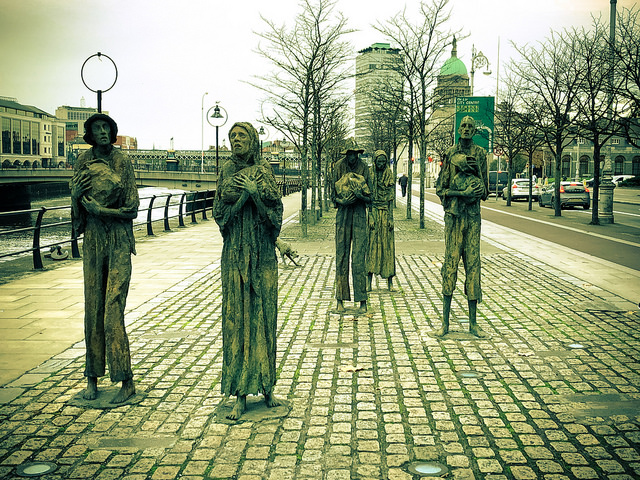
Photo by Andy Hay of the”Famine Memorial” sculpture by Rowan Gillespie, via a Creative Commons license.

Wreak

By Rae Hoffman Jager

To David Wallace-Wells


While we slept, awoke, and made oatmeal,
went to work, walked the dog, and so on,
A crack in the ice shelf grew 11 mile—
raced the ocean where it dropped
with a titanic splash no one heard.

As we make messes, more icebergs calve far off—
tons of carbon released and along with it
prehistoric bacteria and bugs with tentacles
and tusks two feet long.

Even the Doomsday seed vault isn’t safe.
Just years after being built on Spitsbergen,
it flooded. Those small hearts were salvaged,
but that’s not the point—every day

we arm the planet with hotter,
dirtier breath to gag us with.

Is your ulcer heating up yet? —

Bangladesh won’t last the century. Soon,
Mecca will be pan-fried and Haj, a death march.

I guess there is some irony in that we are a lot like ice,
though there is less and less of it to be found: cold,
full of dangerous gas, and indignantly indentured.

Not all the prayers in the world will rehydrate
the kidneys of the El Salvadorian sugar cane fields,
the wilted grains of the west, and dried up river beds—

Just wait.


Author’s note: This is a found poem with words from David Wallace-Wells’ New York magazine article, “The Uninhabitable Earth,” that got the Internet defensive and feeling existential dread.


Rae Hoffman Jager has been in a variety of magazines from Arsenic Lobster to Ambit. In 2014, she won the Cincinnati Library Contest and in 2016 for her poem Tattoos, she read in Salina, Kansas as the New Voice Poet. Rae was named “Reader’s Pick” by Rivet Journal for her poem “Getting Closer to It,” and she joined their poetry staff shortly after. Her chapbook One Throne was released by Five Oaks Press this summer and is available on Amazon and the Five Oaks Press website. Rae’s work has been described as rambunctious, urgent, funny, and elegiac. Visit her website at www.raehoffmanjager.com.

Photo credit: NASA