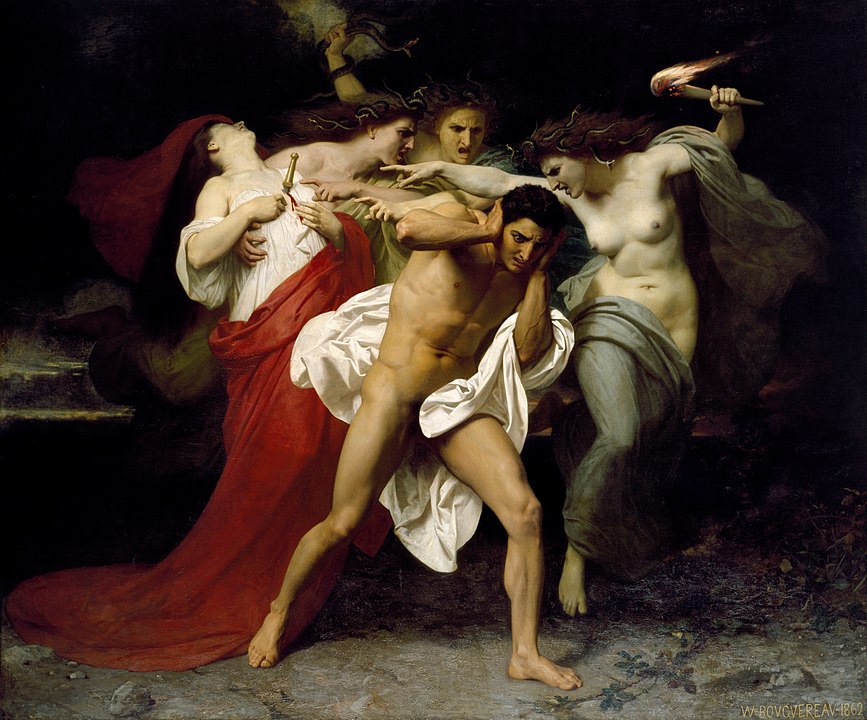
Hope and Furies

By Shana Ross


When vengeance descends
in a collective
noun with feathers:
do we expect
a murmuration
or a murder?


Shana Ross is a writer, mother, muse, sometime wallflower, middle-aged ambivert with a BA and MBA from Yale. Since resuming her writing career in 2018, she has accumulated over 20 publication credits. She is a 2019 Parent-Writer Fellow of Martha’s Vineyard Institute of Creative Writing, and is an editor for Luna Station Quarterly. She does not fully understand why women are not rioting, right now.

Painting, Orestes Pursued by the Furies, by William-Adolphe Bouguereau, 1862.

For Four Years, At Least

By Mark J. Mitchell

For Lyle Grosjean and those of us who walk

None shall kill when all are completed.         

—Kenneth Patchen

Our boots—
brown, heavy and clunky
as gray cinderblocks—
can rest at the backs
of our cluttered closets unless
bright wild flower hills
call us by name.

The green room—
new, shiny, its long table
still wrapped in clear plastic—
will stay empty. No pink
flesh will feel the bite
of silver needles. The window
will be blurred by dust. No one
need witness human sacrifice.

We will not walk
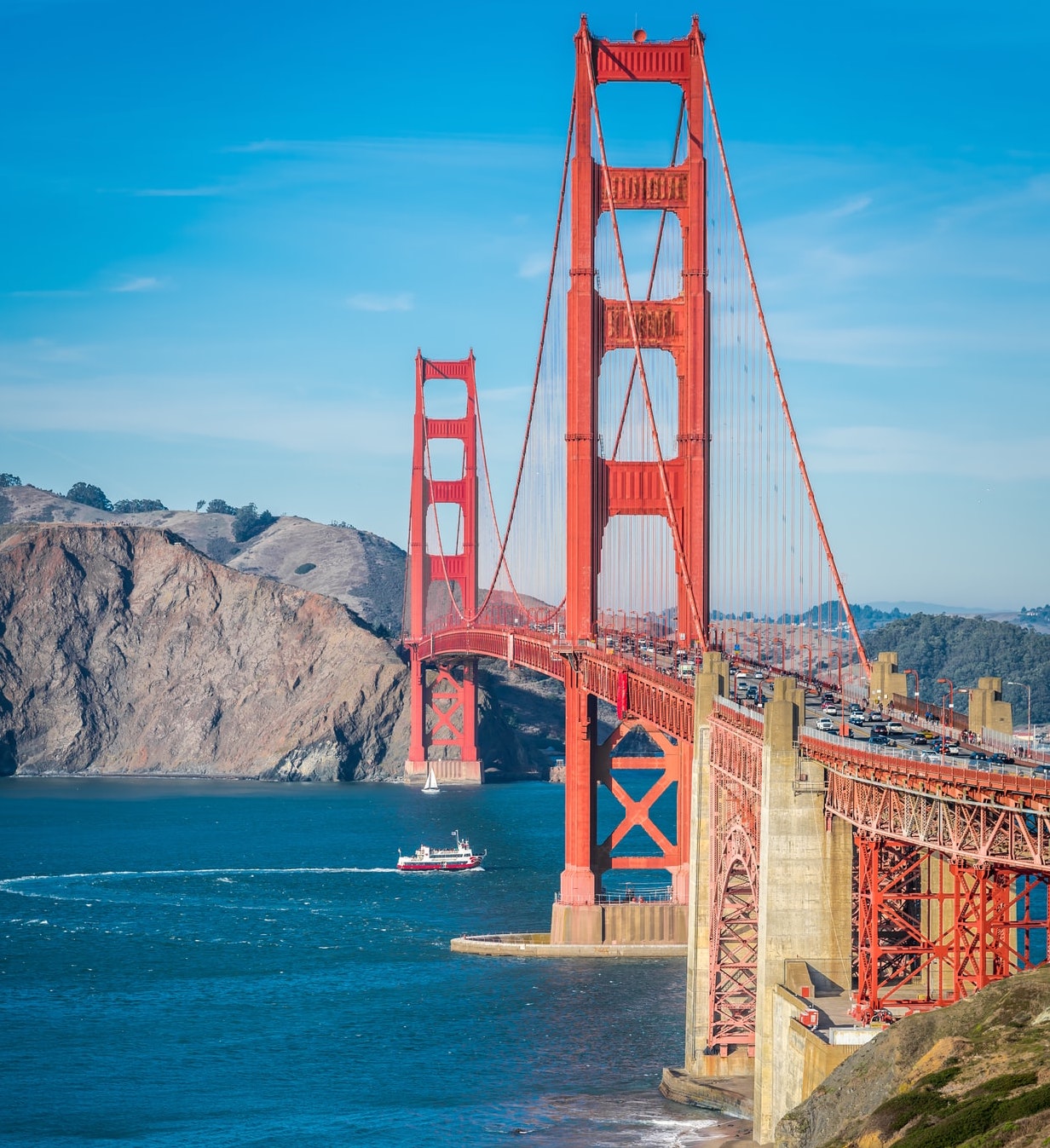
across the red bridge
on blue mornings except
to share quiet joy in each
the other’s company, watching the white
city and the green hills—
our walks yellow and bright
as summer.

For four years, at least,
the machinery of death
will be left to rust.


 Mark J. Mitchell’s novel, The Magic War, appeared from Loose Leaves Publishing. He studied  at Santa Cruz under Raymond Carver and George Hitchcock. His work has appeared in several anthologies and hundreds of periodicals. He lives with his wife, Joan Juster, making his living pointing out pretty things in San Francisco. Since 1978, he has walked from San Francisco to San Quentin, with a likeminded group, each time an execution has been scheduled.

Photo by Tanya Nevidoma on Unsplash.

Apartheid

By Rebecca Ruth Gould


“We don’t serve Arabs,”
says the man behind the counter.
He fixes his eyes on me &
awaits my consent.

My Arab taxi driver is unfazed.
Racism is an old story
in the land of David.
Politeness took over.

We head for the car.
The road is a silent witness to atrocity.
Barren valleys cascade,
one after another.

God is a strange creature,
I think to myself.
What idiot would choose this sterile land
for launching his career?

We reach Bethlehem: checkpoint 300.
I disembark.
Arabs are not allowed
to cross like white women

with American passports.
I journey by foot to the two-storied
white limestone home where
I’ve taken up abode.

I pass tourists in t-shirts,
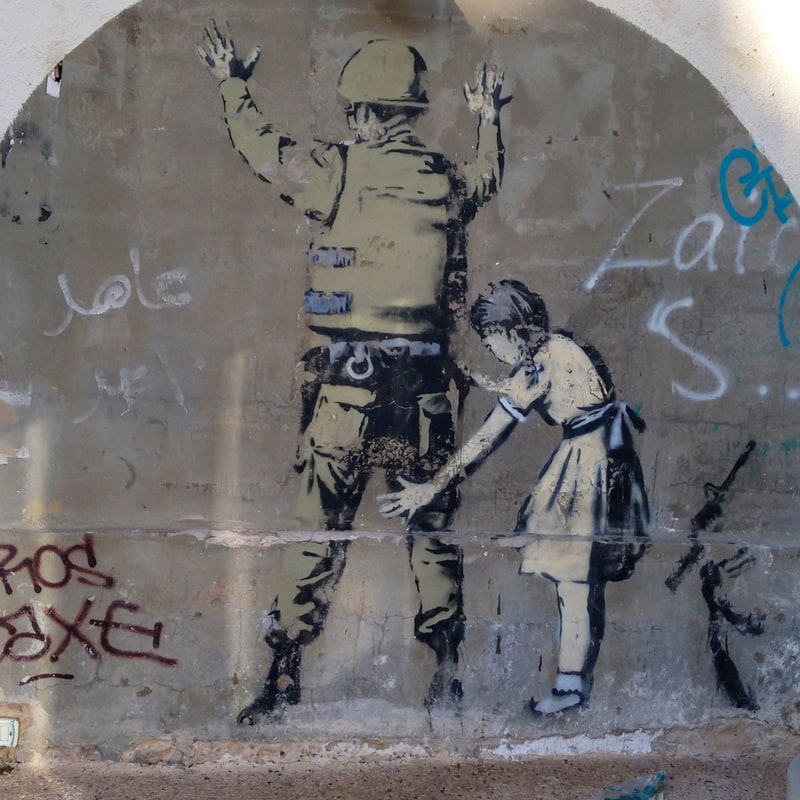
Banksy portraits,
& soldiers armed with kalashnikovs.
Like the racist at the counter—

like every well-heeled politician—
like every international law—
armed soldiers avert their gaze,
revealing glare of the sun.


Rebecca Ruth Gould’s poems and translations have appeared in Nimrod, Kenyon Review, Tin House, The Hudson Review, Salt Hill, and The Atlantic Review. She translates from Persian, Russian, and Georgian, and has translated books such as After Tomorrow the Days Disappear: Ghazals and Other Poems of Hasan Sijzi of Delhi (Northwestern University Press, 2016) and The Death of Bagrat Zakharych and Other Stories by Vazha-Pshavela (Paper & Ink, 2019). Her literary translations have earned comparison with the world’s greatest poets, with a reviewer in The Calvert Journal recently noting, “With her new translation, Rebecca Ruth Gould follows in the footsteps of Russian literature luminaries like Osip Mandelshtam and Marina Tsvetaeva.” Her poem “Grocery Shopping” was a finalist for the Luminaire Award for Best Poetry in 2017, and she is a Pushcart Prize nominee.

West Bank mural photo by Dan Meyers on Unsplash, 2014.

Dan’s note: This was done by Banksy, which I didn’t learn until a couple years later. I paid a Palestinian cab driver to take me to their side of the wall and took a few photos of the “graffiti”/art with my iPhone. The West Bank is walled off like a prison and heavily guarded by the Israelis. For those reasons, of all the “graffiti” I saw, this one resonated the most with me. I hope this pic introduces others to this amazing piece of art or gives some context to those who have seen it before.

Passion Play

By Jose A. Alcantara


The men in white collars
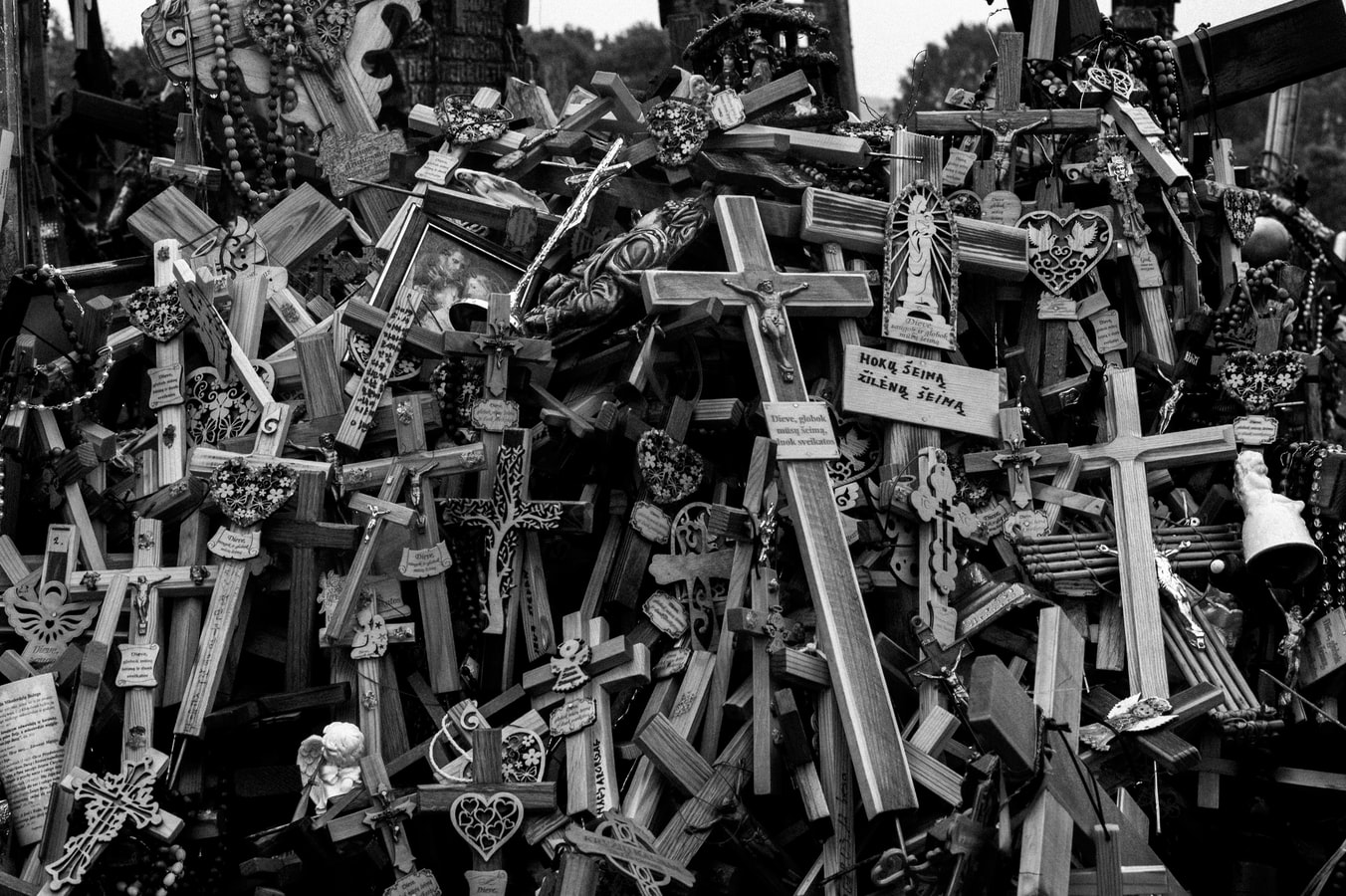
worship the crucified Christ

or what passes for it –
a soft-fleshed boy on a bed

stripped naked,
arms spread, ankles crossed.

They shoot polaroids
to share with other men

of God, those not lucky
enough to be there

that day, on Golgotha,
when the innocent wept

and even thieves
begged forgiveness.


 Jose A. Alcantara has worked as a bookseller, mailman, commercial fisherman, baker, carpenter, studio photographer, door-to-door salesman, and math teacher. He is a former Fishtrap Fellow and was the winner of the 2017 Patricia Bibby Memorial Scholarship from Tebot Bach. His poems have appeared in Poetry Daily, The Southern Review, Spillway, Rattle, High Desert Journal, San Pedro River Review, Pilgrimage, Spoon River Poetry Review, and the anthologies, 99 Poems for the 99%, and America, We Call Your Name: Poems of Resistance and Resilience. His poetry has been nominated for both a Pushcart and Best of the Net.

Photo credit: Photo by lAI mAN nUNG on Unsplash.

On the President’s Announcement of Our Hashtag

By John Linstrom


The President announced we need to keep
some carbon in the ground; he sounded sure,

his raised and lowered index finger maybe
mimicking an oil rig I’ve seen

on my computer screen. I caught his talk
distilled at first, a single image meme,

hashtagged to my cell phone’s glowing face,
the floating phantom of a president

in light above this tiny glowing slab.
Such phones are made of matter. I forget

sometimes the way the world is swept for me,
the oil that forms the plastic, metals heaved

from mines, and heavy metals concentrated
to this short-term task. I hold it here—

the screen dims—it reminds me of the black
obsidian we’d often find in flakes

along the old ravine. We pretended
that was magic, too, but we really knew

it made the body of the place we played,
the mud’s black fingernails, skeletal

outcropped source of grounded mystic wonder.
That stone had been there for millennia.

Then we’d each lift a rock and toss it up
into the clicking branches, watch it fall

gleaming along a trail the trees had altered,
and catch it in our shirt-sleeve-guarded hands.

Later, we’d return the stones to the mud.
The soul of Earth is black like that, I think,

obsidian and coal and oil, the bridges
from molten core to surface, dinosaurs

to us. We listen to our President
on magic flakes we’ve swept from earth’s ravines.

The flakes can prophesy to how we’ve made
an end to all we’ll ever dream to make—

a human listening to the soil’s voice
might speak of moderation, or of love.

#KeepItInTheGround


Poet’s note: Written on the occasion of President Barack Obama’s rejection of the Keystone XL Pipeline, November 2015.


John Linstrom’s poems have recently appeared in Commonweal Magazine, Bridge Eight, Valparaiso Poetry Review, Dunes Review, and Narrative Northeast’s “Eco Issue.” In 2015, Counterpoint Press published his centennial edition of Liberty Hyde Bailey’s eco-philosophical manifesto, The Holy Earth, with a new foreword by Wendell Berry. He now has a collection of Bailey’s garden writings, The Liberty Hyde Bailey Gardener’s Companion, forthcoming from Cornell University Press in the fall. John currently lives with his fiancée in Brooklyn, where he is a doctoral candidate in English and American Literature at New York University, and he also holds an MFA in Creative Writing and Environment from Iowa State University. Visit him on Twitter and Instagram @JohnLinstrom, at his website at johnlinstrom.com, and on Facebook.

“On the President’s Announcement of Our Hashtag” was previously publish by This Week in Poetry.

Photo credit: Photo by Zbynek Burival on Unsplash.

Street Folk

By Ellen Girardeau Kempler


Disembodied. Disenfranchised. Disconnected. Disassociated. Disowned. Disliked.

Distained. Disrespected. Disregarded. Disparaged. Disgraced. Dismissed.

Discarded. Disavowed. Disqualified. Disappointed. Disheartened. Distanced. Disbarred.

Dislocated to:

Dis City,

The Inferno,

Sixth Circle of Hell,

Not in My Backyard,

Planet Earth 00000

(Do not forward. Do not return.) Disappeared.


Called “a timely and powerful selection of climate poetics,” Ellen Girardeau Kempler’s first book, Thirty Views of a Changing World: Haiku + Photos, was published in December 2017 by Finishing Line Press. In 2016, she won Ireland’s Blackwater International Poetry Prize and received honorable mention in Winning Writers’ Tom Howard/Margaret Reid Poetry Contest. She posts a daily haiku and photo “anti-selfie” on Instagram @placepoet, you can follow her on Twitter @goodnewsmuse, and she publishes a newsletter called Tiny Letters.

Photo credit: Photo by Fred Pixlab on Unsplash.

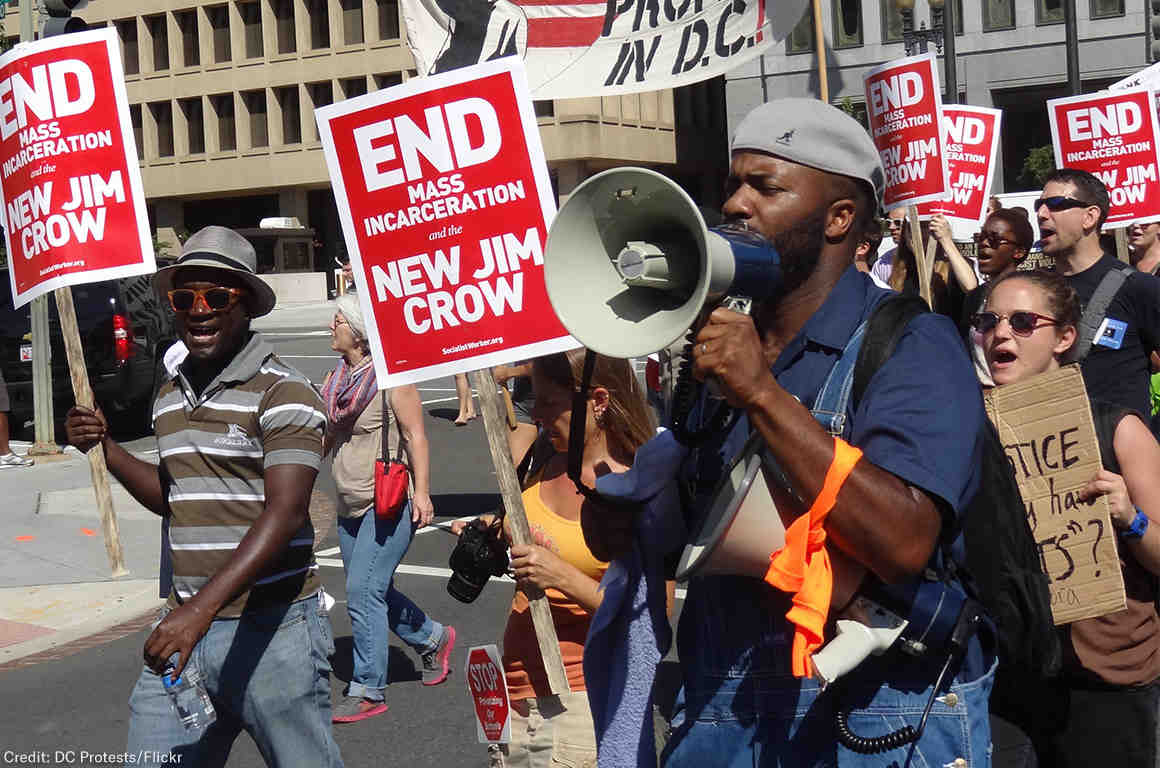
The President Signs the Criminal Justice Reform Act

By Jack Mackey


In the Oval Office dripping in rehearsed applause
from the full-pocketed and the bloated
paid to do a job by corporate wardens enriched
by a three-strike law that scooped up traffic
violators like escaped farm animals

surrounded by billionaire brothers who bought
a conscience on closeout after years of dictating to
lap dog stenographers in the Capitol their wishes
placing innocents into the jaws of a meat grinder

smoothing silk tie with one hand he grins
and turns with camera-ready graciousness to his left
to his right cloaks himself in the mantle of
unearned praise halfway extends his barely average
hands to his greedy kin who get credit for
finally noticing injustice now
because it nested in their family patch

he moves the pen up and down with theatrical force
forging a scribbled signature turning his name towards
the cameras like a child with a finger painting.

I watch this revival-tent duplicity on my TV
wondering, how do we mend a wingless sparrow how
do we put a daddy’s push on the seat of a girl’s swing how
do we place a mother’s palm on a boy’s delicate
fingers guiding as he practices his letters.

How will a new law fix a bad law, return
the confiscated lift all the clothes and furniture
evicted to the curb and fly them back inside the house?


Jack Mackey lives in Rehoboth Beach, Delaware, and Washington, D.C.  He holds an M.A. in English from the University of Maryland. His poems have been published by, or forthcoming in, Darkhouse Books, the Rehoboth Beach Writers’ Guild, Third Wednesday and Rat’s Ass Review.

Photo credit: From the ACLU website.

Coat Hanger Song

By Andrea England


The baby born into a subway toilet

between Harvard and Porter

Baby

with the too-big head and ears

that flap in the wind from a smack

Baby addicted to crack turned

blue as a bruise in his birthday suit

Baby unwanted and doesn’t know why

His father raped his mother

Baby taken

and fostered and fostered and

jailed for no crime of his own

Baby who commits suicide at nine

with a needle spooned from the shelter

of homelessness

Baby hit by the hunger of

water just to be wet

Black baby White

baby

Baby nursed by wolves or cats

Baby who killed his mother and

died anyway in the NICU of  broken

hearts or the

Baby kept in a shed of his own

milk and blood

Beaten like a drum, in the back

alley of our glorious forsaken nation.


Andrea England is the author of Other Geographies (2017, Creative Justice Press) and Inventory of a Field (2014, Finishing Line Press). Her work has been published or is forthcoming in Potomac Review, Glass: A Journal of Poetry, Fourteen Hills Review, and others.. Most recently she had the honor of being a Writer-in-Residence at Firefly Farms (SAFTA). She lives and works in Kalamazoo Michigan, where she teaches English and Creative Writing for various universities and organizations. To learn and read more about her and her work, visit andreajengland.com.

Photo credit: Photo by Palash Jain on Unsplash.

Dark Spaces

By Heather Mydosh

For Indiana HEA 1337


Eve is a common punch line
in the joke against women
with her penchant for the forked tongue
and listening to more than one
authority figure, but if we
peel it back a little further
to rectilinear Pandora, bless her,
created first among women
by temperamental adolescent gods,
she had it even worse—at least Eve
knew what the apple looked like,
could touch it, fingertip trace its cheeks
and test for firmness. Fondling wouldn’t
have done Eve in, but all Pandora
had to do was crack her box
for the proverbial peak.
She couldn’t have known
what was in there, what could take root
in the world outside herself.
If she could have known,
of course she wouldn’t have
opened it and damned herself
to a notoriety which outstrips her gods.
Still we punish women who look
inside themselves to see
what seeds we bear, what traits,
what crooked stems and strains,
and we damn with new laws
those who slam the lid back down
and seal up in their cups and vessels
that which they will not tend and grow.


Heather Mydosh is a professor at Independence Community College in southeast Kansas and a recent graduate of the Stonecoast MFA at the University of Southern Maine. Her work has appeared in The Midwest Quarterly, After the Pause, 99 Pine Street, The Corvus Review, and Kansas Time + Place among others. Visit Heather’s website to learn more.

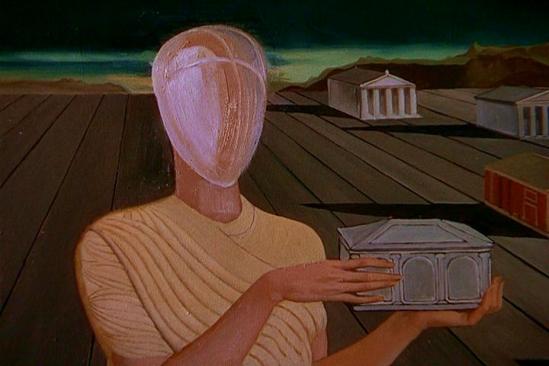
Painting credit: From the 1951 film Pandora and the Flying Dutchman.

Floating

By Penny Perry


Mother couldn’t have known what to do.
She was only twenty-five,
drove her big sister, Leona, six weeks pregnant
to the doctor’s in L.A.

Leona squinted at California bungalows,
backyards with orange trees.
She thought about her husband home worrying,
her baby waiting for her.

She told my mother about her screenplay,
a murder in the Braille room of the public library.
Then, she sat silent, her long fingers tangled like kelp.

The doctor glanced at his medical license
framed on the wall behind him,
said he was afraid to use ether.
Leona jutted her famous Heyert jaw:
“My friend Ruth told me to insist.
With ether I’ll float above the pain.”

It was hot that June morning, 1942.
No air conditioning. My mother
in the waiting room thumbed through magazines.
Big-eyed Loretta Young on the cover of Life.

It happened fast. Ether, a busy housewife,
pulled down the shades.

The doctor waved my mother in.
White face, head back, Leona was no longer breathing.
The ribbon in her dark hair floated in the breeze of a fan.


Penny Perry currently has poems in Earth’s Daughters, Lips, California Quarterly, Patterson Literary Review and the San Diego Poetry Annual. Garden Oak Press will publish my novel, Selling Pencils and Charlie in Spring 2020. “Floating” was previously published in Penny Perry’s poetry collection, Santa Monica Disposal & Salvage (Garden Oak Press, 2012).

Photo credit: Photo by Ava Sol on Unsplash.

At the Funeral of 50 Barefoot Men

By Amirah Al Wassif


once upon a time
there was an ancient place
called “Amon” village
that very far spot
where everybody talks
about the river legend
that very far spot
where everybody knows
how to distinguish
the smell of fresh bread
there, at the Amon village
where all the folks live
in their dreams
and the blazing sun cries
against the face of heaven
there, where the poor sweeper
drowns in the colors of the rainbow
and the great brown mountains
announce their upper secrets
to the mass grave
in the Amon village
where everybody talks
about the river legend
and the real tale of
50 barefoot men
in the ancient village
all people are storytellers
and all of them say
the same story
which starts with
once upon a time

there were 100 men
lived together in the same village
but 50 of them were barefoot
and the other 50 had fancy shoes!
50 men sweeping the streets
and 50 men making the bread
50 ones looking for more!
50 shoes in luxury leather
and 50 toes inflamed and cracked

the river recognized the difference
between the shoes and the toes
then it made a good decision
according to nature rules
and the river understood
the difference between
the torn clothing and the perfect ones
then it made a good decision
according to nature rules

on the ragged edge, all the people walk
under the boiling sun
all people talk
and there were two kinds of talking
talking from shoe to shoe
and talking from toe to toe
and the river didn’t love that kind of speech
so, it made a good decision
according to nature rules

50 barefoot men carrying
their empty pots
their facial bones
tell you about long age of bitterly
shabby dresses, fearful eyes
ancient faces full of pimples
much sweat
and shaky hands

50 barefoot men bearing their pain
looking for a way
to protect their feet
from another pain
but the shattered glass
everywhere

the dispossessed people died
and the rest were alive around the river
laughing, jumping, drinking
but the river has a sense of justice
so, it made a good decision
according to the nature rules
and        dried up!


Amirah Al Wassif is a freelance writer and author. She has written articles, novels, short stories poems and songs. Five of her books were written in Arabic and many of her English works have been published in various cultural magazines. Amirah is passionate about producing literary works for children, teens and adults that represent cultures from around the world. Her first book, Who Do Not Eat Chocolate was published by Poetic Justice Books, and her latest illustrated book, The Cocoa Book and Other Stories was recently released by Breaking Rules Publishing.

Photo by Sofia Truppel on Unsplash.

People Keep Bothering Me with Details

By Pedro Hoffmeister


It’s beginning to snow in Tucson and it’s 65 degrees in Seattle, Washington
in February
But our president says…
He’s tweeting about…

And we should listen to him because he’s the best president we’ve had

this entire year.

That’s a fact. He’s our man. Our leader.

Another fact:
Lori Loughlin, Felicity Huffman, other celebrities have paid money to get their children into some of the most privileged universities, Southern Cal, The Ivies,
where the reported rape rate is higher than at nearby public schools,
Where freshman girls rush sororities, visit fraternities, trip and fall into date-rapists’ arms
But it’s okay
because some of those freshman girls look 13 when they’re 18,
look like
kids

and we all know kids don’t matter – at least not specifically – because there are so many of them.

Try this: Have you ever attempted to think of every single child on earth at the same time?

Exactly.
It’s  too overwhelming             like
trying to name
the name of every celebrity I’ve ever read about.

But children
without names that anyone will learn,
– people keep telling me this –
are in detention centers, Southwest Key in Phoenix, or
Southwest Key in Tucson, or Southwest Key in Youngtown, Arizona
Boring company name – if you ask me,
Boring white vans driving children through boring black gates,
They can do better.

People tell me that a different nameless child is picking the Uzbek cotton that will go into the tongue of my Nike shoes, but the tag on the shoes never says
MADE BY A CHILD’S HANDS
And that stuff is regulated by governments, so this story can’t be true
And anyway
I’m grateful because my kicks will look flawless.

Meanwhile, Asian children (it doesn’t matter where – they all look the same, be honest, they really, really do)
Asian children are wiping
anti-scratch chemicals onto the glass faces of Samsungs, ipads, iphones…
The supervisors in the factories saying something like:

“Dip the rag into the solution, wipe it across the screen, make sure to cover the entire surface, set the glass onto the belt – carefully – don’t touch the front with your grubby fingers. Now dip the rag again…”

These kids are careful – thank God – they care about quality

I’m told
these factories rotate their children every six weeks to let their hands recover from the chemicals – which is nice –
they let the children’s fingerpads and palms heal.
or they replace the children with a new crop – they’re thoughtful about things like that,
like crop rotations to keep our Southern soil healthy.
And I understand that we have to keep the products healthy – that’s what matters – no matter how hard the labor is
Plus, the children are a renewable energy source,

My friend Bill always says, “The dream of America
is a dream of small, willing hands.”

Which is funny

But this evening – all across the United States, and seriously, not funny – we’re watching our people talk about their feelings on The Bachelor
I just feel that…
I’m developing feeling for…
and these feelings are just so…

The thing I love about this show:
No one on this show wastes our time talking about
Authors
Painters
Poets
Activists

They understand that we need to take a break from TOO MUCH THINKING

And this show lets me put myself in The Bachelor’s shoes, stare out at all those women who are available to me

Hannah G., will you accept this rose?

No, actually,
Hannah B. is way skinnier
Ooh, Hannah B. in a bikini…

Hannah B., will you accept this rose?

I’ve noticed that roses on my phone look just as real as the roses in my neighbor’s yard when
I’m looking through my front window,
Realer roses
Truer

I like rose filters,
Which make me think of rose emojis

And emojis remind me of my friend KT who hates emojis – for some stupid reason or another – and doesn’t understand why the emoji movie is so funny
KT,
one of those people who tells me that
Foxconn used Chinese teen interns for 11-hour workdays to produce the iphone X.
Tells me this story twice even after I tell her that
Apple already released a statement that made it clear:
The Chinese teen interns worked voluntarily.

I do like factoids like this:
Professor E.O. Wilson discovered that the collective weight of all ants on earth matches the collective weight of all humans.

He calls the two species symbiotic
somehow
We rise,
we rise,

Like we’ve got diamonds at the meetings
Of our…
Wait, what are the physical characteristics of ants? Or physiological?
Psycho-spiritual?

What I don’t know:
Are ants spiritually and theologically aligned with my religion?

What I do know but I really DON’T care about:
Proceeds from mining for US electronics in the Congo have funded a civil war.

Please don’t tell me about that again
because where even is the Congo? Africa somewhere?

Here’s a question that matters to the people I care about the most:

Are you a part of a meal service, and – if so – which one?

Along with things I don’t care about, there are people I don’t care about as well
Or people I just don’t like
For example:
Stan from IT said something about “Hi-Def drone footage of the fracking fields of Canada” as I was searching music videos on Youtube with my friend at work, Susan.
Susan and I both laughed SO hard.

Stan said:
“What’s the matter?
or better yet,
What else matters?”

And I said to him:
“I matter.
I’m sure I matter.”
Then I looked at Susan and thought of something really smart to say:
“I matter because I know enough about science to be sure that I’m made of matter,
get it?”
Then Susan and I laughed hard again.

But Stan didn’t, and that’s what’s wrong with him. He doesn’t get things.

This is also annoying – and on the same topic:

In my Twitter feed the other day, someone Retweeted:

Is all the matter in the universe finite reconstructive
or infinite dimensional?


After publishing books with Penguin, Random House, and Simon & Schuster, Pedro Hoffmeister just self-published a collection of essays titled Confessions of the Last Man on Earth Without a Cell Phone, so he could say anything he wanted to say. No content editors nixing “questionable content.” No publicists’ input on what sells. Just strong personal opinions, satire, and humor.

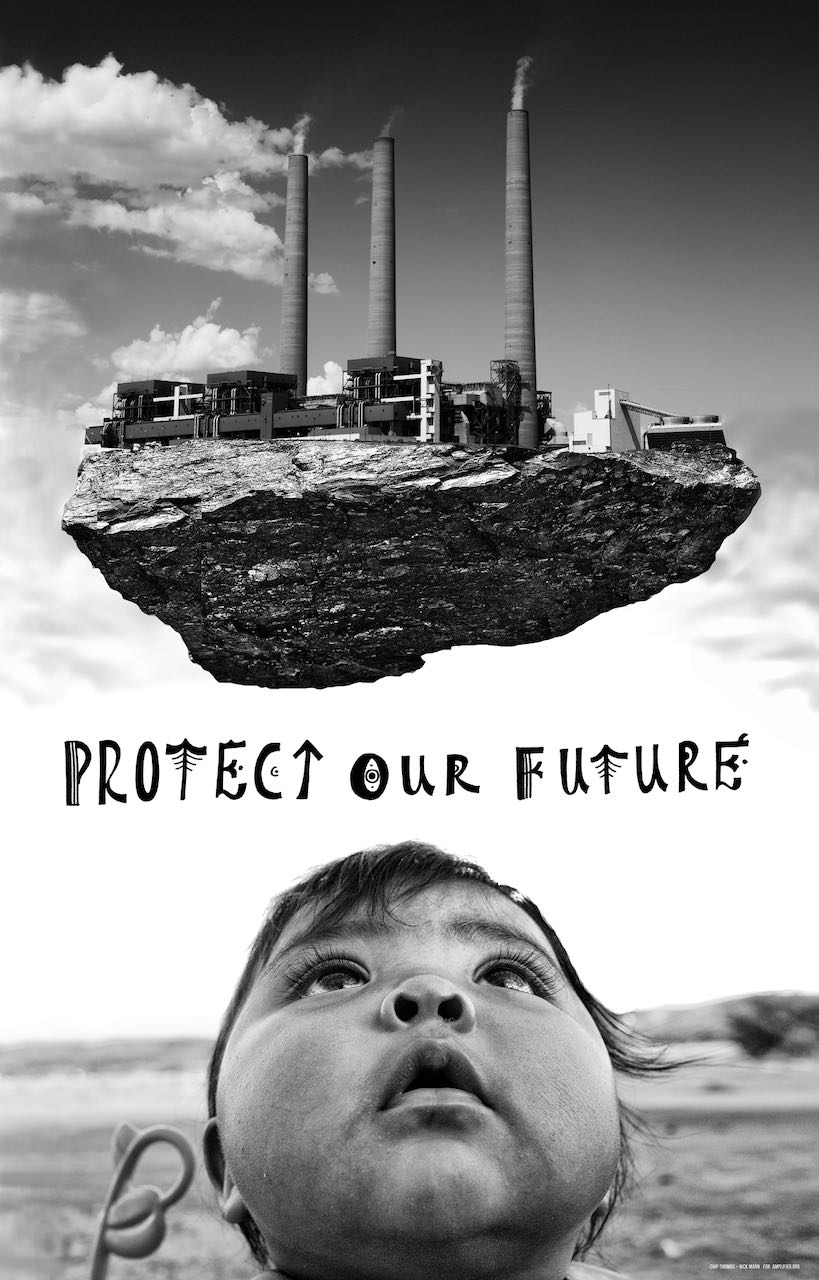
Amplifier poster art by Chip Thomas, photographer, public artist, activist and physician who has been working between Monument Valley and The Grand Canyon on the Navajo nation since 1987. Enjoy more of his activist and collaborative artwork here and his photography here.

Man with a Knife

By Beth Levine


Imagine
that this letter S
floats off the page
becomes a strong
rope
that wraps your hands together behind
your back, like officers do
before putting someone in
the back of a police car.

Imagine
that this letter S floats
off the page and becomes a second
strong rope
one end wraps
around your
left leg
the other hoists you up from
where you are reading this poem so
you are
hanging
upside
down.

Imagine
a man coming toward you
knife in hand
pointing at your throat.
You see
blood on his knife
blood on his hands.
There is no
possible escape.
No one to call on
for help.
No way to free
yourself.
You are
trapped.
Alone.

Imagine
how your heart
desperately races as fast
as a jackhammer and your body shakes
like an off-kilter washing machine,
and you can’t seem to breathe and
helpless tears well-up.

Imagine
how you beg for
your life, for
mercy, but your voice is smaller
than you want it to be,
like when you try to wake
from a scary dream
and you scream, but it is not audible,
not rescuing you
from the nightmare and
you keep pushing the air out
until the sound bursts from your lungs.

Imagine
how the man
keeps coming.
You try
to move him, to
touch his heart, but
his eyes are
vacant and he keeps moving
toward you,
knife in hand.
You wonder how he can be
so cold.
You wouldn’t
ever
ever
do this to another.
You couldn’t
ever
disregard their pleas.

Or could you?

Imagine
bacon.

Imagine
ice cream,
your down comforter,
zoos.

Imagine
your leather shoes,
and eggs.

Imagine
chicken wings.

Now you are the man with the knife.


Beth is a psychotherapist and an animals rights activist. She shares her life with two dogs, and enjoys hearing bird songs and being in nature. In her work, whether poetry, art, or both, she helps the marginalized be seen and heard and hopes to contribute to social change by raising awareness.

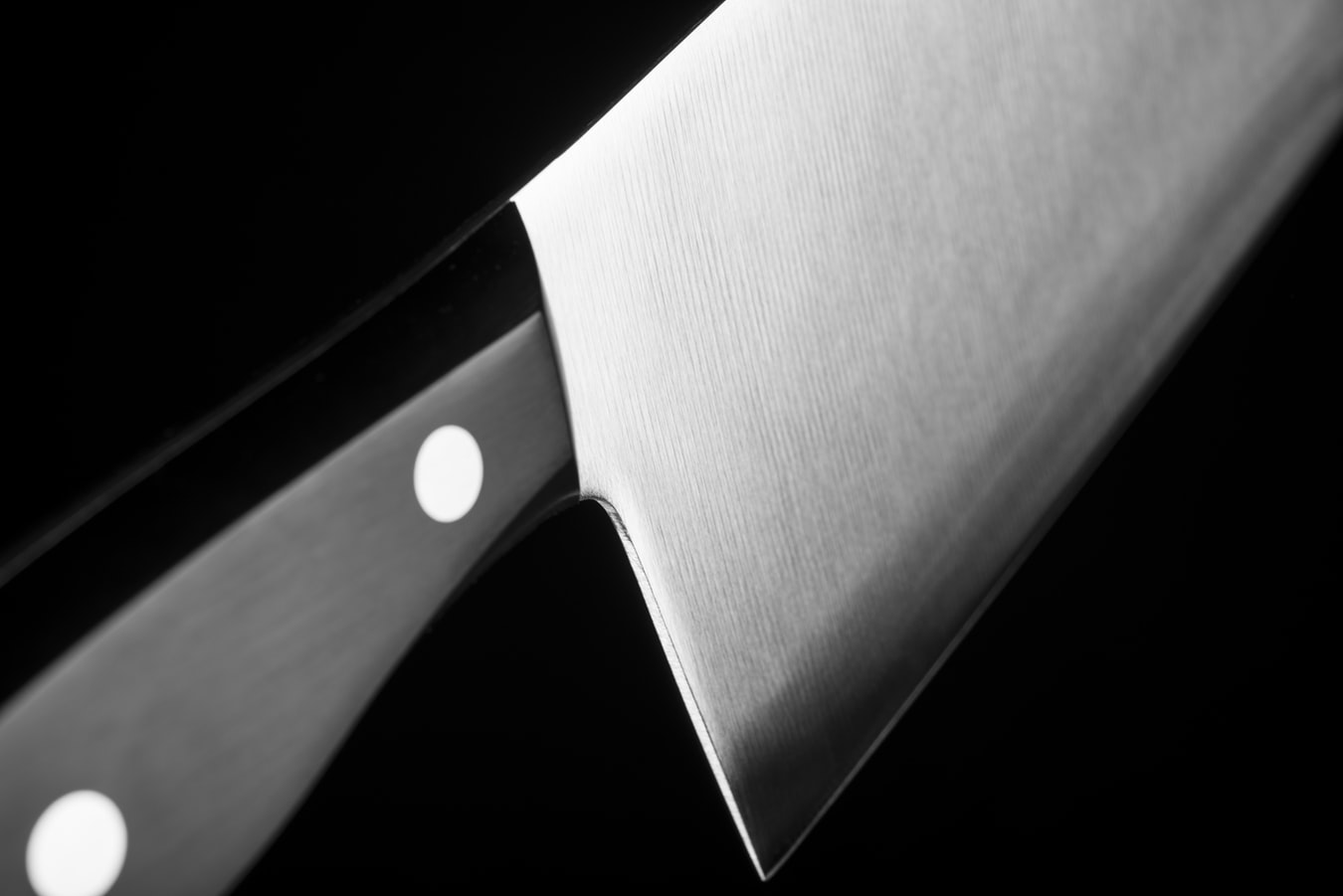
Photo by Kai Oberhäuser on Unsplash.

Questions for My Shooter

By Abby E. Murray


Which of my relatives
will point out how
I was raised humanely,
in a house with a yard
where I could pick
blueberries I grew myself
or sit on a blanket in the grass
when it was warm?
And who will tell them
that’s good because it was,
the humane life, I mean—
how I had constant
opportunities to play
or nest or use my voice,
how I carried myself
into spaces I believed
were beyond assault?
Who will ask whether
the shot was clean,
whether I suffered,
whether I was harvested
responsibly afterward,
my blood stretched far
as a rainy day envelope
or my daughter’s love?
Will the shooting be
diagnosed as a symptom
of Bad Day Disorder
or Disappointment Fever?
Will it be the opposite
of having died in vain?
Sweetheart—may I call you that?
you will, after all,
be the last to change me—
how long will I survive
after we meet?


Abby E. Murray is the editor of Collateral, a literary journal publishing work concerned with the impact of violent conflict and military service beyond the combat zone. She is the poet laureate for the city of Tacoma, Washington, where she teaches community workshops for veterans, civilians, military families, and undocumented youth. Her first book, Hail and Farewell, won the Perugia Press Poetry Prize and will be released in September 2019.

Photo by Tim Marshall on Unsplash.

Fine People

By Paul Colton

Based on Martin Niemöller’s confession-turned-poem, “First they came …”


First a fine man killed six Sikhs in a Wisconsin temple
but Republicans did not act
because they’re not Sikhs

Then a fine man murdered black worshippers in Charleston
but Republicans did not act
because they’re not black

Then a fine man ran down counter-protestors in Charlottesville
but Republicans did not act
because they’re not lefties

Then a fine man slaughtered 11 Jews praying in Pittsburgh
but Republicans did not act
because they’re not Jews

Then a fine man assassinated Hispanics in an El Paso Walmart
but Republicans will not act decisively
because they’re not Hispanic

Soon fine people will come for pale-skinned moderates
but then it will be too late to stifle
their seething hate and assault rifles


Paul Colton has been writing about life’s vagaries for thirty-plus years. His poetry and essays have appeared in more than 75 magazines, literary journals, and poetry anthologies, including The Literary Hatchet, The Satirist, and The Moon magazine.

Photo credit: Christopher Althouse Cohen via a Creative Commons license.

Dear Mitch

By Alicia Cerra Waters


My mother found Jesus.
He was on sale at the Walmart
in El Paso.
Mom is on a budget because
no one pays her any money
to play pretend.
When she prays
to the plastic Jesus
with a ninety nine cent sticker
cemented to the back of his robes
at least she means it.


Alicia Cerra Waters is a writer and educator. She lives with her husband and son.

Fourteen Reasons to Love America the Beautiful

By Tori Cárdenas


  1. Worn flags fall and burn / as bumper stickers / beer cans /
    boardshorts / truck nuts / red visors and head coverings /
    and hearts purple-swelling with pride / beneath twisted
    knuckles
  2. Paint your storm windows / with razor wire / and the
    blessed blood of the unborn / seal out / pungent spices and
    peppers / from your doorways / restrooms / defend your
    borders
  3. It is her fault / their fault / his fault / someone else’s
    problem / Reduce to the common denominator / it is the
    restaurant on the corner / serving anything but a burger and
    fries
  4. Bring your boots / your pipes / your fatigues / bring them
    into the town square / to wage war on people who call it a
    ‘plaza’ / no room for foreign shit here / isolation is survival
  5. Grab ’em by the pussy / treat ’em like shit / fuck their
    daughters / they’re begging you / unless their chests are flat /
    those ain’t the raping kind / lock them up / uptight lesbians
  6. Circle one: true or false / if follow-up: false / if red: true /
    false: blue / no news: good news / the best news / no news
    to speak of here: true / not: false / don’t read all that fake
    shit
  7. They’re bringing drugs / they’re bringing rape / they’re
    bringing crime / and sin and pestilence and parasites / Gas
    their children begging at the nation’s bottom / and fuel the
    swampy top
  8. And yea, the Lord said, “Shoot the snowflakes / the
    women / the children with brown skin / for they displease
    your Lord God Almighty / on his golden Mar-a-Lago”
  9. Cover your assets / for the end times are coming / store
    your gold beneath the eaglet down of your pillows / when
    your coffers runneth empty / a street of walls will meet you
  10. You can survive on nothing / you’re still buying SPAM,
    aren’t you / what about the dollar menu / it may not nourish
    your cells to overthrow this epidemic / but you can still
    make us money
  11. It’s all a hoax / this climate shit / make it warmer / so we
    can bust heads on the beach / blow up the schoolhouses /
    teacher bullshit / gimme a pencil / sos I can black there eyes
    out
  12. Bring back the hanging / decorations / bamboo shoots are
    the new manicure / Full page ads of black brown blue
    babies / withered elders / toss them into the rivers / erase
    them
  13. Hey bro / got a job for you / the boss lets us drink and fuck
    anything we want / don’t forget your golf clubs / got a seat
    for you right here / with a guzzler helmet / and two cold
    Coors Lights
  14. Vote / your voice matters / we’re listening / psst / we want
    to know what you think / it’s your right / pass the earplugs /
    you fought for it / don’t you want it anymore / pussies /


Poetry editor Tori Cárdenas is a queer Tainx/Latinx poet from Northern New Mexico. In 2014, she graduated from the University of New Mexico with a dual Bachelor of Arts degree in History and English, with a concentration in Poetry. She returned to UNM in Fall 2017 to earn her MFA in Fiction. She served as Blue Mesa Review‘s 2018-2019 Poetry Editor, and serves currently as the 2019-2020 Editor-in-Chief. Tori’s work has appeared in Conceptions Southwest, VICE, Pantheon MagazineWriters Resist online journal, and Writers Resist: The Anthology 2018, and it has been nominated for the Best of the Net anthology and a Pushcart Prize. Her works were also featured as finalists in the 2018 and 2019 Rabbit Catastrophe Press Really Good Poem Prize contests. Tori lives with her dog Sophie in Albuquerque, New Mexico.

Editor’s note: The photo of the U.S. flag pistol is used for purposes of noncommercial commentary, satire, and education under the Fair Use Doctrine.


What Then?

By Kathy Lundy Derengowski


And what if the next
crazed school-shooter
is the security officer,
with a long gun
and a long memory
and a short temper,
who is tired of smart-ass kids
who call him “rent-a-cop”
and mock his lumbering swagger?
What if one too many of them
have flipped him off,
and his wife just left him
for another man or woman
and his credit card is maxed out
and his own children never call?
What then?


Kathy Lundy Derengowski is a native of San Diego County. She is an active member and co-facilitator of the Lake San Marcos Writer’s Workshop. Her work has appeared in Summation, the ekphraisis anthology of the Escondido Arts Partnership, California Quarterly, Silver Birch Press, Autumn Sky Daily, Turtle Light Press, and the Journal of Modern Poetry. She has won awards from the California State Poetry Society and been a finalist in the San Diego Book Awards poetry chapbook category. She has been a guest blogger on Trish Hopkinson’s site.

Photo by Jose Alonso on Unsplash.

That One Time My Best Friend Destroyed the World

By Avra Margariti


She goes from gun-shy to
trigger-happy
in a single breath.
That honest sun-smile
nestles in my chest
while she obliterates the world
as we know it.
She’s a rare, delicate bird
perched on the last tree of Earth
watching everything turn to
ash.

Bell jar, birdcage, formaldehyde—
everyone wants to capture her for their
post-apocalyptic
collection.

I go near her
and get a mouthful of
fire and brimstone.
Are you going to destroy the world? I ask.
Yes, she says. By making them

              l  i  s  t  e  n


Avra Margariti is a queer Social Work undergrad from Greece. She enjoys storytelling in all its forms and writes about diverse identities and experiences. Her work has appeared in Wolfpack Press, The Writing District, Dime Show Review, and Page & Spine.

Photo credit: Mark Turnauckas via a Create Commons license.

Malice in Four Thoughts

By Bruce Robinson


They didn’t see it coming
(how could they?)

And then it rained, rained
and we weren’t witness

so we can only surmise
that the days grew shorter

and who’s to say that clocks
could demonstrate a direction

and there was nothing
one could do about it

(which is what we did)


Recent work by Bruce Robinson appears or is forthcoming in Mobius, Fourth River/Tributaries, Pangyrus, Blueline, and the Beautiful Cadaver social justice anthology.

“Malice in Four Thoughts” was previously published by Indolent Books’ What Rough Beast.

Photo by Jeremy Thomas on Unsplash.