Anarchists Unite
By Kirsty Nottage
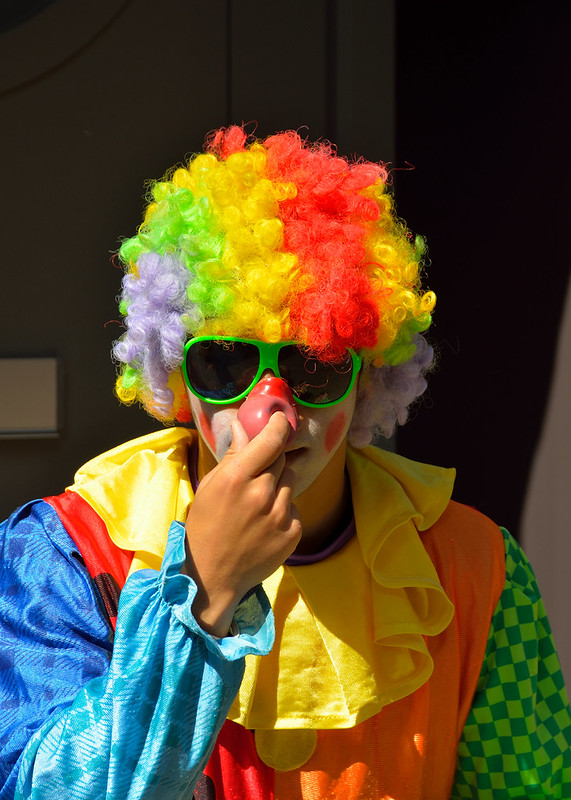
Sandwiched between middle-aged, middle-class people in suits, I feel like a clown. The costume doesn’t help, but it’s more than that.
I know, I know, it’s my own fault. Why would I stand for election as an anarchist?
“Let’s protest the system,” Matt had suggested. “It’s elitist, corrupt and outdated!”
I’d jumped on the idea. “We can stand for election. Call ourselves Anarchists Unite. Get a bit of publicity. It will be perfect!”
It was supposed to be a stunt. We wanted people to think about what politics stands for—or doesn’t—and to show alternatives. I just didn’t expect it to catch on.
We started our pre-campaigns in clown costumes. We pied the right-wingers, to make them sweeter. We squirted the lefties with water, to toughen them up. And we tripped up the centrists—to see which side they fell on.
In a sea of TikTok videos, our antics rode the algorithmic wave. Traffic to our website exploded, and suddenly we were a credible option.The day I set fire to a rose—Labour’s beloved symbol—in front of their leader, cemented us as the alternative vote. Suddenly we had candidates nationwide. So, with no policy except “burn it down and start again,” we began our campaign.
“We need a meeting,” I suggested. “We have to organise, if we’re going to pull this off.”
“Call yourself an anarchist?” Matt laughed. But he came round, organising a non-traditional exchange of ideas, although it was still a meeting to me.
As the members assembled, I immediately regretted the costumes. The oversized shoes squeaked against the floor, and someone popped a balloon just sitting down. Then came the chair-picking ritual. Trying to avoid hierarchical seats took longer than the meeting itself and only enhanced the feeling we were in a circus. Once we finally got started, things didn’t improve.
“We should turn prisons into escape rooms.”
I tried not to roll my eyes. “I don’t really think—”
“Or we can get children to run their own schools.”
I rubbed my forehead, smudging white makeup over my hands. “That’s not really—”
“Ban all money?” Matt chimed in, unable to hide his grin. He always knew how to wind me up.
“And marriage!”
“And the police!”
I took a breath, wanting to take control, but without seeming like a bad anarchist—Matt’s previous words still haunted me. “I think we’re proposing too much. If we throw all of this out there, it’ll confuse people. We need to focus on the big picture: our broken political system. Sure, the police need reform, but saying we’ll just get rid of them? That frightens people.”
“People should be frightened,” Matt shouted gleefully.
“But not of us!”
“That seems unlikely,” he replied, squeezing his nose, making a honking noise.
Despite our haphazard approach, people loved us. The balloons to demonstrate inflation and whoopee cushions for politicians’ empty promises went viral. Requests for interviews poured in, but I was in over my head.
When we were invited on breakfast TV, I knew things had gone too far. But I felt powerless to stop the momentum we’d created—and I didn’t want to let Matt down.
“So, what do you think of the previous government’s approach to immigration?” Leanne Christy asked, her eyebrows furrowed sincerely.
“Well,” Matt said, pulling out his whoopee cushion and sitting on it slowly.
She laughed despite herself before continuing. “But really, how would you do it differently?”
“It shouldn’t be up to us and a handful of MPs to decide.” I pointed at her, “What do you think?”
Leanne blushed, uncharacteristically flustered.
“See? Everyone has an opinion, even if they think they shouldn’t.”
She gave me a sharp look. “Even if I did, it’s not for me to say.”
“Of course it is,” I said, rolling my eyes. “Our parliamentary system was invented when communities were isolated and needed one person to represent everyone. That’s not the case anymore. We know more about people’s opinions than ever. Why not listen?”
A round of applause rippled through the audience.
“And why the silly attire,” Leanne asked, gesturing at our costumes.
“In a world where politicians behave like clowns,” Matt said, smiling, “we thought we’d show the truth.”
“A few tweets have come in suggesting you should lead the county!” Leanne said to me with a smile.
I balked. “I don’t want to be in charge—that’s the point. I don’t believe anyone should have that much power.”
The applause got louder.
“That’s exactly why they want you,” Leanne whispered as we went off air. Matt looked thrilled but my stomach sank. I hoped she was wrong.
Now I’m onstage, sweating under bright lights and layers of face paint. If there’s one lesson to take from this, it’s don’t use elections to make a point. It might not go the way you intended.
“The candidate for Labour received 23,000 votes,” the announcer drones. “The Conservatives received 17,000, Anarchists Unite received 25,000, Liberal Democrats received 10,000…”
I stop listening. I’m not supposed to win. I’m just here to make a statement about politicians—not become one.
As I’m beckoned to the podium, the crowd surges forward, their cheers blending into a cacophony of laughter and chants. Someone tosses confetti while a man in the back blows a kazoo. It’s like I’ve stepped into a surreal nightmare.
I misjudge my steps in the oversized shoes and trip. The crowd roars with laughter, assuming it’s part of the show. I play along, of course. That’s what I’m here for.
I give a quick thank-you speech and tell everybody that this is a huge mandate that we take seriously. Then I burn my notes and laugh.
“What’s next?” a journalist shouts from the sidelines.
My stomach churns. What is next? The truth is, I have no idea. But admitting that feels worse than this ridiculous costume.
So instead, I squirt him with water and shout, “Chaos!” As the crowd roars with laughter, I wonder if this joke has really been on me.
Kirsty is a writer passionate about challenging perspectives and reshaping how we perceive the world. With a knack for creating thought-provoking stories, she explores exaggerated versions of reality through satire and dystopian fiction. Her story Reset recently earned her the Elegant Literature award for new writers. When she’s not crafting imaginative worlds, Kirsty enjoys the company of her two literary-inspired dogs, Dickens and Hardy, who are always by her side as she envisions new futures and reimagines the past. Read more about Kirsty at her website, www.kirstynottage.com and on Facebook.
Photo by Peter Riou via a Creative Commons license.
A note from Writers Resist
Thank you for reading! If you appreciate creative resistance and would like to support it, you can make a small, medium or large donation to Writers Resist on our Give a Sawbuck page.