Storm Front
By Judith Skillman
Artist Statement
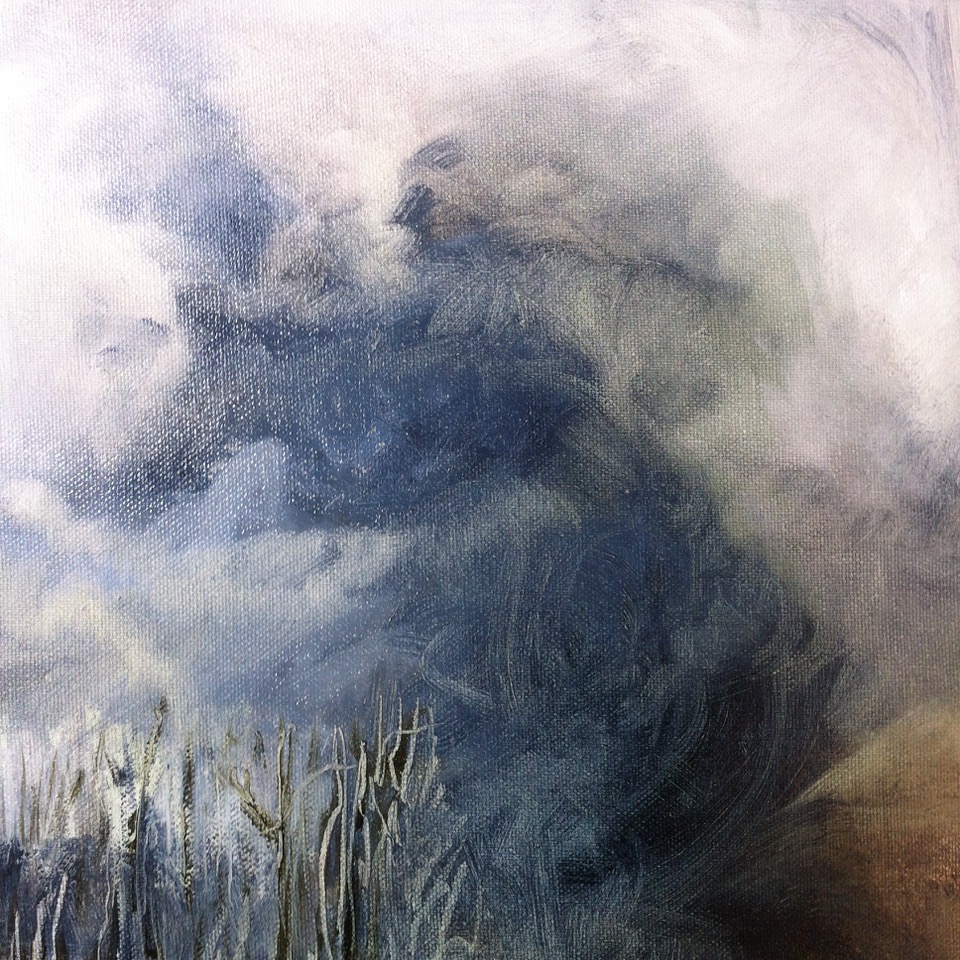
In “Storm Front,” oil and cold wax on canvas, 12” x 12”, the artist used a rag in equal measure to paint and wax. A paint scraper was employed to etch out the trees at the bottom left. Nature provides solace during times of affliction, whether that affliction be physical or political. One can imagine that those who have been targets of fascism and racism—dreamers who deserve their amnesty, “illegal” Mexicans who perform heroic jobs American refuse to do, and the poor from whom government support has been taken and put into the pockets of the very rich—these people still and always remain citizens of the natural world.
Perhaps not surprisingly, given the German term Sturm and drang (transl. as storm and urge, or action and high emotionalism—in the German usage, however, against 18th century norms in literature and music)—a website by the same name, “Stormfront,” which had its domain name “seized for displaying bigotry, discrimination, or hatred,” has become a growing force for white nationalists and neo-Nazi’s. To call this site troubling would be euphemistic. Inherent in the attitudes of those who patronize this site lies a disturbing reality. Not only is the current administration bent on making the rich richer and the poor poorer, it is determined to sacrifice nature in the bargain.
Regulations of vehicle greenhouse gas emissions implemented under the Obama administration have been undone; FEMA has stricken the term “climate change” from its plan book and “climate change” websites have been likewise censored; the Trump admin has decreed that accidental bird deaths, in violation of the Migratory Bird Treaty Act (MBTA), are legal.
To date, the actions of this administration have broken with a tradition of environmental protection—the result of Rachel Carson’s Silent Spring (1962), and other like-minded literature that focuses on understanding the impact humans have had on the earth. The actions taken by Trump and his cronies undo measures to safeguard the only place we have to live. They are shocking; they fly in the face of science, spirituality, and God-given rights for plants, animals and humans.
“Storm Front,” then, can be seen as what has happened since the Trump administration came to power, and what is to come. Viewing the painting requires an admission that this is not the time to sit idly by. Both the natural and the human world require concrete forms of protest—resistance—in order to survive the onslaught of such a dangerous and powerful ignorance.
Judith Skillman is interested in feelings engendered by the natural world. Her medium is oil on canvas and oil on board; her works range from representational to abstract. Her art has appeared in Minerva Rising, Cirque, The Penn Review, The Remembered Arts, and elsewhere. She also writes poetry, and her new collection, Premise of Light, is published by and available from Tebot Bach. Judith has studied at the Pratt Fine Arts Center and the Seattle Artist’s League under the mentorship of Ruthie V. Shows include The Pratt, Galvanize, and The Pocket Theater, in Seattle. Visit jkpaintings.com.