
Now Your True Life Begins

By Claudia Wair                                                                                                              

It’s dark early morning when they take you out of your cell at the county jail. They lead you to a waiting bus, full of other prisoners. The detainees are all Black, like you. Everyone here has been charged with the same crime: taking a white man’s job.

The people on the bus are quiet. Some sleep, others stare with frightened eyes out the windows. Your destination is the State Re-education Camp.

At your trial, you argued that your job as a writer was unique. No white man could write the same words. But the judge laughed and said, Your words don’t matter. Then he banned your books, made you watch as they burned.

It’s late morning when you arrive at the camp and the sun is already hot on your skin. The guards separate the women from the men. You join the line of women and are led to a bunkhouse that smells of old sweat. When the guards leave, everyone introduces themselves: doctors, lawyers, college professors. You feel insignificant with your master’s degree in English literature. When it’s your turn, you say I’m a writer. They burned my books, scrubbed me from the internet. The women shake their heads, suck their teeth in sympathy.

Silence descends when your Instructor enters, a white woman with a cruel sneer. Forget your past lives, she says. Now, your true lives begin. The lives you should have always led.

You’re told that here you will learn to be subservient to white people. That you will learn to love serving them. You know this isn’t true.

During the months of your incarceration, you endure beatings, forced labor, sleep deprivation. You survive it all. Not everyone does.

They humiliate you. They try to make you believe you are less.

They fail.

One day, without explanation, they release you to a halfway house in a strange city. You vow to never lift a finger to serve them. This will lead to prison—or worse—so you run.

You pass yourself off as an Unemployable. You sleep in a hard-to-find corner of an abandoned building, get donations of food and supplies from church basements. You trade secondhand clothes for basic survival gear. You buy information with fresh fruit. Then you set off for the mountains.

You’re chasing whispers and rumors. You follow hand-drawn maps. You stop at secret safehouses, get help from unlikely sources.

By some miracle, you evade the Race Police and the Nazi militias. A Black truck driver stops along the highway and gives you a ride out of the state. You could both go to prison for this. He accepts the risk and muses about following you one day.

After weeks of hiking in the mountains alone, you find the Free People. Your joy at seeing healthy Black and brown faces nearly breaks you. After you recover from your journey, you join the others growing food on the community’s farm. You teach the children using banned literature and history books.

Soon, you are almost yourself again.

The Free People remember your writing. They give you pen and paper and ask you to tell your story. You tell your story. You tell all the stories. One day, you swear, the world will read them.

The community is growing. White allies bring supplies when they can. Clothes, tools, guns.

You learn how to defend your new home. Cradling your rifle, you scan the shadowy forest for intruders. You wonder how you’d acquit yourself if faced with the people who deny your humanity. The people who tried to break you. The people who took your old life away.  

A grim smile crosses your face. Because you know what you’ve lost. Because you know what the world has lost.

Your jaw tightens, your blood burns, and part of you aches for the chance to make someone pay. You are fueled by rage and sorrow and just enough hope to keep going. Enough to aim the rifle and pull the trigger.


Claudia Wair is a Black writer living in Virginia. Her fiction has been nominated for the Pushcart Prize, Best Microfiction, Best of the Net, and Best Small Fictions. Her work has appeared in Pithead Chapel, Astrolabe, Writers Resist, JMWW, and elsewhere. She can be found at claudiawair.com or on Bluesky @CWTellsTales.bsky.social

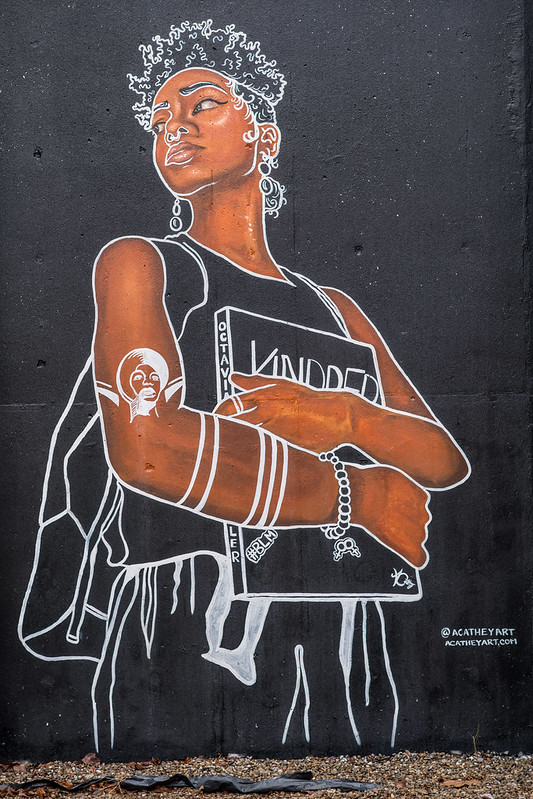
Mural by Ashley Cathey, at Hartford Hall, Jefferson Technical and Community College, Louisville, Kentucky.

Photo credit: Don Sniegowski via a Creative Commons license.


A note from Writers Resist
Thank you for reading! If you appreciate creative resistance and would like to support it, you can make a small, medium or large donation to Writers Resist on our Give a Sawbuck page.


When You Swim Out into the Ocean

By Claudia Wair


You float on your back, your face barely above water. There’s nothing but the silence of the ocean in your ears. In the saltwater’s embrace, you drift, weightless. You stare at the clouds above, trying to empty your mind. You’re away from the beach. Not so far that the lifeguard blows her whistle, just far enough from the splashers and the screamers.

The ocean is peace.

Here, you’re a gently bobbing body, not a stupid nigger, like the man on the boardwalk said when he bumped into you. The water doesn’t care that your skin is dark brown or that your hair curls tight. You’re a small human in a vast ocean.

The rage subsides to a dull ache. Your muscles finally relax. You roll over and swim back to shore. Stroke, stroke, breathe. Stroke, stroke, breathe. Then you feel gravity again, feel the sand, feel the breeze. You find your white friends and sit on your towel. No one asks how you are.

And you pretend you are fine.


Claudia Wair is a writer and editor from Virginia. Her work has appeared in JMWW, The Wondrous Real Magazine, Typehouse Literary Magazine, Corvid Queen, and elsewhere. You can read more at claudiawair.com, or find her on Twitter @CWTellsTales.

Photo credit: “At Sunset” by Giuseppe Milo via a Creative Commons license.


A note from Writers Resist

Thank you for reading! If you appreciate creative resistance and would like to support it, you can make a small, medium or large donation to Writers Resist from our Give a Sawbuck page.

To Face Ourselves

By Claudia Wair


Most people keep their masks in a kitchen drawer or hang them up on a rack next to their keys. The masks are then easily accessible in case of visitors and when you’re on the way out of the house. My mother is different, though. She keeps hers in the top drawer of her bureau and wears it even in the house.

The law only requires that people don their masks at home when outsiders visit, not in front of the family circle. My mother, however, took hers off only for my father in the privacy of their bedroom. As a small child, I never questioned her habit, but as I grew older and understood more about the world outside, I was saddened and a little offended at my mother’s insistence on wearing her mask around us. Only once have I seen her face. That was the day her own mother died. I was nine. Her face was lovely—flawless brown skin, high cheekbones, full lips—and I remember thinking that it was wrong that she had to hide her face.

The next day, Mother’s mask was back. And that was also the day I began wearing my mask about the house. At first, I think it was in childish sympathy, a daughter’s desire to be like her mother. But now I wear it to remind me of what they’ve done to us. To keep me from thinking of the person I’d be without it. And because, if I take it off for more than sleep, I’m afraid I’d never put it on again.

We are taught to be ashamed of what’s underneath. Shame followed my mother into the house like smoke, coalescing into an unnatural shell that surrounded her, her true self shrinking within it.

Individuality is ugly. Conformity is beautiful. Uniformity is cleanliness. Creativity is the result of a bad upbringing.

My brother, always an impetuous boy, joined a militant group of bare-faced people. We see him seldom, and then only at night when he can spend a few hurried hours with us. Before the Law catches up with him. As family members who harbor a bare-faced relative, we are accessories to his crime. He’s never asked us for anything; he may be headstrong but he’s a good boy. He and his friends stage protests in front of public buildings; ripping off their masks or carrying pictures of bare-faced people. Whenever there is a press conference on the steps of the capitol, he and others like him crowd behind the politicians making sure they’re in view of the cameras. They wait for a particularly important moment in the speech, then they remove their masks. Sometimes they rip the masks off and shout their slogans of “Bare-faced and proud!” or “Back to the way we were born!” At other times, they slowly, quietly slip the masks off, so deliberately that it takes the cameramen from the State News Agency a long time to notice that bare-faced people have been filmed live; that good, honest, hard-working people have been subjected to such sordid exposure, and it’s too late to censor the broadcast. There is risk in every show of defiance, so the protesters run, separating to make it harder to capture them all. Escape routes are planned well in advance.

We worry that the police will knock on the door and tell us my brother’s been taken to one of the prison camps. We’d be lucky to ever see him again. The few political prisoners who are released come back with bodies and minds so broken that they need permanent care. The politicians say, “See? These criminals flout the law, and then live off the taxpayers’ hard-earned money!” And the taxpayers agree, even when it’s their own sons and daughters being hauled away.

To express doubt is to admit heresy. To propose change is sedition.

I’m most angry at the people who sit silent. They hold the keys to their own shackles, but have bought into the lie that their chains make them exceptional. They recite the approved litany without comprehending the meaning of the words; each utterance is confirmation of their enslavement.

This has to end. I want to join my brother and his freedom fighters. I have nothing of value to fear losing. There are sympathizers everywhere: the bare-faced, if not able to find shelter, are always sure of at least a meal from the compassionate who, like my mother, are too afraid to remove their own masks.

But when I see strangers’ true faces around me and am confronted with revealing mine, can I look into the empty eyes of my mask and run, leaving it to dry rot and dust?


 Claudia Wair is a Virginia-based writer and editor. Her short stories appear in anthologies including Dread Naught but Time, Fantasia Fairy Tales, and Winds of Despair, as well as in Fiction War magazine. Learn more at claudiawair.com, and follow her on Twitter, @CWTellsTales, Instagram, @CWTellsTales, and Facebook.

Photo by Ruslan Zaplatin on Unsplash.