Dr. Sonali Pattnaik refuses to let the world look away
A powerhouse educator, artist, and poet, Dr. Sonali Pattnaik has built her platform on the understanding that oppression takes many forms, but outrage must remain constant.
While many may agree, few act; it is still hard for women, including women in India, to safely speak out without rebuke or worse, but it’s the only way things will change. Dr. Pattnaik has done exactly that. Her life has been defined by her galvanizing of others and her purposeful attention to what is ignored, acting upon injustices, not just shaking our heads. She has spoken on colonialism, racism, violence and women’s rights and is raising her daughter to be an unapologetically strong woman in defiance of past traditions. In this, her activism is genuine, tireless, and deeply engaging. She has become a vital face of resistance in India and beyond its borders.
Candice Louisa Daquin of Writers Resist, first met Dr. Pattnaik during Daquin’s co-creation of The Kali Project with poet and activist Megha Sood. Ever since, Daquin has stood witness to Dr. Pattnaik’s enduring fight against subjugation, injustice and oppression. Dr. Pattnaik’s resistance work aligns with the core of Writers Resist, and below we present a portion of a conversation they shared alongside Dr. Pattnaik’s video and artwork—a collective rebuke to the idea that women should ever go quiet.
A Social Justice conversation with Dr. Sonali Pattnaik, Indian Professor, Poet, Artist and Social Activist, and Writer Resist Editor Candice Louisa Daquin
Candice: What resistance have you experienced politically/socially from writing about ‘hot button subjects’ that may be points of contention socially and how do you defuse this in a way that doesn’t defuse your purpose, which is to be a voice for equality? Do you get a lot of push-back and how much does that affect your career? This, in an era where people in the West are being fired left-and-right or cancelled, for speaking out against injustices. Do you believe ultimately, we all have a right to speak out, and how do we draw the line in terms of our responsibility as educators or social activists, when sharing our thoughts?
Sonali: I firmly believe it is our duty (and right) as artists and writers and academics or educators to speak against injustice and to stand in solidarity with those suffering injustice anywhere in any capacity but I understand that in an environment that is not conducive to registering one’s resistance, this may feel very threatening to many. We know from history, that unless we speak out for any act of oppression, it will come close enough to affect us. In my case, it has been both a learnt approach as well as an intuitive one. I cannot be a silent bystander to anything, and I cannot be anything other than myself, so if I feel strongly about sexual violence on women and girls, whether it be at home or elsewhere, I will articulate my resistance and outrage.
Honestly, I feel that most of us are not angry enough. The West is clamping down on people’s democratic right to protest against genocide or crimes committed by their leaders and the Indian government has oppressed its young people marching peacefully to demand accountability from their elected representatives. I recall an incident at a literature festival, where I was told that I am “too brave” and told to be careful by well-wishers and other writers. I have always wondered why others don’t speak their truths rather than asking me to be quieter? I address these issues not out of bravery but necessity; be they fascist regimes outside our homes or domination within our walls. I have been fortunate to have been employed in spaces that have been relatively secular in thought and process but having riskily resigned from two permanent positions at major universities, this also freed me up to a great extent, to speak my mind, even if it has meant, or rather can mean, less protection or immediate solidarity at times.
I have also had the love and solidarity of so many whenever I have written on an issue that is seen as ‘controversial,’ such as the genocide in Gaza, the police torture of a tribal activist in my own country, the ‘othering’ and violence upon Muslims, Dalits and women in India, or the violence in a patriarchal Indian marriage or child abuse. When I wrote as a single parent, my daughter only three months old, dealing with unimaginable trauma, I posted my poetry on social media and the responses would fill me with a deep sense of hope and possibility– that I was being heard, understood and also being able to transform my pain into something that many could relate to. That allowed me to breathe and grow–another symbiotic relationship that ended the wound of isolation. Recently a group of young women students, of whom some were hijabi Muslims, from less privileged backgrounds, met me after my talk at their university where I had shared my concerns over having to be careful about dissent or truth, letting me know I should remember them and never stop saying what I am saying. That’s all that matters.
If I cannot provincialize Shakespeare, even as I teach students to bask in the beauty of the lines or draw out the politics of gender-based violence depicted in Othello or Macbeth to map them onto a contemporary context such as marriage, queer identity or sexual violence around us, or help them to read between the lines of a narrative to engage with power in the texts of own lives or of those invisible around them; then I and literature would have failed them. The classroom should be a safe space where all opinions can be aired with mutual respect and young minds ought to be encouraged to historicise themselves, to ask questions of authority. With regimes banning books, punishing thinkers and clamping down on free speech and intellectual rigour everywhere, we need this more than ever.
Candice: What galvanizes you to action? And why have you cultivated a prominent stance in the last few years most of all? What’s behind that decision?
Sonali: I would have to say injustice, firstly. Injustice in a very bare, self-evident manner, where one can see power exercising itself because of impunity, because it can, and also when I see the work of resistance, the possibility of radical transformation –cracks in the narrative from where truth and love and justice can grow– that galvanises me, that moves me to write. I realise that I am the kind of person, if at all we can speak of kinds of persons outside of circumstances that may have shaped our positions in particular ways, who can go on days, painting, reading, managing the day to day, taking care of my child without actively choosing to write just wrapping my heart around beauty and caregiving but it won’t be long before something will arrest that flow and then everything will change,
Then, I will have to write and create to pour out all the churning and birthing taking place inside of me because of what I may have read, witnessed or heard. It could be news about a girl child raped, domestic violence or a political prisoner, an innocent person denied trail for yet another time or a report of police or state torture upon a marginalised community and I will no longer be able to resist the urge to start writing furiously. Often, when I begin to write poetry it is to respond to aching questions and unresolved raw emotions that direct me to write to understand and translate it into a language outside the personal response, to make the invisible visible. When I write, I understand for myself, but also a larger picture emerges which can be transformed into the political or universal; there’s a philosophical dimension to writing. If it’s political injustice, then my writing will at least bear witness or in the writing itself perhaps, become some form of resistance, because leaving suffering alone when we can speak of it, is unethical to me. Very often, given the world we live in where unimaginable violence and oppression is normalised and ubiquitous, the feeling that demands writing from me, is rage or pain.
I think when you have lived with loss from very early on, writing is your only gain and you learn how it can reclaim something and help in historicising and contextualising loss into something very powerful. I experienced loss at an early age and writing came as a compensation for absence. If I have gained a modicum of prominence in the last few years, it’s perhaps as a poet I am as authentically myself as I can be; fierce, vulnerable, playful and impactful without having to let go of any aspect of me. That kind of wholeness is sustaining. It’s the same as being a feminist, a mother or a thinker, for me. I made a decision in around the year 2019 that if I am not going to return to full time academics in the traditional sense then I am free to pour myself into writing, art, thought production and activism in the way I want to and I would not hold back from doing so. Sometimes I falter and still withhold, because the times we live in don’t make it easy. But there is also a different trajectory in the faltering. I grew up without being encouraged to own my voice, feeling crushingly unseen and unworthy at times. This decision to claim or own myself, my choices, my life fully was made possible because of the poets, philosophers, the writers I read and the activist-professors I encountered. I learned to spell myself through the alphabets of powerful, liberating ideas and later on, through the love of my partner and the reclaiming of the self that surviving trauma necessitates.
At 15 I attended boarding school, away from family, I learned that far from invisible, I was deeply opinionated and liked by peers and teachers and a natural rebel. University in Delhi opened many floodgates. It gave me the words/worlds of thinkers like Edward Said, Judith Butler, Michel Foucault, Bhagat Singh, Arundhati Roy and their practices of resistance and justice, creative and critical. I was able to understand my rebelliousness, questioning spirit and wild angst within the context of power, freedom, historical injustice, and most of all, feminism and gender. I had to survive an abusive relationship, which forced me to “defend” my every action or thought. Ultimately, I gathered myself all over again and as a mother; this is where my beliefs were put to the test. The work of reclaiming my whole self and truth, through the unconditional love of my daughter and my partner has helped me understand, love is a political state. Because of the middle-class background I come from, the artist in me took second-place to the prioritization of academia and those worlds–the artistic/poetic and the academic/rational– were cleaved, but I learned I have so much lying unexplored within me, and that reclaiming myself, taking my work to others is a necessity for me, is a responsibility I have towards other women too. When I am writing, I am transforming the conversations in my head into art, wreathing my observations and my ire into poetic form but once its born, it is everyone’s baby, everyone who can hear its cry. At least, that’s the hope.
Candice: Some say the lives of creatives are irrelevant, but in your case, your personal life is intensely you, and you are your life. We witness this in your daughter’s ability as an artist, carrying on the tradition. How has your relationship with your daughter influenced you as a creative? We see a real symbiotic relationship there, borne of love and struggle, where ultimately, you stand in the light together.
Sonali: My personal life was never irrelevant for me but yes, we are raised to think that; I suspect European modernity (which is also partly how modernity has emerged in India) has much to do with this lie. I too believed that lie and I say lie because it a sort of deliberate segregation of personal and political which helps industrial and capitalist modernity thrive. It keeps emotional life, daily oppression and our innermost desires, (that should be forging reality for us,) out of reach of dialogue. This is especially damaging for women and artists and beneficial for patriarchy and other forms of hegemony.
Why have we agreed to not bring the personal onto the forefront of our work? If we did, rape for instance would not be an issue buried under the carpet, but an issue that would define health, culture, masculinity, family, the safety of our communities and the kind of progress that we should be asking for and working towards, rather than looking at it as something that derails all of this. It would be the centrifugal form of violence which could configure our realities and histories. As I realised that my work on women’s safety, queer identity or Muslim identity and its colonial reconfiguration as ‘other’ was born from empathy and to survive I had to navigate the political, I was convinced the personal and the political are one and the same. I am convinced that the fascist state often begins with the family and that for women, a regime that’s oppressive politically, is not too different from the ordinary denials, violations and infringements that they experience in the realm of the personal.
For me it was the site from which my critical and creative work emerged, the urn at which my convictions were wrought, often in stark contrast with what the status-quo taught me. Given the years of violence I was personally subjected to, a part of my understanding of how to emerge with dignity and heal from violence was to not just find a language with which to inscribe the wound but to nurture a way to live, that is in itself an act of resistance. My daughter, and all children, need to stand in that light, especially if they have been subjected to violence and if they are to build a better world for themselves. In that sense, my writing is a palimpsest that registers all that I have known, experienced, felt or imagined. One of the ways in which systemic violence survives, particularly against women and girls, is by shrouding them in silence but silence does not always look the way we expect it to. In India this will take the form of being ‘good,’ appearing normatively physically attractive, suffering quietly, holding the family together despite violence or misery, all attributes that align patriarchy with caste hierarchy and religion. Globally too we see this in several cultures; the image of the ‘good woman’ which is basically a heteropatriarchal ploy that rewards silence and adherence to dominant cultural norms.
To stand in the light together, as mother and daughter breaks many of these codes and rewrites them. French feminist Luce Irigaray has argued that patriarchy thrives on matricide, on destroying the bond between mother and daughter. In India, there is another angle to this; women are also destroyed because of the hyper glorification of the mother-son bond, which is why the Domestic Violence bill includes criminalisation of the abusive husband’s parents, for it is often the mother-in-law who will whitewash her son’s crimes and sustain the violence. So, for my daughter to emerge through my work, is a practice of refusing to deracinate the girl child from her mother’s love, and to live in the creative and joyful possibilities of that beautiful, (in Kristevean terms), semiotic bond. It is that love, that heteropatriarchy is afraid of, that love threatens alliances with men, father-figures and their rule of law.
My daughter reminds me of myself as a child, and by giving her what I was denied, I am also returning to myself. It is indeed symbiotic, our relationship. She returned my love as an infant in such a primal and fulfilling way that I could finally say that the promise of love is not a false one. I must add that she is a better, (if that is the correct word here), feminist than me. I saw this as an educator too, where my students surpassed me in a field I taught and it brings me such joy and pride. My daughter reminds me to wear pants instead of a saree to public events, inspires me with her lack of embarrassment about breaking social norms, rejoicing in her choices like cutting her long hair very short, which is still a big taboo in many cultures for a girl her age, nor is she overly affected by praise. She is living proof that if we truly see our children for who they are and have them feel unconditionally loved, they embrace truth and authenticity without much effort.
Candice: As a political advocate and protestor for human rights, you use your reputation and many platforms to fervently help others, through your advocacy. Tell us how this began and where it emanates from within you personally as a woman of India? What responsibility do you believe we all have to help others less fortunate through our respective platforms? And why do you believe so many people are ‘armchair liberals’ where they agree with what you are saying but do nothing to get in the trenches and help, which you do repeatedly? What impulse exists in you that enables you to do this without hesitation when so many make excuses? And how does this influence what you choose to write about?
Sonali: I think this began at the university, for me. I was a natural rebel but wasn’t born to a revolutionary family. My father’s background was a complex mix of rustic earthiness, deep reverence for education and caste privilege and he was a religious conservative in many ways. My empathy with the marginalised and my need to speak up for my own violation, as a very small child where I was physically and sexually abused– never sat easily with him. My mother and he were happy, practical and somewhat emotionally detached conformists so I may have possessed my maternal grandmother’s poetic, quietly rebellious blood flowing into me.
My grandmother didn’t witness her true place under the sun and its only later I understood she was a shockingly fierce person, who wrote spellbinding poetry. My paternal grandmother who gave birth to, and raised eleven children with very little help, also wrote passionate nationalist and moral poetry. I was not very visible to anyone in my family, so I cannot ever speak of a heritable passion that shaped me into who I am. I feel that much of who I am is self-made, coming from the university’s feminist, or anti-caste thinkers and feisty women I watched and learnt from and mostly the books I read which fired an old kiln in me.
Nobody I know in the family ever spoke of gender, women’s causes, erasure of queer identity, caste oppression, the colonial capitalist provenance of the imbalance of power in the world or the ‘othering’ of Muslims, yet these are the very areas my heart pulled me towards and my feminism became more entrenched through my lived experience(s) as a woman on the streets of Delhi and as a survivor. It is Roy, Toni Morrison, Virginia Woolf, Luce Irigaray, Judith Butler, Audre Lorde, Samuel Beckett, Rokeya Shekhawat Hossein to whom I can trace the genealogy of my desire and conviction for using my voice in the cause of freedom, as well as the lesser-known voices of courage that rubbed their courage onto me. The genealogy of voices and ideas is more powerful than that of lineage.
While I will not judge anyone not speaking out against atrocities, I will ask ‘why?’. Why does it feel to them as though they have the privilege of silence while others risk so much by speaking for people so far from them? I have never suffered from that myopia or complacency. If you don’t speak up and risk something now, then what you think you are protecting? Reputation, democracy a stable future for your daughters, the earth, these may no longer remain yours to protect, and today we can witness that happening at an alarming rate. Perhaps it’s an impulse– I have felt it since my school days where I cannot keep silent at injustice, however small, and I could call it a form of radical empathy. But equally, a recognition of the limits of speaking for others and recognising the privilege of empathy, rather than pretending that we know what they experience. It checks the arrogance that propagates armchair lecturing and victim blaming.
Candice: Do you feel it’s the responsibility of poets to use this medium for social good? What is your experience of being a defender of women in a country where historically there has been as much sexism and oppression of women? It is historically widespread throughout the world that women have not attained true equality, how do you feel India is responding to the new wave of young women who are demanding more? How are Indian men responding? In the US there is an invariable backlash, with men joining groups that ask for women to stop having the vote and stay at home, there’s always a backlash when you speak out, do you find this discouraging, or does it make you fight harder? And do you believe you will see significant change in your lifetime?
Indian women are increasingly recognising that they have been pitted against each other, even in progressive fights against caste or islamophobia and other forms of domination. We don’t want to belong to anyone other than ourselves anymore, so we have less at risk, given living in itself is such an act of risk and rebellion for women anywhere there is patriarchy and misogyny. Inevitably, there is backlash, sadly, here, as in the USA. I think in both countries those in power are hand-in-glove with patriarchal oppression, the Epstein files and the Gujrat pogrom being some of the most discussed aspects of this collusion, and so whether it is through sexist groups on the internet and AI-based violence or through state machinery, on the streets, in college campuses, on our screens or within the walls of our homes, women face greater anger than ever before for daring to take what is theirs. The frequency of rapes India continues unchecked, the increased brutality of rapes and violence against women, girls and babies where bodies are mutilated, children gang raped over years and trafficked within and across borders and burning of bodies, are all signs of that backlash. Yet our voices, here and globally are getting more strident and that solidarity, stronger. This is also what poetry can achieve– it can cut across borders to reach my sisters across the globe to create space for being heard so we can join hands in our fight against men in power and women who support them in their oppression of women and children, in order to destroy patriarchy and misogyny.
I am very hopeful of seeing change in my lifetime because I am an idealist and full of hope, in spite of the fact that I have seen the gargantuan crushing of hope and dissent by the greedy claws of capitalism, patriarchy, colonial domination, because I have also seen what dissent and truth can do to power. As an educator, a parent and writer, keeping hope alive is critical to me. If I am to pass a sense of failure and limitations on to those whom I am supposed to be guiding, then I too will have repeated history. It is our fundamental responsibility to remind the young that the world is theirs to preserve and nurture and when we refuse to stand up for one another, we are a part of the larger downfall that will eventually affect us all. History’s lessons are simple– if you are not vigilant and choose to look away when somebody is being unfairly treated, when the other’s house is burning, you are complicit in the devastation and that it will not spare you either.
If I was to go back and speak to my younger self I would tell her, that her gut feelings about injustice, her response to her own abuse and others are real. I would say her confusion and self-hatred are born from the vacuum of love, support and solidarity that she experienced growing up. I would validate her desires, her dreams and teach her about self-love, about boundaries, consent and the importance of saying ‘no’ to oppression of any kind. Much of the abuse we witness, as women, is also a case of having been lied to about ourselves by society, by unloving or patriarchal parenting or gender discriminating and over-discipling educational environments which erase the agency of children, un-see them or teach them to gaslight their own pain and angst. It is no surprise that they keep taking so much violence. It is because they have been disbelieved frequently.
I would do anything to return to my ten-year-old self to tell her that it is not her fault that she is sexually abused, or psychologically and emotionally oppressed– she is amazing and these are not things to be ashamed of, but rather owned and celebrated, to help her navigate the complexities of the world, and above all to believe her. I would tell her that this is where her resilience will come from, this wound or this place of fear, difference and confusion. That the day she learns to accept who she is completely and love herself unapologetically, she will be free. Since I cannot go back, I write and I raise my daughter as I would have raised myself and I do for other children what I wish someone had done for me– protect them, fight on their behalf or help them understand themselves and embrace kindness.
Candice: In your powerful poem ‘Lest We Forget’ you write:
unnoticed in the thrall of endless death
this embryo spreads its roots
and a blood-covered woman
sees them first, out searching for food.
Do you think one of the main problems in the world is humanities ability to conveniently forget history? Hence the old adage, those who don’t know history are doomed to repeat it? Or is there something within our psyches that seeks to oppress others? Is this something we can change? Do you believe writing about it helps educate others to make different choices in the future? As an educator, is this a responsibility you hold dear to your heart? What if anything, would you tell your ten-year-old-self if you were able to now?
Sonali: I have studied in a British school in Cairo where we had only teachers of British, Irish or Scottish ethnicity and a large percentage of students were British; and in an American boarding school in Mussoorie, India where there was a sizeable student population from the West and almost all of the teachers were American ethnically. Some of my close friends are either from the West or live there. In that sense I am not culturally unfamiliar with the Western world and yet I would think twice before homogenising either the West or for that matter India. I am love that you bring up the fact of my invoking India in my writing. Given a somewhat diasporic background and my rootedness in various cities of India, particularly at the University in Delhi, I find my love of the country and my complex relationship with it, is a given in my work. I still don’t know what kind of Indian I am, but my writing locates me in a nomadic Indianness. As an educator I see the advent of AI destroying students’ abilities to have faith in their own voices leading to a dearth of human originality and a certain intellectual laziness among academics already and I believe we ought to resist this tooth and nail. Perhaps the presence of AI is much more prominent in the West, but it is also true that the labour that feeds this rapacious system is also from countries such as India. So escaping it isn’t a possibility for some here because of their economic vulnerability whereas there are those who can foresee clearly the dangers of AI everywhere and their choosing to ignore those dangers is a problem.
I would be weary of dichotomising East and West as well, for that too we know is a colonial construct that aided the project of the empire. For me, the love of learning was truly unearthed at a rather late stage in life–by wonderful scholars from around the world and activism, informal discussions on significant national and international issues in and around campus were all a part of creating this life-long love for intellectual enquiry in me. The figures, both textual and real, were Indian, African and Western writers, academics and activists and it would be impossible for me to say that only one kind of culture inspired me. I wish to complete the novel I am writing in the next two months, put together my second book of poetry with artwork and finally I want to write a fictionalised memoir. I also want to teach underprivileged girls here and work in the field of alternative education with a focus on gender equality and feminist learning in some form. This could be starting a school, writing a book on it or something else. I will continue teaching at universities and doing talks and lectures as much as possible for teaching runs in my blood and feeds my work. I wish to dedicate time to creating more art and weaving my words and images together in the form of an exhibition or a graphic narrative perhaps. I do dare to dream and that is something no destiny or person has taken away from me.
Candice: Thank you very much Sonali for talking to Writer’s Resist about your work in resistance. Thank you for all that you do. I’m sharing with our readers one of your powerful poems ‘in case of abuse’ from your collection, ‘when the flowers begin to speak,’ (Writers Workshop), and you reading of “Fair Is Foul.”
in case of abuse
sticks and stones may break my bones
but words will never hurt me,
we believe that old saying to be true,
said the wise old judge,
we cannot punish those who hurt you
please be gone—my work here is not done
there’s a queue of people who
have been beaten to near death
I can’t be listening to you—
broken by words?
surely that isn’t abuse!
words, not sticks or stones
words straighter than sticks
heavier than stones broke my bones
but how do I bring my body to prove
that which it has become?
words won’t make my flesh bleed
that much is correct, only untimely bleeds
that are hidden from the world
will be caused by cruel words
blood that’ll seep into soft tissue
disposable blood, blood impure,
circumstantial, not clinching evidence
when it stains your undergarments
it’s a woman’s world, that blood flow
hormones aren’t evidence
the body lies elsewhere
it’s not the blood that flows
when a skull is cracked open
said the good judge
it won’t form scarlet maps that would guide
the investigation to the source
and the scale of the wound
it won’t do to tell me your insides are a mess
you have to show me,
said he, impatiently, with a hiss
in the witness box I chose to strip
the layers of propriety I am cocooned in.
the hardened shell of rational speech
the cosmetic desirability of my face
the air of magnetic grace
the farce of honour and dignity
so tightly wrapped on my scrubbed skin
they wrinkled the flesh within
but like the sarees of a Draupadi
the layers of my skin veiled more skin
under the cuteness of my corporeality
lay more corporeality, forget hormones
the flesh itself was too thick
the body endlessly lying in-between
the case is false, the body is boxed
no damage is visible underneath my skin,
no damage that isn’t already skinned
words disable me, an army of screws
marches into my heart and plants
words dissemble me, they appear as they aren’t
you appear everywhere, displace my stare
into a plethora of tongues, into a giant ear
into my mouth which is a gap
my bristling hair betrays my fear
of the ability to hear your sickly words
even when you are absent
the words, they are here
they are stutters, stammers,
dirty utters but I milk them further
till they ache at the breast
your words are cancer
once spoken they enter
like hardworking ants
the cavernous depths
of my being’s most secret parts
even when aborted, they grow arms
you must know, your honour
I officially spoke,
that words are bombs
you drop them all the time
with a sentence finish a life
they are like police torture,
meted out on coated skin
the injury is deep
but not a mark appears after
rubbish—do you have a witness at least?
someone you can call upon
in this hour of need?
he commanded, rather than asked.
my memory is my substitute body
it is branded by the lash of words
it carries all the marks of my corroded heart
of my defeated art, of my gutted parts
of my becoming the sum of his attacks
may I call upon my memory,
my twin, my unbroken limb,
to testify or will you dismiss it
as an unreliable witness, I ask
I will allow it, sighed the judge
as I hastened to call upon memory,
to prove how your words
broke my face but it came out
all wrong that day
my memory betrayed.
I stammered, stuttered,
words uttered, were they indeed mine?
speaking in tongues, I was two,
I was me and I was you
I couldn’t get memory
to speak what I thought I knew
I could not bring her to testify
against her master’s crimes.
I walked out of the court(eous) room
all mask, no face, secretly bleeding
my witness hostile, my body adjourned
by the judge’s note on sticks and stones
and broken bones.
Fair Is Foul
About Dr. Sonali Pattnaik
Dr. Pattnaik has a Phd in Literature in English and is an alumna and erstwhile professor of English at Delhi University. She is an award-winning feminist poet, academic, educator and visual artist and Visiting Professor of English and External Expert, Board of Studies in English at St. Xavier’s College, Ahmedabad, India. Her solo book of poetry ‘when the flowers begin to speak’ (Writers Workshop) was mentioned in the prestigious Journal of Commonwealth Literature, 2022 and has been described by Prof. Sudha Rai as “a milestone in Indian feminist writing.” She’s the recipient of The Orange Flower Award for Poetry, the WE Illumination Award, WE Gifted Poet Award, International Excellence Award (Poetry), 2023, WE Trailblazing Poet Teacher Award 2024, Panorama International Youth Literature Award 2024 and a finalist for the Woodrose Spiritual Poetry Prize 2025. Her poetry and art have been published in many anthologies and journals including, The Hong Kong Review, Radical Notion (UK) Dissident Voice (USA), Muse India, Contemporary Literary Review India, Yugen Quest Review, Parcham, Cafe Dissensus, Setu (USA), Fem Asia, The Bombay Review, and Shout Network. Her works have also be published in print anthologies by Indie Blue (USA), Red River (India), Red Panda (Nepal) and Sampad (UK).
Dr. Pattnaik has taught literature in several universities and institutes including Kirori Mal College (as Assistant Professor in English, Permanent) and Miranda House College, Arts Faculty, Delhi University, SNDT University and Mumbai University for over twenty years. She has long been an advocate of a gender equal society and has consistently worked towards this vision in her writing, activism and teaching. Her book on gender and body politics of contemporary Bollywood films is forthcoming from Orient Black Swan. Her academic papers have been published as book chapters by several renowned publishers and journals including Intersections: Gender and Sexuality in Asia and Pacific, Tehelka, Orient Blackswan, Primus and Worldview and she has presented both academic and creative work at several international and national seminars and been an invited speaker at many literature festivals around the country, Her research paper on Omkara (‘Author to Auteur’, Worldview and ‘In/Dependence of Indian Cinema, University of Sorbonne Nouvelle) is part of the MA literature syllabus at Mahatma Gandhi University, Kerala. Her book on Bollywood Masquerade is forthcoming from Orient Blackswan later this year.
Follow her on Facebook, Instagram @dr.sonalipattnaik, and YouTube.
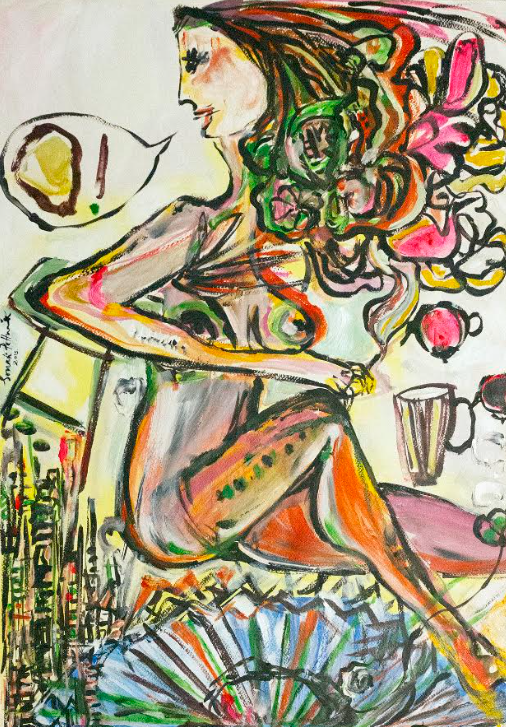
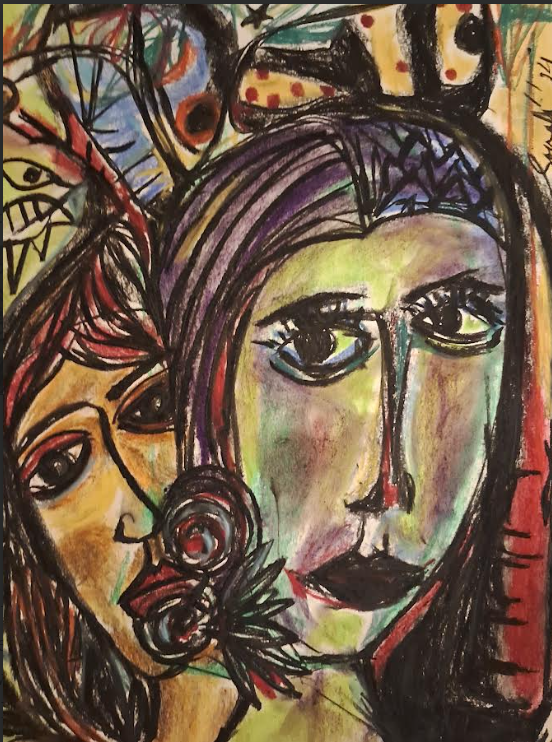
Artwork by Dr. Sonali Pattnaik.