
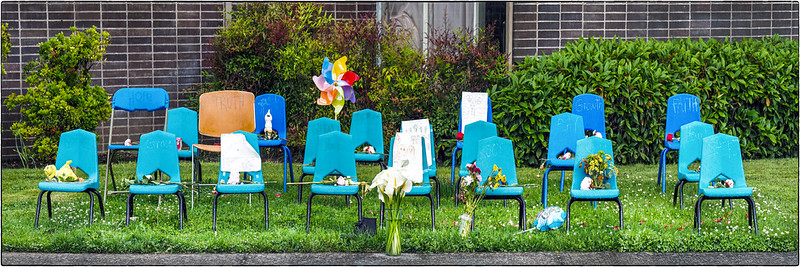
In the Unlikely Event
By Rebecca Watkins
- “I need to buy a bat and a tourniquet,” I say to my husband as I set my bag and keys down.
“What?” he asks frowning.
I’ve just come home from a conference day, which in the education system means a day when students stay home, and teachers attend professional development. Normally, I am not a fan. Normally, PD involves learning more acronyms and the latest jargon. Today, however, it felt worthwhile.
“Oh, we had a shooter training. One of the police officers said we should buy a baseball bat for protection and a tourniquet too because most people die from bleeding out,” I explain.
I don’t realize at first that my husband is horrified. Then I see anger flash across his face; his eyes narrow as he asks, “Is the school going to buy you a bat and first aid kit for your classroom?”
“Of course not,” I laugh, “I’ll buy it.” - According to The Washington Post, since Columbine in 1999, there have been 435 school shootings in the United States, and 398,000 students have experienced some form of gun violence at school. You could fill Madison Square Garden to capacity twenty times with that number.
- The school is empty of students and quiet except for the sound of teachers filing out of the auditorium. We have just watched an FBI video reenactment of a shooter in a restaurant. I noticed there weren’t any children in this video. They didn’t want to traumatize us, I think later. But as I watched it, my stomach was in knots and my hands clenched hard at my sides. The dead bodies weren’t real, but the taste of fear in my mouth is.
- We’ve divided into groups of twenty; my group is on the first floor in the Science Department. Unlike the first few years of school shootings, we are seasoned and know you don’t just hide. You have choices: the Active Shooter Protocol is now Run, Hide, or Fight.
Don’t panic, a handsome young officer is saying. If you freeze, push through, and take action. It is unlikely an active shooter situation will happen. But you must be prepared if it does.
Do you know where the exits are?
We all nod our heads and point to them.
Learn them all and practice leaving by different ones. - It is unlikely this will happen.
Any given day at any school, there are 2 to 3 security guards and then hallways full of classrooms with open doors. The officer is telling us once we lock our doors, a shooter isn’t going to try to break them down. But just in case, look around for how we might barricade the door, look around for what we might be able to use as a weapon should a shooter get in. We begin listing the items: books, trophies, chairs.
It’s ideal to have a bat and go for the head. Don’t hesitate, the young officer is now telling us.Get a good first aid kit with a tourniquet and learn how to use it. If you don’t have one, use a belt. - The AR-15 semi-automatic is dubbed America’s rifle by the NRA and can fire 30 to 100 bullets in rapid succession. The police officer tells us, It’s about body count. That’s why mass shooters will use semi-automatic rifles.
- An AR 15 style rifle was used at Marjory Stoneman Douglas High School in Parkland, Florida in 2018. At the time, I taught at an urban high school. We were reading a modern telling of Hamlet, and those who were paying attention and reading along felt a kinship with the young protagonist. He had come back home to death and betrayal. Life didn’t turn out how he expected, and these teens understood this better than most.
I looked at the clock. My students would be walking out soon. A 17-minute nation-wide protest for the seventeen people, fourteen students and three staff, killed a month ago. I had been instructed to continue teaching, so I stood on the scuffed linoleum floor and watched my students, the majority Black and Latino, stand up and walk out. Most of them already knew what it was like to fight for their lives. This was just the first time they got to acknowledge it publicly. - In May of 2022, nineteen students and two teachers were massacred at Robb Elementary School in Uvalde, Texas, in the deadliest school shooting since Sandy Hook in 2012 when twenty children and six staff were killed. Uvalde, another place like Parkland or Sandy Hook whose name will become synonymous with children being murdered.
- A few days after the shooting in Uvalde, I watched on the news as they showed a recording from that day at Robb Elementary of police officers hiding in a hallway. Some even ran away while children were being gunned down in the classrooms. I felt more rage and grief than my body could hold. Without speaking to my husband, I walked out into the rain, barefoot, waiting for my heartbeat to slow down, waiting for tears that never came. I stifled a scream, one that still burns my throat. As a teacher, it is expected that I will put my body in front of my students when the bullets come. And I will, but on that video, the trained officers ran.
- After our active shooter training, I shop online for first aid kits. I spend hours reading the reviews. That night, I don’t have dreams, or if I do, I don’t remember them. Maybe I am clutching a wooden bat, the texture unfamiliar in my hand, as I swing at an intruder. Maybe I’m messing up a tourniquet. Maybe someone’s bleeding out on my classroom floor.
- As I write this the most recent school shooting in the United States was thirteen days ago.
Rebecca Watkins holds an MFA in poetry and an MSed from the City University of New York. Her creative nonfiction and poetry have appeared or are forthcoming in Ginosko Literary Journal, the Quartet Journal, Hole in the Head Review, the Amethyst Review and the Amaranth Journal among other literary journals. Her creative nonfiction has been shortlisted for The Malahat Review’s Open Season Awards. She is the author of Field Guide to Forgiveness (Finishing Line Press 2023) and Sometimes, in These Places (Unsolicited Press 2017). More of her work can be found at rebeccawatkinswriter.com.
Photo credit: John Gateley via a Creative Commons license.
A Note from Writers Resist
Thank you for reading! If you appreciate creative resistance and would like to support it, you can make a small, medium or large donation to Writers Resist on our Give a Sawbuck page.