
The Price of Standing Still
By Melissa Moschitto
Marianne went out for a walk in a smart men’s suit of houndstooth print, so they arrested her. A woman must not look too masculine, too modern, too severe. The arrest was meant to deter us, but it only tantalized. It was 1850 and there were those of us who wanted to wrench ourselves free of the corset and hoop skirt, those of us who were tired of being constrained by clothing and opinion. We had started wearing bloomers under our skirts. We merely wanted to ride bicycles without getting caught in the spokes, we said. Hemlines were raised by an inch or two. Half man, half woman! the men cried out after us in the streets, to those of us who dared to wear pantaloons. With our legs wrapped in voluminous fabric, we were indecent. You belong to neither sex! the men in the streets accused and they invented new names for us: inverts, she-males, hybrid species, public women.
A woman wandering in public without a predetermined path was not permitted. A woman wandering the streets was immoral. We were tired of the crunch of the corset, the sweat under the stays, the breath trapped in the chest, the permanent choke. At covert meetings, some of us used dolls to demonstrate how to wear modern underwear, helping women dress for freedom. “We must own ourselves under the law first,” said Frances Gage, and we believed her. We invented new names for ourselves: suffragists and women’s rights activists. Even if some of us weren’t brave enough to use those names, the fire had been lit.
It was 1872 and a woman had run for president. Ms. Victoria Woodhull’s defeat was bitterly recounted. Although some women insisted on forgetting, her loss followed us like vinegar. Most men laughed it off while dusting their hands on pant knees; they were privately worried, but publicly cavalier. They reminded themselves, relieved, that women could not vote.
It was 1874 and a woman took off on foot from Kansas City straight through to Sacramento, California, looking for her husband. With no other income but his, she was tracking him down, an act of pure need. Why not take the railroad, it being naturally faster? asked the reporters. I’m not stupid, she replied. Being cornered into the back seat of a car, a mouth smothered with a hand smelling of tobacco—those things happened on a train. We understood. Mrs. Elizabeth Cady Stanton asserted that if women wore trousers, that would surely thwart criminal attacks. Let us walk, we insisted.
We were determined to be freed from the drawing room and the kitchen, the nursery and the wash. If we could not move with leisure, perhaps we could move as sport? A new breed emerged: the pedestrienne! Women started walking competitively around sawdust rings in stadiums. A track was the perfect solution: an endless loop to contain a woman! But we knew better. To walk on a track unencumbered by our daily burdens was not boring nor repetitive; rather, without insistent voices interrupting us with mundane queries, our thoughts belonged to ourselves. When it was suggested that we could not handle the physical toll of such exertion, we politely reminded them that we were well-accustomed to lugging baskets of food and buckets of water, balancing packages and carrying children, all against the constant ricochet of the hoop skirt. In fact, we had already walked the equivalent of Earth to Moon.
It was 1875 and Mademoiselle Lola arrived in New York City, sleek as a cat. Twisting across the sky, the trapeze artist dropped to the ground to walk in P.T. Barnum’s grand Roman Hippodrome. Under its vast tented ceiling and before rows upon rows of seats, Mademoiselle Lola was to race a man. Stretching by the side of the sawdust ring in blue breeches that cut off at the knee, her calves encased in blue striped stockings, she was quite aware of all the eyes set upon her. She nodded to us in her saucy little cap and flicked a riding whip as she prepared to compete. We smiled back, astonished and enamored. We imagined ourselves to be so confident. Despite starting thirty-one minutes after Mr. William E. Harding, it was Lola who crossed the finish line first.
It was 1876 and Chicago was the first city brave enough to host a six-day walking competition for women. Bertha Von Hillern and Mary Marshall were going to compete for a prize of five hundred dollars—more than a year’s salary. Now that was something worth walking for. The race was held at the Second Regiment Armory Building around an oval ten laps to the mile. Tickets were set at twenty-five cents. Organizers kept the price low, to ensure that the public would not be twice scandalized—once by the cost and again by the shock of women walking. But everyone from lawyers to mechanics were buying tickets. And everyone was placing bets. On January 31st, the petticoated pedestrians were off, kicking up sawdust as spectators gasped and gagged. By day two, blisters had appeared and the two women were numb from the cold. On Day three, the papers reported their breakfasts to breathless readers: rare steak, raw eggs, freshly squeezed lemon juice. On day four, with only twelve hours to go, the crowds grew to fill all three thousand seats, engulfing the stadium with a deafening roar. Endurance made it exciting and what else do women possess but endurance! Bertha and Mary vaulted ahead of each other, one mile at a time, looping in and out of ties. The crowds elbowed each other for a view, the police struggled to keep spectators off the track. After one hundred and thirty-two hours, Mary Marshall, in her costume of red, white, and blue, had won.
Several newspapers asserted that as soon as women were permitted to walk, the next thing we’d do was try to vote, a prediction which only made us walk faster. New York City considered an ordinance banning women walkers outright, lest we would have walked from the ring all the way to the ballot box. It failed. Sadie, Theresa, Flora and Ellen signed up straightaway, walking in Toledo, Cincinnati, Detroit, and Milwaukee. Let them watch us, we thought, our feet pounding the dirt track, raising dust and hell.
It was 1879 and twenty-year old Exilda La Chapelle went to Madison Square Garden determined to win. At thirteen, she had begun her career as nighttime entertainment, sauntering through taverns and theaters. At fifteen, she took the only other choice available to her: marriage. By seventeen she was a mother; a year later was bereft, her son having died in infancy. All this she endured. But at the garden, after two hundred and seven miles, she suddenly stopped. It was not the pain that stilled her, nor the exhaustion, nor even the blisters on her feet which needed to be lanced and drained. What she could not abide was her husband, drunk in the stands and flirting with women spectators. What she could not abide were the insults, slurs, and abuse that he shouted. How much was a woman supposed to endure?
It was 1895 and we were going to walk right into the next century and get things started. The hard leather of our shoes cut into our feet, but we walked anyway. Anything to feel like we were going forward, progressing instead of retreating. Police commissioner Theodore Roosevelt permitted a woman to ride on horseback in Central Park! This must be proof, we thought, that something more was available to us.
It was 1912 and we left the sawdust circles to march up Fifth Avenue in white dresses, as if going to a picnic. Ten thousand of us had taken to the streets, demanding the vote. At the front was Mabel Lee astride a sinewy white horse. Mabel, who had moved from China to Chinatown at age nine, where she bloomed. Now at sixteen she wore the white stripe of the Suffragist sash, emblazoned with “Votes for Women!” Later that year, in the chill of autumn, we marched at night so that we could walk with the factory girls, maids and messengers, the working girls and tax-paying women. Linking arms, we lifted five thousand paper lanterns to dispel the darkness, fueling our steps with the insults, slurs, and abuse shouted from the sidelines.
It was 1917 and Fifth Avenue was filled only with the sound of feet on pavement, the sound of a slow-moving current of Black men and women walking in silence, bearing banners against brutality. Ten thousand heartbeats pounding against lynching.
It was 1920 and the newspapers were ablaze: the vote for women had been won! Not for all, but many. Imperfectly, we sought to unbind ourselves.
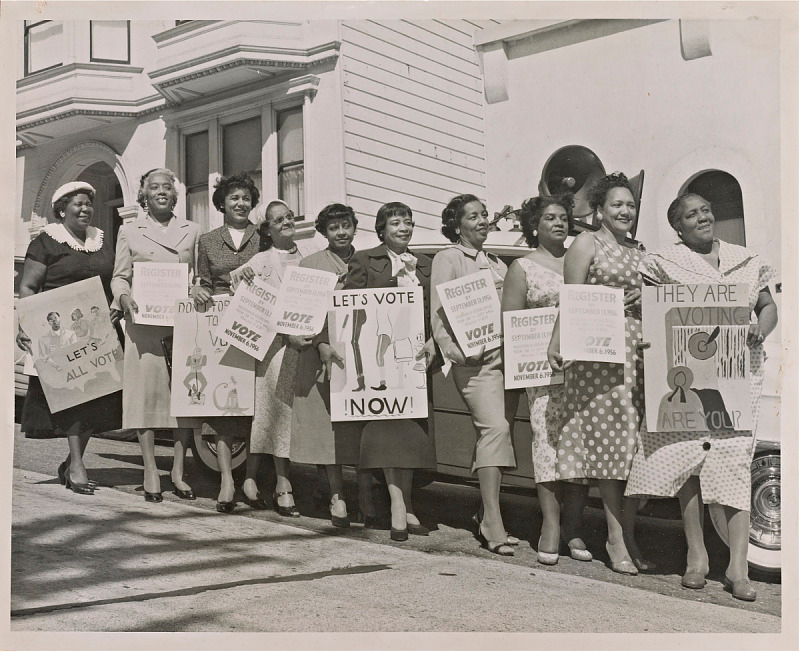
It was 1956 and in the early September sun, Sallie Edwards and Esther Wise and Lurline White dabbed the sweat from their foreheads with handkerchiefs. In nicely pressed skirts that came to the knee, they held their signs high, urging their brothers and sisters to Please, register to vote! Sallie and Esther and Lurline were well aware of which eyes would be on them. By not moving, by standing still, they spoke volumes.
It was 1972 and a woman had again run for president. Shirley Chisholm fought to unbind herself from womanhood’s expectations, only to be betrayed by those who claimed the same. Her loss hit us, sour and sharp like vinegar.
It was the end of the 20th century; we were elasticized and allowed to stretch. We held meetings, sitting in secret circles disguised as Tupperware parties and knitting clubs, schemes to set us free. We were thinking of what it would mean to own our own selves. But the old laws still corseted us to the past.
It is the 21st century and women are running their races across the nation, attired in menswear. They have tired of hearing that they should not appear too masculine, too modern, too severe. We join them in the streets, unconstrained and righteous, and when they lose, can you blame us for our fury? And when the century turns one quarter old, it is as if the track underneath us has turned from sawdust to quicksand. We are in a perpetual loop, yet we keep walking, keep enduring—anything to keep moving, forward.
Melissa Moschitto (she/her) is a fiction writer and an investigative theatre maker, lifting up feminist narratives to catalyze conversation and change. Her fiction has appeared in Bright Flash Literary Review, Macrame Literary Journal, and The Avalon Literary Review. She is the author of two published plays: Artemisia’s Intent and Give Us Bread. The mother of two dramatic children, she resides with her family in New York City. Visit her website at www.melissamoschitto.com.
Photograph of Lurline White, Sallie Edwards, Lulu Carter, Illa Buckner, Beulah Staton, Eddye Keaton Williams, Margaret Buford, Cathryn Williams, Esther Wise, Dola Miller II, and Frances M. Albrier of the San Francisco Chapter of the National Council of Negro Women, 1956, courtesy of The Smithsonian.
A note from Writers Resist
Thank you for reading! If you appreciate creative resistance and would like to support it, you can make a small, medium or large donation to Writers Resist on our Give a Sawbuck page.