
The Age of Unreason
“He who destroys a good book kills reason itself.” – Milton
By Matthew Sam Prendergast
Read to a creative writing class on August 29, 2024:
As you all obviously know, I teach creative writing. But I also teach those pesky Gen Ed composition classes you have to take. I have recently been instructed by the legislature of Indiana that if I “subject” you to ideologies outside of the boundaries of my discipline, such behavior can, and probably to their mind should, be grounds to deny me promotion and tenure. The law also encourages you to file a complaint if I trespass on ideologies.
I should note that I am part of the growing army of contingent faculty, a year-to-year contract worker, so I could stop here and say this subject is irrelevant to me. But the situation could be worse. The university could fire me even more easily. In simpler times, like 1973 Chile or 1939 Spain, we would have been spared any of this by just putting me against a barracks wall.
But these types of laws are how it is done today in a supposed democracy with ostensibly free speech. They are deliberately vague so as to chill speech. As a hypothetical high school teacher in Florida, were I to say that “racism is bad and something should be done at the structural level to redress it,” I don’t consider it implausible that a school board could use state legislation to fire me. It wasn’t enough for them to just ban AP African American Studies, citing the fact that it has “no educational value.”
Furthermore, let’s say I was married to a man, rather than just wanting to be. If I had a picture of my husband on my desk in a third-grade classroom and a student asked who he was and my reply was “That’s my husband,” it’s possible that such a reference to gender and sexuality could be used as grounds for dismissal. The law is so vague in referencing age-appropriate discussions of such matters that, if a parent complained that I had this subversive discussion with a high school senior, I could be fired.
Christopher Rufo, the man most responsible for making Critical Race Theory into the ultimate boogey man of the rightwing, claims that my concerns are hysterical and hyperbolic. That I should even have reason to conduct the thought experiment is enough to make me despair for our democracy and its ideals.
Returning to the specifics of my situation, what is within the boundaries of my discipline as a teacher of composition, a teacher who has an undergraduate degree in philosophy, MA in English, and an MFA in writing? I suppose it could plausibly be argued that everything that has ever been composed is within my discipline.
Let’s play this game some more.
Suppose one of you asked if they could use the bathroom. Now suppose I answered “You do not need to ask for my permission. You are an adult and should be able to come and go as you please.” Have I not “subjected” you to an ideological position that’s not within my discipline? And if I try to explain to you why this Indiana law exists, I have again “subjected” you to a discussion of ideology not in my discipline.
If I insert any discussion of some of the interesting subjects in our current “One book, One University” text, as I am strongly encouraged to do, I risk “subjecting” you to ideologies that fall outside the boundaries of my discipline: It’s about AI. What if I ask you what it means to be truly human? What a world without work could or should look like? If AI should be used in war? Have I not trespassed on ideology?
Clearly the folks who wrote Indiana’s law have but the most elementary understanding of what is even meant by ideology. They have “radical woke gender ideology” or “Cultural Marxism” on their fevered brains as they foam at the mouth and decry the virulent spread of the “woke mind virus.” It’s a law to solve no problem, like someone in a statehouse proposing a resolution to ban Sharia law or forbid first graders from using litter boxes.
You may have seen in your history books pictures of Nazi book burnings. Perhaps you were not instructed that one of the more famous pictures is that of the nascent Nazis burning the library of The Institute of Sexology, whose founder consistently argued for gay rights, for instance when he advocated for the repeal of Paragraph 175 of the penal code which criminalized sexual acts between men. The Jewish writer Heinrich Heine said in 1821, “Where they burn books, they will ultimately burn people too.” Certainly, he has been vindicated.
Today, we see viral pictures of library books from Florida’s New College being thrown into a dumpster, many about gender, sexuality, and race. Now I’m not such an alarmist as to think that I will be deposited in the dumpster. Not yet anyway. I think they’ll be content if I lose my job or am denied promotion and tenure. I think they’ll be content if I can’t marry whom I choose. Perhaps they won’t go further than that.
However, I’ve also been ordered by the legislation to include “intellectual diversity” in the classroom, the language more often cited in these discussions. That would credibly mean defending book burning if my intellectual and ideological position is that book burning is wrong. What might I say? It effectively kept them warm? And of New College, what might I say? I might say at least the state and the right-wingers who took over the school are conceivably sincere in their stated aim to protect twenty-year-olds from the woke mob and its authoritarian efforts to control the scope of what we as a culture deem appropriate thought and ideology. Then, I don’t teach psychology, and it may be dangerous for me if I step out of my lane and explain projection to any of my students, even in my efforts to insert “intellectual diversity.”
I don’t think it will ever come to pass that geologists or anthropologists will be forced to explore, let alone defend, the belief that the earth is flat and six thousand years old and thus that humans have been on the planet for that long. That a biologist will have to teach creationism if they teach evolution. I am certain that those who wrote this law never considered the fact that any economics teacher could conceivably be enjoined to insert Marxist political economy into their classes if in that same class they have a discussion of free markets. But I will say it again and continue to say it, the mere fact that I have to consider any of this is frightening enough.
So, let’s play some more in this dystopian playpen masquerading as a developed democracy in the twenty-first century. I could teach the debate over whether it is still necessary to avoid ending a sentence in a preposition perhaps. But then I am not a linguist and could not have a discussion of the divide between descriptive and prescriptive linguistics as an ideological discussion in that discipline. Do I need to teach students the importance of writing poorly for the sake of intellectual diversity? To explore the arguments for why plagiarism is just fine? That we should abandon the project of writing altogether and leave it to AI? Have a lively debate about whether APA or MLA is the superior documentation style? That paragraphs and thesis statements are unnecessary hindrances? That their goal should be obscurity and verbosity rather than clarity and concision? I suppose these are the ideological debates I may “subject” students to if I am to stay within the boundaries of my discipline.
In our creative classroom, perhaps it is not yet too risky to read Brecht’s “The Burning of the Books.”
I woke up at two in the morning to write this. Why? I was nervous for this reason: Given the lack of communication from the university about navigating this law, I wrote to someone active in the university senate about plans to address these ambiguities. He passed my thoughts on to the executive committee of the senate. I don’t know why he thought a friendly email between colleagues warranted such an action. He was probably just trying to be helpful.
I am a coward, really. I would not have been willing to go to Spain and take a bullet through the throat like Orwell or contribute to the resistance like Camus. I can’t confidently claim that I would even have the courage to hide someone in my attic. But the fact that it could be an act of bravery to share this elegy to reason with this class, or potentially dangerous to show it to a colleague, is enough to leave me unable to sleep.
Matthew Sam Prendergast, graduate of Vermont College of Fine Arts, is a Continuing Lecturer of English Composition at an Indiana university where he maintains a steady output of critical thinkers who learn to question the status quo and avoid the “naked this” and other promiscuous pronoun usage. His debut novel, Affinity, is slated for a Fall 2025 release. He lives in Chicago with his dog and his cat.
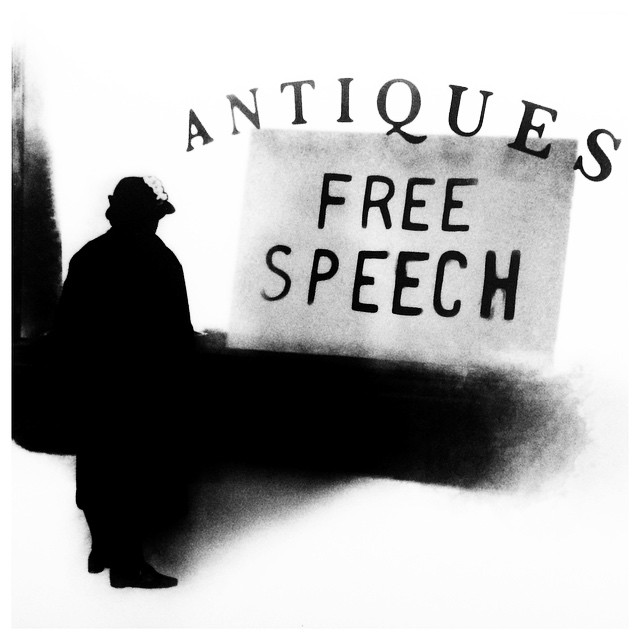
Photo credit: Darren Smith via a Creative Commons license.
A note from Writers Resist
Thank you for reading! If you appreciate creative resistance and would like to support it, you can make a small, medium or large donation to Writers Resist from our Give a Sawbuck page.