
Static Between the Folding Tables
By Fendy S. Tulodo
The microphone died exactly as I said, “I’m an atheist, but even I believe in miracles. Like affordable insulin.”
Silence.
Then someone in the back shouted, “Blasphemy!”
I held the dead mic in my hand and said louder, “Sir, if God’s got stock in that corporation, He owes us an apology.”
The bartender didn’t look at me. The assistant principal did.
Her name is Marisol Vega. She still wears her district ID on a blue lanyard even at night, like she’s ready to discipline the whole country. She’d come straight from another school board fight, where they tried axing ethnic studies again. Looked exhausted. But her gaze? Sharp as glass.
“Keep going,” Marisol said from the front table. “We’ve heard worse.”
The mic came back. I leaned into it.
“Tonight’s set is about capitalism,” I said. “Relax. It’s a short set. Capitalism hates long commitments.”
A few laughs. Tight, careful. This is Southern California after 2016. People laugh like they’re checking who else is laughing first.
I finished with a bit about corporate pride flags and unpaid interns. Afterward, Marisol bought me a soda.
“You know they’re watching,” she said.
“Who?”
“Everyone.”
I smiled. “Good. They need material.”
She didn’t smile back.
• • •
The church basement potluck had buzzing lights and folding tables stained by years of tuna bake and whispered breakups. I don’t believe in God, but I come anyway, this is where plans get made.
Marisol stood by the coffee urn, chatting with two older lesbians from the condo building across from her school. Their names are Diane and Carol. They wear matching sneakers and walk with straight backs like former athletes. They’ve been together since the seventies. They’ve seen worse than this.
Diane waved at me with a paper plate. “You’re the comic,” she said. “You made that joke about insulin.”
“Guilty.”
Carol grinned. “You were funnier than the pastor.”
“Not like there’s much competition.”
Marisol cleared her throat. “Focus. We’ve got a problem.”
She spread documents across the table. Emails. Screenshots. A hidden union scandal at her school. The teachers’ union rep had been quietly meeting with district officials, trading silence on overcrowded classes for a seat on a statewide advisory board.
“They’re selling us out,” Marisol said. “And the staff doesn’t know.”
“Tell them,” I said.
“If I do it wrong, they’ll push me out. Assistant principals are easy to replace.”
Diane tapped the table. “You’ve got parents on your side.”
Carol added, “And us. We’ve waved at worse people than school board members.”
Marisol looked at me. “Can you . . . turn it into something? Make people listen?”
“You want stand-up about labor corruption in a church basement?”
“Yes,” she said. “Make it funny so they don’t shut down.”
So I did.
I stood by the potato salad and said, “Let’s talk about loyalty. When your union rep says ‘We’re negotiating in good faith,’ what he means is, ‘I’m updating my LinkedIn.’”
Laughter. Louder this time. Teachers leaning forward. Phones coming out.
Marisol stepped in after me and laid out the evidence. Names. Dates. Direct quotes.
Diane raised her hand like she was back in high school. “Are we staging something?”
Carol didn’t wait for permission. “We should.”
• • •
Two weeks later, I was on a sidewalk in front of a grocery store chain that had been price gouging baby formula. It was hot. The asphalt stuck to my shoes.
Marisol had printed flyers. Diane and Carol brought folding chairs I carried a sign: “FEED BABIES, NOT SHAREHOLDERS.”
Kids from Marisol’s school showed up. They lay down across the entrance, backpacks under their heads. Staging a die-in. They looked very young.
A security guard walked out. “You can’t block customers.”
Diane stood up. “We’re customers.”
Carol added, “And voters.”
I snatched the megaphone. “Not leaving till they apologize and pay families back!”
A mother with a stroller stopped beside me. “My sister drove to three stores last week,” she said. “Nothing.”
Marisol took the megaphone. “We’re documenting everything,” she said. “Every empty shelf. Every inflated price.”
The guard went back inside. Thirty minutes later, a manager came out with a statement printed on paper.
“We regret the inconvenience,” he read.
“Inconvenience?!” Diane shouted.
I took the paper, read it aloud: “Due to supply chain disruptions. . .”
“Say the real words,” Carol said. “You raised prices.”
The manager flushed. Cameras were on him now. Students were live streaming.
By evening, the corporation posted a formal apology online. Price adjustments announced. It wasn’t a revolution. It was a small correction. But the correction came because teenagers lay on hot asphalt and refused to move.
Marisol squeezed my shoulder. “This is how we win,” she said.
“Piece by piece,” I said.
• • •
At the open mic the next night, I told the story.
“Ever notice,” I said, “how corporations only learn empathy when it trends?”
The crowd laughed harder this time. The room felt different. Like something had shifted.
After my set, a woman approached me. Haitian accent, hospital badge clipped to her scrubs. Her name was Nadine. She works at the ER downtown.
“I saw you at the protest,” she said. “I translate for frightened elders every day. Spanish, Creole, broken English. They’re scared to ask for care. Scared of bills. Scared of immigration. You made them less scared.”
“I told jokes,” I said.
“You made noise,” she said. “Noise helps.”
She asked me to come see the hospital. “Not as someone sick,” she added, grinning. “As someone who sees.”
• • •
The ER waiting room buzzed, lights too bright, chairs too full. Nadine weaved through fast, dropped to her knees beside an older man gripping his chest.
She murmured something in Creole, then faced a nurse. “He says it started three hours back. Waited ’cause he thought he couldn’t pay.”
Nurse scowled. “We’ll sort billing after.”
Nadine snapped, “You always say that.”
I leaned against the wall. A woman in a headscarf asked about forms. Nadine translated. An elderly Latina asked if her insurance was valid. Nadine translated again.
“This is resistance too,” she told me during a brief pause. “Not letting them be erased by forms.”
Back outside, she wiped her forehead. “People think activism is only marching,” she said. “It’s also explaining the fine print.”
“Can I use that?” I asked.
She laughed. “Use it.”
• • •
The union scandal exploded faster than we expected. Teachers confronted the rep at a staff meeting. Parents demanded transparency. Marisol got called into the superintendent’s office.
“They want me to shut up,” she told me later, sitting on the curb by the church basement. “They said I’m overstepping.”
“You are,” I said. “Into the future.”
She exhaled. “If they push me out, I lose health insurance.”
Diane and Carol walked toward us, holding hands.
“We heard,” Diane said.
Carol added, “We’ve got a lawyer friend. Retired. Angry.”
Marisol laughed despite herself. “Of course you do.”
The church doors opened behind us. More teachers stepping out, talking fast, faces lit with purpose.
“This isn’t going away,” I said.
“No,” Marisol said. “It isn’t.”
• • •
At the condo complex across from the school, Diane and Carol stood on their balcony during a small Pride march that passed through the neighborhood. They waved rainbow flags high above the parking lot.
A man shouted from below, “Go back inside!”
Diane leaned over the railing. “We’ve been inside for forty years,” she called back. “We’re done.”
Carol kissed her cheek. Students from the march cheered.
I filmed it and posted the clip. It spread faster than any of my comedy sets. Elderly lesbians waving at hecklers while teenagers chant below. Resistance stays online, too.
That night, my inbox filled with threats and praise in equal measure.
Marisol texted me. “You okay?”
“Yeah,” I wrote. “They hate jokes more than facts.”
“Be careful.”
“I will.”
• • •
The superintendent held a press conference about the union scandal. Cameras lined up. Marisol stood behind the teachers. I stood near the back, phone ready.
He said, “We take these concerns seriously.”
A reporter asked, “Did your office know about the private meetings?”
He hesitated.
Teachers began reading emails aloud. Names. Dates. Details. The story was public now.
The union rep resigned within the week.
Marisol kept her job.
For now.
• • •
The open mic returned to normal attendance. Same sticky floor. Same tired bartender. But the air felt charged.
I stepped on stage.
“I used to think I was cracking jokes,” I said. “Now I realize I’m just filing complaints, with punchlines.”
Laughter rose.
“I don’t believe in God,” I kept going. “But if something’s watching, it’s stacking folding chairs in a church basement, a nurse wrestling with hospital bills, teens lying flat by sliding doors, and two old women waving from their balcony.”
Applause.
“And if you’re waiting for a hero?” I said. “Look in the mirror. It’s probably you.”
A man near the back shouted, “Amen!”
I grinned. “Careful. I don’t believe in that word.”
The crowd roared.
• • •
Three months later, Marisol called me at midnight.
“They’re offering me a promotion,” she said.
“Congratulations?”
“It’s at the district office. No direct contact with students. Higher pay. Less trouble.”
I sat up in bed. “What’s the catch?”
“I’d have to stop organizing. They said they need ‘neutral leadership.’”
Neutral. The word tasted bad even through the phone.
“What’ll you do?” I asked.
Silence stretched.
“I’m taking it,” she said.
My ribs squeezed. “What?”
“Listen,” she said quickly. “From the inside, I can see budgets. Contracts. Emails before they’re cleaned up. I can leak smarter.”
I was quiet.
“Don’t go silent on me, like I betrayed everyone,” she said. “I’m walking right up to the flame.”
I laughed, shaky. “You’re terrifying.”
“I learned from you,” she said.
“From me? I tell jokes.”
“You build noise,” she said. “I’m building access.”
We stayed on the phone until two in the morning, planning. Carefully. No grand speeches. No big announcements.
• • •
At the next church basement potluck, I leaned by the coffee urn again. Diane and Carol bickered over potato salad, mustard or mayo. Nadine arrived late, still in scrubs.
Marisol walked in wearing a new district badge.
People went quiet.
She cleared her throat. “I have news.”
I felt the air tighten.
“I’ve accepted a position at the district office,” she said. A few gasps.
“And I’m not going anywhere.”
She looked at me, then at the teachers, then at Diane and Carol.
“They think they’ve promoted me,” she said. “They’ve promoted us.”
Silence. Then Diane started clapping. Slow, steady. Carol joined. Nadine smiled wide.
I stepped onto a folding chair.
“I guess my new set writes itself,” I said. “Assistant principal goes undercover in central office. Coming soon.”
Laughter broke the tension.
Marisol raised her badge like a small flag. “We’re not done,” she said.
Outside, students packed the lot, phones up, streaming live. Comments rolling in. Support from other states. Other countries.
Resistance stayed online. And offline. And inside the places that thought they were safe.
I looked around the room. The lights kept flickering. The broken chairs were still there. Tired eyes stayed fixed ahead, not turning away.
I’m still an atheist.
But watching a basement full of people who won’t stay quiet? I start believing in something.
Not miracles.
Strategy.
Fendy writes from Malang, Indonesia. His pages carry deep feelings and real life. Stories touch on love, control, and new beginnings. He examines the shadowed sides of existence. His characters face hard choices where right and wrong mix. Follow him on Instagram at @fendysatria_.
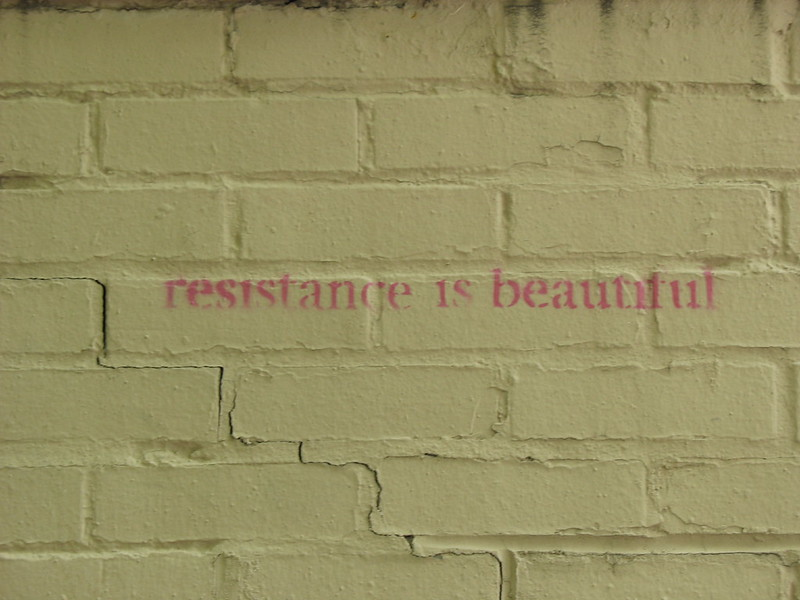
Photo Credit: Resistance Is Beautiful by teofilo via a Creative Commons license.
A Note from Writers Resist
Thank you for reading! If you appreciate creative resistance and would like to support it, you can make a small, medium or large donation to Writers Resist on our Give a Sawbuck page.