
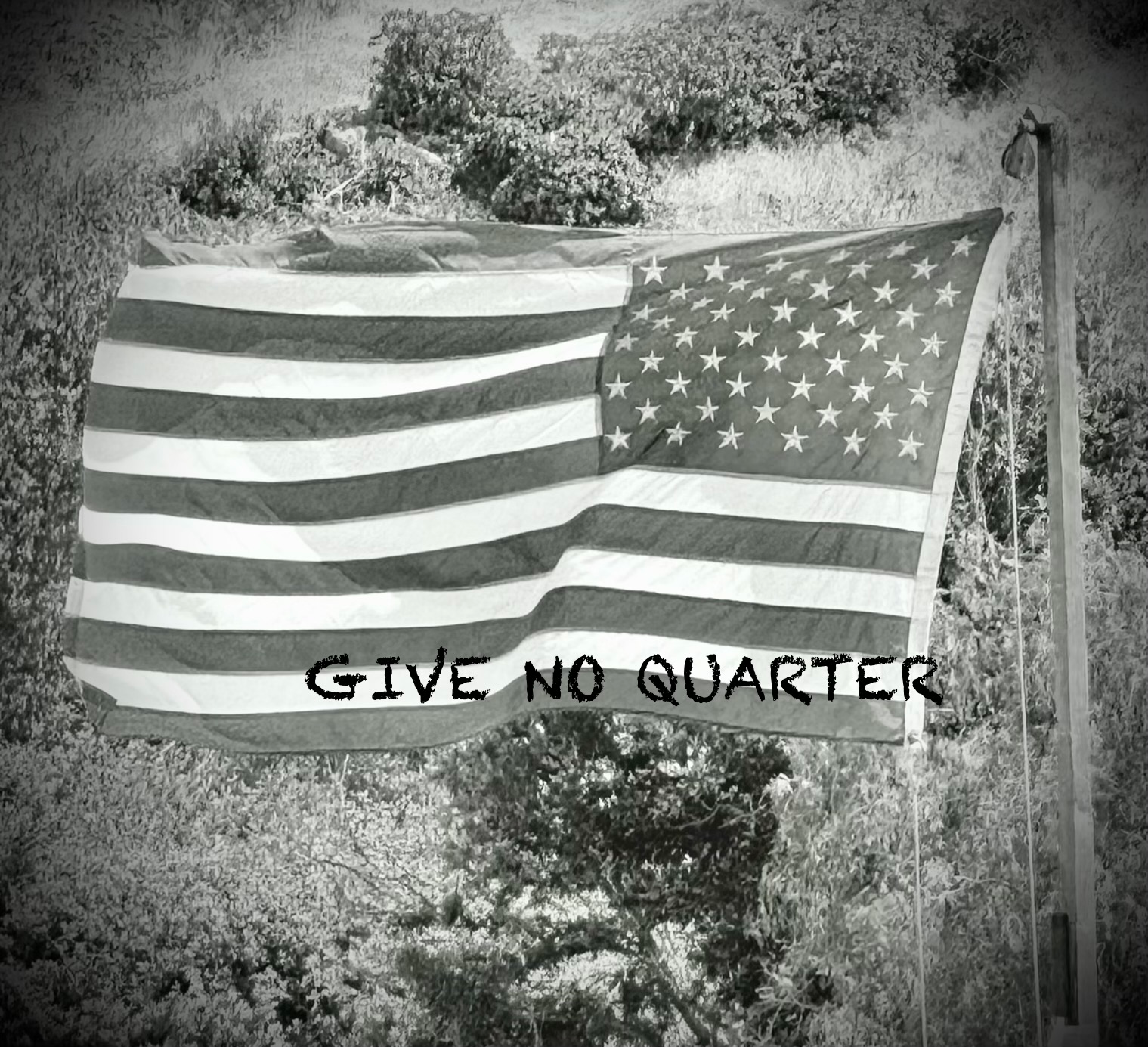
No Quarter
By Julie Gard
My partner and I attended a memorial service in small-town Wisconsin, and there were grayscale American flags all around us, on the hats and t-shirts of serious young men. I am familiar with the thin blue line flag, and of course the Confederate flag. But most popular now, among a crowd that isn’t mine, is this black and gray one stitched on caps and backpacks, printed on t-shirts, and pressed against pick-up truck windows.
I picture all the colors in the silky assortment of LGBTQ+ flags that young people wear like capes as I weave among them at Pride, the red orange yellow green blue purple black brown gray pink lavender mashups, and then this flag that is an X-ray, a drained-out opposite. It looks as if the American flag has rotted underwater for months in silty soil. It looks like something dug up, soaked in ink, seen faintly in the dark. It looks like lost hope.
A little online research reveals that the black and gray flag means “take no prisoners.” No quarter—no lodging—will be provided to one’s enemies They will be killed rather than held captive. According to one merchant’s website, “The phrase ‘give no quarter’ has origins as far back as the 17th century. Our shirts run a little small and are athletic fit, so if you are in-between sizes or are unsure, please order up a size.”
On Reddit, worthlesmeatbag says, “For me, it means ‘I’ll kill you if you fuck around,’” and a sub-comment reads, “I have one in my front yard. Agreed.” Someone else says to chill, that dark flags are tactical flags that identify nationality without drawing attention during combat. Anonymous describes them as “right wing, civil war coming” flags. One poster thinks they’re more stylish than the traditional red, white and blue, which look “dorky and old-fashioned because they’re so primary and bright.” Sabertooth2 agrees it’s a style choice, and also that it means if you fight, you’ll fight “until one side is completely dead.”
As we milled around at the funeral home, a man with a washed-out grayscale flag down the whole front of his t-shirt held his baby gently. He passed out tissues from a big, soft packet, including the one I cried into. After the service, my partner and I wandered down the block and into an open church. We moved among empty pews and stared up at art deco saints awash in luminescent smears of silver and pink, their bodies ending in teal and purple shoes. In the huge front window, sky blue glass was shot with light and increasingly translucent as the panes ascended, creating a sense of height and movement. By the door was a cross of red plastic roses for Mary, next to a small donation box.
Across the street was another church, smaller but with a three-story tower and double front door. Every inch of this church had been painted matte black, except for the stone foundation, and its windows covered with boards. It was a negative of a church, above ground but buried, like a church after a fire. A couple of well-used but gleaming motorcycles were parked out front, next to a leafy, raised-bed vegetable garden. People gathered there, it struck me, not to praise but to prepare.
On the drive home, collapsing barns hoisted defiant, homemade banners. There are signs going up all around us. We need to know what they mean.
Julie Gard’s prose poetry collection I Think I Know You was a finalist for the Foreword INDIES Book Award in Poetry, and Home Studies won the New Rivers Press Many Voices Project Competition. Julie’s essays, stories, and poems have appeared in Axion, Clackamas Literary Review, Superstition Review, Blackbox Manifold, Inside Higher Ed, and other journals and anthologies. She lives and writes in Duluth, Minnesota and is Professor of Writing at the University of Wisconsin-Superior. Visit her website at www.juliegard.com.
Photo credit: Debbie Hall, poet, photographer, author and Writers Resist editor.
A Note from Writers Resist
Thank you for reading! If you appreciate creative resistance and would like to support it, you can make a small, medium or large donation to Writers Resist on our Give a Sawbuck page.