
Run
By JL Smither
People will tell you they run toward things—a thinner body, a stronger heart, their girlfriend’s house. But most people run from things—their own fat ass, their addictions, their girlfriend. Me, I run from voices, from anything that’s out to get me, from everything that could go wrong, from the chaos of the indifferent universe.
I’m the only person I know who doesn’t wear earphones during my run. No music, podcasts, books. Nothing asking me to pay attention or learn. Just the calming shift-shift of my sneakers on the sidewalk, a steady beat I can focus on, and the background noise of cars and people around me. It’s safer, in theory, for a woman running alone, and I know my wife appreciates my caution. Shift-shift-shift-shift. But sometimes, I get so focused on the sound of my feet that I miss my turn on this familiar route. Once, I tripped over a big dog and scraped my elbows up. Shift-shift-shift.
I don’t think about my job while I run, and to discuss why would be so banal. It’s because I’m held accountable for things outside my control. Because I have lots of responsibility and no authority. Because I’m never certain when the business strategy will change, or when it should, or how I’ll be ready. Because I take all this much too seriously, probably, and much too personally, definitely.
I don’t think about my parents, who voted twice for Trump, and who currently roll around in their giant, empty house, bouncing off the polished granite and tile and gargling acid every night, the vine of accumulated hate and mutual abuse hanging thick over the sliding glass doors. They live in Florida anyway, so I don’t have to deal with them much outside my own head.
Shift-shift-shift-shift. Shift-shift-shift-shift. Shift-shift-shift-shift.
Until it’s not even a sound anymore. Until it’s the beating of my heart, of every muscle in my body. Until the grey and white sneaker toes that appear and disappear so easily become the only thing standing still while the world spins recklessly beneath them. Shift-shift-shift-shift. Shift-shift-shift-shift.
I don’t think about Meredith, my wife, who has been crying silently during the day, on and off. I’ll come into a room, and she’ll wipe her eyes and smile at me. And when I ask her what’s wrong, she shrugs and says, “Nothing new. How’s your day been?” I don’t tell her I’m also anxious and scared, I try to come up with something positive, distracting. But I don’t know how to help her. I don’t know how to help either of us.
I don’t think about the uncertainty of life—timing for the next tornado to flatten a neighborhood, the next bridge to collapse, the next social program to lose funding, the next child to go unvaccinated, the next insurance claim to be denied, how many people will starve or overdose or die preventable deaths in the next week.
Shift-shift. My left shoelace starts to loosen. By the third step, it’s undone. Shift-shift, crunch crunch crunch. I step off the sidewalk to retie it.
As I straighten up, I lengthen my neck, raise my eyes, and look around. I’m in front of a house I don’t recognize, which is confusing because I don’t think I’ve missed a turn. I swivel. Next door, that house I know, with the big stone archway. The sycamores lining the streets, leaves brown and falling, trunks white. Across the street, the big Italianate with the blue and purple trim, and there, the statue of the Roman water nymph in the front yard. The street signs, High and King.
My feet feel more solidly on the ground once I’ve oriented myself. I turn back to the unfamiliar house. Small, just one story, narrow. Low roof and faded tan siding. How odd that I’ve been running this way nearly every day for years, and I just noticed it. Had I seen it before and forgotten?
One more glance, and I leap back into the shift-shift-shift-shift. I’ll tell Meredith about this when I get home, and we’ll laugh about it together. I start rehearsing the story to get the pacing and details right. A car thumps loudly over a steel plate in the road.
I don’t think about guns. I don’t think about where the next shooting will be, a school, a daycare, an office building, a church, a festival, a summer camp, a post office, a parade. We’ve seen it all just in my lifetime, and there’s no way to stop it, no way to predict it.
I don’t think about the police, shooting people in their own front yards, killing fathers holding threatening sandwiches, killing mothers sleeping in their own beds, beating people to death for riding the subway. I don’t think about how there’s no one left to keep me and my family safe.
Shift-shift-shift. Shift-shift-shift-shift-shift. I come to a corner and look up for traffic before crossing.
I’m startled to see another house I don’t recognize. In front of it, a man I don’t know is walking a dog I’ve never seen. He pauses at the front gate, unlatches it, and heads up the walk. I stare, breathing heavily, as he pulls a key from his pocket and opens a bright green door I’ve never noticed.
King and Third now, according to the street signs. A major intersection. What used to be here? When did they build that one? I look around. There’s the brick house with the corner turret, where it should be. And over here?
What the hell is that? A stick-construction, modern apartment building, painted grey. Just a handful of units—three floors, one lot. How did that get past the historical council? There’s a well-worn dirt path across grass, running from the sidewalk corner to the glass front door, where I can see a handful of Amazon packages stacked up inside.
I check the signs again. King and Third. I drive through this intersection to get to work. How have I never. . .?
OK, I must be tired. Maybe I’m fighting something off, and this run has taken more out of me than I realized. I check my watch, just for a feeling of security. I’ve been gone 20 minutes, which is about right for this corner. I know where I am, I just don’t know where those houses came from. I should head home—the direct route instead of weaving through the neighborhood like usual.
I turn back and shift-shift-shift-shift away from the house with the unfamiliar dog.
I don’t think about the worsening rash across my belly and legs, about the terrible headaches I’ve been getting on Saturdays, about how many months I have to wait to see my doctor, and how my insurance rarely covers the drugs he recommends.
I don’t think about flying, only about running away. I used to never care about flying. There used to be people I didn’t think about whose job was to keep me safe. But now there are more planes and fewer humans to guide them. The planes started exploding. They started running into each other. One got lost in the tundra. Another landed upside down. A door fell off. People have been dying. Not most, but not zero. And what a stupid decision. Can you imagine being alone on a work trip and the last thing you see before making your wife a widow is LaGuardia? On a connection? What a waste.
Shift, shift, shift, shift, shift, shift.
I raise my eyes while still running, and everything looks OK, where it’s supposed to be. I trip over an uneven sidewalk slab, do a ridiculous dance of flailing limbs in all directions, and catch myself before falling.
I watch my feet again. Shift-shift-shift.
I don’t think about money. Meredith just lost the arts grant she had, covering a year of supplies as well as conference and show fees. She paints, and paint isn’t cheap. Beyond that, the grant was a huge honor, recognition on a national level for her work to date, with the promise of creating much more now that she didn’t have to worry about the expense of creativity. After 145 years, the organization that funded it was gone with the stroke of a pen by someone ignorant and uninterested in art and its value. What an unexpected, unprovoked, devastating blow.
I don’t think about what this faceless attack did to my wife. Her art will never be the same, will never offer the same fearless optimism that I’ve always treasured in her, puzzled how she could convey so much in a brush stroke. She’s been trying to work with pieces of trash now, more sculpture on canvas, although I remind her that we can still afford paint on my salary. The trash sculptures are angry and violent. One night, I dreamed that a creature with cheese wrapper eyes and a zipper mouth came to life and chased us through the house. But I didn’t tell her that.
Shift-shift-shift. I come to the last corner and prepare to turn down my street. I realize I’ve gotten distracted and missed the turn; these aren’t my neighbors’ houses. These aren’t… how far did I miss it by? I check the street sign and feel the blood drain from my head, my sweat turn cold. King and 11th Street. It’s ours. It’s my street.
I turn down 11th and notice the numbers on these ticky-tacky stucco monsters, striving and failing to reach the prestigious status of McMansions. Number 301, no longer the butter brick two-story with the stained glass and the rotting porch railing, now a blue painted archway over a leaded glass door purchased at Lowes. Number 303 has green shutters bolted into the wall, with no attempt made to even feign hinges, when it should have wide navy blue wooden siding with a meticulous hedge. Number 305 used to have a magnificent cherry tree in front, but now there’s an inflatable Jesus swinging his arms out and in.
And where number 307 should be—where my house, 307 East 11th Street, should be—there’s a split-level with fake bricks on the bottom, peach paint on the top, and a three-car garage that takes up most of the curb view.
My mouth fills with spit the way it does when I’m about to vomit. I lean against a tree in the apron to steady myself. Oddly, it’s my tree. It’s the oak that’s always been there. I look up and see the fresh cut from the limb I trimmed off only last week. I hug the tree, hug as if it alone can keep me from floating away. I look back at the house, which is still a split-level dwarfed by a garage, and notice every eyeless window closed with horizontal miniblinds.
I collapse onto the ground, my back pressed into the tree trunk, and my knees pulled up close. There’s dirt and a fresh scrape on my left knee, and I’m not sure if I remember why. I don’t try to remember, but I rest my head on my right knee and close my eyes. I don’t know if I cry, but I no longer trust anything to be the way I expect.
I don’t know how to survive in this world, and I don’t know who to ask for help.
“Janey?” the voice floats from so far away that I think I imagine it. “Janey, honey? Are you hurt?” I hear a gate slam and have a Pavlovian response of “Home.”
I look up, and there’s Meredith, coming down the walk—our walk, the old bricks we found buried in the garden and re-laid ourselves. She’s coming toward me from our red brick Victorian with the huge window and the front porch. She’s by my side crouching, and I’ve grabbed her close to me. She starts to help me up, and I stumble, scraping my knee against a tree root. She’s speaking kindly to me, and I can’t find the words to tell her that each of my tears is made of pure joy and gratitude.
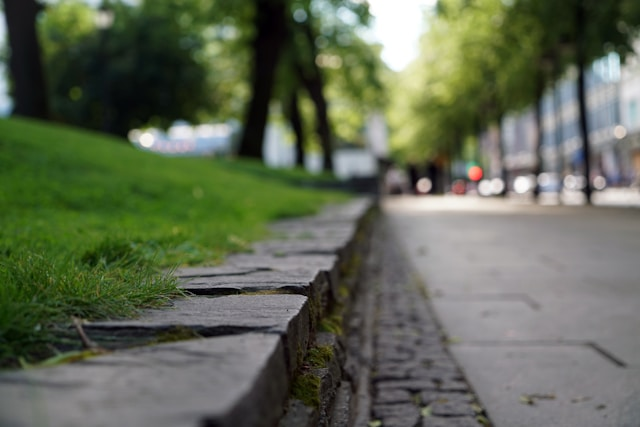
Photo by Tim Photoguy on Unsplash.
JL Smither grew up in Florida, and that’s the kind of thing that doesn’t leave you no matter how long you’ve lived in Ohio, held a job, created a family, and lived an otherwise functional life. She has previously published in Lowestoft Chronicle, Gay City 5, and other venues.
A note from Writers Resist
Thank you for reading! If you appreciate creative resistance and would like to support it, you can make a small, medium or large donation to Writers Resist on our Give a Sawbuck page.