
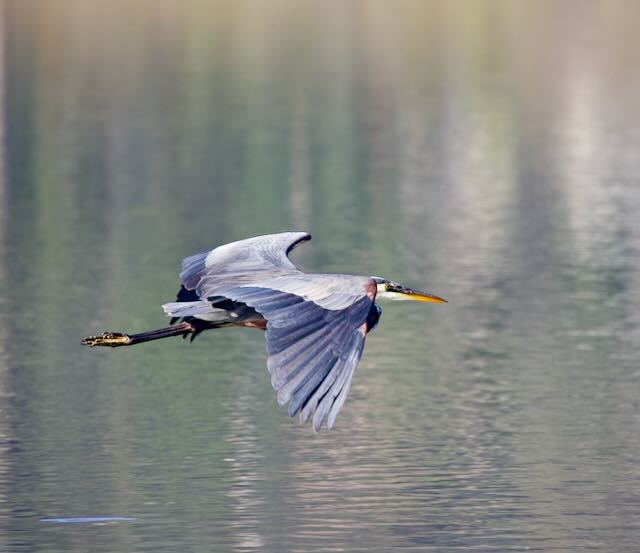
The Heron
By Sam Rafferty
Sunset was approaching when the birdwatcher kayaked deep into the swamp. She hid behind shrubs, which offered a full view of the cypress trees where several herons would soon arrive to roost for the night. The trees reminded the birdwatcher of the uncomfortable debutante balls of her youth. Their roots spread into the water like bell-shaped skirts, and Spanish moss hung from their branches like ringlets of aerosol-laden hair. Her skin still itched at the thought of the crinoline brushing her thighs while she paraded around the ballroom with a flock of other young girls, all whirring in white satin, watched by middle-aged men.
When the breeze blew past her, the birdwatcher shivered and reached for the jacket at her feet. She put it over her shoulders, marveling at how the thick flannel still smelled like her ex-husband, a mix of cheap shampoo and hand-rolled cigarettes. She remembered with a pang that today was Thanksgiving, and he was probably smoking those same cigarettes on the porch of his new home. His new wife was likely inside making a sweet potato casserole they would consider a vegetable despite the marshmallow crust on top. His new kids were probably running around the house, throwing a football that should have made its way outside.
Before the divorce, the birdwatcher and her husband had endured quiet holidays with no children playing and no extended family nearby. Their only guest was the specter of unspoken tension over the question of offspring. Like a heron exchanging sticks with his chosen mate, he had gone through elaborate courtship rituals, preparing to pass on his genetic material through the fertile body of the female before him, only to find that her body was not so fertile, and worse still, that her will was not so bent toward the development of progeny. He had seethed in his disappointment, accusing her of “giving up.” What the birdwatcher had done, however, was notice that she felt no longing to share the high-pitched “sweet-sweet” of the warbler with a child at her heels. She had no desire to hover over a squawking brood in a perfectly crafted nest. Her desires bent instead toward a quiet solitude that motherhood could never provide.
The sun sank lower, leaving an orange haze over the canopy. The birdwatcher sat still in the kayak, breathless, waiting for the loud, shrill cry of a heron. A large group of squawking ibis flew overhead, chaotic white feathers clouding the sky. The birdwatcher held some disdain toward ibis for the way they constantly congregated, digging in the mud with their downturned bills. Ibis held no great love for silence, stillness, or solitude. Herons, on the other hand, were solitary visual hunters, waiting patiently, watching, then striking their prey at the most opportune moment.
Soon, the herons began to fly overhead, coming slowly, one at a time. Their wide wings spread over her, temporarily blocking out what was left of the day’s sunlight. They settled in the branches, grouped in pairs, spread out among the trees. The birdwatcher noticed one heron set apart from the others. It was relatively small, likely a female. She seemed agitated, head turning side to side as if watching for a predator to emerge. The birdwatcher wondered if the heron had been hurt in some way. Though they were once endangered, reduced to hat feathers by opportunistic hunters, herons were protected from humans now, at least in theory. She fixed her binoculars on the bird’s yellow eyes, and it seemed to stare back at her. The birdwatcher saw her own isolation and her fierce desire for freedom reflected in the heron’s gaze. There they stayed, two solitary beings contemplating one another while dusk fell over the swamp.
Darkness thickened, and the birdwatcher felt a need to get back to the warmth and safety of her car. Putting on a headlamp, she began to paddle. Occasionally, she would see alligator eyes peering out of the water at her, shining like the headlights of beastly cars that hid beneath the surface of the black water. The sounds of night assailed her ears: croaking frogs, the hooting “Who cooks for you?” of the barred owl, raccoons scampering over leaves on the banks, the wingbeats of bats overhead.
The birdwatcher’s body warmed as she paddled, or maybe, she thought, this was another flash of heat announcing her imminent transition to crone. When she paused to remove her flannel coat, she felt an eerie sense of being watched, eyes taking in the shape of her shoulders, the curve of her neck, the movement of her hands.
Gazing around, she could not see anything unusual within the radius of her headlamp’s glow. She continued paddling, faster, but taking care not to become frantic. After a few interminable minutes, the birdwatcher was nearly at the dock, which was only a short hike through the woods away from her car. She heard a loud screech as wide wings deepened the darkness over her head. She jumped at the sound, and the paddle slipped from her hands.
Instinctively, she reached for the handle as it sank into the black water, barely grasping the end before it drifted away. She began to paddle again, then shuddered, realizing how foolish she had been to reach her arm into the water where so many predators lay waiting to sink their teeth into vulnerable flesh.
The birdwatcher felt relieved when she pulled up to the dock. Stepping on the warped wooden boards, she leaned over to hoist the kayak up. Then she heard another paddle slapping the water. She peered out, straining her eyes to take in the surroundings illuminated by her headlamp. She could see no one, so she rationalized her fear as the anxiety of a woman alone and continued with her task, beginning the slow process of carting the kayak down the trail to her car.
The trail was overgrown even in winter. Palmettos filled the underbrush beneath towering pines and sprawling oaks, the latter of which had left their leaves to become a carpet of damp brown littering the sandy soil. Hairy tendrils of poison ivy vines circled the trunks and exposed roots of the trees. The birdwatcher made her way down the little worn path, scanning the ground for anything that might impede her: fallen limbs, large rocks, an armadillo making its way through the forest.
When she looked up to see what progress she had made toward the car, her heart leaped in her chest, and she dropped the kayak. Inches in front of her was a man standing stock still on the path. Black hair hung in tangles around his shoulders. The patches of the skin on his face that were not covered by his unkempt beard were translucent. He wore thick layers of camouflage with a rifle slung across his hunched shoulders. An unsheathed machete hung from a belt around his narrow waist. The birdwatcher froze in his presence.
“What’s a girl like you doin’ alone in the woods at night?” he asked, his voice a thick, slow drawl.
“I’m just going home,” was all she could sputter as a reply. It was as though, by calling her a girl, he had suddenly reduced her to a child in ribbon-laden pigtails, murmuring a compulsorily polite, “Yes, sir.”
“Well, let me help you then,” he crooned, crossing close to her as he went to pick up the kayak.
The birdwatcher hesitated. Should she walk with this stranger? Was he a threat? She could take off, running through the trees, but could she outpace him if she did? Though he looked slightly older than her, the birdwatcher took note of the sinewy frame of the stranger as he effortlessly pulled the boat.
She walked silently beside him down the path, hoping against instinct that he was simply showing kindness, though the moonlight reflecting off his machete kept her from feeling at ease.
“So, you never answered my question. What were you doin’ out here?” the stranger pressed.
“Birdwatching.”
“Birdwatching! Well, I’ll be damned. I guess you could call me a bit of a birdwatcher, too. Watch ’em to hunt ’em, at least.” He let out a loud, breathy laugh.
Now was not the time to lecture on the fact that this was a wildlife refuge where hunting was strictly prohibited, so she nervously laughed instead. The birdwatcher’s mind went back to the solitary heron she had seen earlier that evening, remembering her agitation. Had this man been hunting her?
“That’s why I’ve got this knife here. Cuts right through the neck of a bird.” While he spoke, the stranger pulled the machete out of his belt, holding it up as he turned toward her. He stared into her eyes, holding his gaze for an uncomfortably long moment.
The birdwatcher shivered, ready to take her flight, but he slowly put the weapon away. She continued to walk with the stranger, listening to the sound of leaves crunching underfoot, until, after what seemed like an eternity, her feet began to tread over the gravel of the parking lot.
He helped her tie the kayak to the top of the car. Quickly, she thanked him and reached for the door handle, but his rough hands grabbed her arm.
“Drop the keys,” he demanded. She felt the cold steel of the machete hit the back of her neck. Even as her stomach dropped in terror, she felt a sense of vindication. She had known this snake for what he was and had sensed his predatory nature, even if she had fallen into his inevitable trap.
He twisted her arm painfully, repeating, “Drop the keys.” She did as she was told. He turned her around forcefully, and she saw that all the false kindness had vanished from his face. He gripped her tightly, the knife against her throat.
“I’ve been watching you, just like you watch them birds.” He laughed. “You got no husband. No family. No friends. No one to come looking—”
His words were drowned out by a loud shriek overhead. The noise caused the man to flinch just enough to lose his grip on the birdwatcher’s arm. She jerked away, running back toward the woods.
She ran from the man wielding the machete behind her.
But she also ran from the uncle she had been forced to hug at Christmas, though her skin crawled when he placed his hand on her thighs.
She ran from the high school boyfriend who had begged her so often for a blow job that she finally gave in, the taste of his semen like ashes in her mouth.
She ran from the employer who “jokingly” insinuated that sleeping with him could lead to a promotion.
She ran from the disbelieving look on her husband’s face when she told him she would not pursue another round of IVF.
She ran from a lifetime of being stripped of her autonomy and shunned when she tried to reclaim it.
She ran until those rough hands grabbed her once again. She felt her hope collapse as she fell to her knees.
Then, suddenly, she saw it. Gray-blue feathers spanning six feet, neck bent into a taut S-curve. Even in the dim light, the birdwatcher could make out a vision of the solitary female heron she had seen before. She saw a gleam of recognition in the bird’s yellow eyes as it let out a great shriek, diving down toward her assailant. The heron swooped onto his back, knocking him sideways and freeing the birdwatcher. She saw the bird dive its long bill into the man’s eye. His screams echoed through the trees, setting off a chorus of howling coyotes. Warm blood sprayed onto the birdwatcher’s arm, lifting her from her momentary despair. She felt as though she could finally flee all that threatened her solitude.
Grabbing the machete the attacker had dropped in his moment of pain, the birdwatcher ran back through the woods to the parking lot. She dropped down next to her vehicle, her hands moving over the gravel, searching for the keys. Her heart beat violently when she finally grasped them and scrambled to her feet, lurching the door open and slamming it shut. As she cranked the ignition, she could see the man, blood streaming down his face, marching blindly out of the woods toward her, rifle in hand. Then the heron flew past him once more, causing him to stumble backward. The birdwatcher took one last look at the great, terrifying creature and drove off into the night.
Sam Rafferty (she/her) is a Georgia native whose writing often explores the experiences of women in the South. Her other stories are published or forthcoming in Avalon Literary Review, The Sunlight Press, and The Dead Mule School of Southern Literature. You can follow her writing in Instagram at @samraffertywrites.
Photo by Debbie Hall, Writers Resist Poetry Editor. Follow her photographic work on Instagram at @debbie.hall.poet.photog.
A note from Writers Resist
Thank you for reading! If you appreciate creative resistance and would like to support it, you can make a small, medium or large donation to Writers Resist on our Give a Sawbuck page.